Well, Maggie and K-Lo are calling last week a new Roe. Unconvincingly. I’ve been more struck by the far right’s fatalism, silence and identity politics victimology. David Link believes that the “shift back to abortion for the old guard of the GOP is some evidence that this cultural shift on same-sex marriage is taking hold”:
Less than two days after the ruling, the Ninth Circuit Court of Appeals took the final step to permit same-sex marriages again in California, and while a very few of the usual suspects showed their faces to television cameras at the subsequent marriages throughout the state, there are no signs of outrage among the voters whose will was thwarted.
Opposition to same-sex marriage is different from opposition to abortion. There is a real and substantial moral question with abortion: At what point does human life begin? In the 40 years since Roe, that moral question has remained alive and vibrant, and the constitutional argument about abortion has seldom flagged. Moral feelings about abortion start strong and tend to stay strong.
Not so for same-sex marriage, where moral feelings may have started strong, but have weakened substantially over time.
[T]he nationwide protests that began on June 30 brought a new round of sexual assaults and mob attacks, with Human Rights Watch reporting on Wednesday that “mobs sexually assaulted and in some cases raped at least 91 women in Tahrir Square” over the last four days (journalists and foreigners have also been victims of the violence).
Since Egypt’s first wave of game-changing protests in 2011, several online tools have sprouted up to help document these kinds of cases and reduce their frequency. HRW, for instance, cites Operation Anti-Sexual Harassment (OpAntiSH), which confirmed 46 attacks in Cairo’s Tahrir Square on June 30, 17 on July 1, and 23 on July 2. The Twitter accounts @OpAntiSH and@TahrirBodyguard are organizing volunteers to protect women and intervene in instances of assault (according to HRW, OpAntiSH intervened in 31 such cases over the past week).
Tahrir Bodyguard attempts to patrol the crowds at Tahrir with groups of men and women wearing helmets and neon yellow vests. In an interview with Now This News, the group’s co-founder Maria Sanchez Munoz, said the team of 150-some volunteers intervene in sexual assaults without weapons, only with their bodies. The mob-mentality of the large crowds at Tahrir makes their task especially difficult, as they often become subject to harassment and violent attacks themselves.
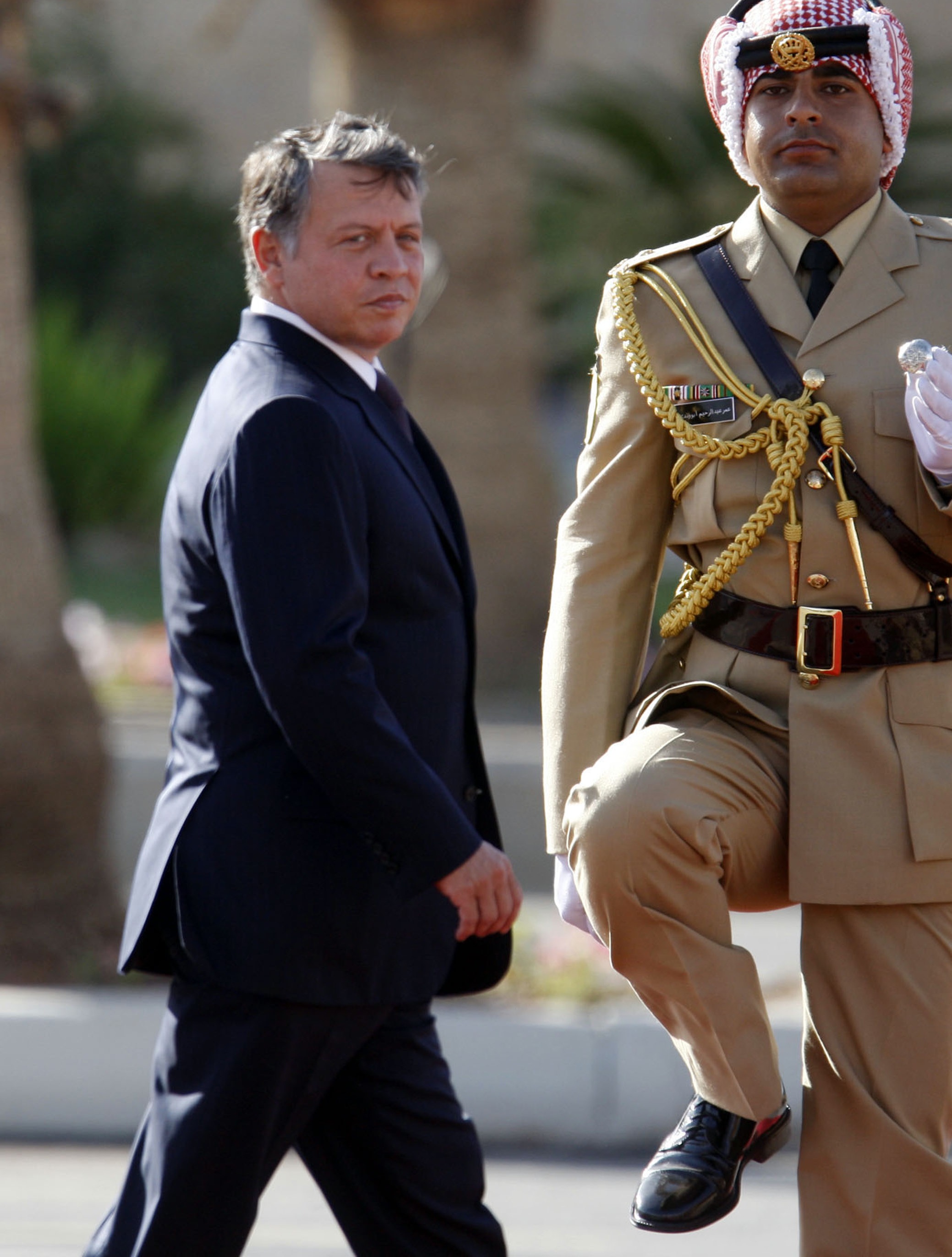
Jeffrey Goldberg seeks advice on Egypt’s democratic transition by bragging of talking to a monarchical dictator, who appoints the members of the legislature and whose foul regime tortures at will. This is how Wiki describes human rights in Jordan:
According to a report by Amnesty International, intelligence agents in Jordan frequently use torture to extract confessions from terror suspects. Common tactics include, “beating, sleep deprivation, extended solitary confinement, and physical suspension.” Palestinians and suspected Islamists are treated especially harshly. Though Jordan has improved many procedures including a prison reform campaign in partnership with EU in this respect, agents at the General Intelligence Department remain largely immune to punishment.[28][29]
In May 2010, the UN Committee against Torture reiterated long-standing concerns at Jordan’s failure to investigate and prosecute allegations of torture, to provide adequate protection against torture, and to prosecute perpetrators in accordance with the seriousness of the crime. It noted the “numerous, consistent and credible allegations of a widespread and routine practice of torture and ill-treatment” including in General Intelligence Department (GID) and Criminal Investigations Department detention.[30] The government did not respond to the Committee’s recommendations.[8]
But they’re not Islamists, so that’s fine. You can even be chums with dictators and brag about it on Bloomberg news. If you somehow don’t see how Abdullah fits into Goldberg’s alleged support for Arab democracy, then you clearly know nothing about the region and should understand all its nuances better.
(Photo: King Abdullah II of Jordan arrives at an official celebration for the 65th anniversary of Independence, on May 25, 2011 in Amman, Jordan. The Hashemite Kingdom of Jordan gained independence from Britain on May 25, 1946. By Salah Malkawi/Getty Images)
The latest scandal-exposing machine in France is an online site unafraid to tackle secret government:
Mediapart operates from a newsroom in the Bastille area of Paris. It has 46 full-time investigative journalists and 75,000 subscribers who pay 90 euros ($117) for a one-year subscription. Mediapart cleared $1.5 million in profit last year. The feisty startup is beating the more established newspapers like Le Figaro and Liberation, which are limping along with the help of government subsidies but just half the number of subscribers.
Two very Dish-like features:
Plenel says that to his surprise, people read even lengthy pieces, and they comment on them. He says there is a dialogue between Mediapart and its community of subscribers. That flies in the face of the advice he was given at the outset: that the information had to be short, flashy and free, or nobody would bother reading it.
“Internet is a chance for journalism, not the death, a chance,” he says. “Because you can organize better journalism — more sources, more documented, deeper journalism.” Plenel says the site is shooting for 100,000 subscribers, but in its quest to get there, it will never accept advertising.
We haven’t taken such an absolutist stand, but we prefer being without ads. And it looks as if we may be able to finance ourselves without them – if you keep up the subscriptions. [tinypass_offer text=”Subscribe!”]
Does this mean gay male couples should publicly challenge the social norm of monogamy? I don’t believe so. What we can do – and what some straight couples do – is contain the details of our relationships to one another. It’s called discretion.
I know you’re a conservative, and you’re framing this as a conservative stance. But as a woman in an open marriage, I think you’d really be doing us girls a solid by going ahead and challenging the social norm of monogamy. Monogamy is part of a larger set of stories that we tell women about how their desire works that are not particularly true because we want to control them.
My experience closely follows the experiences and ideas laid out in some newer books that take on female desire, including What Women Want and Sex at Dawn. My actual desire has an almost inverse relationship to the stereotypes and norms and expectations that surround me. I am visually stimulated. I get attracted to lots of different kinds of things. I walk around feeling kind of sexy all day long on most days. I crave casual sex. And most importantly, I need novelty, or my libido tanks.
Like a number of the women profiled in What Women Want, I did not have a very honest relationship to my sexuality for a long time. I assumed that I need romance and companionship in order to want sex, that I should therefore want my husband – and that if I don’t, I must not like sex. I’ve figured out how to listen to what I actually want, rather than what society tells me I want. And my conservative counterargument is that my marriage is stronger and more meaningful because I cat around.
My real issue, though, is with discretion.
If this were just about me and my pleasure, then discretion would be appropriate. But we control women by diminishing their sexuality, and this hurts! It is actively disempowering to feel as separated from your own desire as most women in our culture feel. It is terribly diminishing to assume that you’re messed up/frigid/broken because you don’t want to have sex with someone you love anymore.
Sex is social – this is why you talk about it so much on your blog! As a gay man, you live in a world where everybody gets the privilege of being straightforward about desire. Women, on the other hand, are charged with this impossible task of simultaneously inhabiting two social sexual spheres: the one that affirms your desire, in which short skirts or red lipstick are expected and rewarded because they signify sex, and the one that denies your desire, in which you are inexplicably expected to be wearing that lipstick for the same person that you regularly fart in front of.
Challenging monogamy challenges this double standard. Women deserve this!
Michael Wahid Hanna will join us to answer your questions related to the ousting of Morsi and the Muslim Brotherhood, as well as what’s next for Egyptians. Hanna’s Twitter feed continues to be a must-read for anyone following the events in Egypt. Additionally, this spring in Democracy, he outlined the seven “pillars” that he believes all Arab democracies need to stand on:
As we watch these riveting, often exhilarating, and sometimes horrifying events [in the Middle East], the bottom-line questions in all our minds are simple. Can democracy take root in the Arab world? How long will it take? Ten years, 20…50? We all hope for a great transformation, in which Egypt, Syria, Yemen, and their neighbors embrace democracy and pluralism and cast off autocracy and extremism. But is there reason to be optimistic?
While we cannot make specific predictions, we can say broadly that the ultimate success of the Arab uprisings will depend heavily on the development of seven core areas. They are: economic growth and equality; education policy; security-sector reform; transitional justice; decentralization; the development of regional norms on democratization; and—in many ways, the linchpin for everything—the flourishing of a more pluralistic politics. These are the seven pillars of the Arab Future. They are the yardsticks by which we can measure progress in the region in the coming years.
Michael Wahid Hanna is a senior fellow at The Century Foundation. He works on issues of international security, international law, and U.S. foreign policy in the broader Middle East and South Asia. He recently served as a co-director of The Century Foundation’s International Task Force on Afghanistan, co-chaired by Thomas Pickering and Lakhdar Brahimi. He has published widely on U.S. foreign policy in newspapers and journals, including articles in the New York Times, the Los Angeles Times, theBoston Globe, Christian Science Monitor, the New Republic, and World Policy Journal, among other publications, and is a frequent contributor to Foreign Policy. He appears regularly on NPR, BBC, and al-Jazeera.
Our ongoing coverage of the developments in Egypt can be found here. To submit a question for Hanna, simply enter it into the Urtak survey after answering all of the existing questions (ignore the “YES or NO question” aspect and simply enter any open-ended question). To vote, click “Yes” if you have a strong interest in seeing him answer the question or “No” if you don’t particularly care.
I have a feeling that when historians look back at the recent death-spiral of the Catholic hierarchy, they will note the radicalism of Benedict in a couple of respects: his sudden resignation, upending centuries of tradition; and his continuation of the absurd sanctification policies of his predecessor and ally, John Paul II. John Paul II canonized more saints than all the Popes since 1588 put together. Those new, desperate developments – showing how theoconservatism is, like neoconservatism, anti-traditionalist and radical in its new modes of thought and action – are culminating in the canonization of Wojtila just eight years after his death.
I agree with Catholic historian Michael Walsh, who sees corruption in all this:
My doubts are about John Paul being beatified by his successor, Pope Benedict. It appears incestuous and akin to the habit of deifying one’s ancestors.
The whole point of the very long and arduous process of canonization (pre-Wojtila) was to guard against the emotional judgment of contemporaries, and the narrow interests of Vatican factions, in order to wait for the cool reason of historical perspective. And it is far too soon to tell what John Paul II’s ultimate legacy will be. He radically transformed the papacy into a traveling rockstar world-tour, a precedent that made his successor seem even smaller than he was. He reversed the intellectual openness of the Second Vatican Council. The Catholicism he revered was very Polish and very anti-modern, even though his own intellect was considerable. There’s no denying his charisma, his charm or the depth of his faith and power of his example. His role in guiding Europe away from Communism was integral to the miracle of the late 1980s. But he also presaged the collapse of the church in Europe and presided over the worst scandal in the church since the Reformation: the rape of thousands of innocent children and the cover-up that protected priests rather than kids.
Unlike Ratzinger in Munich, Wojtila didn’t have a direct, personal role in enabling the rape of children under his direct supervision. But his refusal to see what was in front of his nose, and, more specifically, his long and passionate support for one the the greatest monsters of the scandal, Marcial Maciel, seem to me to argue for caution and time, rather than impulsiveness and a rush. Maciel was a bigamist and a drug trafficker and a multiple child rapist. He even raped his own children. He ran a cult devised to satiate his sexual appetites and bring in money in massive amounts. John Paul II was the prime obstacle in stopping this man’s corruption and evil – far more protective than even Ratzinger. The sheer amount of money Maciel was able to shake down from the wealthy was undoubtedly salient here, as was his ability to bring countless new, Francoite priest-bots into the Church. I just don’t see how a Pope with this on his record can be made a saint almost instantly.
Or not without putting the hierarchy once again on the side of the powerful – at the expense of the souls of countless children. Does this not merit at least some measure of circumspection rather than a rush to instant judgment? And does this process not feel like a sudden move to protect his legacy before its full details come to light?
A man with his face painted the colors of the Egyptian flag looks out as thousands of Egyptian protesters celebrate in Tahrir Square as the deadline given by the military to Egyptian President Mohammed Morsi passes on July 3, 2013 in Cairo, Egypt. By Spencer Platt/Getty Images.


 The Dish