An Imposter’s John Hancock

“Joseph Cosey,” the favored alias of autograph forger Martin Coneely, comes to life in a 1956 New Yorker profile:

From the early thirties until shortly after the Second World War, [Cosey] papered the country with his handiwork—forgeries predominantly of Lincoln, but also of Franklin, Edgar Allan Poe, Mary Baker Eddy, and a score of other illustrious Americans—in such profusion that the autograph market was thrown into a state of demoralization from which it has not even yet fully recovered. …

Cosey successfully forged not only signatures but whole letters and other manuscripts in the handwriting of the signers. Ordinarily, when he attempted holographs, he reproduced an actual text verbatim, but he became so familiar with the literary style of some of the persons whose handwriting he forged that from time to time he improvised texts over forged signatures and thus ad-libbed some lines that became—temporarily, at any rate—footnotes to history.

(Hat tip: Longform)

Do Swedish Meatballs Come With That?

Ikea and the UN’s High Commissioner for Refugees are joining forces to build a better refugee shelter:

Ikea’s [new tent] design, a cross between a giant garden shed and a khaki canvas marquee, is Ikea Flatpackformed from lightweight laminated panels that clip on to a simple frame, providing UV protection and thermal insulation. Like an Ikea product, the polymer panels come packed in a box, along with a bag of pipes, connectors and wires — and no doubt a cartoon construction manual. “It is designed this way, like an Ikea bookshelf, to be easy to transport and easy to set up in the field,” says Johan Karlsson, project manager of Ikea’s Refugee Housing Unit. “And the panels can last up to three years.”

The kit also incorporates a fabric shading sheet with a metallic layer that reflects the sun during the day and keeps the heat in at night, as well as a solar panel to provide the shelter with power.

The UN is planning to test 50 prototype shelters in Ethiopia, Iraq, and Lebanon. Others have developed novel forms of refugee housing, but the traditional canvas tent remains dominant. Alternatives include the Superdobe Eco-Dome, the Buckminster Fuller-inspired Hexyaurt, and the Global Village Shelter, which is made from water- and flame- resistant paper.

Why Should Women Shave? Ctd

Athletes of both genders sound off:

I’ll apologize for taking this thread in a new direction, but as a guy who swam competitively for many years, I have inhabited the flip side of this coin (though of course without the kind of oppression that women endure, to which I am wholly sympathetic). When we shaved for competition, it was considered by many to be an effeminate act and we endured taunts from classmates. Folks were particularly merciless when it was revealed that we made an event out of it and shaved together as a team. It must have been the mental image of a room full of high school athletes shaving together, and shaving each other. Part of the advantage of shaving was thought to be related to the removal of the top layer of skin, so we shaved backs and other inaccessible areas – try that without a helper.

The removal of a layer of skin was thought to make you more sensitive to the flow of the water, but I remain skeptical.

The first thing I noticed about being shaven is how little you can feel, compared to being hairy. When you swim with hair, you know exactly where your leg is and how the water is acting on it, due to the tiny tug that passing water exerts on each little hair. When swimming following a shave, I felt temporarily lost in the water and swam largely on muscle memory. Folks saved their shave for the most important race of the season.

Maybe this was the reason most swimmers used “motion lotion,” a Ben Gay-sort of oil that gave your skin the icy-hot feeling. It was described to me as lubricating the body so it slips through the water better (swimmers would avoid applying the oil on parts of the arms and hands where you would want to “grip” the water”). On reflection, it seems more likely that the icy-hot feeling helps swimmers feel the water, in the absence of hairs.

This seems like an area ripe for systematic study.

Another reader:

Just to make the conversation interesting, I thought I’d throw in the topic of men who shave their legs. I suppose there are a few reasons that come to mind, either you’re a body builder, a swimmer, or in my case, a racing cyclist, then there’s also those who perform in drag and those who just feel like it. Others abound I’m sure.

As a cyclist it’s a funny thing because unlike swimmers, we do it throughout the season, and not just before competitions (as I understand it, that’s what they do). The reasons a cyclist does it are 1) for treating road rash, which if you’re racing, is inevitable, 2) to signify that you are a racing level cyclist, and not a weekend warrior, 3) pros have the additional reason of making it easier for leg massages. People talk about wind resistance, but the time saved is an insignificant difference. Some people might not mention reason 2, but I contend that that’s a force motivating people to do it – like a monk shaving their head before committing to the lifestyle.

The funny thing I’ve run into is having to mentally prep a girl for when I might be hairless again, and the understandable response of “oh, hmm.” I think it’s less a visual thing for girls – cyclist legs are ripped and sweet lookin – and more a feeling thing. When we lay in bed making sexual congress, the silk feeling of my legs against her legs will prompt a “wtf” reaction whether she’s “cool” with it or not. It’s a mixed signal since a part of her mind is expecting one feeling and getting a very different one It’s a small matter to me, if a girl would really object to having sex with me because I have shaved legs I’d stop being interested anyway, but still funny to remember there’s a minority of men who deal with the same problem, though in reverse.

A female cyclist:

I have one particular reason for keeping my nether-regions nearly clean-shaven and haven’t seen it addressed on the blog:  cycling.  Yup, I’m a long distance bicycle rider and, after many years of feeling a post-ride soreness that felt as if someone had taken a baseball bat to my genitals, I realized my pubic hair was the problem!  Being on a saddle for 8 or 9 hours at a time resulted in my pubic hair being tugged every which way for hours.  Tugged, pulled, yanked.  Ouch.  So I began trimming and realized immediate relief.  No more tugging or yanking as I shifted around on the saddle. That was years ago and I remain happily trimmed.  As long as I continue to turn a pedal, I’ll keep the trimmer close by.

Love Has No Narrative

Freddie loved the film Before Midnight, which made him “feel better about romantic love and life-long partnership”:

Perpetually, magazines and publishers release arguments that love is dead, or was always a lie, or that long-term relationships are contrary to human nature, or whatever. I have come to think that these arguments are exactly as immature and juvenile as the fairy-tale vision of love where two people meet and immediately fall in love and live happily ever after. I have had a life filled with both happiness and tragedy and there is no question in my mind that the portrayal of human life or human relationships as some hopelessly bleak and maudlin journey reveals a teenaged sensibility, a grasping and fussy pessimism that speaks of a refusal to confront life as petty indignities and great victories and terrible tragedies and little moments of grace all stacked on top of each other in nothing resembling a narrative or a plan.

Love is hard but it’s probably worth it and anyway, what else?

We have this idea that either you have a relationship with The One or you’re settling, and that the romantic ideal is to pursue the former and not the latter. But as I get older I more and more think that the real beauty comes precisely from the endless negotiation between two flawed people who aren’t perfect for each other or for anyone else but who are willing to work to find a way to live together in order to enjoy the good each has to offer. It’s not “romantic life vs. settling.” It’s getting to good enough with another person out of the conviction that there is nothing else and nothing better. And sometimes it doesn’t work. I believe in Celine and Jesse together, and I love this movie for showing two people who both can’t get along and are meant for each other.

Previous Dish on Linklater’s newest film here and here, which includes the trailer and the famous train scene referenced in the above video.

Innovate, Baby, Innovate

Reihan wants conservatives to embrace a new report, “Putting Energy Innovation First.” Yep, he’s one of the sane ones. In a follow-up, he smartly defends putting innovation before other climate change responses:

While it is true that we have the technological means to curb carbon emissions, we don’t have the means to curb carbon emissions without substantially changing how we organize our society in ways that will tend to also curb consumption and mobility. This is why energy innovation, and specifically devising cheaper-than-coal energy technologies, is so important: Energy poverty remains an enormous problem, and so we have to find a way to both increase energy consumption while also reducing reliance on carbon-intensive energy sources.

Carbon pricing can help encourage the adoption of low-emissions technologies and reduce the amount of driving, etc., yet politically realistic carbon taxes are unlikely to have a dramatic effect. Politically unrealistic carbon taxes, meanwhile, will tend to shift carbon-intensive activities to jurisdictions that don’t impose them. Cheaper-than-coal technologies, in contrast, will spread organically, and quickly. So if energy innovation reform increases the likelihood of achieving energy breakthroughs, I think it makes sense to prioritize it above carbon taxation or CTPs [cap-and-trade programs], both as a political and as a substantive matter.

Meanwhile, Gleckman examines a study finding that current energy-related tax breaks are ineffective:

Although the Code included $48 billion in energy-sector tax preferences in 2010-2011, their effects were essentially nil. “The combined effect of energy-related subsidies for renewable sources and fossil fuels is very small, probably less than 1 percent of U.S. emissions, and could be either positive or negative.” … The NAS report did conclude that one set of subsides—tax incentives for research and development in low-carbon technology—may be effective. However, the panel could not model those preferences.

The Best Of The Dish Today

Lake Georg-IN-645am

Quite simply this. And this:

all eyes are opened, or opening, to the rights of man. the general spread of the light of science has already laid open to every view. the palpable truth, that the mass of mankind has not been born with saddles on their backs, nor a favored few booted and spurred, ready to ride them legitimately, by the grace of god. these are grounds of hope for others.

for ourselves, let the annual return of this day forever refresh our recollections of these rights, and an undiminished devotion to them.

See you tomorrow.

The Quintessential American Word: “Hi!”

Fourth Of July Drummers

[Re-posted from earlier today]

Henry Fairlie published this gem about his adopted country – like me, he was a Tory and a passionate American – thirty years ago today. If you have never read it, do yourself a favor. It’s the experience of a Brit brought up in post-war England discovering America in later life. This anecdote never fails to make me smile – with recognition and wonderment:

One spring day, shortly after my arrival, I was walking down the long, broad street of a suburb, with its sweeping front lawns (all that space), its tall trees (all that sky), and its clumps of azaleas (all that color). The only other person on the street was a small boy on a tricycle. As I passed him, he said “Hi!”—just like that. No four-year-old boy had ever addressed me without an introduction before. Yet here was this one, with his cheerful “Hi!” Recovering from the culture shock, I tried to look down stonily at his flaxen head, but instead, involuntarily, I found myself saying in return: “Well—hi!” He pedaled off, apparently satisfied. He had begun my Americanization.

“Hi!” As I often say—for Americans do not realize it— the word is a democracy. (I come from a country where one can tell someone’s class by how they say “Hallo!” or “Hello!” or “Hullo,” or whether they say it at all.) But anyone can say “Hi!” Anyone does. Shortly after my encounter with the boy, I called on the then Suffragan Bishop of Washington. Did he greet me as the Archbishop of Canterbury would have done? No. He said, “Hi, Henry!” I put it down to an aberration, an excess of Episcopalian latitudinarianism. But what about my first meeting with Lyndon B. Johnson, the President of the United States, the Emperor of the Free World, before whom, like a Burgher of Calais, a halter round my neck, I would have sunk to my knees, pleading for a loan for my country? He held out the largest hand in Christendom, and said, “Hi, Henry!”

One thing that shocked me most about Washington when I moved there was the Mall. I was expecting some kind of royal park or something, I suppose. But around these massive neo-fascist monuments, Americans were playing frisbee, chowing down on picnics, scuffing up the grass, treating the place as if it were their own. And then I realized the core difference: it was their own. There had been no monarchy presiding over this Mall after the Revolution – and that democratic instinct, that leveling perspective gave us frisbees and volleyball and touch football all around secular hallowed ground. I was hooked within weeks of arrival here. Why? I’ll let Henry explain:

I had been in the country about eight years, and was living in Houston, when a Texan friend asked me one evening: “Why do you like living in America? I don’t mean why you find it interesting—why you want to write about it—but why you like living here so much.” After only a moment’s reflection, I replied, “It’s the first time I’ve felt free.”

(Photo: George Goldstein, Harold Johnson and Harold Valentine prepare to march through their neighborhood playing their drums to celebrate the 4th July, circa 1935. By FPG/Hulton Archive/Getty Images.)

Tonight’s Big Event

dish_fireworks1

Neil Irwin presents five facts about fireworks. First on his list:

You might injure yourself. You probably won’t kill yourself. The Consumer Product Safety Commission found that in 2012, there were 8,700 injuries in the United States caused by fireworks that required treatment at a hospital, well within the recent range of injury numbers (the 15-year high was 11,000 in 2000, the recent low 7,000 in 2008). But there were only six deaths reported in 2012, four in 2011, and three in 2010. (Here is more from Sarah Kliff on where on the body those injuries are likely to occur)

Marc Herman reads the The Consumer Products Safety Commission (CPSC)’s report on fireworks safety:

The key to avoiding fireworks injury appears to be, broadly, not treating gunpowder like it’s barbeque sauce. The bulk of injuries came from various homemade firecrackers and misuse of powerful rockets. Reading the directions, and not trying to re-invent something the Chinese had pretty much nailed 2,000 years ago, appear to be the trick to avoiding injury, according to the CPSC report

And Margaret Hartmann finds a political angle on Independence Day festivities:

Thanks to sequestration, the Fourth of July is going to be a good bit less festive this year, particularly if you happen to live on or near a military base or are an air-show buff. As the Washington Post reported this week, politicians’ dire predictions have mostly not come true, but over the long holiday weekend, federal cutbacks will be especially visible as, with the military subject to across-the-board cuts, bases have been forced to scale back or cancel their Independence Day celebrations.

And National Geographic presents photography advice for capturing fireworks.

(Photo by Flickr user bayasaa)

Face Of The Day

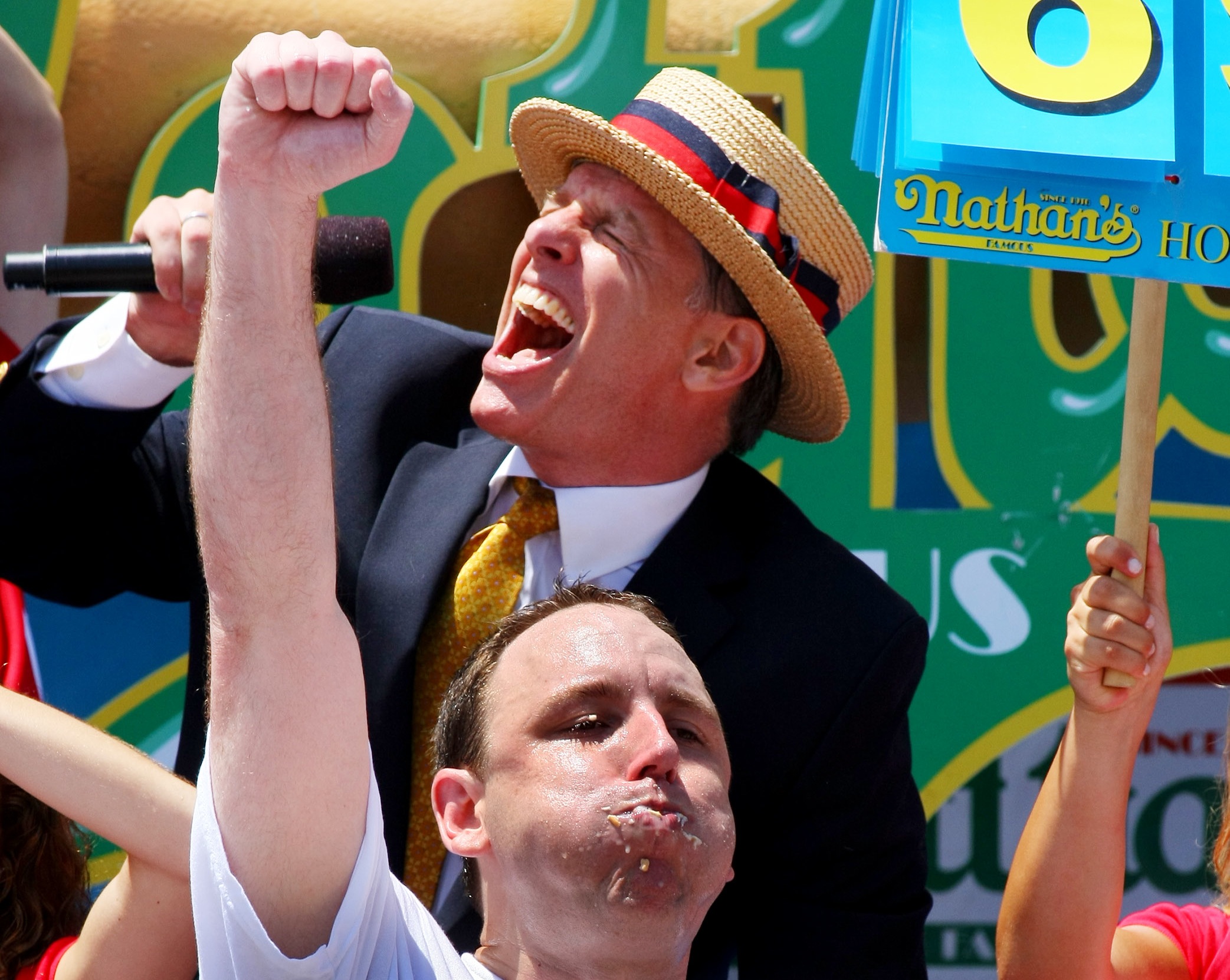
Top Speed Eaters Compete In Nathan's Hot Dog Eating Contest

Master of Ceremonies George Shea cheers as Joey ‘Jaws’ Chestnut sets a new record and wins the Nathan’s Famous Fourth of July Hot Dog Eating Contest at Nathan’s Famous in Coney Island on July 4, 2013. Chestnut, of San Jose, California, ate 69 hotdogs in ten minutes to win his seventh straight title. By Monika Graff/Getty Images.

The Self-Made American

Jim Cullen considers its myth and mythos in American culture:

Today, even those who invoke the self-made man in politics almost always credential themselves as self-made in the realm of commerce (standard operating procedure for Republican politicians in particular, whose private sector credentials are often flimsy, since they have typically spent much of their careers in government service). Rare is the figure— [author Daniel Walker] Howe among them—who recognized this had not always been so. “Few expressions in our language have shriveled as badly as the term ‘self-made man,’” he noted in his chapter pairing Frederick Douglass and Abraham Lincoln in Making the American Self. “Among intellectuals at least, it is widely regarded as the platitudinous expression of an obsolete individualism. Once upon a time, however, the self-made man represented a heroic ideal.”

Indeed, even a brief immersion in seventeenth-, eighteenth-, or nineteenth-century U.S. sources suggests that the conception of the self-made man was a good deal broader than business or politics. Yes, of course, John D. Rockefeller was considered an exemplar of the self-made man. But so was Ralph Waldo Emerson. Benjamin Franklin is widely considered the patron saint of American capitalism, but he was also celebrated by his contemporaries as a self-made scientist, diplomat, and writer. Self-made men came from other realms as well, among them the military (Andrew Jackson, Ulysses S. Grant, George Patton) and the arts (Walt Whitman to Walt Disney).

(Hat tip: 3QD)