The Gender Divide On Drones

Women Drones

Alexis ponders it:

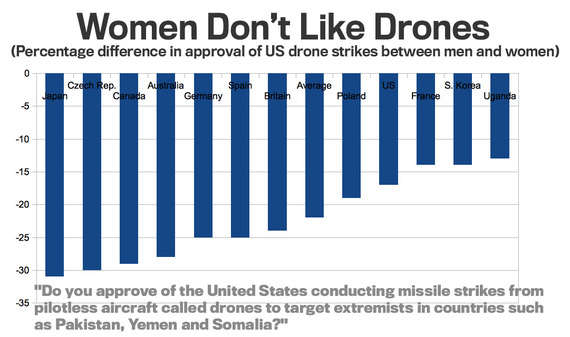
They’re a way of waging a war that men support far more than women. One reason might be that, as Eichenberg summarizes earlier research, “women were far more sensitive — and negative — about the prospects of civilian and military casualties in the war.”

So much of the discourse over drones has focused on the possibility and reality of civilian casualties that perhaps this has tinted the subject for women across the globe.

Another might be that men just really *like* drones and the prospect of troop-less war.

A Rule Of Thumb Drives, Ctd

A reader writes:

Regarding your post on viruses from thumb drives, I believe the Iranians would agree with you.  We infected their nuclear program computers with the  STXNET  virus using the thumb drive trick [NYT]:

The United States and Israel would have to rely on engineers, maintenance workers and others — both spies and unwitting accomplices — with physical access to the plant. “That was our holy grail,” one of the architects of the plan said. “It turns out there is always an idiot around who doesn’t think much about the thumb drive in their hand.” In fact, thumb drives turned out to be critical in spreading the first variants of the computer worm; later, more sophisticated methods were developed to deliver the malicious code.

One a much different note:

Your recent thumb drive post reminded me of a hilarious incident I witnessed during grad school. I was taking a class which required students to present their work during finals week. One very serious student plugged his thumb drive into the classroom’s computer while the projector was turned on. His thumb drive’s contents were suddenly displayed for the entire class to see, and right smack in the middle was a video file named “Sorority Girls 3” or something similar.

The classroom was dead silent. I’ve never been happier.

The Puritanism Of Progressive Parents, Ctd

A reader writes:

As a progressive liberal parent, parenting in progressive liberal Seattle, I’m finding the lopsided caricature of liberal parenting presented recently on the blog to be rather unfair. In the specific case of fluoridation, it is by no means proven that fluoride is harmless –  some studies have linked fluoride to disruption of the endocrine system, leading to metabolic disorders and thyroid problems.  Could America’s obesity rates be somehow linked to its obsession with fluoridating its water?  The case against fluoridation is given here.

But in general, I would consider being against fluoridation to be a somewhat conservative stance. To me the idea of adding medicines to drinking water seems to be the nanny state operating at its finest (there is no other reason for adding fluoride to water beyond the prevention of tooth decay).  If I want to use fluoride, then it’s super simple for me to just buy a fluoridated toothpaste, giving me a degree of choice and control over what I put into my body that federally-mandated fluoridation just doesn’t give me.

On a more general note, I’m a firm believer in “you are what you eat”. I don’t think it’s an accident that my daughter is very rarely sick.

It’s because she generally gets her five fruits and vegetables a day.  But I have to be vigilant over what my eight-year-old daughter puts in her body because no one else is doing it for me.  Added sugars, salt, high fructose corn syrup, and hydrogenated fats are routinely added to processed foods, often when you would least expect them. Why do juice boxes require added sugar? Wherever she goes – camps, after school activities, birthday parties – she is presented with an overwhelming abundance of boxed pizza, boxed mac ‘n cheese and processed sugary treats. Try finding a vegetable, or even fruit,  on any kids menu in America. And that’s before we get to the barrage of propaganda on behalf of (government subsidized) Big Ag that she’s subjected to every time she turns on the TV.

It seems to me that “conservatism” is all about preserving the status quo of Big Ag and Big Pharma, whereas it is we progressive liberals who are seeking to return to and conserve an earlier simpler world where we can all have access to nutritious food grown in proper soil by local farmers. If we occasionally seem paranoid and over-zealous – and we are sometimes – it’s because that simple goal is nowadays really difficult to achieve.

Update from a conservative reader:

It warmed my heart to see this self-described “progressive liberal” parent from Seattle rail against government-mandated fluoridation and government-subsidized Big Ag – it certainly isn’t the libertarians pushing this stuff. I only wish that more of my friends on the left would see the virtues of smaller government.

Francis’ Sunlight: Reax

VATICAN-POPE-AUDIENCE

Jimmy Akin thinks the press is reading too much into the Pope’s words on homosexuality:

Disclaiming a right to “judge” others is something that goes back to Jesus. It does not mean a failure to recognize the moral character of others’ actions, however. One can form a moral appraisal that what someone else is doing is wrong (Jesus obviously does not forbid that) without having or showing malice toward them.

The statement that they should not be marginalized is similarly in keeping with the Holy See’s approach to the subject, as 1992 Vatican document On the Pastoral Care of Homosexual Persons. The statement that same-sex attraction “is not the problem,” when understood correctly, is also nothing new. “The problem,” as Pope Francis seems to here be understanding it, is going beyond merely having a sinful tendency–a temptation to which one is subject. Obviously, temptations are a problem, but if we resist temptation we do not sin. “The problem,” on this understanding, is giving into the temptation and sinning or–worse–building an ideology around the sin and trying to advocate the sin.

But this was precisely what Benedict was trying to ratchet back, by arguing in 2005 that, whatever their conduct or faith, gay men should be barred from seminaries because homosexuality itself is objectively disordered and gays’ very being is inherently against the logic of God’s creation. Benedict’s pronouncements on gays were almost a definition of marginalization: “somehow distorted, off center, and … not within the direction of creation.” Isn’t that what the ancient world said of lepers and the Jewish world say of Samaritans? Benedict’s fastidious, obsessive-compulsive need to re-make all Creation in the image of his own hermetically-sealed and completely abstract theology ended up betraying the most important message of Jesus: that the last shall be first, that everyone is invited to God’s table, and that those you call “distorted” and “off-center” are actually at the very center of a loving God’s compassion.

And this interpretation is of a piece with what he said about divorced and re-married Catholics at the same presser:

“This theme always comes up … I believe this is a time of mercy, a change of epoch. It’s a kairos moment for mercy … In terms of Communion for those who have divorced and remarried, it has to be seen within the larger pastoral context of marriage. When the council of eight cardinals meets Oct. 1-3, one of the things they’ll consider is how to move forward with the pastoral care of marriage. Also, just 15 days ago or so, I met the secretary of the Synod of Bishops, and maybe it will also focus on the pastoral care of marriage. It’s complicated.”

I think it’s bizarre to ignore a Pope when he proclaims “a change of epoch,” when he calls our time a “kairos” moment for mercy. That means a turning point, a hinge of history. Why use that language if you are merely insisting on total continuity with the past? And the issue with re-married Catholics is exactly the same as for gays: the licitness of sexual congress outside one, life-long, monogamous, non-contracepted heterosexual marriage. Kevin Clarke agrees that Francis didn’t depart from traditional church teaching but sees a welcome shift regardless:

His citation of current catechism on the treatment of gay and lesbian people was not revolutionary in any sense; what startles may be the spectacle of a pope saying anything out loud on the matter and stressing the importance of church teaching on the human dignity of gay and lesbian people.

Francis was also asked why he did not spend much time speaking about abortion or gay marriage during his trip (church teaching is already clear, he said) and about the difficulties of divorced and remarried Catholics. “I believe this is a time of mercy, a change of epoch,” the pope said.

Likewise, Francis DeBernardo of the gay-friendly New Ways Ministries thinks this language is a sign that things will get better for gay Catholics: “Even if [Francis] doesn’t drop the sin language, this is still a major step forward, and one that can pave the way for further advancements down the road.” One gay Catholic, Michael O’Loughlin, agrees:

In addition to mercy, Francis’ comments also provide hope, hope to those who live on the margins of the church. In a special way, those who live without—without money, without recognized dignity, without full embrace from institutions of power—are called to live prophetic lives. But sometimes being offered some hope from the powerful, in this case Pope Francis and the church, is needed in order to keep moving forward with the struggle. Francis’ comments, however offhand and however easily dismissed they will be by traditionalists, are worth celebrating.

Elizabeth Scalia also applauds Francis’s call to mercy and forgiveness – and tells us all to relax:

I understand some folks’ concerns that perhaps Francis is too heavy on the mercy and too light on the justice side of things — and certainly the cross itself teaches us that both must be held in balance. But this is still a pretty fresh papacy. The sense I’m getting is that Francis means to scrape some long-attached barnacles from the Barque of Peter, so we can see what the deeper hues of Justice and Mercy look like; he’s readying it to travel some rough, challenging waters…

I’ll tell the new hysterics the same thing I told the old hysterics: you’re gonna be surprised who makes it into heaven and who doesn’t, because it’s not going to line up with what you or I think is Catholicism-done-Correctly, so be sweet to everyone, mind your own soul, not theirs, and trust Jesus to sort it out.

Admitting that “I love the guy,” James Martin, a fellow Jesuit, praises Francis and claims he’s initiating real change in the Church:

Praising Francis does not mean denigrating John Paul or Benedict. Each pope brings unique gifts to the office. But Francis’s election as pope has definitely brought change to the church.

The essentials have not changed: each pope preaches the Gospel and proclaims the Risen Christ. But as we saw last week in Rio, Francis speaks in a different way: plainly, simply, with unadorned prose. Francis has a different style: more relaxed, less formal, more familiar. Francis’s appeal is different and, judging from the crowds, effective. The Pope does the same thing–preaches the Gospel and proclaims the Risen Christ–in a new way. Francis is a different person for a different time.

What Pope Francis did and said in Rio de Janeiro, how he did it and said it, and how the crowds reacted to what he did and said, show that things can change. And that God can change them. All this is an answer to despair. It is a reminder that nothing is impossible with God. So every time I see Francis, hear him speak or read one of his homilies I’m reminded of this great truth.

Martin emails the Dish to add:

The lesser-noticed change in the Pope’s revolutionary words during his in-flight interview was, at least according to the translation in the Italian-language “Vatican Insider,” the use of the word “gay,” which is traditionally not used by popes, bishops, or Vatican officials.

This is a sea change.

(Photo by Alberto Pizzoli/AFP/Getty Images)
The Preemptive War On Paul

The global hegemonists in the GOP – who have never fully addressed the fiscal, moral and military fiascoes that were the Afghan and Iraq wars – nonetheless can still summon the energy to carpet-bomb anyone questioning the logic behind them. Matt Welch marvels at the “Angry Birds’ multi-front attack against” Rand Paul started by Chris Christie last week and continued yesterday by former terrorist-funder, Peter King (seen above):

The openness and vehemence of this interventionist campaign against one of the GOP’s rising young stars three full years before the party’s next nominating convention is telling. Even if the current foot-soldiers in the anti-Paul war are either comic-book non-entities like Peter King and Liz Cheney or foreign-policy blank slates like Christie, the most important thing is that the candidate (and ideological tendency) making headlines and attracting support from unusual quarters get contained before the virus spreads. The defense establishment, long accustomed to getting its way in both policy and politics, is gearing up for some of that ol’ pre-emptive war.

Paul’s camp has fired back at the above comments from King: “He wants us endlessly patrolling the border of Afghanistan and Pakistan instead of ours at home.” And the shifting politics of NSA surveillance suggests that Paul is onto something. If there’s an actual debate within the Republican party about the disastrous legacy of Cheney, it can only advance sanity, and break the groupthink that has paralyzed the GOP intellectually. Of course, there should be a debate about whether the US needs to spend a huge amount of money policing the entire world, and financing the crony capitalism of the military-industrial complex, while its own infrastructure crumbles, its healthcare liabilities mount and its population ages.

Paul needs to remind Republicans that Reagan was, at heart, a peacenik whose global strategy was premised on a Soviet union that no longer exists. He got the hell out of Lebanon the minute Marines were massacred – something Cheney would declare treason if Obama did the same today. He needs to remind them that Eisenhower was the man who coined the term “military-industrial complex” and won or ended wars, rather than starting and losing them, like Cheney and Bush.

The GOP, in other words, cannot be for limited government in all things but defense and national security – where it signs a huge blank check to the defense welfare state because of paranoia and nationalism (which are not to be conflated with prudence and patriotism). Zeke Miller zooms out:

For years the Republican Party has fractured over foreign policy, but libertarians and neoconservatives, while vehemently disagreeing on substance, tried to project an air of party cohesion. Those days are over. “We ignored them and then tried to placate them,” said one hawkish Senate Republican foreign policy aide about the libertarians. “If we don’t move now [to counterattack], it may be too late in 2016.” … The long-delayed GOP foreign policy civil war is finally here.

Egypt Erupts Again, Ctd

EGYPT-POLITICS-UNREST

Read the Dish’s coverage of the bloodshed from Saturday here. More violence could be imminent:

Supporters of Egypt’s deposed president Mohamed Morsi have called for a “million-person march” against his ouster after authorities warned of “decisive” action if protesters are considered a threat. Organisers of protests against the military’s overthrow of Morsi urged demonstrators to march on security buildings on Monday night and called a march for Tuesday. In a statement, the Anti-Coup Alliance of Islamist groups urged Egyptians “to go out into the streets and squares, to regain their freedom and dignity – that are being usurped by the bloody coup – and for the rights of the martyrs assassinated by its bullets.” The protest calls, which raises the possibility of fresh confrontations, comes after at least 72 people were killed at a sit-in in support of Morsi on Saturday morning.

Meanwhile, as seen above, pro-Morsi supporters have fortified their Rabaa encampment in Nasr City near where Saturday’s massacre occurred. Elsewhere, the Egyptian military continues to arrest Islamists and attempt to justify their violent crackdown:

But in a new report, Human Rights Watch emphasizes how nothing the protesters did could have possibly justified the level of the response by security forces:

“The use of deadly fire on such a scale so soon after the interim president announced the need to impose order by force suggests a shocking willingness by the police and by certain politicians to ratchet up violence against pro-Morsy protesters,” said Nadim Houry, deputy Middle East and North Africa director at Human Rights Watch. “It is almost impossible to imagine that so many killings would take place without an intention to kill, or at least a criminal disregard for people’s lives.” …

According to a doctor who was at the scene, the police began to fire teargas when the protesters were approximately 200 meters away. A skirmish ensued between the protesters and the police and men in civilian clothes, lasting for about two hours: protesters set cars on fire and threw rocks, while police fired birdshot and more teargas from their position near the bridge. The doctor told Human Rights Watch that after approximately two hours, live bullets were fired at the protesters from what appeared to be an elevated position, possibly from a nearby building. The timing was corroborated by two other witnesses. Fouad, another doctor working in the Rabaa field hospital, said, “The pattern of injuries we saw here was completely the opposite of the Republican Guard. In the Republican Guard incident [on July 8, 2013] it was mostly random live fire, it only looked like 10 percent [of those killed] were shot by snipers. This time it was like 80 percent were shot by snipers targeted from above.”

K-Lo: The Pope Said Nothing

I was looking forward to the reaction from the theocon Catholic right to Pope Francis’ refreshingly Christian reflections on homosexual people. Kathryn-Jean Lopez does not disappoint – but it’s a pretzel she has to twist into. Here is what Lopez heard the Pope say:

If the chronology of Allen’s report reflects the conversation, Pope Francis had just finished talking about redemption, the fact that Peter himself denied Christ and would later become pope. He warned against a culture in which sins of the past are dug up on people. Should a sin – we’re talking a sin, not a crime – destroy a man, decades later? That doesn’t seem Christian, it seems clear, was the pope’s point.

Huh? There is no chronology in a press conference other than the chronology of the questions. And the idea that the Pope was merely saying that forgiveness is an essential Catholic practice when he specifically reflected on “gay people” “of good will” is a bizarre digression. Forgiveness is an essential Catholic practice in all circumstances. And, in any case, the gay individual he was citing in the previous answer was, he insisted, completely innocent of all the accusations of sin. So there was nothing to forgive! Good try, K-Lo, but, sorry, this was clearly a rebuke to the cruelty and homophobic panic of the recent past from a man who is the first Pope from a Catholic country where marriage equality is the law of the land (and who favored civil unions for gays there).

K-Lo then goes on fearlessly to reiterate Benedict’s foul and anti-Christian pronouncement that no gay men should be allowed into the priesthood … :

Homosexuality is incompatible with the priestly vocation. Otherwise, celibacy itself would lose its meaning as a renunciation. It would be extremely dangerous if celibacy became a sort of pretext for bringing people into the priesthood who don’t want to get married anyway. For, in the end, their attitude toward man and woman is somehow distorted, off center, and, in any case, is not within the direction of creation of which we have spoken.

… and claims it is completely consistent with this statement from Francis:

When I meet a gay person, I have to distinguish between their being gay and being part of a lobby. If they accept the Lord and have good will, who am I to judge them? They shouldn’t be marginalized. The tendency [to homosexuality] is not the problem . . . they’re our brothers.

For Benedict, gay people were “objectively disordered” whose “attitude toward man and woman is somehow distorted, off center, and, in any case, is not within the direction of creation.” For Francis, “they’re our brothers” and “who am I to judge?”

There are none so blind as those who refuse to see. But Jesus came to open eyes to love, not close them.

In Search Of ManBearPig

Al Gore seems to have an ally:

Dr. Eugene McCarthy is a Ph.D. geneticist who has made a career out of studying hybridization in animals. He now curates a biological information website called Macroevolution.net where he has amassed an impressive body of evidence suggesting that human origins can be best explained by hybridization between pigs and chimpanzees. Extraordinary theories require extraordinary evidence and McCarthy does not disappoint. Rather than relying on genetic sequence comparisons, he instead offers extensive anatomical comparisons, each of which may be individually assailable, but startling when taken together. Why weren’t these conclusions arrived at much sooner? McCarthy suggests it is because of an over-dependence on genetic data among biologists. He argues that humans are probably the result of multiple generations of backcrossing to chimpanzees, which in nucleotide sequence data comparisons would effectively mask any contribution from pig. …

When I asked McCarthy if he could give a date estimate for the hybridization event, he said that there are a couple broad possibilities:

(1) It might be that hybridization between pigs and apes produced the earliest hominids millions of years ago and that subsequent mating within this hybrid swarm eventually led to the various hominid types and to modern humans; (2) separate crosses between pigs and apes could have produced separate hominids (and there’s even a creepy possibility that hybridization might even still be occurring in regions where Sus and Pan still seem to come into contact, like Southern Sudan).

This latter possibility may not sound so far-fetched after you read the riveting details suggesting that the origin of the gorilla may be best explained by hybridization with the equally massive forest hog. This hog is found within the same habitat as the gorilla, and shares many uncommon physical features and habits. Furthermore, well-known hybridization effects can explain many of the fertility issues and other peculiarities of gorilla physiology.

It is not yet clear if or when  might support, or refute, our  origins. The list of anatomical specializations we may have gained from porcine philandering is too long to detail here. Suffice it to say, similarities in the face, skin and organ microstructure alone are hard to explain away. A short list of differential features, for example, would include, multipyramidal kidney structure, presence of dermal melanocytes, melanoma, absence of a primate baculum (penis bone), surface lipid and carbohydrate composition of cell membranes, vocal cord structure, laryngeal sacs, diverticuli of the fetal stomach, intestinal “valves of Kerkring,” heart chamber symmetry, skin and cranial vasculature and method of cooling, and tooth structure. Other features occasionally seen in humans, like bicornuate uteruses and supernumerary nipples, would also be difficult to incorporate into a purely primate tree.

Update from a reader:

As usual, PZ Meyers takes apart this crackpot theory.

In Praise Of Bill Simmons

Below is an excerpt from a Friday discussion moderated by PBS’s Mark Glaser on Nate Silver leaving the NYT to set up shop at ESPN (which sponsors Grantland):

I want to add a personal note about Grantland and Bill Simmons. They remain role models for me and the Dish. If we had been able to find a home like ESPN that was prepared to really give us resources and freedom and had a viable business model, we’d have been thrilled a few years ago. We ran the post from Big Lead not as in any way a criticism of Bill and Grantland, but simply as a way to explore and debate further the economics of online media and individual sites (sorry, but I cannot write the words “personal brand” without throwing up a little in my mouth). Anyway, I wanted to make that completely clear. I revere Bill as much as I revere Nate.

A reader is on the same page:

The Dish was the first news website I ever paid for. I would immediately pay for a subscription to Grantland that was in remotely the same cost range (then again, if the Dish charged $100 a year I would pay for that too). Grantland has become the first thing I open in the morning (although I usually see some of the Dish on my phone before getting to work), and I consume almost all of their written material (I haven’t ventured into video or podcast land because I have to do my actual job). Their writing is consistently thought provoking.

I’m fortunate enough not to have to worry about dropping a few hundred on stuff like this; most people are. What are your thoughts on this type of corporate sponsorship?  (They routinely disclose their ties to ESPN/Disney when they come up in the course of a given story.)

At this point we don’t need it, but at some point, if we really wanted to expand faster than our revenue allows us, sponsorship is something we never ruled out. We’re just trying to build a robust, reader-supported site as a first step. It’s much harder, but we’re also trying to forge a model for other smaller sites so we can expand the range of truly independent ventures online. If you want to help us with that, [tinypass_offer text=”please subscribe”]. I keep meeting regular readers who haven’t yet been prodded to pay by the meter (partly because they access the Dish in many different devices); and they always say they intend to. Well, stop intending to and, if that’s you, please take a moment now, get your credit card out and take two minutes to spend $2 a month or $20 a year to help shift the balance in online media away from pageview mania responsive to advertizers, toward more quality content, responsive to readers. [tinypass_offer text=”Click here”].

Another reader:

A grain of salt on the grain of salt offered by the Big Lead on Grantland’s reliance on ESPN for viability.  Bill Simmons and you are, by far, my two favorite people to read online.  I like sports, politics and pop culture, and Simmons (who is in his early 40s, like me) covers the sports and pop culture while you take care of the politics and the leftover pop culture/Internet memes that I’d otherwise miss.  Frankly, I don’t have much time do much else online – if I have time to look at only four websites in a day, which is often, it’s you, Grantland, Facebook and Twitter (not necessarily in that order).

The idea behind Grantland came about when Simmons was nearing the end of his contract with ESPN a few years ago, and told them that he wanted to start his own website where quality writers could have the freedom to write what they wanted. He wanted to get away from ESPN because, among other things, he chafed often at the rules at ESPN when he wrote on their website (e.g. no curse words, nothing overtly sexual, no criticism of any sportscasters at ESPN or other networks – this one really bothered him). He wanted to have the freedom to write about whatever he wanted (and tell edgier jokes) without worrying about upsetting the suits at ESPN.  John Skipper, to his credit, convinced Simmons that he could do the same thing with an affiliated site, which is how they came up with the idea of Grantland.  Other than a small box in the middle/bottom of the ESPN home page, you wouldn’t know of the affiliation, and good luck finding “ESPN” or “Disney” on the Grantland site.

Though he mostly writes about topics you couldn’t care less about, trust me that he is an incredibly talented and funny writer.  He built his own brand before ever being hired by ESPN (and before “blogging” was a thing), and I can attest to the fact that his loyal readers (and there are hundreds of thousands if not millions) would have followed him anywhere, just like yours did.

Would he have the (possibly) bloated staff he has now had he gone out on his own, or been able to attract all of the writers currently employed by Grantland?  Possibly not, but I am 100% confident (and I’m sure Simmons is, too) that he could have built a standalone profitable website similar to what Grantland is today without any backing from ESPN/Disney.  And the goodwill and additional cross-promotion that ESPN is able to do with Simmons under their employ helps drive a lot of other business for them. For example, he was on their NBA pre-game show this year, and I made every effort to watch it when he was on (even DVRing it at times), which is something I would never do in a million years if Simmons weren’t on the show.

The point being, the Big Lead (along with every other sports blogging site on the planet) has a lot of jealousy towards Simmons because he was among the first, and still by far the best, at looking at sports in a new and modern way, and they are always looking to knock him off his perch a bit.

Agreed. That’s my view as well. We air all sorts of opinions – and we knock many of them down here as well. I’m glad, with your help, we knocked Big Lead’s argument down. Here’s hoping Grantland continues to thrive. I just wish we’d had an ESPN in our past willing to make that leap by empowering us.