What Just Happened To Obamacare?

The ACA’s employer mandate is being delayed by a year. Ezra advocates repealing the mandate entirely:

It’s a bad bit of policy. In fact, when it first emerged during the Senate’s negotiations, I called it “one of the worst ideas in recent memory.” … By tying the penalties to how many full-time workers an employer has, and how many of them qualify for subsidies, the mandate gives employers a reason to have fewer full-time workers, and fewer low-income workers.

Cowen thinks that the administration wants to kill the mandate outright:

My view is you don’t serve up a delay and PR disaster like this, on such a sensitive political issue, unless you really wish to derail the entire provision.

Evan Soltas adds:

[T]here is a strong case for getting rid of the employer mandate. Employers shouldn’t sponsor insurance in the first place, as it masks the true cost of care to employees and creates incentives for over-insurance. It also increases the cost of hiring, locks employees into their jobs, and splits the market for insurance into one for individuals and one for employers, which impedes risk-sharing in the individual market.

If that’s where this heads, I’m all for it. Breaking the employer-healthcare connection would help generate competition and make consumers more aware of costs. Beutler notes that the employer mandate was expected to lower the deficit:

Back in 2012, CBO estimated that the employer penalty would reduce the deficit by about $4 billion in fiscal year 2014. But by zeroing out the penalty, the administration will not only forfeit the revenue it would have collected, but it will have removed an incentive for employers to provide coverage themselves. That probably means more workers than expected will land in the exchanges, many of whom will receive subsidies to purchase insurance themselves, which will increase spending under the law and diminish its deficit reducing potential.

Josh Barro also focuses on the budgetary consequences:

One of his key selling points for the law was that it would cut the deficit. Now that the law has passed, his administration is freer to pursue changes that will raise Obamacare’s cost to taxpayers but improve its effects on the economy. Delaying the employer mandate, perhaps indefinitely, is one way to do that. It’s a better reason than “we couldn’t figure out how to do the reporting.” But it’s not one you can say out loud.

Jeffrey Anderson claims that the delay is “a naked display of lawlessness”:

By law, Obamacare’s employer mandate — its requirement that businesses with 50 or more workers provide federally sanctioned health insurance — should go into effect next year.  By executive fiat, it won’t go into effect until 2015.

Chait counters such accusations:

It is true that the law calls for the mandate to take effect in January. On the other hand, administrative delays push back deadlines like this all the time. The Supreme Court ordered the Environmental Protection Agency to regulate carbon emissions in 2007, and the Bush White House evaded that order by refusing to open an e-mail from the agency. Obama’s EPA has delayed its carbon regulation for years now, and no conservatives have demanded that Obama act faster.

The question becomes what happens after the delay is up. Ideally, we could just repeal the employer mandate. Major laws are routinely followed by legislative corrections to smooth out their glitches. But conservatives have steadfastly followed a strategy of the worse, the better, refusing to accept any changes to Obamacare short of repeal. The employer mandate was one of the few aspects of the law that seemed likely to produce real, rather than imagined, economic damage, and thus conservatives invested a lot of their train-wreck hopes in this aspect of it.

And Cohn expects Republicans to use the news to pummel other aspects of healthcare reform:

Employers might quiet down a bit, but the law’s doubters will use this as proof the administration doesn’t know what it’s doing. As Sarah Kliff puts it, it’s trading one headache for another. Or maybe two. Already, conservatives like Erick Erickson are saying it’s unfair to delay the mandate on employers without also delaying the mandate on individuals. Erickson won’t be the last to make this argument, just as he already has plenty of company citing this news as proof that Obamacare is a disaster.

Ask Dan Savage Anything: Wrong About Iraq

In our final video from Dan, he joins the “I Was Wrong” club:

Fareed Zakaria detailed his own similar misjudgment on Iraq in a recent AA here. Our discussion thread marking the 10th anniversary of the Iraq invasion is here. My recent AAs on the subject here and here.

Dan’s new book, American Savage: Insights, Slights, and Fights on Faith, Sex, Love, and Politicsis in bookstores now. My recent conversation with him at the New York Public Library is here. Dan’s previous answers are here. Our full Ask Anything archive is here.

The Liberal Case Against Immigration Reform

T.A. Frank recently made it:

Oddly enough, an early important realization came to me in Hong Kong during the SARS crisis of 2003. I thought about how Hong Kong had created a flawed but remarkable city in which even low-skilled laborers such as these men and women, who were wearing masks and wiping down railings, lived far better than similar laborers on the other side of the border. I also realized that only a wall (and I didn’t much like walls) prevented millions of people on the People’s Republic of China side of the border from coming over to take these lowly jobs for a fraction of the current wage. (Hong Kong had no minimum wage at the time.) I knew I wouldn’t want these unskilled street cleaners to lose their adequate standard of living to such unbridled competition.

But if that was how I felt about protecting Hong Kong’s working class, why shouldn’t I feel that way about America’s?

Dreher replies:

This reminds me of the arguments we used to have in Dallas about immigration reform.

I would make the point that none of us middle-class people had to use public hospitals, or had our kids in public schools that were overwhelmed by illegal immigrants and the problems that come with them (e.g., children who can’t speak English). Nor were our neighborhoods being colonized by illegal immigrants from a Third World country, men living 15 or more to a house, with very different standards of how to live in a community than many Americans do. It’s easy to be in favor of immigration reform when people like you only get benefits from it, and people not like you pay the cost — and to assume that the only real reason anybody could oppose it is because they’re racist.

Charles Kenny, on the other hand, argues that “the evidence keeps mounting that more immigration is somewhere between a benefit for the considerable majority of native-born people to a benefit for the vast, vast majority”:

Perhaps U.S. citizens will start realizing that more people aspiring to become Americans is no threat to the institutions of America, just as they have come to accept that more people wanting to get married—some to people of the same sex—is no threat to the institution of marriage.

Ultimately, immigration reform’s greatest positive impact is on migrants themselves and the developing countries they come from. The CBO estimates that undocumented workers who obtained legal residency would see a 12 percent wage hike. Harvard economist Lant Pritchett has estimated that if all rich countries increased their labor force through migration on a slightly smaller scale than that suggested by the Senate bill, it would add $300 billion to the welfare of citizens of poor countries—give or take, that’s a little more than twice the value of annual global aid flows. So if cultural attitudes change from viewing immigrants as aliens to be fenced out to seeing them as fellow human beings to be welcomed, the impact on both American and global quality of life will be immense.

The latest Dish on the immigration bill here, here, and here.

Hitch-Bait

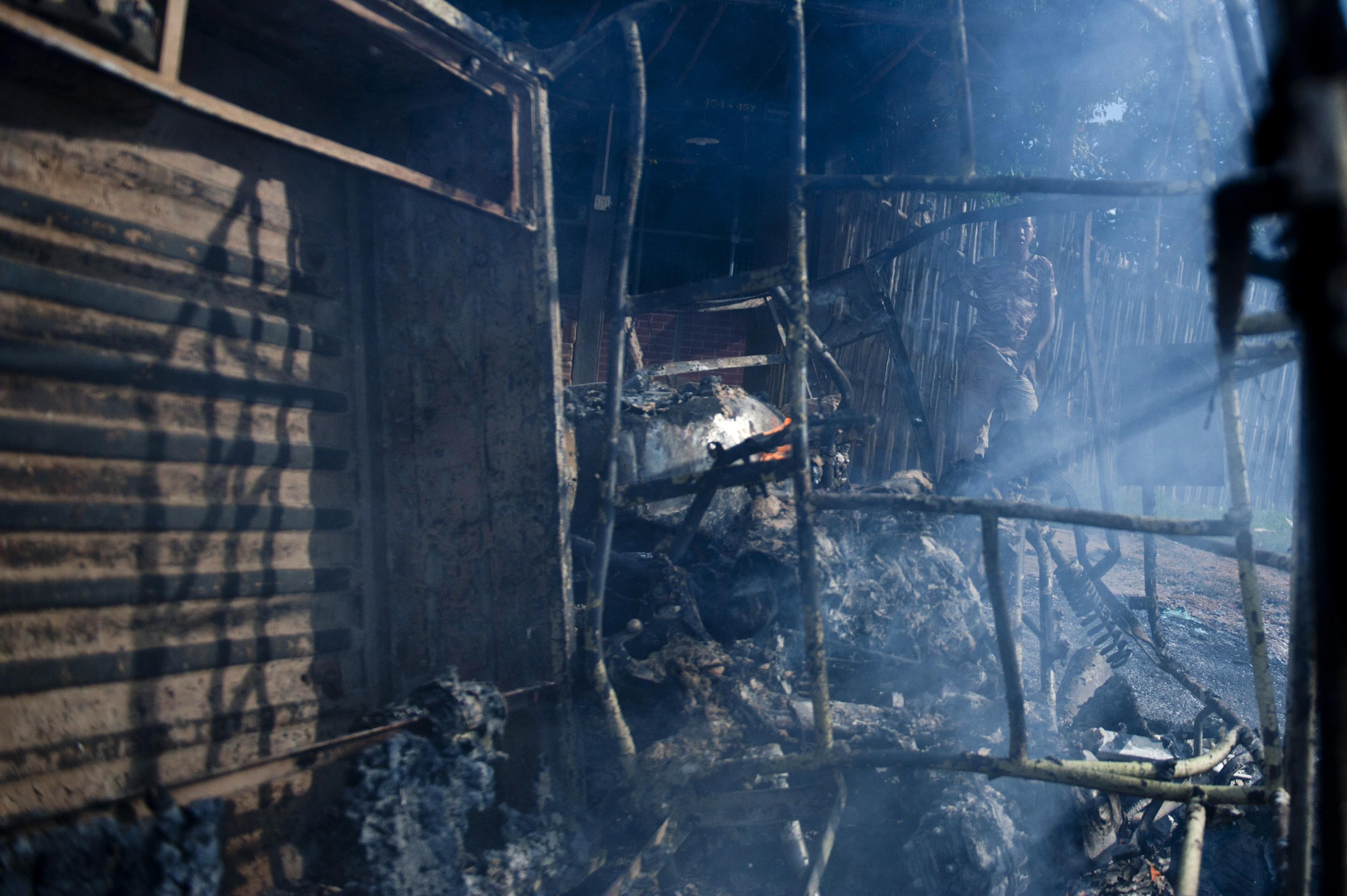
MYANMAR-UNREST-RELIGION

One argument that many people of faith cling to these days is that not all religion is inherently violent or intolerant; non-fundamentalist religion can coexist with modernity, because it can acknowledge the role of doubt and conscience in any religious calling. And yet, religion only fitfully takes this form, and seems inherently prone to controlling the beliefs of others. One argument I’ve used in the past is that if Christianity was successfully turned into a war- and torture-machine in early modern Europe, then it is no wonder that a non-pacifist fundamentalist faith like Islam could also veer wildly off course. But I long suspected that Buddhism was arguably the faith most immune to these temptations, more powerfully drawing people away from conflict and toward meditation and peaceful coexistence. Time for a reality check from Burma:

Days after Buddhist mobs tore through the central city of Meiktila in March, two trucks filled with men showed up in Mr. Nyi Nyi’s neighborhood and hurled stones at the night watchmen with slingshots. Some Muslims with means have fled to Malaysia or Singapore. Muslim-owned businesses are losing Buddhist customers. A growing Buddhist movement known as 969 that has the blessing of some of the country’s leaders is campaigning for a boycott of Muslim products and businesses and a ban on interfaith marriages.

The movement says it is not involved in violence, but critics say that, at the least, hate-filled sermons are helping to inspire the killings. “This is the first time we experience this in our lifetime,” said U Maung Maung Myint, who runs an import-export company and is one of the trustees of the Bengali mosque, which is only a few hundred paces from a Buddhist pagoda, a Christian church and a Hindu temple. He was referring specifically to the mistrust between communities.

And this is a consequence of more democracy. As in Egypt and Iraq, sudden freedom may take intolerant and sectarian religious forms. But when Buddhism becomes a vehicle for mob violence against minorities and sectarian cleansing, it truly is depressing.

(Photo: A youth watches as a structure burns in Lashio, Shan state of Burma on May 29, 2013. Burma’s government called for calm Wednesday after mobs burned down a Muslim orphanage, a mosque and shops during a new eruption of religious violence in the east of the country. By Ye Aung Thu/AFP/Getty Images.)

Yes, We Spy On Our Allies

Protest ubiquit23

And Europeans are none too happy about it:

In Germany, a government investigation into what Chancellor Angela Merkel’s government knew about Prism will likely come into being this week. In Brussels, kickoff talks on the EU-U.S. trade deal could be hampered or stall out completely over fears that the U.S. government is using its spying system to steal European trade secrets. And on both sides of the Atlantic, Transatlanticists are struggling to figure out what still binds both sides.

Stephen Walt says the spying should come as no surprise to political realists:

What we are is a set of national states whose interests align in many areas, but not everywhere. And that’s also why various proposals for a global “League of Democracies” were always a bit silly: Sharing a democratic system is too weak a reed on which to rest a global alliance. Even democratic states experience conflicts of interest with each other, and as the NSA has now shown, they continue to see each other as competitors and spy on each other in order to seize various advantages. So nobody should be surprised that the United States was using its superior technical capacity to try to gain an edge on its European partners, and you can be sure that America’s European allies have been spying on the United States too, if not as extensively or as expensively.

(Photo by Mike Herbst)

Egypt On The Brink, Ctd

Josh Marshall updates us on the situation:

This morning the military will or already has convened a meeting of all political factions to discuss its ‘road map’ for post-Morsi Egypt. With the military, the Interior Ministry lined up against it, significant non-MB Islamist factions standing apart and millions remaining in the street, Morsi and the Brotherhood appear already to have lost control of the state. The ‘coup’ seems almost to have happened in advance of itself. But the prospect of deadly street battles seems very real regardless.

Juan Cole was surprised by “the brevity and completely uncompromising character of the speech” Morsi gave last night:

Morsi did not offer to revise the hated constitution. He did not offer to form a government of national unity, with cabinet members from the opposition parties. This, even though his cabinet is collapsing, with six resignations, and even his own spokesmen have resigned. He did call for a reconciliation commission, and promised parliamentary elections in a few months. But these are not new ideas and are unlikely to resolve the conflict.

Marc Champion wishes that Morsi had taken a different approach:

What Mursi should have said in his rambling speech last night was that the military’s ultimatum was unnecessary, and that when he had earlier offered to engage with the protesters, he had in mind creating just the kind of road map and transitional coalition government that the armed forces appeared themselves to be proposing. What would he have had to lose? By then, at least five members of his cabinet had resigned, abandoning what they saw as a sinking ship.

Instead, Mursi decided to call the military’s bluff, always a bad move when the other side has tanks and you don’t.

A Tale Of Two Families

George Packer praises “Two American Families” (trailer above) and calls the documentary a rebuke to conservatives who blame our economic malaise on a culture of complacency:

If you screened “Two American Families” for Charles Murray and other social critics who believe that the decline of America’s working class comes from a collapse of moral values, social capital, personal responsibility, and traditional authority, they would probably be able to find the evidence they’d need to insulate themselves against the sorrow at the heart of the film.

None of the four parents finished college. The Neumanns’ divorce leaves Terry and the children in worse straits than ever. The Stanleys don’t move to rural Mississippi, where life is cheaper. The kids make plenty of their own mistakes. None of them thinks of inventing Napster. The Stanleys and Neumanns are punished to the fullest extent of the economic law for every mistake made, and for all the mistakes they didn’t make.

But the intellectually honest response to this film is much less comforting, for the overwhelming impression in “Two American Families” is not of mistakes but of fierce persistence: how hard the Stanleys and Neumanns work, how much they believe in playing by the rules, how remarkable the cohesion of the Stanley family is, how tough Terry Neumann has to become. Both families devoutly attend church. Government assistance is alien and hateful to them. Keith Stanley says, “I don’t know what drugs or even alcohol looks like.” In the words of Tammy Thomas, whose similar story is told in my new book, “The Unwinding: An Inner History of the New America,” these people do what they’re supposed to do. They have to navigate this heartless economy by themselves. And they keep sinking and sinking.