Morsi also quoted a conversation he had Monday with President Obama, saying the president assured him that he was committed to the elected, legitimate government (i.e. Morsi). But Obama appears instead to have said that he is committed to the democratic process in Egypt but not siding with any particular party or group. That is, Morsi misrepresented Obama’s call as support for himself. In defying the military ultimatum, the Muslim Brotherhood appears convinced that the US would not permit the officers to make a coup, and that the officers would not dare do so without a US green light. US Chairman of the Joint Chiefs of Staff Gen. Martin Dempsey called Brig. Gen. al-Sisi on Monday, but we do not know the substance of the call.
Morsi’s misrepresentation of Obama will inflame anti-American opinion further in Egypt, where the opposition generally believes that the US is imposing the Muslim Brotherhood on Egypt for its own nefarious reasons.
Laura Rozen provides the White House’s version of Obama’s call with Morsi. I find the prospect of a democratically elected government in Egypt being prematurely overthrown by a popular military coup as deeply ominous for Egypt’s democratic future. There is no opposition movement capable of replacing Morsi, or producing any better results for Egyptians. But even if there were, they should organize for the next election, not side with the forces of SCAF. Reza Aslan puts it best:
Egypt may soon return to its pre-Arab Spring status quo: an oppressive police state that knows how to keep the streets calm. The only difference, of course, is that it will presumably be General Abdul Fatah Khalil Al-Sisi maintaining order, rather than Hosni Mubarak, the country’s erstwhile strongman.
So a few years from now, when President-for-Life Al-Sisi is sworn into office, and the Muslim Brotherhood, radicalized by the belief that they were unlawfully thrown out of power, decide to reject politics and return to violence, we may see history repeating itself with equally devastating consequences.
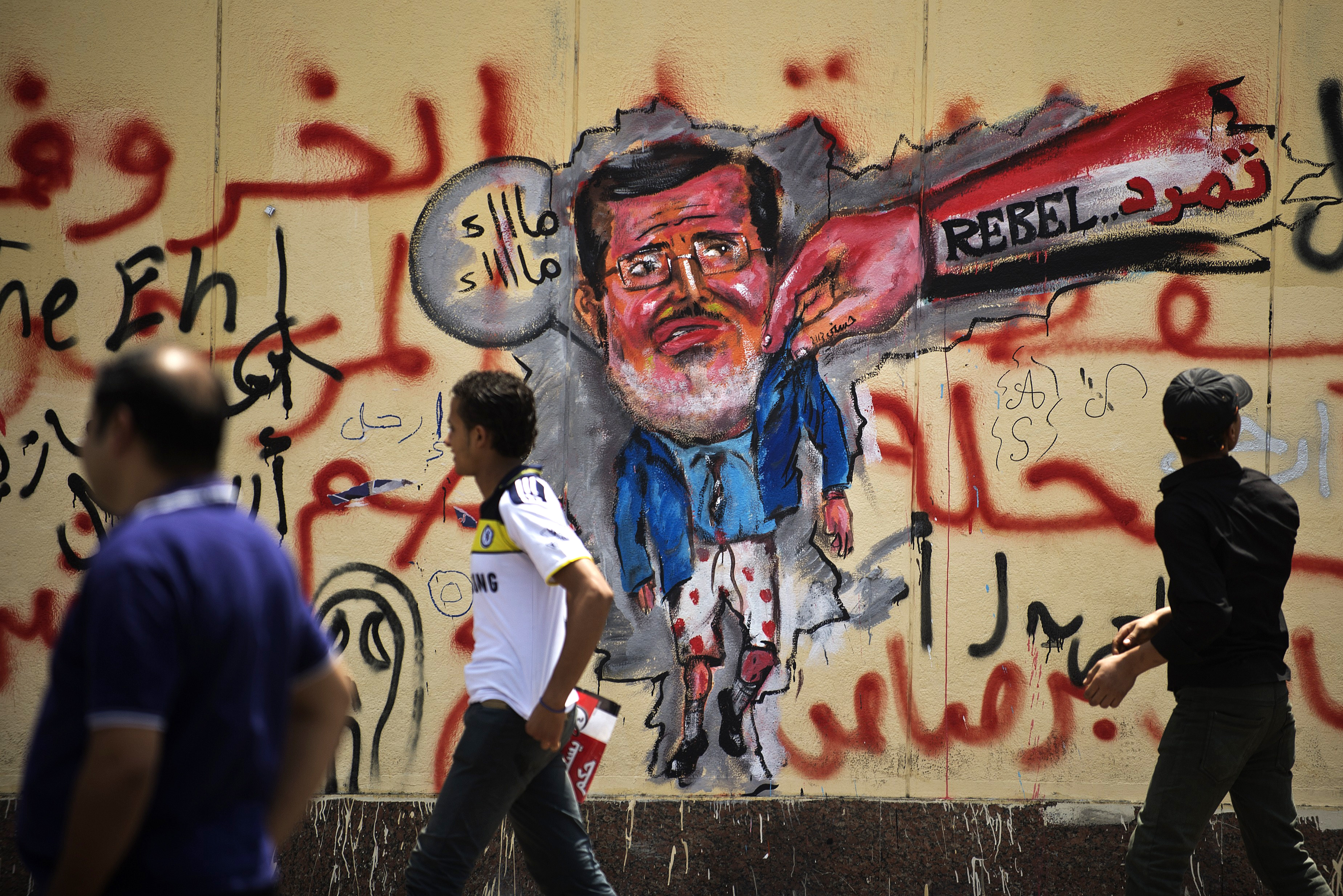
(Photo: Egyptian protesters walk past graffiti against President Mohamed Morsi on the wall of the presidential palace in Cairo on July 1, 2013. By Gianluigi Guercia/AFP/Getty Images)
They’re so trigger-happy they shoot the dog of a man filming cops to check on their behavior. The man has had run-ins with the cops before, and was arrested for playing his car music too loud, thereby obstructing justice. After he put his dog in the car, he gave himself up peacefully, only to have the dog jump out of the window to come to his side. One cop then shot multiple times at the man’s dog, not to wound but to kill. If you’re a dog lover, this video of the event is way too much to watch. But if you care about abuse of police power, the story is important.
I want to reiterate something that I wrote two-and-a-half years ago about the ouster of Egyptian President Hosni Mubarak. I wrote at the time that it was a mistake to describe Mubarak’s ouster a “revolution.” My argument, drawn from Max Weber and Lenin, is that the possession of state power requires a monopoly over the use of force. In Egypt, in the wake of the 1952 coup that brought Gamel Abdel Nasser and a group of officers to power, the military gradually fashioned a state apparatus in which they would not formally govern, but would function as a ruling class—enjoying not merely control over the country’s armed forces, but also over a large part of its economy.
In State and Revolution, Lenin wrote that a revolution would have to “smash the state.” That was a vivid way of saying that it would have to alter fundamentally the terms of state power. That did not happen in Egypt, where the military itself eased Mubarak out of power.
Jeff Martini thinks the military taking direct control would require buy-in from Islamists:
Together, the Muslim Brotherhood and the Salafists won nearly three quarters of parliamentary seats in the 2011-2012 election. Although the lower house of parliament has since been dissolved over a technicality in the electoral law, those results and Morsi’s own 2012 victory cannot be dismissed out of hand.
An intervention absent Islamist support would risk an Algeria-like scenario, in which the military’s overturning of an Islamist electoral victory led to a civil war that embroiled the country throughout the 1990s. To mitigate against the possibility of a violent response, the military could try to coax the Muslim Brotherhood to the bargaining table with the opposition. Failing that, it could try reach out to Islamists from outside the Muslim Brotherhood, such as the Salafists, or breakaway groups, such as the Strong Egypt and Center parties.
Shortly after the ultimatum was delivered, pictures of the “blue bra girl” resurfaced on Facebook with the caption: “Remember this?”
“The SCAF conducted virginity tests, they dragged, beat up and killed people, this (meaning the intervention) should not be cause for celebration,” according to my brother. His objection to toppling an elected president aside, he believes, along with the presumed majority of people, that no one other than the SCAF can run the country, given the continued lack of alternative leadership. “(The SCAF) is a necessary evil,” he concluded, after cursing out the people for being deserving better, the president and the SCAF for not being better.
The “what next” question remains unanswered and each time I ask anyone tonight, I get a different answer. And no answer at all to the question of “who?”
You’re not letting this one go, are you? A reader writes:
In 2008 Barack Obama ran as a candidate opposed to gay marriage. I don’t think there’s any doubt that he chose to do this in the teeth of his personal beliefs and the knowledge that it would be hurtful to the gay community. He chose to do so because he believed to do otherwise would lose him votes and possibly the election. The president has changed his official stance on the issue, and his policies and rhetoric today certainly reflect that change. But I don’t think he’s issued any sort of public apology for his 2008 stance.
Now, Clinton’s past sins in this area dwarf Obama’s, but Clinton was also operating in a political climate much more hostile to gay rights. Are you convinced that, under similar circumstances, Obama would not have behaved the same? I’m not.
Well, that’s an impossible hypothetical, but if forced to give an answer, I’d say I am. Yes, they’re both pragmatists; but there is a limit and a method to Obama’s pragmatism, and a patience in achieving his ends. There is, in contrast, no limit I have been able to find to the Clintons’ pragmatism or careerism. They were also amateurs, who didn’t think through how to achieve their ends, announced aims without beginning to prep for how to get there, and ended up being completely outflanked by the rabid right. Another reader:
From AFP: “Ending the US travel ban had been an uphill struggle for rights groups, who saw former president Bill Clinton’s attempts to repeal the restrictions shot down by conservatives.” So you saying that Clinton “signed the HIV travel ban” by supporting (along with Barney Frank) a generous NIH funding bill with historically high HIV/AIDS funding, which (despite Clinton’s/Frank’s lobbying) re-authorized the ban, would be like saying “Obama signed the green-card ban on gay immigrants” by signing a non-inclusive immigration reform bill (which he’s indicated he’d do if there were no other way to pass immigration reform).
There’s a huge difference between not including gay couples in immigration reform because a Supreme Court ruling would soon likely make it it moot; and signing into law a brutal piece of stigmatization and persecution for countless people with HIV. Jesse Helms said he regretted it. Clinton has never owned up to his role in signing it. Above, in an interview two years ago, he is still blaming others. You will not find a single instance of him blaming himself for bungling these issues in 1993 and then running from them ever since. Again: a simple sorry would suffice. It remains beyond him. Another reader:
Sorry Andrew, but your criticism of Bill Clinton’s record on gay rights jumped the shark when you listed “don’t ask, don’t tell” as one of the ways in which he “did so much damage to gay lives.”
While DADT was seriously flawed insofar as it required that gays in military remain closeted, it prohibited – for the first time – discrimination and harassment against closeted homosexual and bisexual service members and applicants. This distinction seems ludicrous now, but it was a huge step forward at the time. Clinton, moreover, actually wanted to sign an executive order that would have allowed gays to serve openly, but he was forced to fall back on DADT as a compromise position after being met with staunch opposition from prominent congressional Republicans and Democrats who threatened to write the exclusion of gays into law.
In fact, other than DOMA, Clinton’s record on gay rights is extremely impressive for the 1990s. He was the first president to appoint openly gay men and women, he issued executive orders lifting the ban on security clearances for LGBT federal employees and outlawing discrimination based on sexual orientation in the federal civilian workforce, and he also pushed for both hate crimes laws and for the private sector Employment Non-Discrimination Act. All this at a time when supporting gay rights was pretty unpopular.
None of this, of course, excuses Clinton from later selling out gays for his own political gain, but you overplayed your hand.
He sold us out at the very beginning. He had no plan to implement the end of the gay ban; it was just another promise to fundraisers he never thought through. Then he dropped it almost immediately and left all those who had come out in the lurch. Then under Clinton as commander-in-chief, the rate of discharges on grounds of homosexuality doubled compared with this predecessor. He did nothing to stop this, even as George Stephanopoulos reassured me and others that gay servicemembers were going to be safer under the new law. They were, in fact, sitting ducks – and Clinton learned one lesson: take the money from the gays but fire more of them than any private employer. Note above that he even blames Colin Powell before taking responsibility himself. But Clinton never took responsibility for anything but his successes. Another reader:
The issue about Clinton and DOMA taps into a bigger question I have about how to view the millions of conversions on this issue over the last two decades, and the millions more who have not yet changed their minds. Are they all recovering bigots?
I did not support same-sex marriage when DOMA passed. Few Americans did; in 1988, only 11 percent supported gay marriage or had much idea what it would actually mean. I opposed DOMA, but mainly because it singled out gays and lesbians – not because I had a substantial disagreement with the policy of allowing only heterosexual marriage. Though I believe now that it was an awful law, DOMA seemed a logical step for those who sincerely opposed same-sex marriage.
There was an interesting moment on this week’s “Meet the Press” (a rarity, I know), when Ralph Reed and Jim DeMint accused Rachel Maddow of labeling Bill Clinton and all those who once supported DOMA as bigots. Maddow pointed out that Reed and DeMint were the only ones using the word “bigot”, but they had a point. As our society’s views continue their tectonic shift on this issue, how do you accommodate people whose deeply held beliefs are changing?
Was I a bigot in 1996? Or did I not yet recognize the discriminatory effects of my beliefs? I don’t really have an answer to that yet – and I would suggest that the answer is just as fuzzy for Clinton and other politicians who supported gay rights in principle but also supported DOMA.
I try to avoid the word “bigot” as much as possible for those reasons. I don’t think Clinton was a bigot just because he made a big show of returning to Arkansas in election year to personally preside over the execution of a mentally retarded African-American man, Ricky Ray Rector. I just think he was a disgusting opportunist, and if it ever was a choice between his career and minorities, his career always came first. It still does, and I wouldn’t be bothering with his Baldwin-like inability to own his own anti-gay record, if he weren’t obviously trying to win the White House back again, by-passing the 22nd Amendment via his wife.
Paul Waldman considers a recent study in which nursing home residents that got a Paro robot, “a baby harp seal stuffed animal that has some sensors and actuators and responds to your touch,” reported improvements in their quality-of-life:
As important as actual human contact is for us, it turns out we don’t have trouble forging real, even profound relationships with beings that have far from our own level of cognitive and emotional sophistication.
Everybody talks to their pets as though those pets understand much more of our words than they do. If you’re feeling bad, you can get a lot of succor from your dog, regardless of whether the dog actually understands what you’re feeling. It’s enough that he puts his head in your lap and lets you pet him. It’s true that something like a Paro is capable of a far narrower range of interaction than your dog, but that’s only because the technology at the moment is rather primitive, compared with what it will be in a decade or two. Also, you don’t have to take it outside and pick up its crap with a plastic bag. …
With the overworked staff at the nursing home incapable of devoting large amounts of time every day to each resident, robots could provide dramatic improvements in well-being, particularly as they get more sophisticated and can not only coo at you when you pet them, but also do things like make you a margarita, clean up around the apartment, and give you a sponge bath. If you can just hold off on getting checked in to the home for a couple of decades, maybe it won’t be so bad.
More Dish on the growing relations between humans and robots here.
Tate Watkins looks at why Haiti, which grew half of the world’s coffee during colonial times, has struggled in recent years:
Washed beans that sell for high prices abroad account for less than 2 percent of coffee grown in Haiti. Unwashed beans make up 90 percent of Haitian production, most of which is consumed by the domestic market or slips across the border to the neighboring Dominican Republic on donkeys, duty-free.
Poor farmers have sporadic cash flows, and most prefer to sell as quickly as possible, with little regard to price or who happens to be buying. The farmers’ cooperatives that sell washed beans for export lack financing and pay only a portion of the price up front; members have to wait until the end of the season to receive the remainder, or ristourne. Local and Dominican traders can often pay immediately upon purchase and are happy to buy low-grade coffee or even raw cherries. The majority of Haitian farmers wind up selling low-value coffee at correspondingly low prices.
How Haiti compares to Rwanda, whose coffee exports have boomed over the past few decades:
Haiti and Rwanda produce about the same volume of beans each year. But Rwanda has exported nearly 20 percent of its coffee in recent years as washed beans for gourmet markets, up from just 1 percent in 2002. Haiti sells 90 percent of it’s production as cheap, dry-processed beans that never leave the island of Hispaniola. The upshot is that in 2010, Rwanda made $55 million from coffee exports. Haiti made $1.5 million.
Update from a reader:
I’m glad to see the topic of Haitian coffee come up. it does seem like a real possibility to start pulling Haiti back up. I would like to give a quick plug for the Singing Rooster non-profit that has been providing loans and training to co-ops in Haiti. The coffee’s fantastic and the put the money back into Haiti.
What makes great literature “great” is that cannot be reduced to a formula or a simple answer; it cannot be used up. This is a lesson that students need to learn in our sound-byte culture. When they talk freely about great literature, their ideas take new and exciting form, and they begin to discover who they are.
The buzzword in education circles is that literary analysis teaches critical thinking. But this always struck me as a limited and rather condescending way of thinking about literary talk. Yes, literary analysis teaches critical thinking, but it also allows students to grapple with important topics that they might not normally discuss, and to apply the complex themes and structures that literature raises to their own lives.
I have been told that my classroom sometimes resembles a group therapy session. I take this as a compliment. When students talk seriously about a great literary text this leads, inevitably, to their talking about themselves. Sometimes they can get very deep into the latter, though they always have the former near at hand to ground them.
Recent Dish on studying the humanities here and here.
When hypothetically on the cusp of death, physicians overwhelmingly decide against life-prolonging intervention, with the exception of pain medication. Lisa Wade talked to USC professor and doctor Ken Murray to figure out why:
First, few non-physicians actually understand how terrible undergoing these interventions can be. [Murray] discusses ventilation. When a patient is put on a breathing machine, he explains, their own breathing rhythm will clash with the forced rhythm of the machine, creating the feeling that they can’t breath. So they will uncontrollably fight the machine. The only way to keep someone on a ventilator is to paralyze them. Literally. They are fully conscious, but cannot move or communicate. This is the kind of torture, Murray suggests, that we wouldn’t impose on a terrorist. But that’s what it means to be put on a ventilator.
A second reason why physicians and non-physicians may offer such different answers has to do with the perceived effectiveness of these interventions.
Murray cites a study of medical dramas from the 1990s (E.R., Chicago Hope, etc.) that showed that 75% of the time, when CPR was initiated, it worked. It’d be reasonable for the TV watching public to think that CPR brought people back from death to healthy lives a majority of the time.
In fact, CPR doesn’t work 75% of the time. It works 8% of the time. That’s the percentage of people who are subjected to CPR and are revived and live at least one month. And those 8% don’t necessarily go back to healthy lives: 3% have good outcomes, 3% return but are in a near-vegetative state, and the other 2% are somewhere in between. With those kinds of odds, you can see why physicians, who don’t have to rely on medical dramas for their information, might say “no.”
Previous Dish on the subject and Ken Murray’s work on it here, here, here, and here. Update from a reader:
This chart has been popping up all over the internet without a key piece of context. As can be seen in Figure 2 here, or at this Radiolab article, the original caption for it reads as follows:
Preferences of physician-participants for treatment given a scenario of irreversible brain injury without terminal illness (see text for details). Percentage of physicians shown on the vertical axis. For cardiopulmonary resuscitation (CPR), surgery, and invasive diagnostic testing, no choice for a trial of treatment was given. Data from the Johns Hopkins Precursors Study, 1998.
Emphasis mine. Irreversible brain injury changes the calculus somewhat. It’s probably not true, as the chart without context suggests, that over 60% of doctors would refuse to take antibiotics to save their lives if they had a chance of regaining normal functioning.


 The Dish