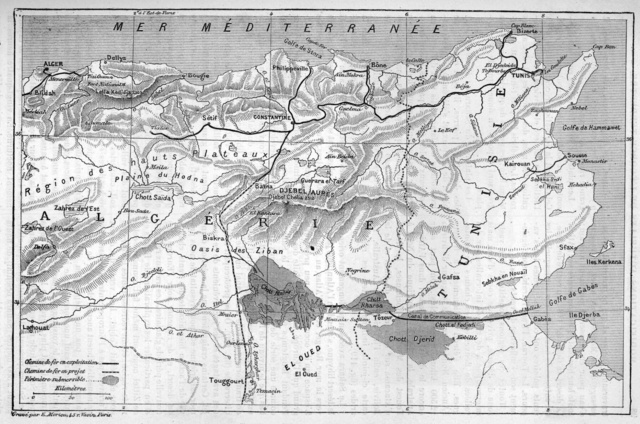
Frank Jacobs shares the story of François Élie Roudaire, a French Army captain who led the failed colonial campaign to create an inland sea in the Algerian desert. Roudaire proposed the project in 1874, after he came across upon a dry salt-lake bed, Chott el-Mehrir, that seemed strangely familiar:
Knowing his classics, Roudaire couldn’t help thinking that this submarine salt plain might once have been part of the fabled Bay of Triton. Described by Herodotus but unknown to modernity, the lake’s debatable existence and location constituted an Atlantis-type mystery popular among geographers. Could Chott el-Mehrir be contiguous with other chotts [dry lake beds] towards the Tunisian coast, forming the ghostly imprint of a former sea inlet? And could this semi-mythical body of water be resurrected?
With the blessing of Suez Canal engineer Ferdinand de Lesseps, Roudaire developed a plan to construct a 78-foot-deep, 3,100-square-mile inland sea. The project would cost a fraction of France’s Suez Canal venture, he assured investors:
The price tag [was] a mere 25 million francs. A small investment with a large return: the proof of France’s enlightened policies, progressive intentions and beneficial results in North Africa. “The Sahara is the cancer eating away at Africa,” Roudaire wrote. “We can’t cure it; therefore, we must drown it.”
But nothing came of the plan except dreams:
The London Times said that the plan “dazzles the imagination, yet it has a sufficiently substantial basis to satisfy several shrewd traders in African commerce and some distinguished engineers.” … This new sea “is sure to be frequented by trading vessels,” reported the British magazine All the Year Round, “to carry off the produce of its banks, which will eventually be dotted with groves of date and coconut palms. … Hotels, perhaps towns, will spring up on picturesque and eligible sites; luxurious house-boats will float in its most sheltered and shady creeks.”
(Image: Map of the planned sea. Note that Lake Geneva is offered for scale in lower right-hand corner.)
 The Dish