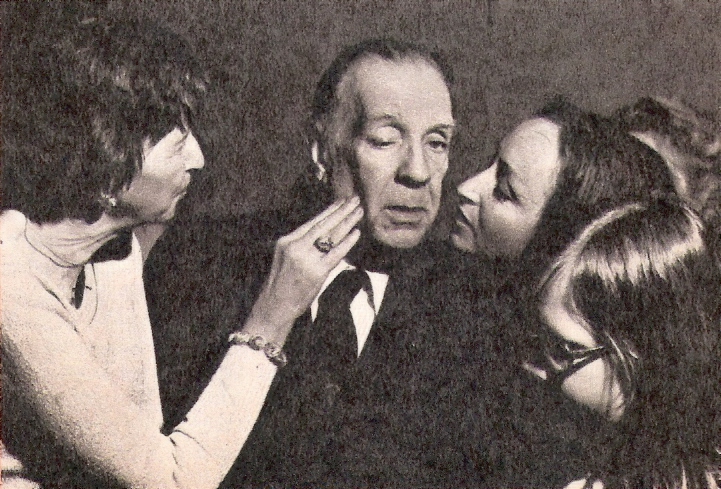
Eric Benson takes a look at Professor Borges, a new book compiling the transcripts of a survey course taught in 1966 by Jorge Luis Borges, the famed Argentine writer:
The twenty-five lectures that make up the book are ostensibly introductory, but they’re only masquerading as English 101. Instead, this is Borges’s highly idiosyncratic tour of his favorite authors and most revered myths, a view of history and literature as filtered through his capacious, whimsical mind.
The book begins with the Anglo-Saxon migration to Britain in the Fifth Century AD and ends with Robert Louis Stevenson’s death on the Samoan Island of SavaiʻI in 1894. Vikings, mythical Old English heroes, and Icelandic historians dominate the first third of the course. James MacPherson, a literary forger who composed an anachronistic epic called Ossian and tried to pass it off as ancient Scottish verse, is credited as a key founder of the Romantic movement. The writings of nineteenth century poet William Morris are the topic of the three classes. The works of John Milton and William Shakespeare are the topic of none.
Instead of hallowing the English tradition’s most acclaimed texts, Borges offers the proudly non-academic thoughts of an erudite enthusiast. He narrates the events of largely forgotten battles. He goes on tangents to discuss arcane linguistics. And he tosses off historical theories based on the scantest shreds of evidence (Beowulf’s setting in Denmark and Sweden is definitive proof that “after 300 years of living in new lands, the Anglo-Saxons still felt homesick”). It’s hard to imagine these lectures will end up as required reading for any serious English-literature course. It’s also hard to imagine any serious reader failing to discover pleasure in the joyful digressions and virtuoso distillations of this strange, wonderful book.
Mark O’Connell marvels at the man’s immense learning – and peculiar prejudices:
The “Borges” who is revealed, or perhaps performed…seems like the Platonic ideal of the man of letters: a man who taught himself German because he wanted to read Schopenhauer in the original, and learned it, moreover, by reading the poetry of Heine; a man who taught himself Icelandic in order to pursue his interest in Norse sagas. His loss of sight seems strangely appropriate; in the interviews, he speaks of the “luminous mist” of his blindness as though it were a kind of blessing, a removal of all distraction from what was most important, most real—the life of the mind. (And there was never any shortage of people willing to read to the great writer in his old age.)
But there were things that Borges didn’t see whose invisibility had nothing to do with his physical blindness—things he didn’t see because he wasn’t interested in looking at them. The lecture course in “Professor Borges” doesn’t feature anything written by a woman. It’s a history of English literature that includes no Austen, no Shelley, no Charlotte or Emily Brontë, no Eliot, and no Woolf. He was a great admirer of Emily Dickinson’s poetry, but even that admiration is not without its strain of condescension: in an interview with the collection’s editor, Willis Barnstone, he describes her as “the most passionate of all women who have attempted writing.”
Hardcore fans can check out this Borges lecture on Johnson and Boswell, excerpted from Professor Borges in the New York Review of Books.
(Photo of Borges with “groupies” in 1976, via Wikimedia Commons)
 The Dish
