After her five-year-old daughter started reading Roald Dahl, Rebecca Makkai recalls the influence the author had on her own childhood:
The Twits concerns a husband and wife whose sole mission is to play horrible tricks on each
other. I remember, when I first listened to the story, gleefully raising my hand to announce that “This house is just like my house!” I didn’t mean that anyone in my home was gluing furniture to the ceiling—but I saw a dysfunction reflected in this book that I just hadn’t found in Encyclopedia Brown or The Mouse and the Motorcycle.
Of course it’s children’s writers who are most able to ignore the dark side (I’m thinking here of the sweet, simple books for very young children)—and maybe there’s a good reason some of my favorites children’s writers (notably Lemony Snicket and Dr. Seuss, in addition to Dahl) are ones who started off writing gritty things for adults and then moved younger. But we’re sometimes tempted to ignore the dark stuff when we write for adults, too. Our characters are flawed, but only a little bit, ha ha, just kidding, he’s really a good person! She’s going to have an affair, but nooooooo, she’s not, she changed her mind! I’m not arguing that every story has to be The Shining. But if kids can handle Miss Trunchbull’s torture closet, adults can handle the darker spots of the human soul.
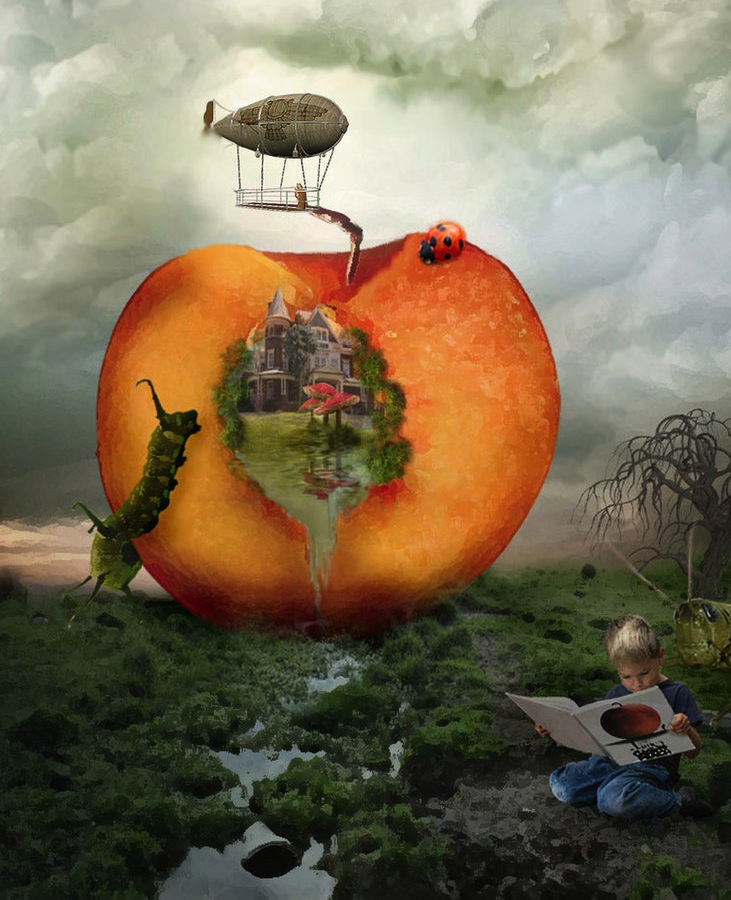
(Image by graphic artist futuregrrl, inspired by Dahl’s James and the Giant Peach)
 The Dish