Bee Wilson considers the literary merits of the recipe:
Recipes have a story arc. You need to get through the tricky early prepping stages via the complications of heat and measuring before you arrive at the point of happy closure
where the dish goes in the oven or is sliced or served. When a recipe has many ingredients and stages and finicky instructions, it can be hard to concentrate, like reading a Victorian novel with so many characters that you need a dramatis personae to keep things straight. Sitwell includes a lamb korma recipe from Madhur Jaffrey, with an ingredient list that goes on for more than a page (“a piece of ginger, about 1.5 inches long and 1 inch wide, peeled and coarsely chopped, 1 large tomato (tinned or fresh) or 2 small ones, peeled and coarsely chopped, 1 tsp ground turmeric,” and so on). I’ve cooked this dish. It is, like all of Jaffrey’s recipes (or rather, all of the ones that I’ve tried, which is about twenty), very delicious, with a wonderful balance of flavors and textures. But if we forget cooking and “simply” read, you might get a quicker payoff from the recipe for peach melba by Auguste Escoffier, the nineteenth-century chef who popularized French cooking
Poach the skinned peaches in vanilla-flavoured syrup. When very cold arrange them in a timbale on a bed of vanilla ice cream and coat with raspberry puree.
There are many mysteries here: What is a timbale? And how do you make a vanilla-flavoured syrup? If Escoffer tried to clear them up, the recipe would be easier to use but less intriguing. And part of the pleasure of recipe-reading is the feeling that you are about to discover a great secret.
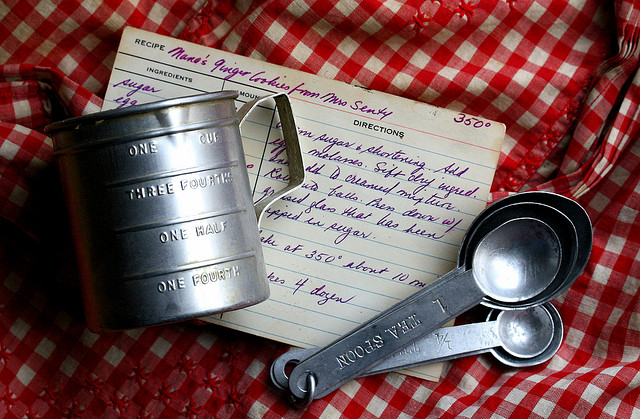
(Photo by Flickr user Muffet)
 The Dish