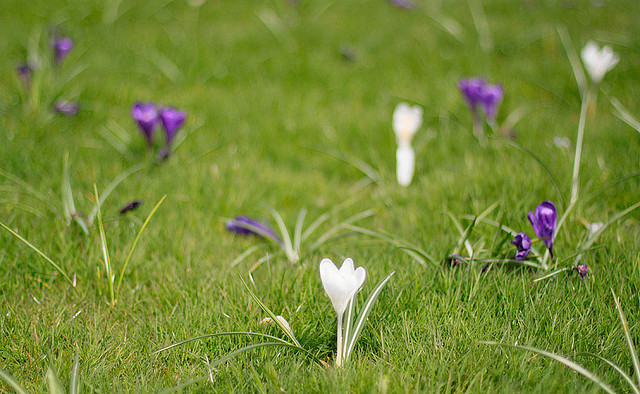
Ferris Jabr suggests that the typical American grass lawn is out of harmony with nature:
A conventional lawn is … a complete perversion of grass’s typical life cycle. Lawn grasses fall into two general categories: cool-season species, such as fescue and bluegrass, and warm-season species, such as Bermuda and zoysia. During the summer, wild cool-season grasses stop photosynthesizing, turn brown and grow far more slowly if at all in order to conserve energy; in the fall, they rebound. Conversely, wild warm-season grasses become dormant in cooler months and flourish in the summer. To keep our grass lawns green year-round, we continuously douse them with water and fertilizer, forcing the plants to grow nonstop.
But we don’t want them to grow too tall, of course. By mowing down grass before it has the chance to produce flowers and seeds, we effectively trap the plants in perpetual sexual immaturity—although many are still able to reproduce asexually, cloning themselves and spreading laterally with creeping roots. Mowing also requires grass to devote a lot of energy and resources to healing itself by sealing off all wounds. The smell of freshly cut grass—so often comforting and nostalgic—is a chemical alarm call: a bouquet of fragrant volatile organic compounds that plants release when under attack.
(Photo by Flickr user waferboard)
 The Dish