Reviewing a history of art forgery, Charles Hope explains that authenticity had a different meaning in the Middle Ages:
What mattered about objects such as these was not so much whether they were originals or copies, whether they were old or modern, as whether they worked miracles. In this respect they were like relics, for which there was also an enormous demand, met in part by the production of fakes. Such forgery required no technical skill, since what was most often required was a fragment of bone, supposedly human. The church was of course alive to the danger of forgery, and had an elaborate procedure for establishing the authenticity of relics, described in fascinating detail by [author Thierry] Lenain in Art Forgery.
Various types of evidence were used. These included any label attached to the supposed relic, the length of its known history, its source, the beliefs of the local clergy and congregation, and, most important of all, the relic’s ability to work miracles. Apart from this last criterion, these types of evidence have something in common with some of the categories of argument used today to establish the authenticity of works of art. In both cases much weight is given to provenance and to such written evidence as old labels and other documents; and in the case of relics the role of the clergy is comparable to that of art historians, with much importance given to the views of the majority and to tradition.
Even the supposedly miraculous power of the relic has a surprising parallel in discussion of the status of works of art. For the potency of the relic was thought to be generally due to some physical connection with a saint, whether because it was part of his or her body, or had touched a part of the body or some other relic. In much the same way, as Lenain explains, it is widely believed today that an authentic work of art contains in itself some trace of its maker, in a way that a copy, however accomplished, never can.
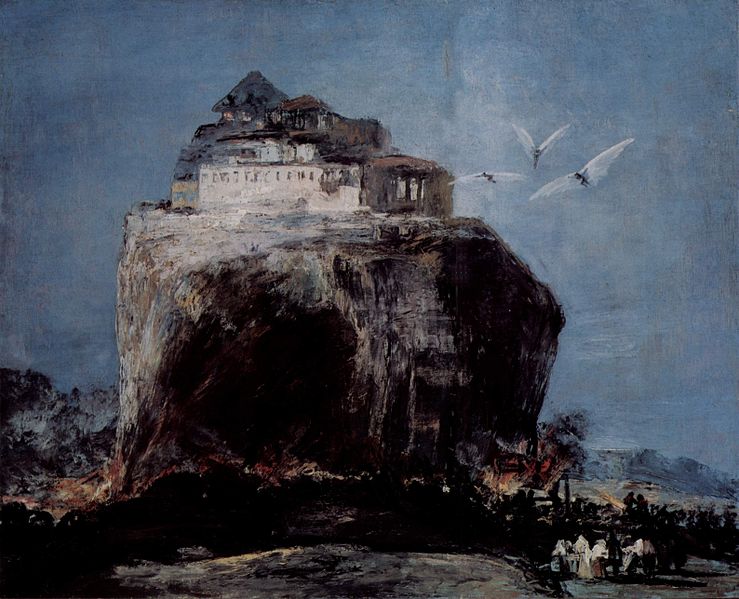
(Image: A City on a Rock, once attributed to Francisco de Goya and now considered the work of his follower Eugenio Lucas, via Wikimedia Commons)
 The Dish
