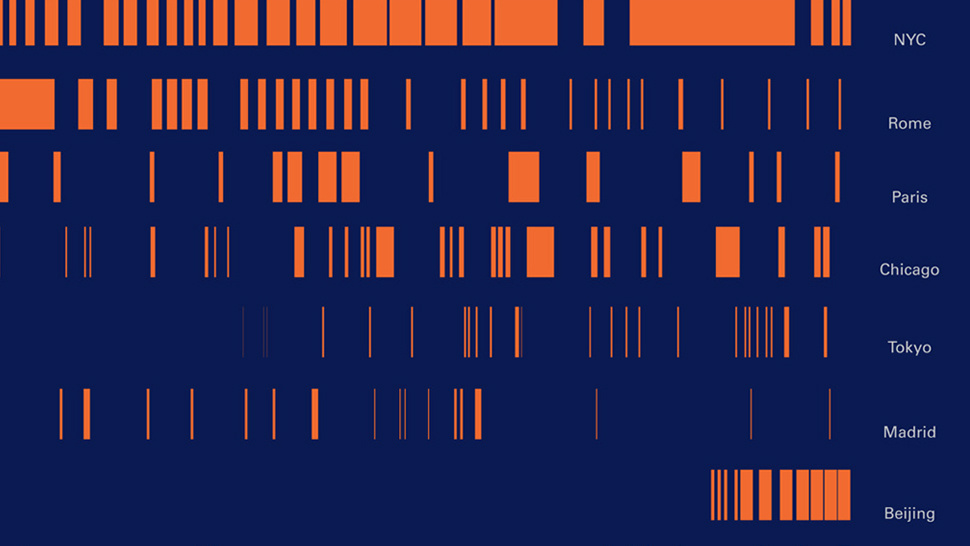
Using data from Google N-Gram, the largest database of digitized books, Edgard Barbosa created the above graphic illustrating the frequency of city names over the last two centuries. Kelsey Campbell-Dollaghan comments:
First, the obvious: That English-language books tend to feature English-language cities, like New York and London. But beyond that, things get more interesting. For example, Rome starts off strong—thanks to its strong hold on the Victorian-era imagination—and peters out in contemporary times. Meanwhile, Beijing and Mumbai are nearly absent (with the exception of a few blips during the peak of Britain’s colonial reign) from the 19th century, but explode over the past two or three decades.
In another Google N-Gram study, a scholar has found that the rise of individualistic words and phrases parallels increasing urbanism over the last 200 years:
Use of the words “individual,” “self,” and “unique” all steadily rose over the course of the two centuries, while “obedience,” “authority,” “belong,” and “pray” all gradually declined. The use of the words “feel” and “emotion” also increased, reflecting “the growing importance of psychological expression,” she writes.
Greenfield does not see this as evidence of our ethical decline, but rather an entirely logical shift that reflected the realities of our new environments. In her view, a mindset that values “choice, obtaining things for oneself, child-centeredness, psychological mindedness, and the unique, individual self” is one that is more likely to thrive in an urban area.
 The Dish