Keith Lowe explores how historians are increasingly reevaluating idealistic beliefs about World War II. Aaron William Moore, for instance, examines the wartime diaries of Japanese, Chinese, and American soldiers in his book Writing War:
Perhaps most disturbing of all is the way that Moore analyses the actual process of diary writing by these men. In all three countries, he reveals, the thoughts and feelings of soldiers were closely monitored by their superior officers. As a consequence the sentiments they expressed were self-policed: soldiers effectively used their diaries as a way of convincing themselves to act in the way that was required of them by the state.
The implications of this are huge, and draw a question mark over one of our strongest taboos about the war. When Chinese, Japanese or American soldiers spurred themselves on to commit acts of bravery, or atrocity, how much were they expressing their own desires and how much were they resigning themselves to things that were expected of them? Does this – can this ever – at least partially absolve them of the things they did during wartime?
The fact that we can ask such questions says as much about our own time as it does about the second world war. Perhaps we are more comfortable expressing doubt now than we were a generation ago, or even 10 years ago, when we were deeply embroiled in the black-and-white certainties of the cold war or the war on terror. Perhaps the behaviour of our armed forces today – such as the Abu Ghraib scandal – has allowed us also to ask questions about how our soldiers behaved in the past.
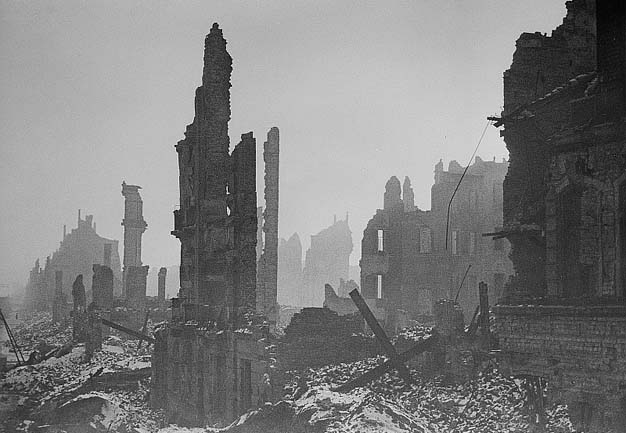
(Photo: The ruins of a firebombed Dresden, circa 1945, via Michael Scott Moore)
 The Dish