by Chris Bodenner
A reader joins the previous ones:
Recently my husband and I have been dealing with the decline and loss of our two beloved cats,
Noot and Echo, who had been our “babies” long before we had human children. Noot entered our lives as a blue-eyed handful of white fluff in 1996. In 2000, Echo joined us as a tiny grey kitten. Noot was very avuncular (even motherly?) toward little Echo, gently playing with him, bathing him, sleeping with him. As the years passed, they remained buddies, and seemed to grow closer to each other, and further from us, after our first baby arrived in 2006. They went from being major lap cats and sleeping with us before we had kids (Echo slept cheek to cheek with me), to cozying up together in more remote areas of the house, such as the bathroom cabinet, to escape the little hands and frequent shrieks of our three children. I always felt a bit guilty that our cats had been a bit displaced by the kids. After all, they were here first. But at least they had each other.
In his last few years, Noot had a number of health problems, including diabetes. But with proper treatment and TLC, he made it to the respectable age of 16. Then, one night last December at 3AM, my husband heard a strange meowing sound and found Noot having a major seizure. He looked so afraid. I brought him to the emergency vet, still seizing, but they were unable to determine the cause of the seizures and he continued to have them throughout the next day. He had likely experienced major brain damage, and after 24 hours of the vet trying every drug he could think of, we decided we did not want him to have another seizure and we were ready to let him go. I went to visit him at the veterinary hospital late at night while my husband stayed home with the sleeping kids, and even though he was unconscious I stroked him and lay my head against him and told him how much we loved him. Then I stayed with him while the doctor gave him the drugs that brought his suffering to an end.
After Noot was gone, we were thrown off by our grief and by the huge hole his death left in our family. Eight months later, we still think of him all the time. Echo was very confused by Noot’s absence and went through a huge change in behavior.
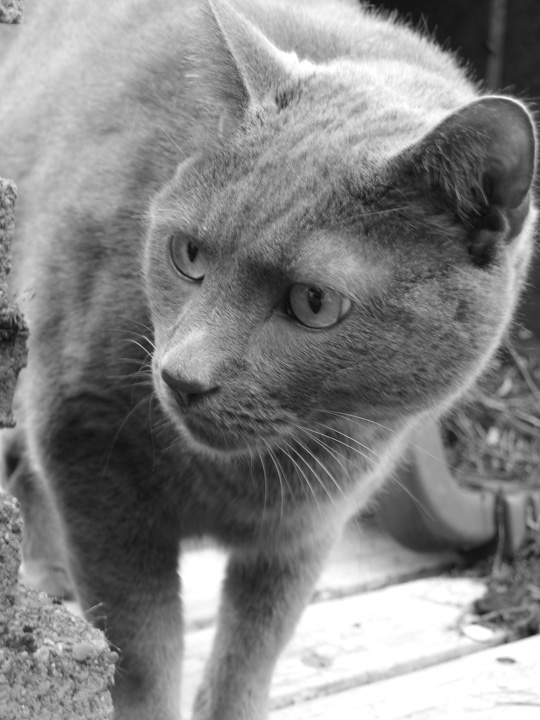
Usually quiet, he meowed loudly all over the house for months, especially at night, presumably looking for Noot. Without his “older brother” cat to keep him company, he suddenly inserted himself into the daily life of our family, came out and sought affection from the kids during the day, and started sleeping in our bed again after six years of hiding out with Noot. I was delighted to have my little gray buddy sleeping in the crook of my arm with his cheek against mine again after so many years. We think of cats as being more solitary animals, but Echo clearly noticed his companion was gone and grieved deeply for him.
Last fall, Echo had been diagnosed at age 12 with chronic renal failure, after the vet had noticed an unexpected weight loss since his last visit. Other than slimming down a bit (which was not entirely unwelcome, as he had been a bit pear-shaped for quite some time), he exhibited no other outward symptoms and retained enough kidney function to carry on with his usual activities. We changed to prescription food and gave him daily meds and were happy to see him still jumping up on the counter to drink out of the faucet and generally looking well.
This spring, we had to add at-home subcutaneous fluid infusions a few times a week, to help flush the toxins out of his body, but he still appeared largely well. He also started eating less, and keeping weight on him became more of a challenge. About a month ago, he stopped eating entirely and started his final decline. He was hospitalized to get IV fluids for a few days, to see if they could give him enough of a boost to start eating again. They released him hoping we could get him to eat at home. In addition to new meds and daily subcutaneous fluid infusions, I tried everything to get him to eat something – regular food, treats, super-rich food, high-calorie nutritional gel, liquid food, and sometimes he would give me some hope by eating a little, but never a significant amount. He continued to get weaker but did not look like he was in pain. We tried to give him as much love as possible. (I’ve attached a photo of Echo in better days.)
While Andrew was working through deciding “when it was time” for Dusty, I was struggling with making the same decision for my Echo. We wanted to keep him with us as long as possible, and yet we knew that his kidneys could not be fixed and so he had a limited amount of time left. I had read that the very end of kidney failure can be excruciatingly painful. We did not want to wait too long and have him reach the point where he was in pain and afraid. But it was so hard to let him go.
This weekend he took another turn for the worse and it appeared that he was no longer drinking. I left the kids with good friends Sunday night for a sleepover, and my husband and I had a difficult discussion about Echo over dinner. We agreed that it was time to help him have a good death. When we got home, we picked up Echo is his cozy bed, put his blankie over him, and he rode on my lap in the passenger seat. No scary cat cage/carrier for this trip.
In the exam room, he lay wrapped in his blanket on his warm bed, in my lap, with my husband and I both softly petting him and talking to him, while the drugs were administered. He died totally relaxed and purring loudly, which is the best possible death we could have given him. We have to remind each other we did the best we could, that we did everything possible to keep him alive, and that helping him die well was what he really needed from us in the end. But it is still so hard, isn’t it?
Another reader:
I know this is piling on because everyone has a story to tell about their pets passing away. I’ve always had my other animals present when one of my dogs was euthanized. It was a comfort to me as well as to the dying pet – until the last one. My beautiful Golden Retriever had a hemangiosarcoma of the spleen (also labeled the “silent killer”) and within two hours was literally bleeding to death. At the time I didn’t know the diagnosis, only that she needed immediate care at the emergency clinic. She was put to sleep there. I was so traumatized and desolate that I couldn’t even think.
I always thought that our younger dog, Chloe, a reactive rescue, was the Alpha in our family. After Abby died, Chloe at first relished the extra attention. But she eventually took up the same habits as many others have described – eating very little, acting depressed, etc. The most amazing thing to me was the fact that Chloe had never learned to tell us she needed to go potty; Abby always did it. She never had to let us know it was time to eat; Abby did it for her. She was lost without Abby’s guidance and all along we had it backwards. Chloe was loud, pushy, and unpredictable, and yet it was Abby who was quietly in control the whole time.
Chloe eventually got another sibling, and her attitude changed after first letting the puppy know who was boss. She is a much happier having another dog in her pack. My best to Eddy, Andrew and Aaron. It does get better, but not without the wistful smile on your face when you remember your four-legged buddy.
Another zooms out a little:
I have been loosely following your long-running thread on the decline and death of sweet Dusty and other readers’ pets. I’ve been navigating similar waters now for a year. My wife, son and I had a beautiful black lab, Manny. And like so many of your readers, I have an endless supply of stories that would make us laugh and cry – often at the same time. As a parent, I was so appreciative of how loyal, trustworthy and tolerant he was of my son who – as a toddler – harassed him endlessly. But mostly I think of Manny’s greatest gift was his love that he gave me ceaselessly as I mourned the death of my mom last September.
I was estranged from her – as with the rest of my immediate family – and I was forbidden from seeing her at the end. I could have flown or driven from the Bay Area to LA in time to make it, but I honored their ostracism so not to cause a scene at the hospital. Turns out I could have gone because the rest of them decided to let her die alone at the hospital that night. So my mourning was, and continues to be, soul wrenching.
Manny was my loyal companion through it all. As I neared the holidays, I dreaded having to participate in festivities and spend time with my in-laws – who I dearly love but have struggled with because they have implored me to reconnect with my surviving family despite years of physical, psychological and emotional abuse directed at all three of us. The holidays at the in-laws were indeed hellish. But I was so thankful to come home on January 1st and be back with just the four of us (my loving spouse, beautiful boy and loving lab). Manny died the next morning of heart failure. He was 13 and half – quite long for a lab.
While I do consider myself spiritual and one who has his believes (but not religious), I have never bought into concepts of “meant to be” or spirits visiting us or even animals having some human-like intuition. Not any more. I don’t believe in “coincidence” very much now. As I reflected back on Manny’s life, I could not help but keep coming back to the timing of us death: 24 hours after our return from what I knew would be a hellish 10-day trip with in-laws that would test my last nerve. This was a trip that I had been dreading since Halloween. He stayed with me even then. Had he died prior to then, I would have absolutely lost it. Manny knew. He KNEW. He took his very last ounce of loving energy to stay with me and get me through it all.
 The Dish