Should America bomb Syria, Julia Ioffe bets that Russia won’t stand in our way:
Russia sells weapons to Assad and supports him financially, but it won’t tell him what to do, nor does it want to. It’s also probably none too happy that Assad has pushed the envelope so obviously and so gruesomely because now Russia has to strut around doing its usual, increasingly ridiculous song and dance to give him cover, insisting on absolute unknowability and absolute precision as to whether and when chemical weapons were used. But it won’t retaliate if the U.S. strikes, mostly because there’s not all that much it can do, and because Syria is still far smaller in the Kremlin’s imagination than it is in the White House’s. Moreover, Sergei Lavrov, Russia’s übertan foreign minister, said as much today. “But, of course,” he said, “we’re not going to war with anyone” over Syria.
So Russia may veto any U.N. Security Council resolution on Syria and make a rhetorical fuss about suddenly caring about international law, but it won’t get in America’s way once the Tomohawks are streaking towards Damascus. More likely, it will just grumble on the sidelines.
My sense is that Assad’s end would be hastened even by a limited U.S. attack. It should be framed as retribution for a heinous crime. It will not in itself solve anything—but then nothing will. It may, however, bring us closer to the end game.
But that’s not what research on the subject finds:
The data incorporate 150 conflicts during the period from 1945 to 1999, 101 of which had outside interventions. Using a hazard analysis, the results suggest that third-party interventions tend to extend expected durations rather than shorten them.
Consider this clip from the MGM film Babes in Arms from 1939, featuring Judy Garland and Mickey Rooney in blackface sing with a minstrel chorus. In another scene, June Preisser’s exchanges with Rooney are totally lascivious. And Garland infuses her blackface performance with a sexiness not present in her other performances in the film. Interesting.
Another has a more nuanced take:
I guess I always knew the Judy Garland perennial “Swanee” was problematic, but my reverence for all things Garland overshadowed any discomfort I might have had watching this when I was younger. Seeing A Star is Born again more recently, I’m horrified. But also thrilled. Watching this video of Garland performing “Swanee”, it seems impossible not to see, along with the ugly stereotypes, a huge love and admiration for African culture, even if it comes to us from the horror of slavery. If you wanted to denigrate black folks, why would you learn to dance like that? (And yes, I do worry a little that this attitude is a rationalization only possible from my position of white privilege). It’s more complicated than we’re usually willing to talk about because the issue is so incendiary.
I remember watching Song of the South in school, as part of a unit we did on the Brer Rabbit stories. (I’m 50 – kind of old, but not super old; it wasn’t that long ago.) The crazy thing about that movie is that it’s intended as a kind of love letter to African-American culture.
A family goes back to the old plantation so their young son can meet Uncle Remus and hear those stories at his knee. That experience and the stories were seen as important and valuable. The movie itself sees itself as doing the noble work of preserving them.
I don’t think your discussion so far has really caught how central white supremacy was to American pop culture. There’s a sense that there’s something odd about the examples of racism in children’s stories that you’re pointing out. But it was everywhere, in everything. Movies that don’t really have anything to do with race would put in a gratuitous dig somewhere. That screwball comedy from the ’30s that you love will have a really bad bellhop character. He’ll only be on the screen for half a minute, but it’s enough to taint the entire movie.
Now, when everyone hangs out together – and we all have friends of different backgrounds – it’s hard. When you’re hanging around, it’s hard to say, “I really love this old Astaire/Rogers film,” because it’s going to have one of those scenes in it, and if you all watch it together, it’s bad. At least that’s been my experience with it. When I used to watch old movies, I’d just gloss over those scenes. I knew they were offensive, but they went by quickly, and there was so much other stuff in there that was good that I let it slide, I wouldn’t even remember it was there. But it is there, and if you vouch for such a movie to your friends, you can hurt people’s feelings.
There’s a minstrel number in White Christmas too, you know. Complete with Mr. Bones and Mr. Interlocutor. They’ve just ditched the blackface. By the ’40s and ’50s, it wasn’t about race anymore – minstrelsy was a show business tradition a lot of generally tolerant people (including Bing Crosby) participated in and paid tribute to. Take that for what you will.
Another:
Fred Astaire performed only one blackface number on screen: “Bojangles of Harlem” from Swing Time (1936):
This embed is invalid
Ebert calls it “perhaps the only blackface number on film which doesn’t make one squirm today. His skin made up as an African American rather than a minstrel-show caricature of one, Astaire dances an obvious tribute to the great Bill Robinson.”
A few more examples from readers:
There’s this from the Marx Brothers’ 1933 classic, Duck Soup, when Groucho says: “Well, maybe I am a little headstrong, but I come by it honestly. My father was a little headstrong. My mother was a little armstrong. The headstrongs married the armstrongs and that’s why darkies were born.”
Another:
I can’t pinpoint a date when racism and sexism stopped being so prevalent in cartoons, but it wasn’t the ’40s. Sexism was upfront in the classic “Wimmin hadn’t oughta drive” Popeye cartoon. Popeye also had stereotypical depictions of just about anyone who wasn’t white. How times have changed.
One reason Syria Comment is against American intervention in Syria:
The opposition is incapable of providing government services: Millions of Syrians still depend on the government for their livelihoods, basic services, and infrastructure. The government continues to supply hundreds of thousands of Syrians with salaries & retirement benefits. Destroying these state services with no capacity to replace them would plunge ever larger numbers of Syrians into even darker circumstances and increase the outflow of refugees beyond its already high level. Syria can get worse.
Most militias are drawn from the poorer, rural districts of Syria. Most wealth is concentrated in the city centers that remain integral (such as Damascus, Lattakia, Tartus, Baniyas, Hama, etc.), which have survived largely unscathed in this conflict, and have not opted to continue the struggle. If the militias take these cities, there will be widespread looting and lawlessness which will threaten many more civilians who have managed to escape the worst until now.
Many in these urban centers have managed to continue leading fairly stable lives up to the present; despite the tremendous level of destruction seen so far, many areas are still a long way from the bottom. It would be preferable to avoid a Somalia-like scenario in the remaining cities and provinces.
It’s not at all clear that U.S. intervention can improve the economic or security situation for Syrians.
Peter Galbraith argues that, if “our military intervention is not going to be effective we shouldn’t do it, and if it’s not clearly going to lead to a better situation, then we shouldn’t do it”:
[W]hat’s so striking about the Syrian situation is the minorities have not joined the revolution. It’s almost entirely a Sunni revolution. And that should be more concerning to people in Washington than it is. It’s understandable why the Alawites would stay with Assad. Understandably, they fear they may face genocide if he is overthrown. But the Kurds, who were the first to rise up against Assad in 2004, simply don’t trust the opposition. They think they’re interested in a Sunni Islamic regime that will exclude them and maybe be dangerous to them. The Christians, the same thing, and the Jews, the same thing. I consider that lack of support like a canary in the mine, and we ought to pay more attention to it.
Fisher flags a video that “purports to show a father reuniting with his young son, who he thought had been killed, as thousands of Syrian children have been, in a recent attack by regime forces.” The father appears about a minute into the video:
Even if you don’t speak a word of Arabic, the family’s body language says everything. There is a lot of crying and hugging and grateful recitations of the Takbir (“Allahu akbar!” or “God is great!”). If you can hold it together through all seven minutes, you’re stronger than I am. But this video provides a welcome, if all too rare, moment of solace and joy in a war that has had precious little of either.
Now that the Treasury has declared we’ll hit the debt ceiling mid-October, Congress is once again ready to fight over whether to raise it. Yglesias advises the White House to refrain from engaging the GOP on the issue:
Republicans have been offering a lot of wild theories about their negotiating strategy around this, but on CNBC this morning Secretary Jack Lew said the right thing about the administration’s bargaining strategy—there is no strategy because there is no bargain. Getting sucked into a negotiation over raising the debt ceiling back in 2011 is one of the biggest mistakes the Obama administration ever made. It’s one they avoided repeating the second time around and should never try to repeat again.
Schieber agrees, and puzzles at a proposed sitdown between administration officials and Republican senators:
The White House willingness to engage in a multi-issue mega-negotiation plays entirely into Boehner’s hand. It’s basically a strategy designed to maximize Republican leverage and minimize Obama’s. At the very least, the White House should want to keep each track of the negotiation unambiguously separate, forcing Boehner to acknowledge his terrible bargaining position.
But I’d go a bit further and recommend the following: Obama should announce immediately that he’s perfectly happy to negotiate over pretty much any budgetary issue the GOP wants to talk about, but that—and this is the key—he won’t negotiate for a second until Congress raises the debt ceiling. That is, don’t just say you won’t negotiate over the debt ceiling. Make raising the debt ceiling a precondition for any future negotiation.
Barro insists the GOP knows demanding default is a dead-end strategy:
If Republicans were to stage another debt ceiling showdown over entitlement reform, they would have to (1) threaten to cause an economic crisis unless (2) they are given a package of reforms that many Republican officials don’t even want, which (3) would also happen to be hugely unpopular with voters.
This. Is. Never. Going. To. Happen.
So why is Boehner making debt ceiling threats again? Well, for one thing, it’s August, and in August, Republican House members go to town halls filled with rabid conservative constituents who need red meat. A lot of Republican activists think rendering the government unable to pay its bills is just what the country needs.
Despite all that, Drum expects the debt loons may get their way:
[L]ogic is selling at a deep discount these days. The fever swamp wants a debt ceiling default, and there’s a pretty good chance they’re going to force one through. Boehner just doesn’t have the clout or the influence to stop his lemmings from racing over the cliff. At this point, the most germane question probably isn’t whether Republicans are going to force a default, but how long they’ll hold out after they’ve done it. Just how badly do global markets have to panic before they finally come to their senses?
Jack Goldsmith asks why Obama doesn’t get Congressional approval to attack Syria:
Why is President Obama going to act unilaterally? Why doesn’t the man who pledged never to use force without congressional authorization except in self-defense call Congress into session to debate and authorize the use of force in Syria? Why doesn’t he heed his own counsel that “[h]istory has shown us time and again . . . that military action is most successful when it is authorized and supported by the Legislative branch,” and that it is “always preferable to have the informed consent of Congress prior to any military action”? Why is he instead rushing to use force in a way that will set a novel constitutional precedent for presidential unilateralism that will far outlive his presidency?
Since U.S. intervention in Syria portends many foreseeably bad consequences, and because there is so little support in the nation for this intervention, why not get Congress on board – not just to legitimate the action, but also to spread political risk? Why exacerbate the growing perception – justified or not – of a presidency indifferent to legal constraints? Why not follow the example of George H.W. Bush, who sought and received congressional authorization for the 1991 invasion of Iraq, or George W. Bush, who did the same for the 2003 invasion of Iraq? Or to take an example more on point, why not follow David Cameron, who (embarrassingly for the President) recently called Parliament into session to debate and legitimate Britain’s planned involvement?
Even if Obama has already made up his mind to launch a strike, and even if that operation goes perfectly, something about it will go wrong. Messages will get blurred and bungled; the fog of war will interfere; innocents will be killed. How many people planning the bomb-Serbia campaign in 1999 imagined that it would create a crisis between the U.S. and China, because of the mistaken bombing of the Chinese embassy in Belgrade?
Obama can’t know what exactly will happen if he launches a strike. But he should know, for sure, that even the cleanest intervention will bring mistakes, tragedies, and eventual blame. Therefore it should be 100% in his interest to share responsibility for the decision before it is solely his.
Nancy Duarte maps the rhetoric in the “I Have A Dream” speech:
She writes:
Metaphors are a powerful literary device. In Dr. Martin Luther King Jr.’s “I Have a Dream” speech, about 20 percent of what he said was metaphorical. For example, he likened his lack of freedom to a bad check that America has given the Negro people … a check that has come back marked ‘insufficient funds.’” King introduced his metaphor three minutes into his 16-minute talk, and it was the first time the audience roared and clapped.
Reuel Marc Gerecht claims that “America’s credibility in the region — which is overwhelmingly built on Washington’s willingness to use force — will be zero unless Obama militarily intercedes now to knock down the Assad regime”:
If the president intends to maintain American influence, which means maintaining a credible threat to go to war to stop Iran’s quest for nuclear weapons, then Washington’s response to Assad’s challenge must be devastating. The entire regime must be targeted: elite military units, aircraft, armor and artillery; all weapons-depots; the myriad organizations of the secret police; the ruling elite’s residences; and other critical Alawite infrastructure.
Military interventions don’t automatically make future threats to use force more credible. The wars in Iraq and Afghanistan drained the treasury, exhausted the American military, and lowered the public’s support for wars of any kind. If we never fought those wars, Iran and Syria would have much more reason to fear our saber-rattling because America would still have the will and resources to launch a real war should the need arise. Getting bogged down in Syria makes our threats to Iran less credible, not more. Larison sighs:
If the “credibility” argument is nonsense, and it is, how ridiculous is Obama’s willingness to make policy decisions on the basis of it?
If Obama knows that the military action he’s about to order is useless, it is that much more indefensible if he proceeds to order it. The fact that the attack will be brief and relatively low-risk for U.S. forces is its only redeeming feature. An attack on Syria has the potential to trigger retaliation, lead to military escalation, or possibly even spark a regional war, and yet it is entirely unnecessary for U.S. or allied security. Obama’s readiness to use force obviously isn’t in doubt, but each time he yields to the impulse to intervene militarily when no U.S. interests are at stake his reputation on foreign policy takes a well-deserved hit.
What is most striking about this affair is how Obama seems to have been dragged, reluctantly, into doing something that he clearly didn’t want to do. He probably knows bombing Syria won’t solve anything or move us closer to a political settlement. But he’s been facing a constant drumbeat of pressure from liberal interventionists and other hawks, as well as the disjointed Syrian opposition and some of our allies in the region. He foolishly drew a “red line” a few months back, so now he’s getting taunted with the old canard about the need to “restore U.S. credibility.” This last argument is especially silly: If being willing to use force was the litmus test of a president’s credibility, Obama is in no danger whatsoever. Or has everyone just forgotten about his decision to escalate in Afghanistan, the bombing of Libya, and all those drone strikes?
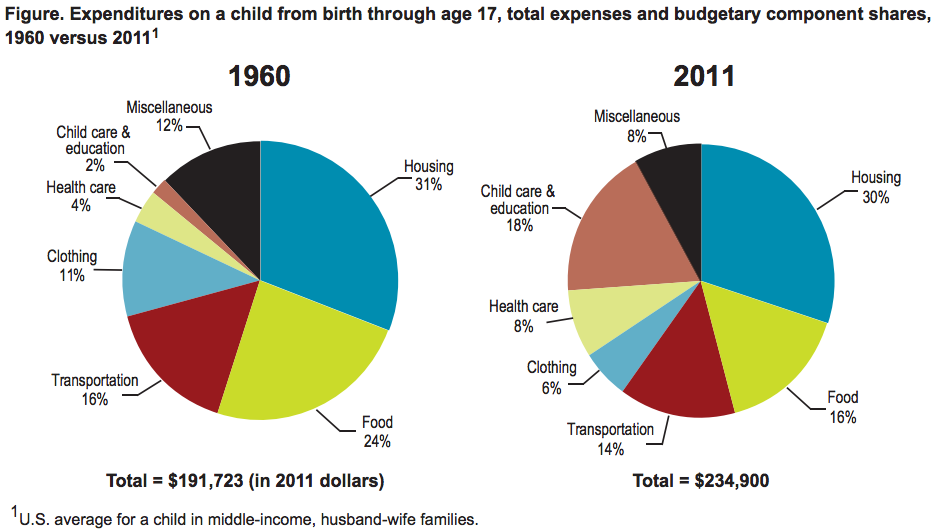
Christopher Carr thinks the rising cost of raising a child is actually a mark of progress:
Much was made last week of a recent study on the cost of child-rearing by economist Mark Lino at the U.S. Department of Agriculture. The total cost of raising a child born in 2012 is an estimated $241,080 – and double that if your kid attends college. That’s a 23-percent increase from 1960.
It’s easy to conclude that the cost of raising children is becoming more burdensome over time, and the historical data suggests that’s right – but only half-right. The rising cost of child care does create a great burden for some families. But it also represents commendable progress in our ability to meet our kids’ most basic needs. The middle class is far better off now than we were in 1960. We can afford to spend more on our kids’ well-being. In fact, the vast majority of the increased spending is for services that were once the exclusive province of the rich, such as high-quality health care and education.

 The Dish