From The “Experts” Who Brought You The Iraq War

by Patrick Appel

Waldman mocks the Weekly Standard‘s call for war:

[I]n case you were on the fence about whether the American government should take military action in Syria, Kristol has returned with an open letter urging President Obama to get bombing post-haste, and go big. You can find the letter on the Weekly Standard‘s website, where it runs under the not-sarcastic headline, “Experts to Obama: Here is what to do in Syria.” Among the “experts” are not only Kristol himself, but a whole bunch of folks with a nuanced grasp of the subtleties of Middle East politics and a track record of wise counsel on matters of war. People like Iran-Contra criminal Elliot Abrams, evangelical leader Gary Bauer, former seat-warming senator Norm Coleman, French gadabout Bernard-Henri Levi, foreign-policy genius Karl Rove, and presidential laughingstock Tim Pawlenty, not to mention the hilariously named Arch Puddington, who apparently is an actual person and not a character from a children’s book.

Scott Lemineux piles on:

I’m not 100% sure that military intervention in Syria is wrong. But it is true that 1. al-Assad is terrible 2. ????? 3. Bomb lots of stuff! is a terrible argument, and the arguments — really assumptions — in the above letter have scarcely more meat on them. There should be a very strong presumption against military action, but instead it’s the one form of government action that doesn’t seem to face any kind of cost-benefit analysis in our political discourse at all.

Conor joins the chorus:

I’d never claim to be a foreign policy expert. But I know enough to scoff when The Weekly Standard grants ”expert” status to Karl Rove, and to discount the prognostication skills of everyone that urged American intervention in Iraq without the faintest idea of what would follow. But in D.C., expert status is never taken away for being repeatedly, catastrophically wrong.

In response to the Weekly Standard, Fallows names the military thinkers he trusts:

Whose advice would I like to hear? Andrew Bacevich’s, for one. And it turns out he has already weighed in.  For another, Jim Webb. I’ll ask him, but there is this clue from last year. Or Anthony Zinni, whom I will try to locate. Significantly, unlike virtually all of the experts urging “surgical” intervention, these are people who have fought in wars themselves or been responsible for their aftermath. Perhaps Robert Gates too — and now that I look, I see how he is leaning. Or James Mattis — and, as it turns out, his instincts are the same. Also Gary Hart, who has just written in a similar vein, for instance: “The use of force is not a policy; it is a substitute for policy.”

So: the men who gave us Iraq on one hand, the people who were against it or far more cautious on the other. Let’s give the tie-breaking vote to Dwight Eisenhower, from up in heaven. One guess about what he would recommend.

Why Do Chinese Tourists Have Such A Bad Rep? Ctd

by Chris Bodenner

Screen Shot 2013-08-27 at 6.32.19 PM

A reader contributes the above photo to the ever-popular thread:

As a blond, fair-skinned child who grew up in Ashiya, Japan in the mid-90s, I can attest to the Asian obsession with blonde, fair-skinned children. Everywhere my mother took me, we were swarmed. Even the construction workers across the street loved me. And everyone was surprised when this little gaijin started speaking Japanese. In fact, they loved me so much that one year they hoisted me off the street during a festival (to my father’s delight and my mother’s horror) and paraded me around on the town’s danjiri. As you can see from the photo, I was not pleased.

Others had more pleasant experiences:

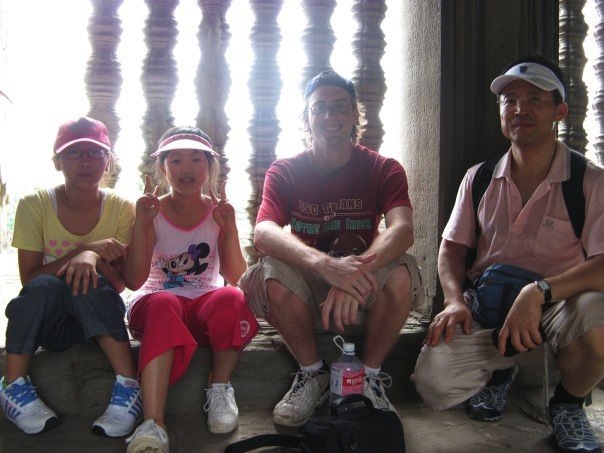
When I traveled through Asia in 2006, I was frequently approached by other tourists interested in snapping a photo with me, and I never did figure it out. I was a tall, skinny white guy traveling on my own – not a hugely common sight in Beijing or Cambodia, but not Bigfoot or anything. At any rate, after the first couple of experiences, I started taking pictures with everyone who requested a picture with me. If they were going to take my picture, I was going to take theirs, dammit! At any rate, I enjoyed turning the tables. I’ve attached a picture with a family at Angkor Wat:

Family Angkor

I’m really hoping one of your readers can shine some light on this phenomenon, because it remains a mystery to me to this day.

Another reader:

I love that story about Asians tourists stopping the reader to take pictures of his kid. I lived in Hong Kong for two years, and at that time my little sister was 5 years old and very very blonde. We could never go out without everybody stopping to look at her with fascination. Some would touch her hair without asking, some would ask for pictures. From Hong Kong to Thailand, everywhere in Asia it was the same phenomenon, but in China most heavily.

It’s the novelty I assume. My parents were very nice about it; they would stop each time and indulge. And oh boy did my sister love this. Everywhere you go people stop and worship you. She was a little blond princess and she loved every minute of it.

It was a nice bonding moment with those Chinese families. We couldn’t talk, but the gestures, the smiles … now that I look back I cherish those moments. To think back now and to think about these hundreds, maybe thousands of pictures of my very cute little sister in all these family albums sitting in China and elsewhere is heartwarming.

A parallel but very different experience:

My sister and her husband lived in Nanjing for 2.5 years.  When they moved there, my nieces were 3-1/2 and just-turned 1.  Blond hair, blue eyes – both of them. And they were MOBBED every time they went out.  It actually got scary, as there would be 10-40 (yes) people crowding around my sister and the stroller, taking numerous pictures.  My sister would be unable to move, just hemmed in by the crowd. And not one of them ever asked permission to take a photo.  My niece got afraid to go out. When they moved back to the States, she seemed a bit surprised that her public appearance didn’t immediately garner crowds of people.

And it’s not just the blondes:

My husband and his two siblings visited China as tourists several years ago.  All three of them have red hair – two of them flaming red.  With red hair being a real rarity in China, and with red being the color of good fortune, they were consistently stopped to be photographed with strangers in front of landmarks.

And it’s not just hair color:

A friend went to China with a tourist group that included a morbidly obese American woman. People on the street surrounded her and actually poked her belly! I don’t know if they photographed her or not.

Turning Every Muslim Into A Suspect

by Tracy R. Walsh

New York magazine has a lengthy excerpt from Matt Apuzzo and Adam Goldman’s forthcoming book about the NYPD’s post-9/11 surveillance program, and their account manages to be both harrowing and absurd. One example, of many:

Nobody trained the rakers [undercover officers] on what exactly qualified as suspicious, so they reported anything they heard. One Muslim man made it into files even though he praised President Bush’s State of the Union address and said people who criticized the U.S. government didn’t realize how good they had it.

Even the FBI recognized the problems with the program:

Confirmation that the activities of the Demographics Unit went far beyond what federal agencies were permitted to do was provided by the FBI itself. Once, Sanchez tried to peddle the Demographics reports to the FBI. But when Bureau lawyers in New York learned about the reports, they refused. The Demographics detectives, the FBI concluded, were effectively acting as undercover officers, targeting businesses without cause and collecting information related to politics and religion. Accepting the NYPD’s reports would violate FBI rules.

Conor pounces:

The full story contains a lot more objectionable behavior, and after reading how the undercover officers operate it’s easy to understand why the unit would cause Muslim-American mosque attendees, small-business owners and patrons, and students throughout the city to grow paranoid in their daily lives. And defenders of the program are unable to point to even a single case where it prevented a terrorist attack – in fact, they can’t even point to a terrorism-related arrest or prosecution.

Usually, when I write phrases like, “This is how a secret police force with files on innocent Americans starts,” I’m issuing a warning about the future. But the NYPD literally started a secret police unit that began indiscriminately keeping files on innocent Americans. This isn’t a warning about a slippery slope. It is an observation about ongoing abuse of civil liberties in America’s biggest city.

The Sectarianism Of Syria

by Patrick Appel

Levant_Ethnicity_

Max Fisher explains the map above, which “shows the different ethnic and linguistic groups of the Levant, the part of the Middle East that’s dominated by Syria, Lebanon and Israel”:

Ethnic and linguistic breakdowns are just one part of Syria’s complexity, of course. But they are a really important part. The country’s largest group is shown in yellow, signifying ethnic Arabs who follow Sunni Islam, the largest sect of Islam. Shades of brown indicate ethnic Kurds, long oppressed in Syria, who have taken up arms against the regime. There are also Druze, a religious sect, Arab Christians, ethnic Armenians and others.

Syria is run by Alawites, a minority sect of Islam whose members include President Bashar al-Assad and many in his inner circle. They’re indicated in a greyish green, clustered near the Mediterranean coast. Although Alawites make up only 12 percent of the Syrian population, they are playing a crucial role in the war, fighting to prop up Assad’s regime.

He uses the map to discuss Fareed Zakaria’s argument, from June, against intervention in Syria:

Zakaria’s thesis is that what we’re seeing in Syria is in some ways the inevitable re-balancing of power along ethnic and religious lines, with the Sunni Arab majority retaking control from the Alawite minority. He compares the situation to post-2003 Iraq, when members of the Shiite majority violently took power from the Sunni minority that, under Saddam Hussein, had ruled them. That would explain why so much of the killing in Syria has been along sectarian lines. It would also suggest that there’s not much anyone can do to end the killing because, in his view, this is a painful but unstoppable process.

(Map from the Gulf/2000 Project)

What Would Science Do?

by Brendan James

Here’s some New Atheist crack: a study showing that merely thinking about science triggers moral behavior. Researchers at UC Santa Barbara “primed” participants with scientific buzzwords and then administered a series of moral quizzes:

Participants first completed a word scramble task during which they either had to unscramble some of these science-related words or words that had nothing to do with science. They then either read [a story about date-rape] and answered the same questions regarding the severity of that transgression (Study 2), reported the degree to which they intended to perform a variety of altruistic actions over the next month (Study 3), or engaged in a behavioral economics task known as the dictator game (Study 4). …

Across all these different measures, the researchers found consistent results. Simply being primed with science-related thoughts increased a) adherence to moral norms, b) real-life future altruistic intentions, and c) altruistic behavior towards an anonymous other. The conceptual association between science and morality appears strong.

Living In Nixon’s World

by Tracy R. Walsh

Ben Richmond calls the newly released Nixon tapes both “quaint” and ahead of their time:

From the 21st century, the content of the Nixon tapes – the casual sexism and racism and paranoia – are shocking, but the existence of the recordings seems almost banal. So much of communication is recorded just as it’s made, and when it surfaces via Wikileaks or wherever, people applaud the transparency of it all. …

But maybe this makes the Nixon tapes an even more fascinating relic, as they may contain the last truly candid recordings. They might contain the last time people spoke frankly in the White House. After Nixon’s public destruction and his [successor] Jimmy Carter’s blunder of saying America was having a “crisis of confidence,” everyone realized what a liability displaying human frailty could be. It already feels like we live in a world of Nixon’s creation – China is our most important trading partner, the most advantageous political position is playing the victim (no matter how powerful you actually are), and if you need someone to blame, “the media” is always there. And, of course, everyone recording everyone else is de rigueur.

(Audio: In a conversation recorded April 26, 1973, Richard Nixon and Attorney General Richard Kleindienst discuss the Oglala Lakota and American Indian Movement occupation at Wounded Knee, South Dakota.)

Who Will Become The Face Of The GOP?

by Patrick Appel

Beinart feels that Ted Cruz is gaining steam:

Cruz is eclipsing Rubio, it’s worth recalling, at a time when the American people’s biggest complaints about the GOP are that it’s “too unwilling to compromise” and “too extreme.” (PDF) Were the Republican Party’s shrinking cohort of right-wing activists not sheltered from the rest of America by the informational cocoon Fox News has built for them, they would see in Rubio’s immigration work a politician struggling, not always coherently but with a degree of humility and good will, to show younger, poorer, newer, less white Americans that the GOP gives a damn about them. They might also realize that this kind of inclusive gesture, combined with Rubio’s natural charisma, offers the chance to partially undo the GOP’s reputation as a party beholden to blue bloods and bigots. Instead, they’ve discarded Rubio in favor of Cruz, a man who combines Sarah Palin’s worldview, Richard Nixon’s commitment to fair play, and Al Gore’s folksy charm.

Enten focuses, instead, on Christie, who he dubs the establishment candidate. He sees elite support for Christie as evidence that the GOP hasn’t completely lost its mind:

Christie’s scoring on the two rankings we have available place him more toward the center than any other candidate to win a Republican nomination since 1964. Some of you might say that Christie is more conservative than these scores indicate. But it seems to me that for every issue where Christie takes a conservative stand, he takes a moderate stance. So that while he’s conservative on taxes, he’s for campaign finance reform and green energy.

The point is he’s more toward the center than previous nominees. He no doubt will move somewhat towards the right, once he wins a second term in November. Still, even a hard turn right would still leave him as relatively moderate. A Republican leadership that was looking to move more towards the right would not be interested in nominating this man or nominating the committee chairmen they are in congress. This is a party that wants to win. It’s a party leadership that at least right now is following the historical pattern of wanting to nominate a more moderate candidate, after losing the the presidential election in two consecutive cycles.

Make Gotham Goofy Again?

by Brendan James

As fans explode over the casting of Ben Affleck for the next Batman film, Noah Berlatsky wishes the franchise would return to its campy roots:

[T]he truth is that the most sophisticated and knowing Batman we’ve had thus far isn’t Frank Miller’s or Alan Moore’s or Christopher Nolan’s. It’s Adam West’s. … Batman’s omnipotence in the television show isn’t a function of his popularity. It’s a multi-level gag. Wouldn’t it be fun, the TV Batman asks, to live in a world where the fuddy-duddy scions won’t run stop-lights, where they’d rather die than blow up a handful of baby ducks, and where they can always get the right answer out of the bat computer? And isn’t it also more than a little ridiculous to hope for that world and its paunchy, bat-eared dad? Trust me, Adam West assures us, and I will pretend to save you.

Thus we have the conclusion of Batman: The Movie from 1966, in which Adam West in the batsuit accidentally swaps all the brains of the members of the UN Security Council one with the other. Having completely screwed everything up, he quietly declares victory and leaves — which is a much more insightful take on American imperial adventures than anything you’re likely to find in Iron Man.

Intervention Usually Does More Harm Than Good

by Patrick Appel

Yglesias flags research finding that, in general, “intervening on behalf of rebels increases the number of civilians who are killed by increasing the desperation of government forces”:

Now of course just because intervention typically fails to reduce civilian deaths doesn’t mean that intervention fails in all cases. But proponents of helping-by-killing seem to me to be mighty blithe in their estimates of the upsides of these endeavors. And you can see why that is. A mission is undertaken to help the good guys and stop the bad guys. If the bad guys kill even more good guys once your mission starts, the tendency is to put that in the “evidence that the bad guys are really bad” file rather than the “evidence that this intervention didn’t work very well” file. By the same token, proponents of helping-by-killing are generally very eager to assert that killing bad guys (and their subordinates) will set valuable precedents for the future and tend to discount the risk that interventions create perverse incentives for rebel groups. For example, did this fierce civil war in Syria break out in part because the intervention in Libya led opposition figures to believe that even a low-probability-of-success military uprising stood a good chance of receiving a NATO bailout?

Not Supporting “Support Our Troops” Ctd

By Chris Bodenner

Screen Shot 2013-08-28 at 4.47.55 AM

A reader writes:

I saw this post and immediately thought to myself that Steven Salaita must not remember Vietnam or does not fully understand the history of the whole movement to express support for our troops. Whatever anyone thought of Vietnam, there’s no arguing that many Americans treated returning vets horribly. People who were against the war were unable to distinguish their hatred of the war and those who were unlucky enough to be sent into the battle, and so there was too much vitriol directed at the troops returning (and going to) Vietnam, despite the fact that they had nothing to do with the policy to continue and escalate the war.

The “support or troops” effort grew directly out of this unfortunate history and was intended to ensure that, regardless of how one feels about any policy decision to send our troops someplace, we don’t take it out on the soldiers who are only carrying out their orders.

There is no question that people sometimes conflate “support our troops” with supporting a broader war effort, which shouldn’t be the case. It is imperative that someone who opposes a war should still “support our troops” and offer them our thanks and gratitude for putting their lives on the line to protect the country. The movement has been so successful that the original purpose behind it has probably become completely lost on most people 45 and below, and anyone old enough to remember Vietnam doesn’t realize that half of the adult population has no memory of those bad old days.

Another turns to a different war:

When I was a junior in high school in 1990, the Gulf War was about to begin and many of us felt that it could go either way – quickly like Panama or more drawn out like Vietnam. So even though my family was conservative, all but the most ardent sons and daughters of the Woodstock generation found resonance in “Support Our Troops”. It was meant to bridge the gap, not to imply some sort of blind allegiance. Iraq had committed international aggression against Kuwait and it was obvious we were the only ones to smack them back into line. But more so, if it went horribly wrong (as the second Gulf War later showed), it meant our troops shouldn’t be rejected as the Vietnam generation had been.

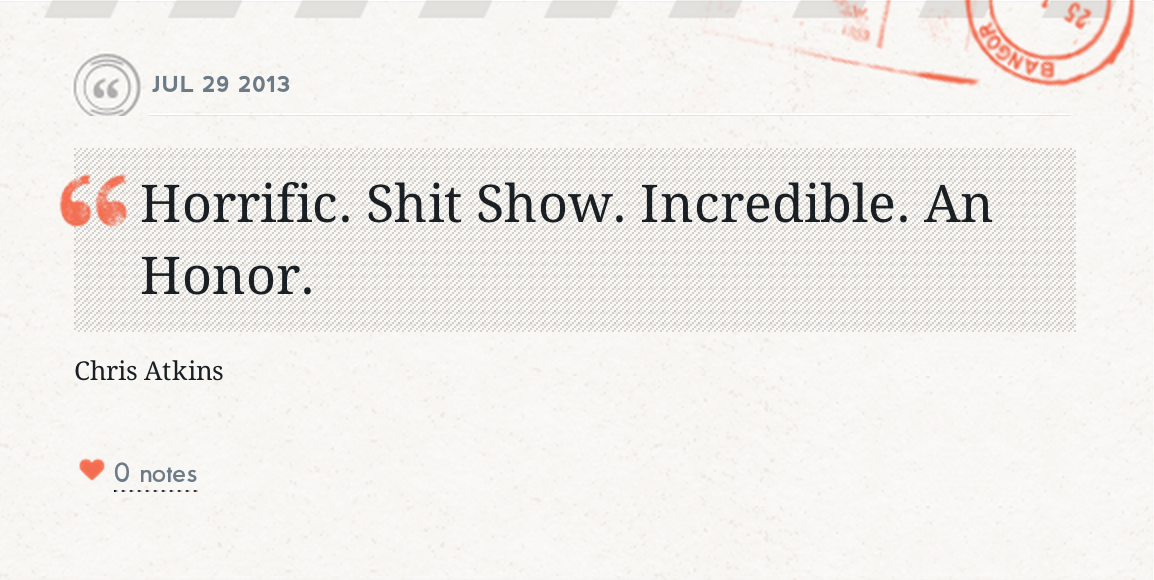
(Above screenshot from the tumblr Six Word War, “Real stories from Iraq and Afghanistan in just six words.”)