Advice To The Freshmen Faithful

by Matt Sitman

Kevin O’Brien, a Jesuit priest at Georgetown University, reflects on how going to college can challenge the faith of young people, arguing that often “we have to let go of a familiar, tried-and-true way of praying or believing in order to embrace another way of relating to God”:

We have to let ourselves feel incomplete, even empty sometimes, so that we can be filled in unimaginable new ways. This spiritual longing – like homesickness for our loved ones at home – means that in our emptiness, we still love God deeply.

Doubts are natural. Jacob wrestled with his angel. Thomas did not believe the good news of the resurrection. Even Jesus hesitated in the garden and questioned on the cross. To doubt does not mean to lack faith. To the contrary, doubt can be a sign that one’s faith is very much alive. We care enough about our relationship with God to wrestle with the Divine. Questions are a way of keeping the conversation going.

His advice:

[Y]oung adults transitioning to college need to be gentle with themselves and others. Parents do well to model that patience. The devout high school son may come home at Thanksgiving and announce his love for Nietzsche and his conviction that he is now an atheist. The once church-going daughter may return home a “seeker,” having experienced a variety of religious communities with her new friends. I recall that during my freshmen year at Georgetown, after taking the first required theology course, I fell into a deep spiritual funk, which felt very uncomfortable in my Irish Catholic skin. In the class, I addressed unsettling and age-old questions about the existence of God and the problem of evil. I got through it after a few months, with a stronger, more grounded, more deeply personal faith – and a life-long desire to learn more.
Divine Revenue

by Brendan James

Yglesias proposes we start taxing churches:

Whichever faith you think is the one true faith, it’s undeniable that the majority of this church-spending is going to support false doctrines. Under the circumstances, tax subsidies for religion are highly inefficient.

What’s more, even insofar as tax subsidies do target the true faith they’re still a pretty bad idea. The basic problem with subsidized religion is that there’s no reason to believe that religion-related expenditures enhance productivity. When a factory spends more money on plant and equipment then it can produce more goods per worker. But soul-saving doesn’t really work this way. Upgrading a church’s physical plant doesn’t enhance the soul-saving capacity of its clergy. You just get a nicer building or a grander Christmas pageant. There’s nothing wrong with that. When I was young I always enjoyed the Grace Church Christmas pageant. But this is just a kind of private entertainment (comparable to spending money on snacks for your book club—and indeed what are Bible study groups but the original book clubs?) that doesn’t need an implicit subsidiy.

Dylan Matthews crunches the numbers:

[Sociologist Ryan] Cragun et al estimate the total subsidy at $71 billion. That’s almost certainly a lowball, as they didn’t estimate the cost of a number of subsidies, like local income and property tax exemptions, the sales tax exemption, and — most importantly — the charitable deduction for religious [giving]. Their estimate that religious groups own $600 billion in property is also probably low, since it leaves out property besides actual churches, mosques, etc.

The charitable deduction for all groups cost about $39 billion this year, according to the CBO, and given that 32 percent of those donations are to religious groups, getting rid of it just for them would raise about $12.5 billion. Add that in and you get a religious subsidy of about $83.5 billion.

A Serious House No Longer

by Matt Sitman

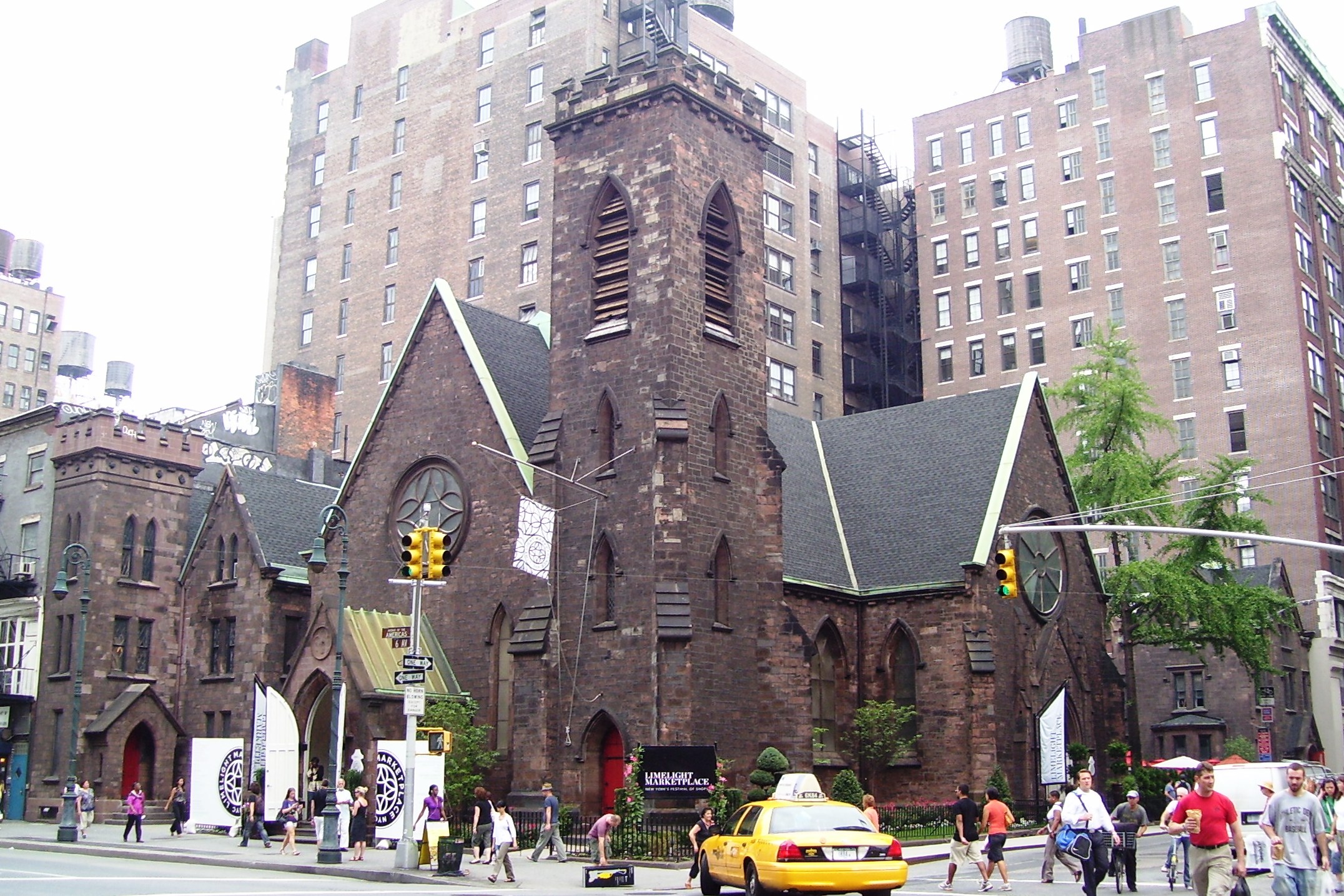
Limelight

Spurred by a chance encounter with the former Episcopal Church of the Holy Communion, now a retail mall called Limelight Marketplace, B.D. McClay considers the fate of deconsecrated churches, wistfully concluding with these thoughts:

A deconsecrated church is just a pile of stones, I guess, no different from any other. Its not wrong to live or work or do business in that space, or sacrilegious; and yet, the space is too full of its past. I can never get used to them; I walked past a church that had been made into an apartment building every day for almost two years, and I never did stop feeling a little surprised.

Back in 1976, when the Church of Holy Communion was deconsecrated, they covered up some of the reminders that the church had once been a holy place. According to the Marketplaces website, as part of transforming the building into a Festival of Shops,” these details were restored as historically significant.”

Well-yes, in one way. But really, they’re only significant insofar as they aren’t historical, and only historical insofar as they aren’t significant. And that is the trouble with deconsecrated churches; they mean too much, even when they no longer mean anything at all.

(Photo of The Limelight, formerly the Episcopal Church of the Holy Communion, via Wikimedia Commons)

A Different Kind Of Halo

by Matt Sitman

Amit Majmudar doubts people’s desire for a typical religious afterlife, citing video games in defense of his thesis:

[H]eaven must get pretty boring. This has to do with its stasis; its unvarying bliss, devoid of any contrasting emotions by whose paradoxical grace we might treasure or even perceive bliss; its perfectly certain future, which is eternal continuance; and above all its absence of conflict. Still worse, you are denied the company of flawed people, who are, let’s face it, a vast and interesting tribe.

This is why the human race, over the past 30 years—roughly my life span—has aggressively developed simulated realities that have very little in common with the concept of heaven as described in traditional religion. The place to look for the truest, deepest human fantasies about the afterlife is gaming. There’s no spiritually correct nonsense there, just pure choice. Game designers are free to design an environment; game players are free to elect or not to elect to enter it. Inevitably, when analyzing video games, your conclusions will be skewed toward young males, but it’s still worth studying the kinds of worlds in which gamers elect to spend their time.

A Poem For Sunday

by Alice Quinn

zachspoem

“This Slow Unearthly Spell” by Natan Zach:

This slow, unearthly spell of standing
still.
Not to trade places with, or envy
those flying overhead at night, passing
in a shriek of polished and cold metal,
jostling each other in a mysterious
light.

Not to set out again. To spend each
evening
among familiar tokens, making
a barren speech before the stars.
Keeping close watch
over Time’s steps. To bring to an end
all that is loved and rare
with an unhurried hand and a shattered
heart.

(From The Countries We Live In: Selected Poems Natan Zach 1955-1979, translated, from the Hebrew, by Peter Everwine. Used by kind permission of Tavern Books. Photo by D.H. Parks)

The Danger Of Political Dogma

by Matt Sitman

The British philosopher Roger Scruton sees accepting the legitimacy of your opponents as necessary for politics – and always threatened by the intrusions of religion:

In our own system the opposition is a legitimate part of the legislative process. Laws are seldom steam-rollered through Parliament without regard for disagreement, and the general assumption is that the final result will be a compromise, an attempt to reconcile the many conflicting interests. This idea of legislation as a compromise is an unusual one. The natural order is that described in the Old Testament, in which kings rule by decree, taking advice perhaps, but not allowing a voice to interests other than their own.

There are aspects of human life in which compromise is either suspect or forbidden. In battle you don’t compromise with the enemy. In religion you don’t compromise with the devil. And it is when religion intrudes into politics that the political process is most at risk. This is the reason why, in the history of modern Egypt, successive presidents have tried to keep the Muslim Brotherhood out of power. The Brotherhood believes that law and politics are not about compromise but about obedience to the will of God.

He looks to the teachings of Jesus for one way of handling these tensions, seeing in his teachings the sources of the West’s distinctive approach to the matter – “religion, in our society, has become a private affair, which makes no demands of the public as a whole.”

The Indispensable Saint

by Matt Sitman

800px-Fra_angelico_-_conversion_de_saint_augustin

In a review of Miles Hollingworth’s recent book, Saint Augustine of Hippo: An Intellectual Biography, Joseph Bottum sizes up the Christian thinker’s place in the history of the West:

To read The City of God is to realize Augustine was a great philosopher, of course. Maybe not quite in the absolute “A” class of Plato, Aristotle, Aquinas, Kant, or Hegel, but not down at the next level, either—with the “B” class (but still great) likes of Marcus Aurelius, Francisco Suárez, and Friedrich Schiller. Call it the “A-minus” set of world-historical thinkers: Plotinus, Hobbes, Machiavelli, Hume, Wittgenstein, Augustine. But to read De Doctrina Christiana would convince anyone that Augustine belongs in the first gathering of theologians, the greatest of the many fine theological minds among the church fathers in Latin Christendom. There’s a reason, after all, that Thomas Aquinas and Martin Luther alike engage Augustine in a way they do no other theological thinker. Then, too, as the Confessions show, Augustine was among the last great classical stylists, trained in a rhetorical tradition that would cease to exist all too soon.

What’s more, he stood at the moment of the failure of Rome—dying as the Vandals besieged Hippo, his Roman city in North Africa—and he had the most significant historical event of 1,000 years to explain and translate into a lasting understanding of the human condition. But it’s somehow the combination of all this that makes Saint Augustine so central: What he wrote, joined with how he wrote, joined with when he wrote.

There is no Western civilization without him. He shapes our intellectual tradition in the way others who are so good they force themselves into our minds do.

(“The Conversion of St. Augustine” by Fra Angelico, via Wikimedia Commons)

“Think What We Might Do”

by Matt Sitman

Brian Doyle, a Catholic writer, charmingly describes when, as a child, he first encountered a Protestant – at his uncle’s wedding reception, of all places. This exchange between Doyle’s father and the man he simply calls “the Protestant” stands out:

[M]y dad strode back into view and claimed me for family photographs, but before we left he put both hands on the Protestant’s shoulders and said, “I am deeply touched that you are here, that you made the effort and came all this way. It means a great deal to me. It’s the human moments like this that will bring us all back together as a common force for witness and justice, perhaps. It is only history that divides us, and that’s all in the past. Think what we might do if we all walk together again.”

The Protestant said he too was touched to be invited, and honored, and added, “You can count on me as a partner in the long work, Jim, and maybe the time will come, when Brian is our age, that the walls have crumbled among the Christian traditions, and we are joined in the work we were asked to do by the Founder—and him a Jewish man at that.”

My dad laughed and the Protestant laughed and we parted, but all these years later I remember the way my dad put his hands on that man’s shoulders, and the way they spoke to each other with real affection and respect and camaraderie.

I am older now than they were then and the walls among the Christian traditions have still not crumbled, for any number of silly reasons—mostly having to do with lethargy and money and paranoia—and no sensible man would have the slightest expectation that they will in my lifetime. But sometimes I still wonder what it would be like if they did crumble suddenly somehow, and the two billion Christians on earth stood hand in hand, for the first time ever, insisting on mercy and justice and humility and generosity as the real way of the world. You would think that two billion people insisting on something might actually make that thing happen, wouldn’t you?

Live From Studio 8H

by Jessie Roberts

Phil Hartman auditions for Saturday Night Live:

Excerpts from a lively oral history of SNL auditions:

JIMMY FALLON: In makeup, they go, “Hey, Jimmy, some advice: Lorne Michaels doesn’t laugh when you audition. So don’t let that throw you.” Then the audio guy, he goes, “Hey, little advice — Lorne doesn’t like to laugh.” I’m like, “O.K.” Then Marci [Klein, a longtime “SNL” producer] comes out: “Jimmy, they’re ready for you. But hey, a little advice for you. If Lorne doesn’t laugh, be cool.” I’m like, what is this guy’s problem? He’s doing a comedy show. Why does he not like to laugh?

CHERI OTERI: I felt good because I heard Lorne laugh a little bit. I saw him out of the corner of my eye, laughing his very subtle, subtle laughter. Almost regal laughter.

RACHEL DRATCH: I didn’t get it that year [of her first audition]. They hired Horatio [Sanz], Jimmy [Fallon] and Chris Parnell, and they said: “We’re not taking any women this year. But maybe next year.” I was at peace with it.

SETH MEYERS: They flew me all the way back to New York to meet with Lorne. I realized later that he was doing a final personality vet. He said, “Do you think you can live in New York?” And I thought, “Does anyone blow it at this stage?” Does anybody get this far in the process, and then is like, “It’s definitely New York? Well, if you guys can’t be flexible on that, I’m not sure if I can be flexible on that.”

WILL FERRELL: [Mr. Michaels] never really has a moment where he says, “So, welcome to the show.” He phrases it, “So, we’re bringing you to New York.” And I thought, God, another audition? And he goes, “Cheri’s going to be there, too.” And that’s when it hit me: Oh, my God. I got the gig. But I didn’t have a celebratory moment with him. Then I got self-conscious, like it came across that I didn’t care about getting the job. So I stood up real quick, and I’m like: “Well, gosh, thank you. I just want to shake your hand.” And he said, “Do whatever you have to do.”

A collection of audition tapes viewable online is here.