An Underrated Classic

by Jessie Roberts

Loris Stein commemorates John O’Hara, whose novels, he says, “deserve to be much more famous than they are.” He describes the heroine of BUtterfield 8:

This heroine, Gloria Wandrous, is one of O’Hara’s true originals: a young woman endowed with beauty, a strong libido, and large sexual experience, who is neither a pornographic fantasy nor a femme fatale. To put it simplistically, Gloria is a sexual subject, not dish_Butterfield8 an object. Over the course of BUtterfield 8, we hear about threesomes, orgies, “Lesbians,” “fairies,” consensual rough sex, brutal sadism, abortions, even the new technique of artificial insemination—all from her point of view. Even more striking, we see Gloria in a close, erotically charged friendship with a man, Eddie Brunner, who loves her and is not her lover. Theirs is not the only such friendship in American fiction, but it is one of many touches that make the novel seem uncannily up-to-date, much more up-to-date than the “modernized” 1960 movie starring Elizabeth Taylor.

In the movie, Gloria is a call girl who wants to “go straight” and get married. But the Gloria of O’Hara’s novel is, crucially, not a prostitute, and she considers the prospect of marriage with deep ambivalence. Based on a real-life acquaintance of O’Hara’s named Starr Faithfull, Gloria is a creature of the great sexual revolution of the twentieth century—the one that occurred in the twenties, thanks to cars and speakeasies. To read O’Hara is to discover how much more people used to say and do, in private, than most novelists, even daring ones, could bring themselves to write. The publishers of BUtterfield 8 made O’Hara remove the word “fuck” from his manuscript (they seem to have replaced it with the phrase “stay with”). Even so, even now, you could hardly place the book on a high school syllabus.
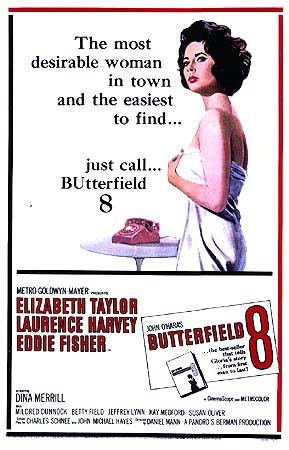
(Image: movie poster for BUtterfield 8, via Wikimedia Commons)

Don’t Trip Over Psychedelics

by Brendan James

A fresh review of US health records by Norwegian researchers reveals yet more evidence that psychedelic drugs won’t fry your brain:

“Early speculation that psychedelics might lead to mental health problems was based on a small number of case reports and did not take into account either the widespread use of psychedelics or the not infrequent rate of mental health problems in the general population,” [researcher Teri] Krebs was quoted in a release from the Norwegian University of Science and Technology. “Over the past 50 years tens of millions of people have used psychedelics and there just is not much evidence of long-term problems.”

Surely people have had bad trips. And, the researchers report, surely they have. But their population study was looking at more permanent problems; they report that the “adverse effects of psychedelics are usually short-lived; serious psychiatric symptoms following psychedelic use are typically resolved within 24 hours or at least within a few days.” And anecdotal reports of longer-term mental issues or “hallucinogen persisting perceptual disorder” they tend to reject as unsupported by further investigation, mistaking correlation for cause, or derived from small studies with suspect methodologies.

Talking With Ray Bradbury

by Jessie Roberts

Maria Popova digs up a 1974 interview with Ray Bradbury, above. One highlight, on writing:

I never went to college — I don’t believe in college for writers. The thing is very dangerous. I believe too many professors are too opinionated and too snobbish and too intellectual, and the intellect is a great danger to creativity … because you begin to rationalize and make up reasons for things, instead of staying with your own basic truth — who you are, what you are, what you want to be. I’ve had a sign over my typewriter for over 25 years now, which reads “Don’t think!” You must never think at the typewriter — you must feel. Your intellect is always buried in that feeling anyway.

Drinking As The Romans Did

by Jessie Roberts

Italian archaeologists are borrowing a page from Virgil and the ancient winemaker Columella in an attempt to make wine that tastes like it did in antiquity:

At the group’s vineyard, which should produce 70 litres at the first harvest, modern chemicals will be banned and vines will be planted using wooden Roman tools and will be fastened with canes and broom, as the Romans did.

Instead of fermenting in barrels, the wine will be placed in large terracotta pots – traditionally big enough to hold a man – which are buried to the neck in the ground, lined inside with beeswax to make them impermeable and left open during fermentation before being sealed shut with clay or resin.

“We will not use fermenting agents, but rely on the fermentation of the grapes themselves, which will make it as hit and miss as it was then – you can call this experimental archaeology,” said researcher Mario Indelicato, who is managing the programme.

When Childhood Classics Aren’t Innocent

by Tracy R. Walsh

Russell Saunders watched Peter Pan in its entirety for the first time and was shocked by its racism and sexism:

Popular media is full of beloved movies that are, in retrospect, embarrassing in some way. I remember a (straight) friend prevailing on me to watch Revenge of the Nerds with him (I’d never seen it), and then having to reconcile his remembered affection for the film with the offensively fey gay character, which he hadn’t really thought much of when he first saw it decades before. (I wasn’t all that worried about it.) Attitudes change, generally for the better in my opinion. Unless we want to constantly cull things from our culture (which I am loath to endorse), we have to address the mixed bag of good and bad that they will appear to be from the perspective of our contemporary vantage point.

But it still leaves me a bit stunned that something so obviously racist was made such a relatively short time ago and is still so universally embraced. For all the talk about whether or not Washington’s football team or Atlanta’s baseball team need new names, I would honestly have expected more attention paid to the much more overtly problematic content of a movie that has spawned a whole “fairies” franchise of its own. America’s attention to such things remains quite selective, it seems, and makes me wonder how much more attention I should be paying than I have up to this point.

Weeding Out Weak Women

by Jessie Roberts

Elizabeth L. Silver advocates the death of the ingénue in fiction:

I recently went to hear Isabel Allende speak about her latest novel, Maya’s Notebook. At the Q&A, a young aspiring female writer rose to ask a question that surprised a majority of the audience. “You write a lot of strong women in your books,” she said, before asking, “Has there been anyone who has influenced you?” Allende either didn’t understand the question or wanted to emphasize the lunacy of it, and after three attempts replied: “Do you know any weak women?” Needless to say, a resounding uproar of applause emerged from the previously unobtrusive audience. This is not a topic that is far from the consciousness of the literary establishment, nor is it one that should be. It is so prevalent on people minds and hearts precisely because of its relevance. Readers don’t want to see any more ingénues or stock characters. They want to see the people that they know, the strong women who populate their lives, because, as Isabel Allende so bluntly and perfectly stated, there really aren’t weak women.

I’m not naively suggesting that contemporary fiction has conclusively banished the ingénue from its pages; nor am I claiming that the character is close to her coffin in certain genres, but I am suggesting that that she should be. Fiction, as any vital art form, serves a purpose to reflect society in its emotional, environmental, and political nuances. It informs us, teaches us, reflects humanity in its reverie. If the ingénue, which may be dying in literary fiction, begins to fade in all genres of contemporary literature, if we accept the evolution of the young female protagonist in literature, we may stop expecting women off the page to play that stock role, as well. By exiling the word to the trash bin or perhaps feeling a little bit guilty whenever used, we might continue to represent women as they are – likeable or not. Powerful characters who sometimes want love, sometimes want power, ache with ambition and passion, refuse to be called ingénues, or any other pile of stock stereotypes. They are merely women who need no other label.

Update from a female reader:

Are Silver and Allende honestly trying to maintain that there are no weak women in the world? And therefore that modern writers know better than to create weak fictional women? My, my. I personally know a lot of weak women. Some of the even act like ingénues. To call them off-fictional limits is to degrade faction. And it doesn’t help women either. It’s not empowering; it’s patronizing, and I’m a little embarrassed that spokespersons like Silver and Allende are so lacking in confidence that they need to insist on valorized fictional females.

Real-Life Fictions

by Jessie Roberts

Mike Jay examines how culture and technology affect our understanding of psychotic delusions:

Persecutory delusions, for example, can be found throughout history and across cultures; but within this category a desert nomad is more likely to believe that he is being buried alive in sand by a djinn, and an urban American that he has been implanted with a microchip and is being monitored by the CIA. ‘For an illness that is often characterised as a break with reality,’ [researchers Joel and Ian Gold] observe, ‘psychosis keeps remarkably up to date.’ Rather than being estranged from the culture around them, psychotic subjects can be seen as consumed by it: unable to establish the boundaries of the self, they are at the mercy of their often heightened sensitivity to social threats.

Jay notes that, for Evelyn Waugh, the experiences of fiction-writing and paranoid delusions were not mutually exclusive:

In 1954, the English novelist Evelyn Waugh suffered a psychotic episode during which he thought he was persecuted by a cast of disembodied voices who were discussing his personality defects and spreading malicious rumours about him. He became convinced that the voices were being orchestrated by the producers of a recent BBC radio interview, whose questions he had found impertinent; he explained their ability to follow him wherever he went by invoking some hidden technology along the lines of a radionics ‘black box’, an enthusiasm of one of his neighbours. His delusions became increasingly florid but, as Waugh described it later, ‘it was not in the least like losing one’s reason… I was rationalising all the time, it was simply one’s reason working hard on the wrong premises.’

Waugh turned the experience into a brilliant comic novel, The Ordeal of Gilbert Pinfold (1957). Its protagonist is a pompous but brittle writer in late middle age, whose paranoia about the modern world is fed by an escalating regime of liqueurs and sedatives until it erupts in full-blown persecution mania (a familiar companion for Waugh, who abbreviated it discreetly to ‘pm’ in letters to his wife). Although the novel smoothes the edges of Waugh’s bizarre associations and winks knowingly at Pinfold’s surreal predicament, the fictionalisation blurs into the narrative that emerged during Waugh’s psychosis: even for his close friends, it was impossible to tell exactly where the first ended and the second began.

The “Birdman” On Film

by Jessie Roberts

This embed is invalid


Jessie Auritt explains how she came to make the above short documentary, The Birdman, about the owner of the copiously-stocked Rainbow Music shop in Manhattan’s East Village:

I had been wanting to do a short film, and was thinking about something I could do locally, and was curious — how do all of these, or at least what remains out of these, music stores stay in business? So I just poked my head into Rainbow Music — that was the first place I visited because I figured that would be a good place to start because the store itself, you can see … it’s a disaster. … So I just poked my head in there, told him I was interested in doing a documentary and at first his response was “no, I don’t want you to show my face. You can film the store and you can interview me but you can’t show my face.” And then once I got in there he totally warmed up and I just kind of plopped the camera down and he started talking. So I didn’t necessarily have a story outlined before I started, but it was just more of a subject I was interested in. I was initially planning on going around the neighborhood and interviewing different owners of music stores, but then The Birdman was such a fascinating character to me that I felt like he deserved his own film.