Fighting To Learn In Pakistan

by Jessie Roberts

Rahul Bhattacharya profiles Humaira Bachal, a woman who has devoted her life to educating her community in Pakistan:

What would become the Dream Model Street School began in 2001, with one blackboard, at home. Humaira taught ten friends of her age, seven of them girls. She started with the alphabet, in Urdu and English, and proceeded to the names of things. She supplied blank pages from her own notebooks, until it got her into trouble with her teachers. Then the friends went round asking people to donate paper, or bought scrap.

Soon, Tahira, who was 11, and three other girls were teaching alongside Humaira. “We were militant about time. Time for study, time for play, time to eat—and time to go out and recruit. We didn’t have the sense to realise we didn’t have space, books, teachers, money. We went around to houses, telling people, ‘We’ve opened a school, send your children, you must send your children!'”

A short film released on YouTube this year, “Humaira, Dreamcatcher”, demonstrates the challenges of this recruitment.

It’s the work of an Oscar-winning Pakistani-Canadian documentary-maker, Sharmeen Obaid-Chinoy, whose crew have been following the lives of Pakistani women fighting for change. Twelve years after the school started, the film shows local men still making their points: for girls to study is not our culture; they will be stared at while going to school; what use is educating a girl when she is only going to marry and run a house? Permissions, given reluctantly, are withdrawn easily.

Yet by 2003 Humaira’s team had enrolled over 150 children. The students could no longer fit into the Bachals’ home, so the young teachers decided to rent. They took a 240-square-foot plot with two sorry rooms surrounded by mounds of mud. They levelled the ground themselves, erected wooden poles and strung up discarded flour sacks for shade. These collapsed in the rain. Someone suggested they use Panaflex signboards in place of the sacks. But the wooden poles would not take the weight. Somebody else suggested they use iron pipes, so they found a welder who helped rig them up. Finally, the shelter stood.


The View From Your Window Contest

vfyw_8-24

You have until noon on Tuesday to guess it. City and/or state first, then country. Please put the location in the subject heading, along with any description within the email. If no one guesses the exact location, proximity counts.  Be sure to email entries to contest@andrewsullivan.com. Winner gets a free The View From Your Window book or two free gift subscriptions to the Dish. Have at it.

A Whale Of A Book

by Jessie Roberts

& Sons author David Gilbert lovingly describes his favorite chapter from Moby-Dick, “The Grand Armada”:

I know it makes no sense, or comes across as pretentious nonsense, but so often when reading this book I find myself on the verge of tears and I have no idea why. A lost world perhaps? A striving for connection? A certain secular religiosity. No matter, the whales are doomed. They form a circle, circles within circles, like a clockwork mechanism in fin and tale, and the smaller boats lower into the water and go about their true business, the killing of whales, darting the weaker ones, taking advantage of mammalian affinities and loyalties, maiming as many as possible. And it is within this shoal that Starbuck and Queequeg and Ishmael find their boat inadvertently pushed into the very innermost circle, what Ishmael compares to a valley lake, “the enchanted calm which they say lurks at the heart of every commotion,” and it is this moment in Moby-Dick that I reflect on most often, that living wall of whales and the pastoral scenes glimpsed beneath.

All this violence, all this blood, and yet, for a moment, small tame cows and calves, “the women and children of this routed host,” visit the side of the unexpected boat and accept pats and scratches from Queequeg and Starbuck. They are the innocent, the cherished, the ones being protected by the larger herd from “learning the precise cause of its stopping.” And then Ishmael looks down into the water and

…far beneath this wondrous world upon the surface, another and still stranger world met our eyes…for, suspended in those watery vaults, floated the forms of the nursing mothers of the whales, and those that by their enormous girth seemed shortly to be mother. The lake, as I have hinted, was to a considerable depth exceedingly transparent; and as human infants while suckling will calmly and fixedly gaze away from the breast, as if leading two different lives at the time; and while yet drawing mortal nourishment, be still spiritually feasting upon some unearthly reminiscence; — even so did the young of these whales seem looking up towards us, but not at us, as if we were but a bit of Gulfweed in their new-born sight.

A bit of Gulfweed, that’s what they are — what we are. It is that moment of calm and metaphysical understanding, the divide between the spirit and the body and the near constant human attempt to bring those polarities together, that plus the sentimentality of the scene, of these mothers and children, these whales, resigned yet not uncaring, making due with the cruelty of the distant stars, just slays me.

Face Of The Day

by Chris Bodenner

tumblr_mrq91qwM8z1sfm4w7o1_1280

From the new tumbr Book Shelfies, an exercise in literary narcissism. Naturally we had to go with the canine stand-in:

Ruby reads:

The Complete Stories of Flannery O’Connor
The Dwarf by Par Lagerkvist and Alexandra Dick
11/22/63 by Stephen King
The Fortress of Solitude by Jonathan Lethem
Knockemstiff by Donald Ray Pollock
I Capture the Castle by Dodie Smith
Loving Frank by Nancy Horan
Into the Forest by Jean Hegland
American Skin by Don De Grazia
A Lesson Before Dying by Ernest J. Gaines
In the Woods by Tana French
Middlesex by Jeffrey Eugenides
The Road by Carmac McCarthy
Ishmael by Daniel Quinn

A Suspicious Character?

by Jessie Roberts

William T. Vollmann reveals in Harper’s (subscription required) that the FBI investigated him as “Unabomber Suspect Number S-2047.” Annalisa Quinn summarizes:

Vollmann’s heavily redacted FBI file, which he obtained under the Freedom of Information Act, reveals that he became “Unabomber Suspect Number S-2047” based on a tip from an anonymous citizen, whom Vollmann dubs “Ratfink.” “UNABOMBER, not unlike VOLLMANN has pride of authorship and insists his book be published without editing,” part of the file states. Other sections link his appearance to composite sketches of the bomber and suggest that “anti-growth and anti-progress themes persist throughout each VOLLMANN work.” A source told the FBI that Vollmann “reportedly owns many guns and a flame-thrower.” (“I would love to own a flamethrower,” he notes cheerfully.) After the real Unabomber was caught, Vollmann was listed among the suspects in the 2001 anthrax attacks.

Though Vollmann writes that he was initially flattered to be labeled “ARMED AND DANGEROUS,” he became alarmed over the privacy violations the file suggests. He writes: “I was accused, secretly. I was spied on … I have no redress. To be sure, I am not a victim; my worries are not for me, but for the American Way of Life.” Vollmann spoke to Morning Edition’s David Greene in an interview Thursday morning and said he minded the FBI’s secrecy almost as much as the invasion of his privacy: “If we’re not allowed to know what they’re doing with this information, I can’t help but think that we are headed for really serious trouble.”

A Poem For Saturday

by Alice Quinn

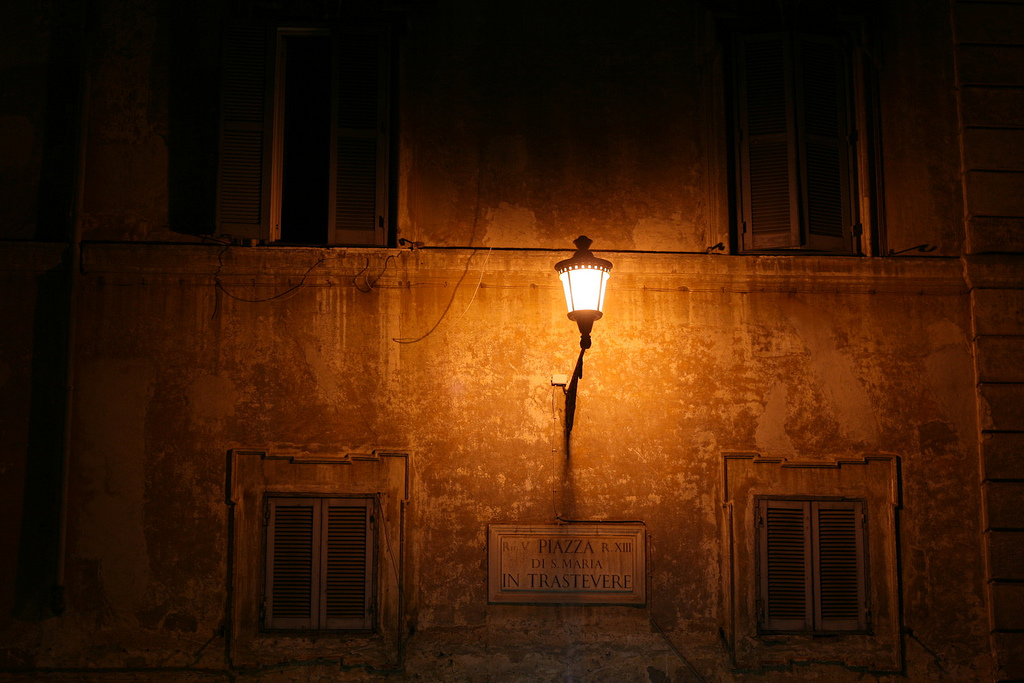
piazza

This week, we’re excited to hold aloft poems from beautiful volumes brought out by Tavern Books of Portland, Oregon and Salt Lake City with this mission:

In addition to reviving books that have fallen out of print, we seek to build a catalog of poetry in translation from the finest writers of our modern era.

Out of appreciation for these goals and the unerring taste embodied in the books published thus far, we are posting three poems this week from the Tavern list and direct readers of The Dish to the Tavern Books site to learn more about their efforts. The first selection is “I’ll Protect Myself” by Leonardo Sinisgalli:

I’ll protect myself from the quick wind
Dusting the piazza light
On the tops of the poplars.
In the quivering pause a swarm
Of leaves climbs the brow of the wall
And thrashes there, a voice
Aching in me all night long.
Again I feel the sad
Vocation to exist,
Dying to seek myself in every place.

(From Night of Shooting Stars: The Selected Poems of Leonardo Sinisgalli, translated, from the Italian, by W.S.Di Piero. Used by kind permission of Tavern Books. Photo by Flickr user Paolo)

Inattention Please

by Jessie Roberts

Wayne Curtis praises Serendipitor, a navigation app that encourages you to embrace happenstance:

“Serendipitor is an alternative navigation app for the iPhone that helps you find something by looking for something else,” the developers explain, although not very helpfully. But their explanation gets better: “In the near future, finding our way from point A to point B will not be the problem. Maintaining consciousness of what happens along the way might be more difficult.” Toward that end, the app is “designed to introduce small slippages and minor displacements within an otherwise optimized and efficient route.” Using Google maps as a base, Serendipitor plots random walks for you, from wherever you happen to be to, well, wherever you happen to end up. Along the way “small detours and minor interruptions” pop up, with instructions such as: “Turn left on Chestnut Street and then follow a pigeon until it flies away. Take a photo of it flying.”

I’ve used this app a number of times. And in an obscure kind of way, it actually helps me stop and pay attention. It’s especially handy when I’m traveling. It serves as a sort of anti-guidebook, prodding me out of the deeply worn routes past the usual landmarks, and making me look around. I have yet to take a picture of a pigeon, but Serendipitor once by happenstance had me walk around a school where I watched the tightly choreographed ritual of picking up children at day’s [end] (it was so precisely orchestrated Merce Cunningham could have been behind it). It also once directed me through a sketchy neighborhood where elderly men sat on stoops and watched me with grave suspicion before greeting me with waves and smiles and small conversations. Serendipitor has introduced some minor adventures into otherwise mundane days.

Curtis quotes Walker Percy:

“The search is what anyone would undertake if he were not sunk in the everydayness of his own life,” said Walker Percy’s protagonist in The Moveigoer. “This morning for example, I felt as if I had come to myself on a strange island. And what does such a castaway do? Why, he pokes around the neighborhood and he doesn’t miss a trick. To become aware of the possibility of the search is to be into something. Not to be onto something is to be in despair.”

Detroiters Should Move To Israel

by Tracy R. Walsh

NextCity_Detroit_FINAL_1300_janik_860_1782

Bill Bradley compiled a list of countries that receive more more federal aid than Detroit:

Oftentimes, the first thing people say when they see Detroit’s hulking ruins and blight is, “It looks like a third-world country.” It’s not unsavory to imagine how more money injected into depopulated cities and struggling urban cores, from New Orleans to East New York, instead of struggling countries might benefit the economy and country as a whole.

The Group Effort

by Jessie Roberts

Bill McKibben thinks that climate science has risen to prominence “not despite its lack of clearly identifiable leaders … [but] because of it”:

For environmentalists, we have a useful analogy close at hand. We’re struggling to replace a brittle, top-heavy energy system, where a few huge power plants provide our electricity, with a dispersed and lightweight grid, where 10 million solar arrays on 10 million rooftops are linked together. The engineers call this “distributed generation,” and it comes with a myriad of benefits. It’s not as prone to catastrophic failure, for one. And it can make use of dispersed energy, instead of relying on a few pools of concentrated fuel. The same principle, it seems to me, applies to movements.

In the last few weeks, for instance, 350.org helped support a nationwide series of rallies called Summerheat. We didn’t organize them ourselves. We knew great environmental justice groups all over the country, and we knew we could highlight their work, while making links between, say, standing up to a toxic Chevron refinery in Richmond, California, and standing up to the challenge of climate change.

From the shores of Lake Huron and Lake Michigan, where a tar-sands pipeline is proposed, to the Columbia River at Vancouver, Washington, where a big oil port is planned, from Utah’s Colorado Plateau, where the first U.S. tar-sands mine has been proposed, to the coal-fired power plant at Brayton Point on the Massachusetts coast and the fracking wells of rural Ohio—Summerheat demonstrated the local depth and global reach of this emerging fossil fuel resistance. I’ve had the pleasure of going to talk at all these places and more besides, but I wasn’t crucial to any of them. I was, at best, a pollinator, not a queen bee.

The Best Of The Dish Today

by Chris Bodenner

European Tourists Flock To Ibiza For Their Summer Holidays

Another slow news day in the late summer doldrums. Tracy outlined the president’s new push for a college ratings system and Patrick checked in with the far right’s latest racial obsession. We also examined the dangers that Chelsea Manning could face in prison and debated the renewed push for intervention in Syria. A top Canadian pol talked openly about smoking pot and a conservative Catholic came out in favor of same-sex marriage.

This observation of the omnipresence of tattoos was popular with readers, and now even animated tattoos are starting to emerge. As “bullshit jobs” are on the rise in the information economy, so are virtual assistants. Language weirdness rankings here and the sunnier side of the Internet here. Major beardage here and here.

Happy weekend!

(Photo: A group of tourists sunbathe at Platja d’en Bossa beach on August 21, 2013 in Ibiza, Spain. The small island of Ibiza lies within the Balearics islands, off the coast of Spain. For many years Ibiza has had a reputation as a party destination. Each year thousands of young people gather to enjoy not only the hot weather and the beaches but also the array of clubs with international DJs playing to vast audiences. By David Ramos/Getty Images)