The Latest Conservative Defector On Same-Sex Marriage

by Matt Sitman

In a moving, personal essay, Joseph Bottum, the conservative Catholic and former editor of First Thingscomes out in favor of same-sex marriage – only five years after declaring its proponents were attacking “biblical ethics.” Part of his argument? Its the wrong battle at the wrong time:

[T]here are much better ways than opposing same-sex marriage for teaching the essential God-hauntedness, the enchantment, of the world—including massive investments in charity, the further evangelizing of Asia, a willingness to face martyrdom by preaching in countries where Christians are killed simply because they are Christians, and a church-wide effort to reinvigorate the beauty and the solemnity of the liturgy. Some Catholic intellectual figures will continue to explore the deep political-theory meanings manifest in the old forms of Christendom, and more power to them, but the rest of us should turn instead to more effective witness in the culture as it actually exists.

How he connects same-sex marriage to his own conservative instincts:

[S]ame-sex marriage might prove a small advance in chastity in a culture that has lost much sense of chastity. Same-sex marriage might prove a small advance in love in a civilization that no longer seems to know what love is for. Same-sex marriage might prove a small advance in the coherence of family life in a society in which the family is dissolving.

I don’t know that it will, of course, and some of the most persuasive statements of conservatism insist that we should not undertake projects the consequences of which we cannot foresee. But same-sex marriage is already here; it’s not as though we can halt it. And other profound statements of conservatism remind us that we must take people as we find them—must instruct the nation where the nation is.

Mark Oppenheimer, interviewing Bottum, unpacks (NYT) the theological assumptions behind his change of heart:

Natural law, Mr. Bottum writes, depends for its force on a sense of the mystery of creation, the enchantment of everyday objects, the sacredness of sex. In the West, that climate of belief has been upended: by science, modernism, a Protestant turn away from mysticism, and, most recently, the sexual revolution. The strictures of natural law were meant to structure an enchanted world — but if the enchantment is gone, the law becomes a pointless artifact of a defunct Christian culture.

“And if,” Mr. Bottum writes, “heterosexual monogamy so lacks the old, enchanted metaphysical foundation that it can end in quick and painless divorce, then what principle allows a refusal of marriage to gays on the grounds of a metaphysical notion like the difference between men and women?”

Traditional-marriage activists would counter that we can at least begin a Christian renaissance by upholding marriage’s last connections to its Christian past. But Mr. Bottum says that’s the wrong starting point.

Is Fish Farming Sustainable?

by Patrick Appel

Aquaculture

Erik Vance worries it isn’t:

Many scientists and environmentalists have been looking to aquaculture — fish farming — as a potential savior for today’s radically diminished wild-fish stocks. Indeed, aquaculture in the crucial Mexican states of Sinaloa and Sonora has doubled every few years over the past decade. In Harper’s, I pointed out that farmed salmon, shrimp, and tuna require massive amounts of fishmeal, which is usually harvested from wild populations. The recent news displays another problem that I didn’t mention, but that is equally problematic: cramming thirty shrimp into one square meter is a little like putting thousands of people into unsanitary prison camps. Disease runs rampant.

(Chart: “Global total wild fish capture and aquaculture production in million tonnes, 1950–2010, as reported by the FAO” from Wikimedia Commons.)

Autism As Artistic Device

by Matt Sitman

Tom Cutterham asks what Christopher and Oskar, the autistic narrators of The Curious Incident of the Dog in the Night Time and Extremely Loud and Incredibly Close, respectively, can teach us about contemporary subjectivity:

The kind of knowledge Christopher and Oskar lack isn’t information — they both have plenty of that. It’s technique. And imagining that lack means we imagine its negative image as well: the subject-supposed-to-know, the person without autism, who can read minds through his or her far more complete grasp of the social world. In other words, we readers see things the narrator can’t, even though he is the one doing the description. It’s precisely this dramatic irony that drives the affect of the novels. The disparity in knowledge doesn’t just create distance between reader and narrator, it creates a kind of closeness, too.

Such relationships with characters makes us feel a little bit like parents. That is, they makes us feel the kind of care that comes with knowledge and power. We know what kind of chaos and hurt will ensue when Christopher turns up unexpectedly to live with his estranged mother and her lover, and just because he doesn’t, we hope it’ll turn out all right anyway. And at the same time that we root for Christopher and Oskar not to get hurt, we excuse the pain they cause to other people. They don’t know what they’re doing, so it’s not their fault.

Recent Dish on autism here and here.

Not Going Where The Jobs Are

by Tracy R. Walsh

mstrtcr1

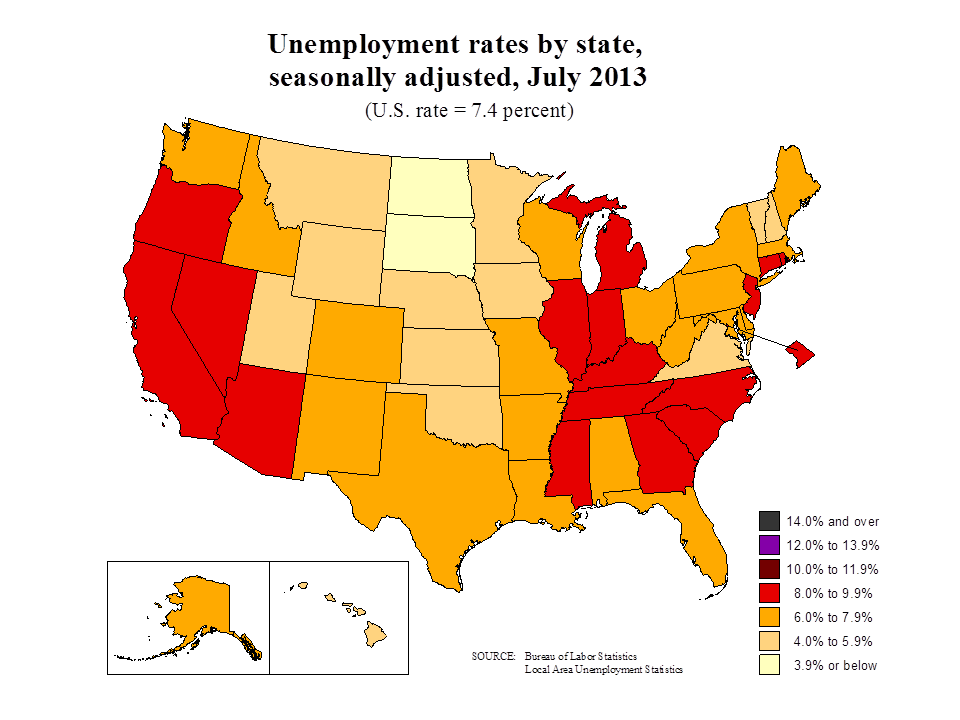
Yglesias wonders why more Americans aren’t moving to find work:

Back in 1985, over 20 percent of the population moved. That number fell steadily to 11.6 percent in 2011 before ticking back up to 12 percent last year. What’s more, even if you just look at interstate moves, a lot of the shifting doesn’t appear to be related to a search for employment. New York to Florida (presumably retirees) leads the Census Bureau’s list of the 10 most common state-to-state moves. None of the 10 lowest-unemployment states are destinations of the top 10 interstate moves, and none of the five highest-unemployment states are departure points for the top 10 interstate moves.

This is bad for unemployed people in Rhode Island and Nevada who perhaps could be getting work in Vermont and North Dakota. But it’s also bad for the broader economy. An outflow of unemployed people from high-joblessness regions would reduce pressure on state and local budgets. And in the low unemployment areas, the arrival of more workers wouldn’t just fill job openings. Their presence would make local labor markets more efficient and would spur investment.

(Map: U.S. Bureau of Labor Statistics)

Why Do Chinese Tourists Have Such A Bad Rep? Ctd

by Chris Bodenner

Readers can relate to a recent post:

One of my vivid memories of traveling in Tibet in 2006 is from visiting one of the monasteries in Lhasa to see the monks debate one another. Dozens of them gathered in a courtyard criss-crossed with stone paths to take part in these lively sessions. It was a unique and wonderful experience, but the Chinese tourists who attended were the one black mark. They treated the place like a zoo and the monks like animals. While almost everyone stayed on the stone paths and kept a respectful distance watching the monks debate and snapping the occasional photo, the Chinese tourists would walk straight up to the monks and stick a camera literally inches from their faces. It was jarring to watch them do it, and obviously the history and ongoing tension between China and Tibet colors the dynamic even more.

Another:

As you can tell from my VFYW and airplane window photos you’ve published, I get around. And little irritates me more while traveling than Chinese tourists.

I enjoy hiking, but don’t expect to see any wildlife when Chinese tourists are around. They block trails by not letting anyone pass, speak at their loudest, don’t respect personal space and just drive every living thing away from their vicinity. As you can imagine, bus loads are the worst, and the Chinese tour guides don’t do anything to take control of the chaos, as they’re often just as bad as their charges right to the point of using bullhorns.

The main reason I’m writing is to share an amusing experience with a Chinese couple while traveling in Australia. On a flight from Sydney to Adelaide a married couple, probably in their mid-fifties, obviously clueless about air travel, was driving the flight cabin crew crazy with their mild panic about every little thing, with the language barrier only making the situation worse (they didn’t speak one word of English and there was no one on the plane who could translate). We were relieved to be landing so we could be rid of them, but as we were descending, wheels down, runway dead ahead, everyone including the cabin crew strapped into their seats, suddenly the Chinese woman decided it was time to use the bathroom! A female cabin crew member unbuckled herself, bolted down the aisle, grabbed the woman from behind, threw her into her seat and buckled her in, then made it back to her own seat just in time for touchdown.

That was entertaining, but we weren’t through with them yet!

Adelaide has a small airport and an equally small luggage carousel. The Chinese couple pushed their way in front of the waiting passengers to the luggage exit and began pulling every black bag off the carousel in what appeared to be a panic as they looked for their own. Soon there was a small pile of black luggage as they were tripping over themselves trying to pull more off while throwing some of the bags back on after they confirmed, with much nervous discussion between themselves, that each rejected bag was not theirs. At one point the Chinese man even fell to one knee onto the carousel, so I was expecting a recreation of the Ab Fab episode where Patsy was riding it! The waiting passengers were dumbstruck. No one knew what to do or wanted to get too close, so I finally announced I’d go get a member of airport security to take charge.

That’s when I heard “They are my parents!” I turned and saw a young Chinese man in his early twenties, just standing there and watching the spectacle. I realized he had arrived at the airport to pick up the couple, so I blurted out “Help them!” He seemed offended and replied “They never travel before!” We had words about his responsibility to help his parents, so the older couple finally settled down and retrieved their bags with their son’s help. Knowing East Asian cultures, younger people are often hard-pressed to correct or give direction to members of their older generation, even when they’re making a scene.

It turns out Adelaide has several universities that attract large numbers of Chinese students, so we surmised this couple was making a visit to their son, possibly their first time outside of China. Hopefully he gave them some instructions for making it home without any calamities.

Another:

My husband and I were in Paris last February and did a tour of Versailles. We lucked out in that we were the only English speakers that morning and had an English-speaking tour guide to ourselves. Over the course of three hours, we were jostled from room to room and throughout the grounds, fighting for space among the bus-loads of Chinese tourists. Towards the end of the tour, our snobby French tour guide, who never seemed to thaw towards us, turned to us and said “I can’t believe I’m going to say this but Chinese tourists make me long for the days when Versailles was overrun by Americans.”

Ranking Languages By Weirdness

by Tracy R. Walsh

English is full of maddening irregularities, but by global standards it’s far from the most unusual language:

A recent study by a language-processing company called Idibon tried to establish not which languages are “hard,” but which are “weird.” It used a resource called the World Atlas of Linguistic Structures (WALS). WALS indexes hundreds of languages across hundreds of different features (from whether verbs precede objects to whether the language uses click-sounds as consonants). The Idibon study tried to find which languages use the greatest number of unusual features—i.e., those features shared with few other languages. But for tricky methodological reasons, the study had to limit itself 21 features. The languages that have the least “normal” values of these 21 features are the “weirdest.”

Does English rank high? Not especially. Many non-European languages dominate the top of the list. Of those languages in the Indo-European family with English, German, Swedish, Danish, Dutch, Norwegian, Czech, Spanish, Kurdish and Kashmiri all rank as “weirder.” English is at place number 33 of 239 languages in the “weirdness index.”

However, the study’s authors note that 33 out of 239 is still “highly unusual.” The weirdest tongue is Chalcatongo Mixtec, a tonal language spoken by 6,000 in southern Mexico, while the most conventional language is Hindi.

Treating Your Stomach For Depression

by Brendan James

Carrie Arnold explores research pointing to increasing evidence “that psychiatric woes can be solved by targeting the digestive system”:

For decades, researchers have known of the connection between the brain and the gut. Anxiety often causes nausea and diarrhea, and depression can change appetite. The connection may have been established, but scientists thought communication was one way: it traveled from the brain to the gut, and not the other way around.

But now, a new understanding of the trillions of microbes living in our guts reveals that this communication process is more like a multi-lane superhighway than a one-way street. By showing that changing bacteria in the gut can change behavior, this new research might one day transform the way we understand — and treat — a variety of mental health disorders.

So far it looks like tweaking bacteria would carry the most mental benefits while a patient is still young.

Syria In The Red, Ctd

by Brendan James

Andrew J. Tabler advises the White House move to preempt further chemical violence:

Washington should make clear to Russia and Syria that, absent convincing evidence of the regime exercising control over all C.W. [chemical weapons] on its territory, episodes such yesterday’s will require the United States and its allies to take military action to prevent future use. Given the practical difficulties of locating and seizing C.W. stocks and the danger to nearby civilians from attacks on C.W. storage sites, such a warning would presumably mean airstrikes on regime units responsible for using chemical agents and, perhaps, on C.W.-related facilities.

The Post’s editorial board also opts for intervention, through a no-fly-zone. Larison shoots down the idea:

A no-fly zone isn’t going to target the missiles and artillery that the regime would use to launch more chemical weapons. As such, a no-fly zone might be imposed over southern Syria and civilians would still come under attack anyway. Establishing a no-fly zone creates the illusion of protection without offering the real thing. Foreign attacks on the Syrian military would give Assad another incentive to use more chemical weapons, and they certainly wouldn’t be able to prevent future use of those weapons.

U.S. military action wouldn’t reduce the likelihood of more chemical weapons being used against civilian targets, and to the extent that it succeeded in weakening regime forces it would increase the chances that those weapons are captured by jihadists.

More Dish on the renewed debate over intervention here and here.

Christopher Lane Isn’t Trayvon Martin

by Patrick Appel

Glenn Beck fixates on the race of Christopher Lane’s suspected murderers:

Adam Serwer looks at how the right has seized upon the story:

Twenty-two year old Christopher Lane, a student at East Central University, was shot dead in Duncan, Okla., on Aug. 16. Lane’s death has drawn national attention because the teenage suspects allegedly told police that they shot him because they were “bored and didn’t have anything to do.” Many Australian press reports have have focused on the easy availability of firearms in the United States.

Conservative media however, have honed in on the argument that the three suspects are black and the victim is white. In fact, one of the suspects is white, an official from the Stephens County District Attorney’s office told MSNBC Wednesday. “That is not the case,” the official said when asked whether all three suspects were black. “One is black, one is half-black half-white, the other is white.” Conservative media appear to have relied on an erroneous report in the Australian media about the identity of the suspects. Right-wing outlets have since singled out tweets from one of the suspects that include derogatory language aimed at white people.

Local officials have not presented evidence yet that the killing was related to or based on race, but for many conservative outlets, the assumed race of the suspects was proof enough that Lane’s killing was racially motivated.

Bouie adds:

Lane’s death has become fodder for conservative media, and in particular, its narrative of white victimization.

See, the two suspects charged with murder aren’t just teenagers, they’re young black men. And for these right-wing provocateurs, the identity of the assailants is a direct rebuke to the “Justice for Trayvon” movement and evidence of racial hypocrisy from civil-rights leaders and anyone else who spoke about the George Zimmerman trial.

“It’s worse than a double standard. This is a purposeful, willful ignoring of the exact racial components, but in reverse, that happened in the Trayvon Martin shooting,” said Rush Limbaugh, speaking on his radio show. “From Obama on down, didn’t care about Trayvon Martin. All that mattered was that incident offered them an opportunity to advance a political agenda.” He also dinged the media for not focusing on the “racial component of any of the people involved in this.”

Weigel counters Limbaugh et al:

[H]ow hard is it to understand how the Martin/Zimmerman case became a sensation? It wasn’t the only shooting of a black person by a nonblack person that year. Martin was shot on Feb. 26, 2012. Zimmerman was taken in by police but released after five hours, and not charged. The first national media stories about the shooting came more than a week later, and it took until April 11 for Zimmerman to be charged. Compare that with the Lane tragedy: He was shot on Friday, and the suspects were charged four days later. And the second wave of Zimmerman/Martin news came after Zimmerman was acquitted. On Earth-2, where Zimmerman is charged on Feb. 27, does this story from Sanford, Fla., become a national “teaching moment”? I don’t think it does.