Syria In The Red, Ctd

by Chas Danner

https://twitter.com/DarthNader/status/370221107862700032

Michael Hirsh connects this week’s chemical attack to how the US has handled Egypt:

[W]e may now be at a historic turning point in the Arab Spring—what is effectively the end of it, at least for now. Assad, says Syria expert Joshua Landis, is surely taking on board the lessons of the last few weeks: If the United States wasn’t going to intervene or even protest very loudly over the killing of mildly radical Muslim Brotherhood supporters, it’s certainly not going to take a firmer hand against Assad’s slaughter of even more radical anti-U.S. groups. …

What began, in the U.S. interpretation, as an inspiring drive for democracy and freedom from dictators and public corruption has now become, for Washington, a coldly realpolitik calculation. As the Obama administration sees it, the military in Egypt is doing the dirty work of confronting radical political Islam, if harshly. In Syria, the main antagonists are both declared enemies of the United States, with Bashar al-Assad and Iran-supported Hezbollah aligning against al-Qaida-linked Islamist militias. Why shouldn’t Washington’s policy be to allow them to engage each other, thinning the ranks of each?

Andrew Tabler predicts that if Assad is allowed to win, it will lead to a perpetual problem:

The most realistic scenario [for] a postwar Assad-led Syria is a state in which multiple sponsors of terror — Assad himself, the Iranian regime, Sunni offshoots of al Qaeda — are simultaneously pursuing their own ends alongside one another. It would likely be the source of instability, as well as the site of brutal crimes against humanity, for years to come. That’s why it is in the West’s interest to prevent Assad’s survival by ordering airstrikes on regime targets, pressuring Moscow and Tehran to stop supporting him, and aiding moderate members of the Syrian opposition. Otherwise, the only upside of Syria’s future will be that it will finally put the lie to the adage “Better the devil you know than the devil you don’t.”

Earlier Dish on the US response to Syria here.

Afraid Of The Enemy Within

by Patrick Appel

Jessie Walker thinks that “Washington is petrified of itself”:

Washington is classifying documents at a remarkable rate. According to a report from the Public Interest Declassification Board last year, one intelligence agency alone classifies the equivalent of about 20 million well-stuffed four-drawer filing cabinets every 18 months. Nearly 5 million federal employees or contractors have access to at least some secret information. Even more have access to information that isn’t classified but might embarrass someone.

That creates a double bind: The more the government trusts someone with sensitive data, the more it has reason to fear that person. Trust breeds mistrust. It’s the sort of situation that might make a person paranoid.

Bruce Schneier explains how to minimize leaks:

The best defense is to limit the number of trusted people needed within an organization. [NSA Director General Keith] Alexander is doing this at the NSA — albeit too late — by trying to reduce the number of system administrators by 90 percent. This is just a tiny part of the problem; in the U.S. government, as many as 4 million people, including contractors, hold top-secret or higher security clearances. That’s far too many.

The 10,000 Hour Rule

by Patrick Appel

Peter Orszag thinks it has been debunked:

Like many others who read Malcolm Gladwell’s book “Outliers” when it came out five years ago, I was impressed by the 10,000-hour rule of expertise. I wrote a column (for a different publication) espousing the rule, which holds that to become a world-class competitor at anything from chess to tennis to baseball, all that’s required is 10,000 hours of deliberate practice. David Epstein has convinced me I was wrong. His thoroughly researched new book, “The Sports Gene,” pretty much demolishes the 10,000-hour rule — and much of “Outliers” along with it.

Gladwell protests:

“We’ve tested over ten thousand boys,” Epstein quotes one South African researcher as saying, “and I’ve never seen a boy who was slow become fast.” As it happens, I have been a runner and a serious track-and-field fan my entire life, and I have never seen a boy who was slow become fast either. For that matter, I’ve never met someone who thinks a boy who was slow can become fast. Epstein has written a wonderful book. But I wonder if, in his zeal to stake out a provocative claim on this one matter, he has built himself a straw man.

The point of Simon and Chase’s paper years ago was that cognitively complex activities take many years to master because they require that a very long list of situations and possibilities and scenarios be experienced and processed. There’s a reason the Beatles didn’t give us “The White Album” when they were teen-agers. And if the surgeon who wants to fuse your spinal cord did some newfangled online accelerated residency, you should probably tell him no. It does not invalidate the ten-thousand-hour principle, however, to point out that in instances where there are not a long list of situations and scenarios and possibilities to master—like jumping really high, running as fast as you can in a straight line, or directing a sharp object at a large, round piece of cork—expertise can be attained a whole lot more quickly. What Simon and Chase wrote forty years ago remains true today. In cognitively demanding fields, there are no naturals.

Earlier Dish on Epstein’s book here.

How Gay Is Russia? Ctd

by Chris Bodenner

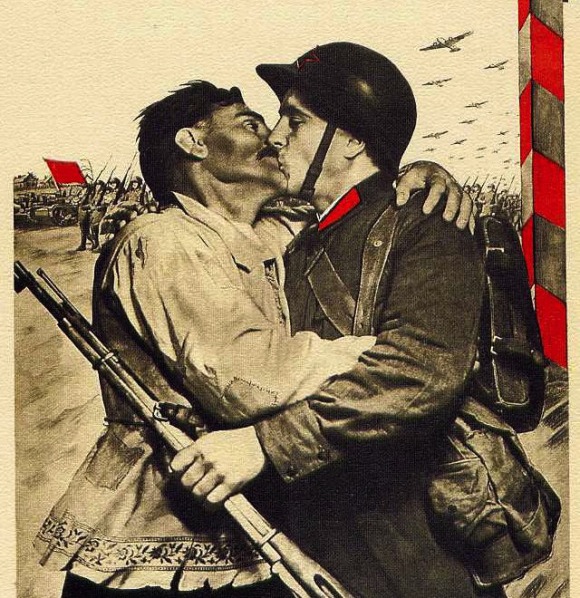
27liberation1939-1

A reader sends a “great image to add to the thread”:

It’s a WWII-era Soviet propaganda poster commemorating the Soviet occupation of Western Belarus, liberating the region from Poland as a result of the Molotov-Ribbentrop Pact. The image you see is being played completely straight, so to speak; Stalinist propaganda in 1939 was NOT the place to be subversive.

Another:

To the reader who said that Russia was until recently less homophobic society than America … wow. I will defer to his personal experience, but then I should share my own, because I wonder how much of his is Moscow-based (and if it’s just Moscow, the apt comparison would be NYC, not “America”.)

I’m straight, but on occasion I went to the one semi-underground gay bar that any of my gay-heavy, Western European circle of friends could find in St. Petersburg in 2002. (This is the country’s second city, mind you.) Two years later I taught HIV/AIDS education in the capital of one of the wealthiest Russian provinces, and the open and vitriolic homophobia displayed by the high school and college kids was intense. I was back there for many months in ’07 and it hadn’t disappeared. All my Russian friends were well-educated: doctors, journalists, judges, etc. The level of homophobia on display was, again, intense.

Maybe Moscow’s different; I wouldn’t know. But I can certainly say that my experiences in the provinces and Petersburg don’t match up with your reader’s.

From Bradley To Chelsea Manning

by Brendan James

https://twitter.com/attackerman/status/370619079151075328

This morning Bradley Manning released a statement declaring a new gender identity, taking the name Chelsea and resuming a transition interrupted by her military trial. Manning’s biographer Denver Nicks places the announcement in context:

We’ve known for some time that Manning struggled with gender identity issues–a struggle that got top billing in his defense–and considered herself, at least for a time, to be a woman, so I’m not surprised by the announcement. I suspect it is coming only now, after his sentence has come down, because Manning wanted to avoid antagonizing the court by appearing to make more of a spectacle of the trial than it already is. … Inevitable rhetorical challenges aside, the important thing for us in the media is to report on Manning with respect for the trans experience.

In response to the NYT and other outlets referring to Manning as “he” while reporting the change, Ryan Kearney points out that most style guides provide easy rules in this case:

The Guardian, to its credit, changed its topic page to “Chelsea Manning.” This should not be the exception, but the rule. Even the Associated Press stylebook says so: that reporters should “use the pronoun preferred by the individuals who have acquired the physical characteristics of the opposite sex or present themselves in a way that does not correspond with their sex at birth. If that preference is not expressed, use the pronoun consistent with the way the individuals live publicly.”

Maureen O’Connor notes that the media respects other types of name changes:

Why is it so hard for people to type an extra when they write about Manning? We updated our nomenclature for “Snoop Lion” and “the Artist Formerly Known as Prince.” “Ali Lohan” and “Lil’ Bow Wow” became “Aliana” and “Bow Wow” to reflect personal growth. We accept typographical requests from branded products like iPhone, PowerPoint, and eHarmony — and from branded humans like Ke$ha, A$AP Rocky, and ‘N Sync. (The last being unusual even without the asterisk.) The idiosyncrasies of capitalism, apparently, are more compelling than a human’s self-professed gender.

Amanda Marcotte urges the press to start using the new pronoun:

The goal here should be to move as quickly as possible from referring to Manning by a male name and male pronouns to her female name and pronouns. The sooner journalists stop writing “Bradley” and start writing “Chelsea,” the quicker everyone following this story will adapt—and even change their Google search terms when looking for coverage. A gender-free headline to indicate that this is an in-between stage in coverage makes sense, but with this announcement, Manning herself gave everyone a nice, clean break—a point to just stop saying “he” and start saying “she.”

Even if you disagree with Manning’s actions and believe she deserves the harsh sentence she received, her gender identity had nothing to do with her crimes.

Katie McDonough views the episode as a rallying point for coverage of transgender subjects:

[T]hese failures in reporting have not gone unchecked. There is a growing chorus of transgender rights advocates rallying for accountability from major news outlets. Formal complaints have been submitted to the BBC and the New York Times, and this conversation, probably the most mainstream discussion the press has had to-date about transgender identity and the importance of respectful (and truthful) use of pronouns and chosen names, could very well set an important precedent for future coverage of transgender issues.

Of course, Rod Dreher isn’t having it:

I presume Bradley Manning still has a penis and male chromosomes. He is not a female simply because he says he is. Though I very much doubt that the military will give him the female hormones he has requested for his prison stay, Manning may have the operation one day, but for now, he is still a he. I don’t see why feeling pity for Manning’s psychological suffering requires us to play along with his hallucination. If you want to do so, be my guest, but shouldn’t journalists hold themselves to different standards?

Meanwhile, Sarah Kliff looks into whether Manning is likely to receive the hormone therapy she’s requested, since Fort Leavenworth denies they supply it:

“Where inmates have been denied care, courts have said that’s unconstitutional,” says Jennifer Levi, director of the Transgender Rights Project at Gay and Lesbian Advocates and Defenders. “I don’t know of any cases that have been brought yet against military prisons. But they would have the same obligation to provide adequate medical care.” Levi worked with a North Carolina inmate to reform federal policy on hormone replacement therapy in prison. Vanessa Adams entered a North Carolina facility at age 29. She was biologically male but “self-identified as female throughout her adult life,” according to court documents.

“Because of this, she wanted to initiate the gender transition process prior to her incarceration, but found herself unable to do so in the face of the restrictions imposed on her by a conservative family and workplace,” the lawsuit continues. Adams had been diagnosed with gender identity disorder; Manning has also received the same diagnosis.

Al-Jazeera Arrives, Ctd

by Brendan James

Laura Bennett is impressed with the new American channel, but notes that “the overall effect is not quite as different from the rest of cable news as Al Jazeera imagines it”:

The overall message is clear: that this is an open and democratic forum, a place for guests to freely express complicated and wide-ranging views rather than have them crammed into ideological categories. Of course, in its own sly way, Al Jazeera pushes its politics with the same insistence as Fox or MSNBC, if not with nearly the same theatrics; an undercurrent of Bush-era exasperation with American blinkeredness still runs through every report from the Middle East. And it’s strange to see #pray4Egypt flashing on the bottom of the screen, a subtle bit of community-building that makes audience participation seem more ideological than ever.

But Al Jazeera’s coverage is fueled by a placid faith in the reasonableness of its position rather than a knee-jerk ideological defensiveness.

Lloyd Grove felt that, during the network’s debut, the “pace was slow, the production values were plodding and predictable, and the presentation relied heavily on yakking, and more yakking, straight to camera.” But he hopes the network will succeed:

[I]n an age of media belt tightening, when once-imposing journalistic institutions are being shuttered or sold for a fraction of their historic value, it is heartening that a Gulf-state emir, of all people, is willing to spend hundreds of millions, and probably billions, of dollars to field a serious news organization in the United States. For that reason alone, I am rooting for Al Jazeera America and its 850-odd staffers led by veteran ABC News executive Kate O’Brian, and hope they find a way to reach an audience, attract advertisers, and land on a growing number of cable systems.

Ana Marie Cox doles out high praise for AJAM’s nightly news program, America Tonight:

What’s revolutionary about the show is what wasn’t in it: no mention of “Obamacare” (indeed, I’m not sure there was a mention of Obama, specifically). No mention of rodeo clowns, or Ted Cruz’s birth certificate, or Hillary. Nothing about gun control or Trayvon Martin, either. Nor voting rights, gay rights and the Olympics, nor the Tea Party.

It’s as if the producers: a) knew that the first primaries for 2016 were a year away; and b) understood that some topics, while worthwhile, had not further evolved since they were last discussed. While there was a suspicious lack of “America” to the stories on “America Tonight”, what stories did run bore more relevance to the contemporary lives of average Americans than anything on the other networks.

Does Birth Order Matter? Ctd

by Chris Bodenner

A reader writes:

One point about the arguments you’ve posted so far: They all seem to operate from the assumption the family dynamic is a closed system absent of any outside influences.  That certainly isn’t our experience. With two working parents, our daughters spend a good deal of time with the sitter and her three boys (all older than our girls).  My first born might be that at our house, but she’s the fourth during the day, Monday through Friday.  My wife and I are certain she modeled eating, walking, potty training and many other developmental milestones off of her weekday siblings’ examples. We are grateful for this because it made our lives much easier as first-time parents. But if someone was evaluating her birth order and the impact on her development, temperament, personality, etc. they’d get it all wrong without that additional background about her upbringing.

Thanks for the great blog.  It’s a godsend for busy parents who don’t have a ton of time but still need a helpful filter and fresh perspective on the day’s news.

An expert weighs in:

There are hundreds of studies looking at the effects of birth order, mainly because it is among the easiest parameters to ask a test subject on a questionnaire. Effects ranging from long-term income to personality type get assigned to birth order. Unfortunately, most of these studies suffer from two major flaws, outlined in Welcome To Your Child’s Brain. The first issue is:

who answers the survey? If you ask family members about each other, they answer in terms of their relationships. Mothers tend to think their older children are more responsible, and their younger children are more rebellious. Well, duh – this is the relationship between siblings. In studies where the evaluator is a non-family member, these effects go away.

The second issue is more subtle: every family with children has a firstborn, but only multi-child families have later-borns. So on average, later-borns come from larger families – and therefore have fewer resources per child. Once this socioeconomic confound is removed, many more effects go away.

After all this, one remaining factor that remains significant is theory-of-mind, a measure of empathy. Younger siblings acquire theory-of-mind before older siblings, by about 6-8 months for each older sibling. Reasons might include having a sibling to emulate, or having to understand the motivations of others to compete for resources. This does not necessarily mean more intelligence – but it might mean more empathy.

Not All Cancer Kills

by Patrick Appel

Virginia Postrel discourages grouping different types of cancer together:

[T]hough [prostate cancer specialist Peter] Carroll thinks calling slow-growing prostate tumors “cancer” is important to encourage vigilance, [urologist Ian] Thompson wants to change the nomenclature, using the term IDLE (indolent lesions of epithelial origin) to describe low-risk cases where waiting isn’t likely to make a difference. Just using the word “cancer,” he argues, creates unnecessary suffering.

“The number of people that will die from those slow-growing prostate cancers is really low,” he says, but the unacknowledged costs of giving them a cancer diagnosis are huge: “the person who can’t sleep for two weeks before his next test results, and all the follow-up biopsies and all the lost wages, and the people who can’t get life insurance because they now have a new cancer diagnosis, the person whose firm says, ‘Well, we’re concerned you have cancer and therefore you can’t be promoted to this job.’”

It’s a compelling case, but changing the vocabulary finesses the fundamental cultural issue: the widespread and incorrect belief that “cancer” is a single condition, defined only by site in the body, rather than a broad category like “infectious disease.” Someone doesn’t develop “cancer” but, rather, “a cancer.” How frightening that diagnosis should be depends on which one.