Antiheroes Everywhere, Ctd

by Brendan James

A reader makes an interesting point about our attraction to antiheroes:

All the antiheroes that have been mentioned so far have a single thing in common: competence. We are invested in a character if they are shown to be competent at what they do. It gives them dimension. We don’t care about those truly rotten, no-good, one-dimensional thugs and ne’er-do-wells who serve as their subordinates, simply because they get caught easily, or are shown in some other way not to be very good at it, the ‘it’ here being evil. But we care about their bosses, the Tony Sopranos and the Walter Whites, because their bosses have been demonstrated to be good, very good, at being terrible.

Is that really all it takes for us to forgive, or at least look past, murder, treachery, deceit, betrayal, and manipulation, of which both Tony Soprano and Walter White are most certainly guilty? That you’re good at it? That’s what it takes in real life, too. We have a secret respect for sociopaths whom we find to be talented, even if what they do is abhorrent to us. That’s why we elect them to higher office.

Shouldn’t we change that? Doesn’t that say more about us than them?

Another supports the view that Breaking Bad is a critique, not an example, of the antihero ethos:

Your reader wrote, “Walter White … is the show, and we very much care what happens to him.”

Um, sorry. No.

Anyone who cares what happens to Walter White shares at least some of his extensive laundry list of pathologies.  Except for the obvious hiccup it would cause in the show’s dramatic arc, Walter White should have been put down like a rabid dog a long time ago and I wouldn’t care who did it – Jesse, Skyler, Gus, Mike, Jane, Tio or any of the thugs who drift in and out of the show, apparently unable to figure out how depraved Walter White is because of his mad chemistry skillz.

The only reason I’ve watched this long is to see Walter White take his licks and hope that someone takes off that stupid hat of his…with his head still in it. I’ve never wanted any character in film or TV – including the villains – to meet his or her demise more than I want it for Walter White. Not an iota of redemptive value in the man. (Yes, I suppose hating on Walter White is one of my pathologies.)

Another can’t accept viewers are still feeling for Walter, despite his role as the protagonist:

That reader has written himself or herself out of the moral universe. If there is to be sympathy for Walter White, it is only of the most limited kind: grief for what he was and what he has become.

But even that’s a stretch. At this point, if you still hope that Walter somehow makes it out of this alive, you truly are fraternizing with the devil, and a devil that has systematically dismantled the chances for wholeness of all the people around him. Hoping the best for him is wicked.

“Life Has Become Safer Without A Beard”

by Chas Danner

Haitham El-Tabei highlights how pogonophiliacs are being persecuted in Egypt as anti-Islamist fervor sweeps the nation:

One Western news photographer decided to shave his beard after being repeatedly accosted in the street and even threatened by Egyptians who mistook him for a member of the Muslim Brotherhood. A bearded taxi driver, meanwhile, admitted customers were increasingly reluctant to use his services.

“This is possibly the beginning of a campaign to boycott bearded taxi drivers,” he told AFP.

Mohammed Ibrahim, a pharmacist who also has a beard, has changed his route to work and the hours he keeps in order to avoid “tension with the popular committees.” As the crackdown continues, reports have suggested that some preachers have even offered religious dispensation to the faithful who want to shave their beards to avoid being targeted.

“The hostility of the people is even worse than police harassment,” said Mohamed Tolba, a Salafist Muslim.

Deciding Between The Decades

by Patrick Appel

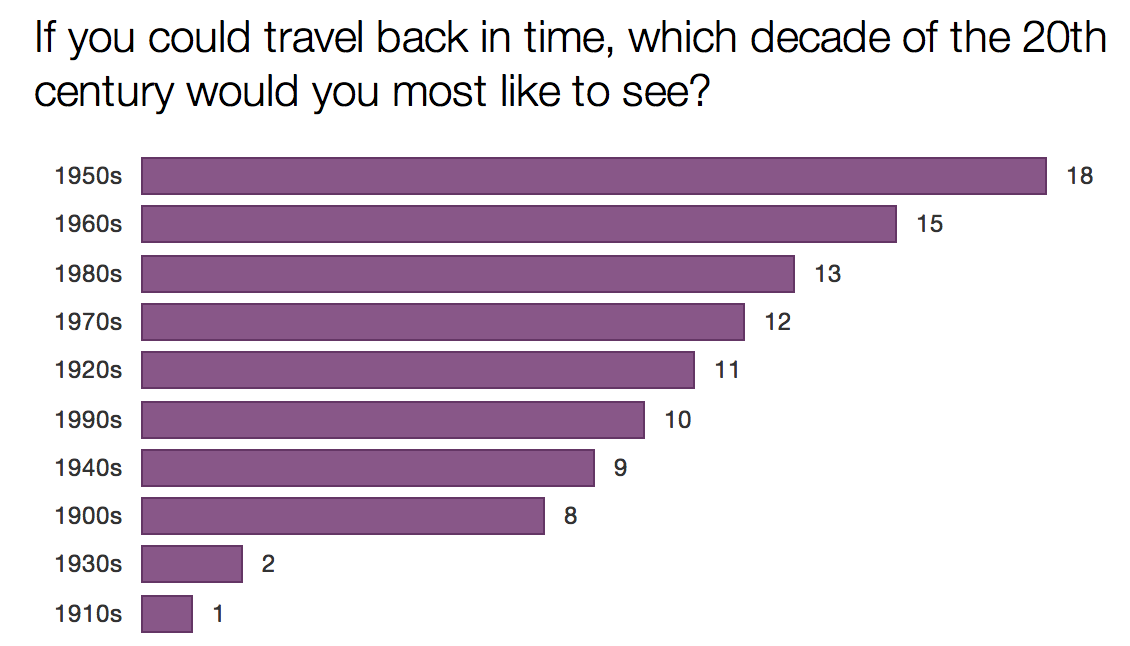
The results of a recent YouGov survey:

Time Travel

Drum breaks down the numbers by age:

[T]he most popular choice of nearly every age group is a decade of their youth. millennials like the ’90s, when they were growing up. My generation likes the ’80s, when we were just out of college. Only the thirtysomethings seem not to care, showing no particular preference for any decade between the ’50s and ’90s.

But it’s the nostalgia of seniors for the ’50s that intrigues me the most. I’d love to see a demographic breakdown of that. I assume that nonwhites aren’t pining away for that era, which means that white seniors must really be in love with it to produce such a high overall number.

Millman compares Republicans and Democrats:

Republicans and Democrats largely agree about the decades before the 1980s. Democrats actually like the Republican-dominated 1920s better than Republicans do, and Republicans slightly prefer the Kennedy-Johnson ’60s over Democratic views of that decade, but from the 1900s through the 1970s, memories move roughly in tandem. Then, in the 1980s, there’s a split, as Republicans prefer the ’80s somewhat over the ’70s, while Democrats feel the opposite. And then, with the ’90s, there’s a huge disparity, with Democrats preferring them slightly over the ’80s, and roughly in-line with the ’50s, ’60s and ’70s, while Republicans loathe the ’90s only slightly less than they do the ’30s or the ’10s.

And, finally, Yglesias asks why the 1990s gets so little love.

What Egypt Has Become

by Patrick Appel

Jon Lee Anderson compares Egypt’s military junta to the former military dictatorships of Latin America that the US supported in the name of fighting Communism:

Today’s Islamists can be yesterday’s Marxists, it seems: killable on behalf of notional constructs of law and order. … The no-holds-barred military terror in Egypt, and the language the military is employing to justify it, is reminiscent of the worst of human legacies. These are the sort of statements made not by ordinary armies but by armies that have embraced ideological convictions that make it easy to shoot down people in the streets, even civilians, if you believe that they are with the terrorists—or whatever it is you decide to call them.

Nathan Brown looks ahead:

What is clear now is that Egypt’s constitutional moment is over.

The hope born in the 2011 uprising was that diverse political forces would come to an agreement on the rules of politics — ones that would protect human rights, provide for a popular voice in governance, and devise mechanisms of accountability, and do such things in ways that were broadly accepted. That hope is not just dead; it was murdered by the country’s feuding leaders. The question is no longer whether the current course is the wisest one for Egypt  – it almost certainly is not. But this is the choice that Egyptian leaders have made for each other.

The result, while it is based on a destruction of the hopes of 2011, is one that will have recognizably democratic elements (elections, a multiparty system, civilian leaders). It will likely establish itself as operational even if it does not provide full stability or social and political peace. Its actual working will enable rather than avoid repression. Egypt’s international interlocutors in the West may have advised against this path, but they will have to decide soon whether or not to accept it. The current regime’s insistence that this is a sovereign decision will make Western governments uncomfortable for now but they will likely ultimately accept it. They will still face the question of whether to treat it as a distasteful autocracy or a flawed but aspiring democracy — or whether to bother to make the distinction.

Syria In The Red

by Brendan James

More images and testimonials of this week’s purported chemical attack flood in, with Human Rights Watch currently placing the death toll at several hundred. Jay Newton-Small sums up the administration’s tepid response, despite previous red-line rhetoric:

[T]he White House isn’t exactly springing into action. “We are calling for this U.N. investigation to be conducted,” said Obama spokesman Josh Earnest on Wednesday. “This is a situation that is ongoing, and our efforts to work with the international community and to work with the Syrian opposition to remove [President Bashar] Assad from power are ongoing.” Earnest upgraded his rhetoric slightly Thursday morning, telling reporters aboard Air Force One en route to Buffalo where the President was scheduled to give a speech about making college more affordable, that the images out of Syria “are nothing short of horrifying.”

Still, the translation amounts to: Don’t hold your breath waiting for air strikes.

Jon Western wonders if this latest attack will serve as “Syria’s Srebrenica”:

If you recall, Srebrenica did not fundamentally change the traditional, realist strategic logic on the ground during the Bosnian conflict — yet all of the internal notes on White House deliberations (as reported in Ivo Daalder’s Getting to Dayton or Derek Chollet’s history of Dayton) reveal how conceptions of interests and ideals became intertwined with the scale of the atrocity.   Domestically, there was some Congressional pressure to do more in Bosnia, but very little pressure from public opinion. Srebrenica was a game changer.

I think this is what we are likely to see happen now in Syria — and I think it changes the equation regardless of whether or not there is definitive proof as to who perpetrated the attack.  The mere fact of such a large scale loss of life in a chemical attack — along with changing dynamics throughout the region — will produce significant pressure on, and within, the administration to commit resources — airstrikes on key Syrian military installations and probably no-fly, no missile zone over Syria — something, anything, to move the conflict to some kind of end-game.

Still, Max Fisher lists off the reasons not to expect a new agenda from the White House:

Any White House cares first and foremost about domestic politics, and this administration was punished severely for its leadership on Libya; many of the same political voices that demanded the intervention spent months hammering the White House when, in the foreseeably dangerous post-conflict disorder of Benghazi, a militant group succeeded in attacking the local U.S. diplomatic outpost and killing the ambassador. You might think that Libya would have been considered a political success for the Obama administration, but it became a major political liability.

The White House’s efforts to reach out to Islamist groups in Egypt and Tunisia, meanwhile, received condemnation and criticism at home. Pragmatic, long-view Middle East watchers turn out to represent a fairly narrow slice of the American electorate. And political figures who ask the White House to take big foreign policy risks appear quite willing to punish the administration if anything goes wrong.

Who Should Cover Climate Change?

by Patrick Appel

Everyone:

Climate change is about rapidly accelerating changes in the substrate of modern civilization, the weather patterns and sea levels that have held relatively steady throughout all advanced human development. By its nature, it affects everything that rests on that substrate: agriculture, land use, transportation, energy, politics, behavior … everything. Climate change is not “a story,” but a background condition for all future stories. The idea that it should or could be adequately covered by a subset of “environmental journalists” was always an insane fiction. It is especially insane given the declining numbers who identify themselves as such.

We need to disentangle the fate of environmental journalism from media coverage of climate change. The two need not be connected. The pressing, nay existential imperative to divert from the status quo and radically reduce greenhouse gas emissions is necessarily enmeshed in all major human decisions. And so journalists who cover those decisions, whatever their “beat,” need to understand how climate change, as a background condition, informs or shapes the decisions. In journalism, as in other fields, climate needs to be freed from the “environmental” straightjacket.

The Poor Door, Ctd

by Chris Bodenner

A reader quotes Josh Barro:

“The only real outrage is that Extell had to build affordable units at all.” Pardon me, but fuck that. A legitimate goal for a city is to make provision for housing to its low-income residents. In the not-so distant-past, that goal was met by housing projects in the ghetto. It only took a generation or two to quickly realize that wasn’t the best way to go.

The new way is to lavish massive subsidies on developers in exchange for a certain number of the total housing units in a development to remain affordable for a period of time. It works like a mortgage, only no repayment is required. The subsidy could be direct cash in the project or more lucrative low-income housing tax credit deals.

Here Extell is being allowed to boost its square footage and have their development subsidized. The city is able to meet its goals. Extell could jog on and find another project, but they didn’t because there is more money to be made. Outrage? Excuse me again when I say fuck that.

Another:

As a New Yorker who lives in a similar “80/20” building on the Upper West Side, I strongly support John Barro’s position. I pay $5200 a month for a 1050 square foot apartment with two beds and two baths on a high floor of our building that has Hudson River views.

I know to 99% of the country, that figure is ridiculous, but in New York, it is what it is. Over the past few months, our management company has been jacking rents on both vacancies and renewals by at least 20%, meaning that if I want to stay in my apartment I have to pay $6200 or more. So my wife and I have decided to move.

Meanwhile, 12 floors below us are “low-income tenants” living in basically the same apartment without the view of the Hudson River – for less than $1,000 a month. Do you know how much more disposable income I would have if I could pay $1,000 a month? Of course, the 20% of the units that are rent-controlled/rent-stablized will not be faced with the same level of rent increases.

Look, I don’t have the answers to the affordability of Manhattan, but my wife and I work our asses off to afford the life we live. So it’s unfair, unnecessary and unreasonable for folks who can’t afford it to be afforded the right to live in the same building, in basically the same apartment, for $5,000 less per month than me.

Another New Yorker:

This “new” development does not sound all that new to me. What I am about to describe are events of 15 years ago.  After ten years on the Section 8 waiting list, my mother moved from a slum on E. 103rd Street to a new building on 95th Street.  This building had two wings: one of five or six stories of Section 8 housing connected to a high-rise tower of luxury condos, separated by the spa and fitness facility.  Along with a separate elevator bank, there was a separate entrance for the Section 8 wing to the street, but one could use the avenue entrance door at any time.  At first blush, the “separateness” seemed to be appalling.

Then a reality check.  My mother’s apartment was very nice and nicely equipped, the common areas were well-maintained, there was 24-hour building security, the building staff – from management to cleaning staff – treated my mother as they treated every other resident: with respect and dignity.  And when my mother died, there was no trouble gaining access to her apartment, we received a very nice condolence card from the building management, and every staff person we came into contact had something nice to say about Mom.

Bottom line: For the last few years of my mother’s life she lived in a safe, clean building, and she was treated with dignity in the place she called home.  Compared to where she lived before that, this was a dream come true.  The separate “entrance” was – and is – a non-issue.

Update from a reader:

I am not familiar with the details of the proposed project in Manhattan, or of the building in which your reader lives who complained about the cheap rents offered to low-income families; however, I am in the commercial real estate industry and familiar with the issues and incentives and how it plays out here in the DC suburbs.

As in Manhattan, the extremely affluent DC area has a problem trying to provide affordable workforce housing.  Programs providing developers with increased density or tax relief to incentivize construction of such housing, leveraging tax revenues by having the major capital outlays be made by the developers.

I would be careful about assumptions that the subsidized apartments are essentially the same other than not having river views.  A couple of years ago, a local GOP politician and a conservative think tank with dubious credentials stirred up our community with talk about how recipients of public housing were getting luxury amenities and implied that subsidized housing residents were living in $1,000,000 homes.  A review of tax assessment information for one of the developments, however, showed that there were MANY differences between the market-priced housing and the subsidized town-home units.  The subsidized units not only were much smaller, but had basic finishes (the market units had granite and other high-end finishes) and no garages, fireplaces or decks (all of which were present in the market-priced homes).  Nobody who was living in the market-priced housing would want to trade places with the subsidized residents.

How Choice Fuels Consumerism

by Patrick Appel

Derek Thompson finds evidence that “choices reduce anxiety by making us feel like we’ve searched exhaustively — and now we’re ready to buy”:

A few years ago, Williams-Sonoma had a problem. They couldn’t get anybody to buy their breadmaker, which retailed for $279. So they did something that might strike you as bizarre: They started selling a $429 model, as well. Of course, nobody bought the expensive version. But sales of the cheaper model doubled.

Why?

You could offer a few reasons. One is that the fundamental rule of prices is that consumers don’t know what anything should cost (especially breadmakers) so we’re persuaded by clues. The expensive breadmaker here acted as a clue — a decoy that told other shoppers: Hey, you are getting an amazing deal on this breadmaker!

But another possible reason is that we’re incredibly reluctant to certain items — especially expensive items — when only one option is presented. If you walked into a Best Buy store, and there was only one TV left, would you buy it? Even if it was pretty much what you were looking for? [Daniel] Mochon’s research [pdf] would suggest that many of you wouldn’t.

How Can Cities Reverse Brain Drain?

by Tracy R. Walsh

portland

Garance Franke-Ruta thinks college graduates should have some student loans forgiven if they move to struggling areas:

Cities like Detroit; Cleveland; and Gary, Indiana, need people: young people, college-educated people, people with an entrepreneurial spirit who might be willing to put down roots and pay local taxes and taken on renovation projects and bring new views and businesses and opportunities to distressed, underpopulated communities. Debt-burdened recent college graduates, for their part, need cheap housing and to pay off their student loans. . … Maybe it’s time to try to yoke these two problems together and allow for partial loan forgiveness for people who commit to living in distressed communities for a set period of time. The rents in Detroit couldn’t be cheaper, nor could houses, should anyone want to lay down deeper roots. Think of it as something akin to Washington’s first-time-homebuyer tax credit, but available to renters, too, and accomplished through educational-debt reduction rather than the tax code.

Meanwhile, Aaron Renn wants city governments to take a page from corporate America and recruit residents:

While most cities have paid lip service to attracting newcomers, few have put any real muscle behind it. There might be a website or marketing-type materials, but often these are not very good. The lack of seriousness in these efforts is shown by the critical missing piece: sales. That is, going out and actively recruiting individual, specific people to want to live in a place, not just to fill a specific opening at a specific company. Ask yourself this: The last few times you visited a place, did anyone try to sell you on it as a community you might want to live in or build a career or business? In my experience, the answer is almost always no.

(Photo by Michael Coté)

Addicted To The Daily Grind

by Patrick Appel

Jordan Weissmann rounds-up research on workaholics

Even as the precise outlines of workaholism remain a bit fuzzy, various studies have tried to identify its physical and emotional effects. At the risk of carrying on like a Pfizer ad: research has associated it with sleep problems, weight gain, high blood pressure, anxiety, and depression [3]. That’s to say nothing of its toll on family members. Perhaps unsurprisingly, spouses of workaholics tend to report unhappiness with their marriages [4]. Having a workaholic parent is hardly better. A study of college undergraduates found that children of workaholics scored 72 percent higher on measures of depression than children of alcoholics. They also exhibited more-severe levels of “parentification”—a term family therapists use for sons and daughters who, as the paper put it, “are parents to their own parents and sacrifice their own needs … to accommodate and care for the emotional needs and pursuits of parents or another family member” [5].

How many people are true workaholics? One recent estimate suggests that about 10 percent of U.S. adults might qualify [6]; the proportion is as high as 23 percent among lawyers, doctors, and psychologists [7].