When Animals Grieve, Ctd

by Chris Bodenner

A reader joins the previous ones:

Recently my husband and I have been dealing with the decline and loss of our two beloved cats, EchoNoot and Echo, who had been our “babies” long before we had human children. Noot entered our lives as a blue-eyed handful of white fluff in 1996.  In 2000, Echo joined us as a tiny grey kitten.  Noot was very avuncular (even motherly?) toward little Echo, gently playing with him, bathing him, sleeping with him.  As the years passed, they remained buddies, and seemed to grow closer to each other, and further from us, after our first baby arrived in 2006.  They went from being major lap cats and sleeping with us before we had kids (Echo slept cheek to cheek with me), to cozying up together in more remote areas of the house, such as the bathroom cabinet, to escape the little hands and frequent shrieks of our three children.  I always felt a bit guilty that our cats had been a bit displaced by the kids.  After all, they were here first.  But at least they had each other.

In his last few years, Noot had a number of health problems, including diabetes.  But with proper treatment and TLC, he made it to the respectable age of 16.  Then, one night last December at 3AM, my husband heard a strange meowing sound and found Noot having a major seizure.  He looked so afraid.  I brought him to the emergency vet, still seizing, but they were unable to determine the cause of the seizures and he continued to have them throughout the next day. He had likely experienced major brain damage, and after 24 hours of the vet trying every drug he could think of, we decided we did not want him to have another seizure and we were ready to let him go.  I went to visit him at the veterinary hospital late at night while my husband stayed home with the sleeping kids, and even though he was unconscious I stroked him and lay my head against him and told him how much we loved him.  Then I stayed with him while the doctor gave him the drugs that brought his suffering to an end.

After Noot was gone, we were thrown off by our grief and by the huge hole his death left in our family. Eight months later, we still think of him all the time. Echo was very confused by Noot’s absence and went through a huge change in behavior.
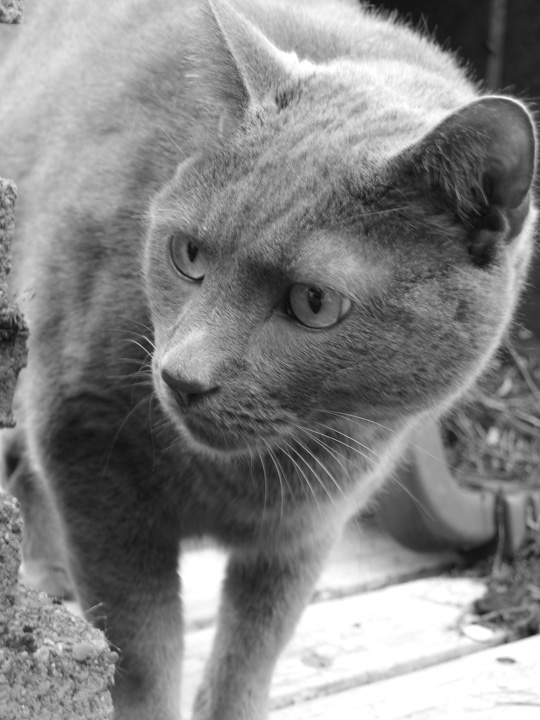
Usually quiet, he meowed loudly all over the house for months, especially at night, presumably looking for Noot.  Without his “older brother” cat to keep him company, he suddenly inserted himself into the daily life of our family, came out and sought affection from the kids during the day, and started sleeping in our bed again after six years of hiding out with Noot.  I was delighted to have my little gray buddy sleeping in the crook of my arm with his cheek against mine again after so many years.  We think of cats as being more solitary animals, but Echo clearly noticed his companion was gone and grieved deeply for him.

Last fall, Echo had been diagnosed at age 12 with chronic renal failure, after the vet had noticed an unexpected weight loss since his last visit.  Other than slimming down a bit (which was not entirely unwelcome, as he had been a bit pear-shaped for quite some time), he exhibited no other outward symptoms and retained enough kidney function to carry on with his usual activities.  We changed to prescription food and gave him daily meds and were happy to see him still jumping up on the counter to drink out of the faucet and generally looking well.

This spring, we had to add at-home subcutaneous fluid infusions a few times a week, to help flush the toxins out of his body, but he still appeared largely well.  He also started eating less, and keeping weight on him became more of a challenge. About a month ago, he stopped eating entirely and started his final decline.  He was hospitalized to get IV fluids for a few days, to see if they could give him enough of a boost to start eating again. They released him hoping we could get him to eat at home.  In addition to new meds and daily subcutaneous fluid infusions, I tried everything to get him to eat something – regular food, treats, super-rich food, high-calorie nutritional gel, liquid food, and sometimes he would give me some hope by eating a little, but never a significant amount.  He continued to get weaker but did not look like he was in pain.  We tried to give him as much love as possible. (I’ve attached a photo of Echo in better days.)

While Andrew was working through deciding “when it was time” for Dusty, I was struggling with making the same decision for my Echo. We wanted to keep him with us as long as possible, and yet we knew that his kidneys could not be fixed and so he had a limited amount of time left.  I had read that the very end of kidney failure can be excruciatingly painful.  We did not want to wait too long and have him reach the point where he was in pain and afraid.  But it was so hard to let him go.

This weekend he took another turn for the worse and it appeared that he was no longer drinking.  I left the kids with good friends Sunday night for a sleepover, and my husband and I had a difficult discussion about Echo over dinner.  We agreed that it was time to help him have a good death.  When we got home, we picked up Echo is his cozy bed, put his blankie over him, and he rode on my lap in the passenger seat. No scary cat cage/carrier for this trip.

In the exam room, he lay wrapped in his blanket on his warm bed, in my lap, with my husband and I both softly petting him and talking to him, while the drugs were administered.  He died totally relaxed and purring loudly, which is the best possible death we could have given him.  We have to remind each other we did the best we could, that we did everything possible to keep him alive, and that helping him die well was what he really needed from us in the end.  But it is still so hard, isn’t it?

Another reader:

I know this is piling on because everyone has a story to tell about their pets passing away. I’ve always had my other animals present when one of my dogs was euthanized.  It was a comfort to me as well as to the dying pet – until the last one.  My beautiful Golden Retriever had a hemangiosarcoma of the spleen (also labeled the “silent killer”) and within two hours was literally bleeding to death.  At the time I didn’t know the diagnosis, only that she needed immediate care at the emergency clinic.  She was put to sleep there.  I was so traumatized and desolate that I couldn’t even think.

I always thought that our younger dog, Chloe, a reactive rescue, was the Alpha in our family.  After Abby died, Chloe at first relished the extra attention. But she eventually took up the same habits as many others have described – eating very little, acting depressed, etc.  The most amazing thing to me was the fact that Chloe had never learned to tell us she needed to go potty; Abby always did it.  She never had to let us know it was time to eat; Abby did it for her.  She was lost without Abby’s guidance and all along we had it backwards.  Chloe was loud, pushy, and unpredictable, and yet it was Abby who was quietly in control the whole time.

Chloe eventually got another sibling, and her attitude changed after first letting the puppy know who was boss.  She is a much happier having another dog in her pack.  My best to Eddy, Andrew and Aaron.  It does get better, but not without the wistful smile on your face when you remember your four-legged buddy.

Another zooms out a little:

I have been loosely following your long-running thread on the decline and death of sweet Dusty and other readers’ pets. I’ve been navigating similar waters now for a year. My wife, son and I had a beautiful black lab, Manny. And like so many of your readers, I have an endless supply of stories that would make us laugh and cry – often at the same time. As a parent, I was so appreciative of how loyal, trustworthy and tolerant he was of my son who – as a toddler – harassed him endlessly. But mostly I think of Manny’s greatest gift was his love that he gave me ceaselessly as I mourned the death of my mom last September.

I was estranged from her – as with the rest of my immediate family – and I was forbidden from seeing her at the end. I could have flown or driven from the Bay Area to LA in time to make it, but I honored their ostracism so not to cause a scene at the hospital. Turns out I could have gone because the rest of them decided to let her die alone at the hospital that night. So my mourning was, and continues to be, soul wrenching.

Manny was my loyal companion through it all. As I neared the holidays, I dreaded having to participate in festivities and spend time with my in-laws – who I dearly love but have struggled with because they have implored me to reconnect with my surviving family despite years of physical, psychological and emotional abuse directed at all three of us. The holidays at the in-laws were indeed hellish. But I was so thankful to come home on January 1st and be back with just the four of us (my loving spouse, beautiful boy and loving lab). Manny died the next morning of heart failure. He was 13 and half – quite long for a lab.

While I do consider myself spiritual and one who has his believes (but not religious), I have never bought into concepts of “meant to be” or spirits visiting us or even animals having some human-like intuition. Not any more. I don’t believe in “coincidence” very much now. As I reflected back on Manny’s life, I could not help but keep coming back to the timing of us death: 24 hours after our return from what I knew would be a hellish 10-day trip with in-laws that would test my last nerve. This was a trip that I had been dreading since Halloween. He stayed with me even then. Had he died prior to then, I would have absolutely lost it. Manny knew. He KNEW. He took his very last ounce of loving energy to stay with me and get me through it all.

North Korea’s Meth Habit

by Patrick Appel

One cause of it:

As Isaac Stone Fish reported in a great 2011 Newsweek story, many regular North Koreans started using meth to treat health problems. Real medicine is extremely scarce in the country. But meth is much more common, which means that the price of medical drugs are artificially inflated while the price of meth is artificially low. In a culture without much health education and lots of emphasis on traditional remedies, people were ready to believe that meth would do the trick for their medical problems, and many got addicted.

The Anti-Hero’s Other Half, Ctd

by Chas Danner

Emily Bazelon notes Skyler White’s transformation in the latest Breaking Bad episode (spoilers):

For me, [the] central thrill of this episode [was that] Skyler chose. She chose Walt over Hank and Marie. She chose asking for a lawyer over confessing like a good girl. She chose sin over remorse. Can she still be the show’s moral fulcrum? I don’t think so.

Hank assumed Skyler would cooperate; he also must have thought she would go to pieces. The genius of this scene is how much he underestimates her. He opens a door to innocence—“you’re done being his victim”—and fully expects her to walk through it, even turning on his tape recorder right there in the restaurant with a little paper lantern overhead. And Skyler refuses to play the role he has scripted for her. In earlier seasons, she has struggled against Walt’s expectations. Now it’s her brother-in-law whom she has to outsmart and push away. And in fact, she is a step ahead of him. She can see how little evidence he has and how much he needs her to build his case. She decides not to give him what he wants.

Alan Sepinwall marvels:

[Skyler] is not a saint. If she was a saint, she wouldn’t belong on a show that recognizes the messy contradictions that come with being a human being on this planet. She’s a complicated person, sometimes a victim, sometimes a fool, sometimes a heroine. She is, in other words, a worthy, fascinating character in this story, and even if it’s Walt’s story, Skyler’s role matters, and needs to be considered once again before things are over and done with.

Alyssa’s take on the scene shown above being one of the show’s great “baroque horrors” is here. Previous Dish on the meaning of Skyler White here.

Egypt’s Martial Media, Ctd

by Brendan James

Joshua Hersh notes that the creeping censorship of the Egyptian press post-coup is actually “self-censorship, growing out of an instinct for conformity”:

In the final years of the Hosni Mubarak era, private television networks and newspapers had opened the door to critical coverage of the regime; their encouragement and reporting helped pave the way for the revolution. There was hope that with a toppled regime might also come a truly independent press, one of the few institutions that could steer the country as it tumbled through a tumultuous post-revolutionary era.

But now, when the official state-run television channel puts a banner reading “Egypt Fighting Terrorism” in the corner of its screen (referring, of course, to the Brotherhood), the private networks do so as well. Over the weekend, the privately owned OnTV treated viewers to a highlight reel of the police clearing the Brotherhood sit-in, set gloriously to the soundtrack of “Rocky.”

This was the only coverage of the event many of those watching would have seen; local newspapers and television stations give no information about the number of Brotherhood dead, and have never shown images of them. And when reports broke on Wednesday that the former dictator Hosni Mubarak might be imminently released from prison, the local media took hours to mention the news. In the interim, they covered the traffic.

Caffeine Cologne

by Brendan James

product of Peter Thiel’s fellowship program for young entrepreneurs:

The big idea is to make caffeine palatable to people who get the jitters from coffee and energy drinks. Four sprays, the recommended dose, has less caffeine than a cup of coffee, Yu says. Since it’s applied to the skin, it’s absorbed steadily, avoiding the rush and the crash of a strong cup of joe. Yu’s father, who has a Ph.D. in bioorganic chemistry and owns his own lab in China, helped develop it.

Sprayable isn’t the first business to market atomized caffeine, though Yu notes the others are meant to be sprayed into the mouth, requiring significantly more caffeine. To allay safety concerns, Yu, who uses his product regularly, says he’s tested it on hundreds of people without negative reactions. Drinking it is an explicit no-no, and Yu notes that because of caffeine’s bitterness, it would “probably be more pleasant to eat a cockroach.”

Must Scientists Be Apolitical? Ctd

by Chris Bodenner

A reader points out:

By calling on scientists to take political action in the form of an open letter, Dan Cass demonstrates his ignorance on the current state of climate action; such a letter already exists. The most recent incarnation is known as the Stockholm Memorandum and was signed by 17 Nobel Laureates. More information can be found through the Union of Concerned Scientists.

Another lists more open letters:

As a climate scientist, one of the more difficult aspects of the job is balancing the “right” amount of advocacy with the appropriate level of disconnect required to remain impartial. However, using the Einstein open letter on nuclear armaments as an example misses what climate scientists and all scientists have been writing for years: 20062008, 2009 [pdf], 2010,  2010 again [pdf], and 2012.

So I don’t think another open letter from prominent scientists is going to fix this problem.

The Best Of The Dish Today

by Chris Bodenner

As the news out of Egypt ebbed quite a bit today, we shifted focus to Syria to track reports of what could be the deadliest chemical attack in 25 years. The biggest domestic story on this slow news day was the sentencing of Bradley Manning, but behind the scenes on Capitol Hill, the nails started to go in the coffin of immigration reform.

Before another big NSA story broke this evening, Ambinder analyzed both sides of the agency’s surveillance scandal. Kirchick, with signature flair, hijacked RT to assail the Russian TV network over Putin’s anti-gay laws (see above). Julia Ioffe joins the applause:

This segment brought me pure, unalloyed joy for several reasons. One, Russia Today is a ridiculous sham of an organization where “whataboutism” reigns supreme. It unintentionally produces segments—like this one on America’s colonization of Sweden (“The United States of Swedamerica”)—that seem like they were picked up off the cutting room floor at “The Colbert Report.” … But the main reason Kirchick’s performance is spectacular is because this is exactly what people should be doing to protest Moscow’s anti-gay laws: Don’t boycott Russia, troll it. Boycotting them gives them a sense of wounded pride and artificial importance; trolling, they don’t know what to do with. As Mr. Kirchick so aptly demonstrated today.

Elsewhere on the Dish, readers told stories of forcibly committing a sibling and of getting saved from black guys in hoodies by another black guy in a hoodie. Go get some writing advice from Chuck Palahniuk and Cormac McCarthy, as well as some insight from Ta-Nehisi on learning a second language. And head here for your daily fix of Breaking Bad.

Life Is But A Distraction

by Chris Bodenner

According to Woody Allen at least:

It’s just an accident that we happen to be on earth, enjoying our silly little moments, distracting ourselves as often as possible so we don’t have to really face up to the fact that, you know, we’re just temporary people with a very short time in a universe that will eventually be completely gone. And everything that you value, whether it’s Shakespeare, Beethoven, da Vinci, or whatever, will be gone. The earth will be gone. The sun will be gone. There’ll be nothing. The best you can do to get through life is distraction. Love works as a distraction. And work works as a distraction. You can distract yourself a billion different ways. But the key is to distract yourself.

The Struggle Of A Second Language

by Patrick Appel

Ta-Nehisi reflects on learning French in Paris:

I came here everyone told me that the enemy was the French. It would be their rudeness, their retreat into English that would defeat me. But I am here now and it is clear that–as with attempting to learn anything–the only real enemy is me. My confidence comes and goes. I have no innate intelligence here–intelligence is overrated. What matters is toughness, a willingness to believe against what is apparent. Learning is invisible act. And what I see is disturbing. In class my brain scatters, just as it did when I was in second grade. I have to tell myself every five minutes to concentrate.

The hardest thing about learning a language is that, at its core, it is black magic. No one can tell you when, where or how you will crossover–some people will even tell you that no such crossover exists. The only answer is to put one foot in front of the other, to keep walking, to understand that the way is up. The only answer is a resource which many of us have long ago discarded. C’est à dire, faith.

One of TNC’s commenters adds:

Learning a second language as an adult involves an implied contract. The negative side is that you’re now, if not the village idiot, then at least the village’s linguistically-challenged person. You will struggle for words, you miss stuff, you can’t make jokes, you’re stiff and slow, you’re not eloquent. All that beautiful stuff you said about Paris in English? You have no idea how to say that in French. Your brain is rewiring itself for something unanticipated, more or less as happens with people with head traumas who must relearn their native language. You’re not the same person you are in English: if I can be blunt, you’re dumber in French. For now.

The positive side? You’re opening yourself up to another world, and the people in that world. People appreciate that, on a pretty fundamental level. You’re learning humility, and there are few more visceral ways to do it. You are taking steps toward knowing people in a way you couldn’t know them before. You’re going to learn the intricate social dance that happens when two people who know each other’s language to different degrees figure out – word by word – how they like to talk to one another

Dreher applauds TNC:

What a wise man, welcoming the humiliation of hard experience, in faith.

Faces Of The Day

by Chris Bodenner

Lara Shipley

Alyssa Copelman highlights a talented photographer:

Lara Shipley became interested in doing a project in southern Arizona after moving to Phoenix in 2010. Shipley was raised in a small Midwestern town and sees this as the source of her interest in isolated and rural areas. Once she arrived in Arizona, Shipley began investigating the borderlands, spending time getting to know the various towns and their inhabitants and making as many as two trips a month from her home in Phoenix. She finds her subjects organically, meeting people during her visits.

Shipley’s stylistic approach is to use a blend of found and manipulated scenarios; some are staged, and others are shot as she finds them. This blending of actual, real-life documentary subjects with manipulated elements becomes interesting when applied to a region generally covered in a more straightforward documentary fashion.

(Caption for the above diptych: “Left: Terri, Twin of Klayla. Right: Klayla, Twin of Terri.”)