How Best To Challenge Putin? Ctd

by Patrick Appel

Jamie Kirchick’s tactic:

Michael Scherer claps:

American reporter and pundit Jamie Kirchick did the cable news medium proud by ambushing a conversation about Bradley Manning on RT, the cable channel funded by the Russian government, to attack Russian President Vladamir Putin over his government’s anti-gay policies. Truly. Great. Cable. Television.

Zack Ford points out that, contra Kirchick, RT has covered Russia’s anti-gay laws – but “much of the coverage has been used to justify it.” Recent Dish on protesting Russia’s anti-gay policies here.

The Poor Door

A New York developer is under fire after proposing separate entryways for rich and less-rich tenants at a planned luxury condo:

A 33-story building slated to be built on Riverside Boulevard between 61st and 62nd street will have an entirely separate entrance for people of lower socioeconomic means: a door for the poor, or as we call it, a “Poor Door.” The affordable homes will be oriented towards the back of the building, while market-rate units will have a view of the Hudson.

Emily Badger calls the building, which will include 55 affordable-housing units, “a perfect metaphor for New York City’s gaping inequality”:

Of course, it’s easy to segregate affordable housing–and the people who live in it–into its own part of town, its own neighborhoods, even its own isolated blocks. But it takes some serious creativity to keep the haves and have-nots apart in the very same building.

Bill Bradley sees a case of tax incentives backfiring:

Floors two through six of the building will be available only to residents earning less than 60 percent of the area median income, putting them under the “affordable” umbrella. Those five floors are part of the exact same building as the luxury condos, but because of the separate entrance they could be legally designated as a separate entity. So technically, [the developer] would have an entire building consisting of affordable housing. On paper, this makes the project eligible for subsidies ostensibly meant to protect lower-income tenants, not move them out of sight.

Unsurprisingly, critics are out in force. Barro is one of the very few to defend the separate entrances:

We require and incent developers who build market-rate housing to also sell or rent some units in the same developments at cut-rate prices. The idea is that affordable housing shouldn’t just be affordable and livable; it should be substantially similar in location and character to new luxury housing. If rich people are getting brand new apartments overlooking the Hudson River, so should some lucky winners of affordable housing lotteries. … Getting mad about the “poor door” is absurd. The only real outrage is that Extell had to build affordable units at all.

How Gay Is Russia?

by Chris Bodenner

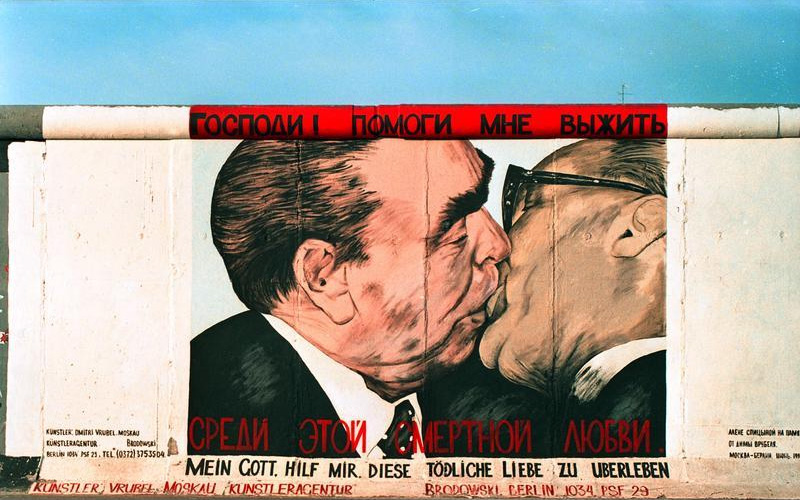
Berlin, East Side Gallery

A reader writes:

I’d like to comment on the “controversial” lip-kiss shared between two Russian athletes earlier in the week. It’s important to remember that other cultures have not eroticized same-sex kisses as Americans have. Here is a link about the history/culture of Russian lip-locking. And of course we can’t forget the iconic (fraternal) kiss of Eastern Bloc history, seen here [and a graffiti reproduction seen above].

We’re dealing with societies that, while deeply homophobic, still have a deep sense of same-sex friendship. I studied abroad in Moscow and Greece – both conservative Orthodox Christian countries – and was shocked to have a good Russian guy-friend, my age, put his head on my shoulder to take a nap during a long train ride. In Greece, men will drape their arms over each other in public and display physical affection that, unfortunately, will never fly among heterosexual men in this country and in much of the West. As the American media eroticizes this behavior, we run the risk of unintentionally unleashing a homophobia on same-sex (especially male) friendship that we in America experienced in the mid-20th century.

Another reader shares his first-hand perspective on Russian culture and homophobia:

As a gay man who lived in Moscow for 18 years (1989-2007), I consider myself and my dear Russian gay friends and lovers to be rather quite a bit more knowledgeable on the subject of gay life in that country than the usual parade of Cold War-trained “experts.”  I was there last September, and I’m in constant contact with a broad circle of Russian gay friends on Facebook. I would venture to say Russia has been in many ways less homophobic than the US, until very recently.  Russia has become suddenly more closed, and the US has become almost as suddenly more open.

People were absolutely fine with you being gay in Russia, with one big caveat:

like so many other things in Soviet society, you were not to speak of it. I lived with one of my lovers six blocks from the home he grew up in, we slept in one bed that his family helped us set up, and I was a constant guest at their city and country homes for any occasion, large or small.  But no one spoke of the nature of our relationship, keeping up the appearance that we were “just good friends.” He came out after we broke up, and their family is still as close as ever.  No religiously-motivated banishments, no condemnations, only a bit of mourning over the grandchild-not-to-be.  With other lovers we were out from the start, and I was treated with respect and usually with affection.

The current rise in homophobia is completely artificial, as evidenced by the unanimous vote in parliament, which included the gay clique in the clownish right-wing Liberal Democratic party, headed by the notorious bisexual Zhirinovsky (who was a habitué of some of the wildest Moscow sex clubs in the ’90s and whom I have personally seen make speeches about tolerance in a gay bar two blocks from my home there), and his deputy, the closeted gay (and up to now high profile gay-rights supporter) Mitrofanov.

The current campaign is part of intimidating the young professional class that began to rebel last year, and gays were very active participants in that movement. The rise of a money-driven brand of Orthodoxy has also fueled the fire, but it is a ridiculous farce.  It is being marketed to the broader public not as anti-gay, but as anti-pedophile, and while many are fooled for the time being, it is not the sort of thing that will hold up over the long term. Russians generally have a very healthy, sometimes even extreme mistrust of their government, and Putin’s chickens will come home to roost sooner rather than later.  Most Russian (and Russian gays) probably just say “just be quiet and everything will be OK,” which is exactly what Putin wants.

Moscow’s enormous gay bars and numerous others throughout the country are still partying all night long, the elaborate bath houses are still open 24/7. This campaign has more to do with crushing any issue-politics groups and providing an “us” vs. “them” cover for Putin’s dysfunctional structure and failings than it is about a national homophobic bias.

Previous Dish on gay-ish campy culture in Russia here. Update from a reader who sees things getting better in the US:

I’d like to provide an anecdotal rebuttal to this comment: “In Greece, men will drape their arms over each other in public and display physical affection that, unfortunately, will never fly among heterosexual men in this country and in much of the West.” It might please this reader to know that I do not believe that male/male affectionate behavior shall “never fly among heterosexual men in” the US.

My 19-year-old son played soccer for many years, and most of it on a “premier” travel team. One of the most interesting and amazing aspects of this all-male team’s group behavior was their: a) totally comfort with the concept of homosexuality; b) their often pretending to be in some way homosexual towards one another – and I’m not talking in an ugly and minimizing way but instead in a fun and I would dare say team-bonding manner; c) their complete immodesty with each other; and finally and most importantly to this discussion, d) their very affectionate behavior towards and among themselves. They would sit on each other’s laps, often drape arms around the guy next to them during relaxation periods; sit and lay very close to one another without any concern for appearances; lay around in beds together during team trips and generally have incredibly affectionate behaviors towards their team-mates.

These behaviors – and their apparent total lack of concern in terms of appearing gay – was often a topic of discussion amongst their Gen X (or older) parents. We all recognized that something has irrevocably changed in our sons’ generation.

How To Boost Artificial Intelligence’s IQ?

by Patrick Appel

Gary Marcus unpacks Hector Levesque’s paper (pdf) on artificial intelligence:

In Levesque’s view, the field of artificial intelligence has fallen into a trap of “serial silver bulletism,” always looking to the next big thing, whether it’s expert systems or Big Data, but never painstakingly analyzing all of the subtle and deep knowledge that ordinary human beings possess. That’s a gargantuan task— “more like scaling a mountain than shoveling a driveway,” as Levesque writes. But it’s what the field needs to do.

In short, Levesque has called on his colleagues to stop bluffing. As he puts it, “There is a lot to be gained by recognizing more fully what our own research does not address, and being willing to admit that other … approaches may be needed.” Or, to put it another way, trying to rival human intelligence, without thinking about all the intricacies of the human mind at its best, is like asking an alligator to run the hundred-metre hurdles.

How Nefarious Is The NSA?

by Patrick Appel

Ambinder rattles off reasons to be concerned about the NSA scandal. First on his list:

The NSA is the most powerful single institution in the world. It can collect more information, more quickly, and cause action from that information, more efficiently than any company, country or intelligence entity. Even if no one accused the NSA of doing anything wrong, it is the interest of a freedom-seeking society to layer in as much transparency as possible for no other reason than that there is really no historical precedent for an organization that large with that much power not abusing it, whether incidentally or deliberately.

In a separate post, he defends the NSA on various counts:

It is eye-raising to base one’s objection to NSA’s self-reporting on the idea that there is no way to independently check what the NSA says. Well, of course. There is a logical problem here because someone or some entity will be at the bottom of the chain. It has always been difficult to establish transparent legal and formal mechanisms to make sure that agencies that secretly collect secrets don’t abuse their power. But it is easier now than it has ever been. The evidence suggests that NSA has MORE checks on its power now than ever before.

The Bradley Manning Sentencing: Reax

by Brendan James

This morning he received a 35-year prison sentence. Michael Scherer sums up the news:

The sentence was considerably less than the lifetime sentence Manning faced under the original charges brought by the government, including aiding the enemy, for which he was acquitted. It was also nearly half of the 60 years recommended by the prosecutors after he was convicted in July of leaking information and six violations of the Espionage Act. Manning’s lawyer, David Coombs, had previously suggested that Manning face only 25 years in prison, given that the information he leaked would likely be declassified after that time.

Manning, 25, was dishonorably discharged and had his rank reduced to private and his pay forfeited. He will get credit for three and a half years already served in prison. If he serves his entire term, he would be a free man at the age of 58, but under military rules he could become eligible for parole after serving one third of his sentence.

Molly Redden suspects he could have faced much worse:

For their part, Manning’s defense team is probably relieved.

Earlier this week, his attorney David Coombs asked the judge, Col. Denise Lind, for a sentence that would allow Manning “to have a life,” while attorneys for the military asked her to make an example of him. Said Capt. Joe Morrow, “There is value in deterrence. … This court must send a message to any soldier contemplating stealing classified information. National security crimes that undermine the entire system must be taken seriously.” Not visibly reacting to the verdict was Manning himself—who appeared stone faced as Lind read out his sentence, and as a military escort walked him out of the courtroom.

Marcy Wheeler walks throughs Manning’s chances for parole:

Bradley could be released after serving one third of his sentence. In light of the fact Judge Lind has imposed a term of 35 years, Mr. Manning, considering the time he has already served, could potentially be eligible for release in as little as 9 years from now. As painful as it is to admit, this sentence, and Bradley Manning’s prospects could have very easily looked far worse.

Ryan Evans declares good riddance:

Manning is lucky he did not receive life, which he should have. The sympathy for this “troubled young man” is emblematic of a post-accountability society. No one, it seems, is to be held responsible for their actions any longer. Instead, blame is shifted to a difficult childhood, bullying, loneliness, or—my personal favorite—“the system.” In Manning’s own words, he was “dealing with a lot of issues.” … Manning himself has admitted that he understood what he was getting into when he agreed to provide these documents to WikiLeaks. To those who argue that he should not be held accountable for that decision, I ask: Why not?

Charlie Savage notes that, in addition to time already served, Manning “will be credited with 112 days for the treatment he endured at a military jail that the judge ruled was unlawful.” Charles P. Pierce adds:

Manning was treated barbarically over those 112 days. This didn’t happen by accident. This wasn’t an oversight. It was a policy decision. He was treated that way deliberately by this government. He was treated that way because that is how this administration wanted him treated. This is an administration that simply does not want the people to know what is being done in its name. The last administration didn’t want that either, but C-Plus Augustus wasn’t a constitutional law professor promising the most open and transparent administration in history, either.) And that’s the part of the story that shouldn’t go away with Bradley Manning.

Scott Lemieux, who expected a gentler sentence, agrees:

I don’t object to Manning being charged with a crime. I certainly strongly object to the way he was treated in prison. And I think the idea that his leaks merit a 35-year sentence is absurd. And as I said before, it’s particularly appalling when you consider the Obama administration’s “look forward not back” approach on torture. It’s hard to square this life-ruining sentence with the fact that no torturer was even considered worthy of being charged. I’d also say that at this point that it’s pretty hard to the American government to complain when other countries refuse to extradite whistleblowers.

Hillary Isn’t Too Old To Run

by Patrick Appel

Nate Cohn reviews the actuarial tables:

A 65-year-old white woman has the same odds of dying the following year as a 60 year old white male. That puts her in roughly the same place as George H.W. Bush when he sought the presidency. She probably has a better chance than Ronald Reagan did. It would seem to give her much better odds than vice president Joe Biden, who’s a male and already older: eight percent of 69-year-old white males will die before the 2016 presidential election.

Christie has worse odds than Clinton

The New Jersey governor is just 50 years old, but studies show that obesity reduces life expectancy anywhere from six to ten years. According to the University of Pennsylvania life expectancy calculator, Christie’s life expectancy is 73 years, with a median of 74. That gives Christie the worst odds of any candidate: he has a 96.6 percent chance of living to the 2016 presidential election and only has an 84.2 percent chance of surviving until January 2025, when he might be concluding his second term in the White House. In comparison, Hillary Clinton gets a 93.8 percent chance—which lines up nicely with the 92 percent of white female senators, cabinet secretaries, and first ladies who have survived to age 78.

All Eyes On Egypt

by Brendan James

PAKISTAN-EGYPT-UNREST-PROTEST

Madawi Al-Rasheed observes how the Saudi theocracy is keeping its own Islamist opposition in order as Egypt burns nearby. King Abdullah recently set the tone, declaring full support for the junta in Cairo:

The king’s message was clear: zero tolerance for all those who use Islam to pursue political agendas, sort of an oxymoron in the Saudi context as the state itself had been manipulating, co-opting, and promoting Islam for agendas that are nothing but political. The foundation of the state itself is a process of instrumentalizing Islam to revive the Al-Saud control of vast territories, under the pretext of purifying Arabia from blasphemy, innovation, and atheism. The Muslim Brotherhood and its likes appear to be latecomers to the project of politicizing Islam.

King Abdullah’s message, supposedly meant for Egyptians, did not go unheeded among the many Saudi Islamists who abhorred their government’s support for the Egyptian coup. Since July 3, they have turned into defenders of Morsi and the Brotherhood, issuing statements on social media condemning their own government for backing the coup.

A small group of activists launched an online petition to gather signatures against the aid that had been promised to Egypt immediately after the coup. Following the circulation of the petition, a couple of veteran activists such as Mohsin al-Awaji were briefly detained while many other Islamists remain banned from travel, most famous is Sheikh Salman al-Awdah whose television program “you have Rights” was abruptly stopped on an Islamist independent television channel. The government is carefully watching the hyperactivity of Islamists and their statements on television and online, which have so far strongly condemned the Egyptian coup and their own government’s unequivocal endorsement of General Sisi.

Michael Koplow notices that Turkey’s government is alarmed for the opposite reason, as an Islamist party supportive of the Brotherhood:

[T]he specter of crowds massing in the streets and the military overthrowing the government hits a little too close to home for Erdoğan given what he was dealing with in June and the history of Turkish military coups. Erdoğan’s biggest claim to fame is his defanging of the military, and even after demonstrating that Turkish civilian control (and undemocratic intimidation) over the army is complete with the Ergenekon verdicts a couple of weeks ago, no Turkish prime minister – and certainly no Turkish prime minister with Erdoğan’s background – is ever going to feel completely safe from the long arm of the military. Erdoğan looks at what is taking place in Egypt through a distinctly Turkish prism, and in many ways his views on the Egyptian coup are actually a complex psychological projection of his fears about his own position. …

Erdoğan sees the army removing an elected government amidst accusations of policy overreach and undemocratic behavior, and he imagines a nightmare alternate universe where the same could happen to him.

Previous Dish on the region’s reaction to Morsi’s ouster here and here.

(Photo: Islamic political party Jamaat-e-Islami activists march in support of ousted Egyptian president Mohamed Morsi in Karachi, Pakistan on August 20, 2013. Supporters of Morsi announced new demonstrations as Egypt grew increasingly polarised and the death toll in four days of violence topped 750. By Asif Hassan/AFP/Getty Images)

The Puritanism Of Progressive Parents, Ctd

By Tracy R. Walsh

Keith Humphreys thinks the phrase “progressive Puritans” is unfair to both progressives and Puritans:

A Puritan would be delighted to meet a fellow member of the faithful, but that is not what I see in these parents. If they are vegetarian and meet another vegetarian, they are unhappy and commit to becoming a vegan. If they then meet another vegan, they become unhappy and commit to becoming an ovo-lactic vegan. They don’t want other people to share faith in a community of peers; they want to outrank their lessers within a hierarchy. This is also why they are not truly liberal or progressive. They are not trying to save the world, they are trying to get an edge in life for themselves and for little Hayden and Sawyer too.

Rather than surrender the terms liberal or progressive so easily to the domain of lifestyle and shallow issues of personal identity, I suggest we let those terms retain their political meaning by not describing panicky, entitled, hierarchy-obsessed, materialistic strivers as “liberals.” Likewise, let’s not throw theology and history to the side and call them “Puritans” either. If we need a shorthand term for them, I suggest that someone with literary skill invent an entirely new one, as long it isn’t very polite.

Any ideas? More of the popular thread here.