Nick Valery worries that pilots are too dependent on automated systems:
The problem today is that aircrew may log thousands of hours on the flight decks of modern airliners, but their actual hands-on flying experience may amount to mere minutes per flight. When things get frantic – whether through a mistaken input or a sudden runway change by air-traffic control during descent – aircrew can be so preoccupied punching fresh instructions into the flight-management computer that they may fail to notice their airspeed and altitude are falling precipitously. This reduction in situation awareness, along with the degradation of basic piloting skills and a huge increase in cognitive workload on flight crew are all part of the unintended consequences of cockpit automation. Combined, such human factors can quickly lead to disaster.
America’s two recent fatal air crashes – the Asiana Boeing 777 passenger jet on final approach into San Francisco international airport on July 6th and the United Parcel Service Airbus A300 freighter coming into land at Birmingham airport in Alabama on August 14th – are cases in point. Though investigations have barely begun, both situations point to distractions the pilots faced while trying to take control of the aircraft. In both instances, the pilots seem to have been unaware, until the last few minutes, of their proximity to the ground and of how slowly their planes were flying. Both finished up crashing short of the runway.
A new NBC poll finds that an overwhelming majority of Americans think Obama should be required to get approval from Congress before attacking Syria. A chart on the key question:
If President Obama is feeling lonely after the British vote, asking Congress to debate military action would give him excellent cover for either gathering support or backing away from unilateral warmaking — and it would also abide by the Constitution. That’s an approach Barack Obama himself would have approved, not so many years ago.
Larison continues to doubt that Obama will bother to get congressional approval:
If Obama doesn’t think he is legally required to go to Congress, wouldn’t it still make sense politically to involve Congress and get their backing for his attack? It might seem so, but the case for the attack is so weak that it wouldn’t withstand much public scrutiny, much less debate in both houses.
Because the proposed military action is supposed to be brief and limited, Obama probably sees going to Congress as a useless headache and unnecessary complication. Of course, it shouldn’t matter whether he feels like doing it. Unlike Cameron, he is obliged to do this when he plans to initiate hostilities against another state. It is up to members of Congress and the public to make him fulfill that obligation. Unless that happens, Obama will go ahead with the attack as if Congress is irrelevant because it will have proven itself to be exactly that.
The lesson Amy Davidson hopes Obama will take from Cameron:
Obama may take the British vote as proof that he can’t risk putting himself in Cameron’s position. But facing Congress after things don’t go according to plan—if there even is a plan—would be all the more humiliating. Obama can’t win this the way that Cameron lost it: by talking as though he is the only one acting according to principle, and that those who disagree just haven’t seen enough pictures of the effects of chemical weapons. There are principles at work in wondering whether something that feels satisfying but causes more death and disorder is right, too. The real Cameron trap is thinking that a leader can go to war personally and apolitically, without having a good answer when asked what’s supposed to happen after the missiles are fired. Does the President get that?
P.W. Buchanan discusses a study that compared seniors who committed suicide to seniors who died from natural causes:
While debate about the ethics of elder suicide tends to revolve around terminal illnesses and loss of autonomy, those end-of-life issues didn’t turn out to be the common causes of real-life suicides among the elderly. The study found that those who took their own lives actually had less impairment of “functional autonomy” in their final months of life. Those who took their own lives also had fewer chronic health problems than those who died naturally. “In our study,” the report observes, “suicide cases were found to have a lower risk of having cancer, emphysema, and cardiovascular disease at the time of death.”
Now, one could posit that these elderly people had decided to end their lives precisely because they were still able to and because they anticipated imminent impairment. Significantly, however, the study found that mental health, most notably depression, was a variable that showed up much more frequently in the suicide cases than in the control cases. Based on the psychological autopsies, “the suicide cases were ten times more likely to present a current psychiatric disorder during the six months preceding death than the controls.”
All of which complicates how we think about elder suicide. It might be another vestige of dogma, but why am I more inclined to privilege physical pain and external circumstances when I consider the ethics of suicide? Why does internal pain, in the form of mental illness and chemical imbalance, strike me as a less acceptable reason? And isn’t this why physicians’ opinions are part of the law—because we want to limit suicide to those who are unarguably rational?
Spurred by Dave Roberts’ year-long hiatus from the Internet, Dan Savage vents about the demands of his readers to comment on every issue:
It’s not that I don’t care about Manning or about the issues raised by her actions and her prosecution and her transition. It’s just that I don’t feel I have anything of value to add to the conversation. And it’s not just Manning: I haven’t had much to say about the ban on gay blood donors (serious issue!) or Miley Cyrus’ performance at the VMAs (unserious issue!) or what the hell is going on in Syria (serious issue, yes, but one that I am disqualified from having opinions about in public). And I have been angrily called out again and again for my failure to tweet about Manning and blood bans and Miley, etc. It’s as if my failure to have a take on absolutely everything somehow violates the terms of a contract I don’t recall signing.
To my fellow writers I say…
We don’t have to have a take on everything. Yes, if we fail to comment on something—if we fail to have a take—small e-mobs gather under our e-windows demanding comment and waving our failure to comment over their heads like a bloody shirt. But fuck ’em. Don’t let the Mark Kackstetters get inside your head. It’s okay to sit some shit out. Sometimes writers get to be readers too.
That pressure to have an opinion about everything is something Andrew struggles with constantly, and every day in the inbox I see the demands of readers who can’t believe the Dish hasn’t posted on a particular story already. The flagging of stories by readers is often essential and always appreciated, but a pushy tone can be grating sometimes, especially since the Dish is already such a demanding job. From one reader a few days ago:
Seriously guys, I can’t believe you still haven’t mentioned this [the issuing of marriage licenses in five counties in New Mexico]. The Dish noted the potential for marriage equality in New Mexico only a month ago, and this is the most grassroots, organic progress on this issue I’ve ever seen. Since my email last week, two more NM counties have started licensing same-sex marriage and it’s unlikely to stop because (1) NM marriage laws are not gender-specific, but (2) the state constitution DOES prohibit sex discrimination and (3) maybe most importantly, here in New Mexico there has been virtually NO objection to this. The NM Attorney General announced early that he’s not going to challenge it, our (Republican) governor is silent so far, and there has been absolute silence as best I can tell from regular citizens and the church crowd.
Of course, a couple dozen state GOP legislators have asked for IMMEDIATE state supreme court action to stop this new evil. But that ain’t gonna fly here; New Mexico is a VERY cool state and this is a big story. Dan Savage and others are on it already and my favorite blog should be too.
On it. Update from a reader over Labor Day weekend:
Enough with the fluff, sidebar, back-of-the-book features. Where the hell is the coverage about Syria? I didn’t subscribe for crap like that at time like this. This is a disgrace
Nine Inch Nails has decided to release its new album, Hesitation Marks, in two versions, one mastered with maximized loudness in mind (as is the norm with virtually all mass-market music released today) and the other meant to respect the more natural dynamic range of the album as it was recorded in the studio. Dan Seifert explains why this is important:
This second “audiophile master” mix is the latest salvo against the overbearing loudness of pop music today, and, according to the band, it’s the first time that anyone has mastered the same album twice for different audiences.
Most songs produced today are louder than ever before, and have less variance between the loud and soft sounds within their tracks. This “brickwall” method of mixing music (which refers to a very compressed and loud audio track) is generally derided by audiophiles because it eliminates the delicate tones that can be heard with quality audio equipment.
Seifert adds that, “Chances are, audiophile-quality mixes of music will never really make the mainstream: for most people, pop music is too ephemeral to waste time, money, and storage space on higher-quality tracks.” But Zach Schonfeld thinks artists and audio engineers have a responsibility to ratchet back the loudness, seeing the alternate version of Hesitation Marks as an unfortunate half measure:
Famously attentive to every millisecond of sound, each snare hit and synth bubble, [Nine Inch Nails’ Trent Reznor is] throwing a bone to the thick-spectacled audiophile corner of his fanbase: He’s offering them a higher-quality product. But he’s also drawing a line in the sand between audiophile and average listener and suggesting that sound quality is only of interest to the former. Reznor is challenging the Loudness Wars, yet simultaneously capitulating to the new normal by offering up the “Audiophile Version” for a niche audience only.
This is a shame. As his producer, Alan Moulder, writes, “It is a fact that when listening back-to-back, loud records will come across more impressively, although in the long run what you sacrifice for that level can be quality and fidelity.” So why not just release the audiophile version on CD and vinyl and let it speak for itself?
Schonfeld also recommends Nick Southall’s fine 2006 essay on the Loudness War, a key section of which is excerpted below:
There are two ways to measure “loudness”—peak levels and average levels. The former refers to the loudest part of a piece of music or sound; a crescendo or climax. The difference between the highest and lowest points makes for the average level. Sadly, the science of psychoacoustics suggests our ears generally respond to the average level rather than the peak level of volume—hence we would perceive a consistently loud piece of rock music as being “louder” than a piece of classical that reaches the same or even a higher volume level during a crescendo, simply because the rock song is “loud” all the way through. “Loud” records grab our attention (obviously—being louder they are harder to ignore on first impression) and in order to grab attention quicker and more effectively in a crowded marketplace, record companies and artists have been striving to make their records as loud as possible from the second the first note is played, whatever the cost.
This isn’t a recent thing. The “Loudness War” has been going on almost as long as pop music has existed, and probably longer—nobody has ever wanted their record to be the quietest on the jukebox or the radio. The Beatles lobbied Parlophone to get their records pressed on thicker vinyl so they could achieve a bigger bass sound more than 40 years ago. The MC5 apparently mixed their second album, Back in the USA, at such extreme volume in the studio that they failed to notice how tinny and thin it sounded—there’s practically no bottom-end to it at all. Then there’s Phil Spector’s legendary “wall of sound” production style, mixed and mastered to sound good on tiny, tinny transistor radios, squeezing as big a sound as possible into as small a space. Three or four decades ago record companies would send out compilations of singles to radio stations on a single vinyl record—if a band or producer heard their song on one of these and it was quieter than the competitions’ song, they would call the mastering engineer and get him to up the levels until it was the loudest, even if that meant corrupting the sound quality.
Yet another aspect of the IRS ruling is the fact that many states derive their state income tax calculations from the Federal 1040 – et.al. Maryland (albeit a marriage equality state) populates its 502 form directly from the federal forms. Then you subtract the Schedule A deduction for MD state taxes, add in the County override, and you’re done. A non-marriage equality state would have to require that gay partners re-figure their tax liability as single people, and then use those numbers to file state taxes. I suspect that this level of complexity will weigh strongly against state tax agencies taking a “moral” stand against marriage equality, just to produce mountains of extra work and complexity. This is yet another tunnel being dug under the field of inequality that will contribute to its ultimate collapse.
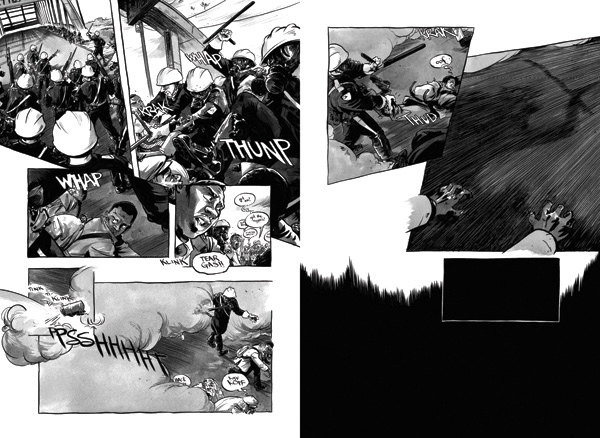
A popular new graphic novel, March: Book One, takes a look at the civil rights movement through the eyes of Congressman John Lewis. Aaron Colter explains why Lewis embraced the project:
Lewis — who spoke at the March on Washington, participated in lunch counter sit-ins, marched miles for social justice, and was jailed on several occasions — remembers another lesser-known but still influential tool for getting out the message of the movement: a 10-cent comic book. Titled Martin Luther King and the Montgomery Story, the comic told the story of Dr. King and the 1955 bus boycotts inspired by Rosa Parks while offering recommendations for non-violent protest tactics borrowed from Mahatma Gandhi. “We read the book in Nashville, Tennessee, and we started sitting in,” said Lewis at the recent Book Expo America. “[This book] has been translated into more than four languages, and it’s been read and inspired people in the Middle East, in Vietnam, especially in Egypt.”
There’s no question that Powell is one of the most exciting visual talents on the scene, and part of what makes his illustrations a delight to look at is the ease with which he conveys complicated situations. His abilities are particularly evident with text, which skitters and whips around the edges of panels. Often, characters far away are talking, and we see their dialogue rendered so delicately that you can almost read it, but not quite. When action overlaps from one panel into the next, it’s done so seamlessly that it hardly calls attention to itself. Every once in a while, we get a big, dark night scene in the country, reminiscent of the 1930s WPA prints of the South, with a tiny house dwarfed by trees and encroaching black negative space. It’s easy to see the heroes of the civil rights movement as more than human, but the words and pictures work together in March (Book One) to put the everyday back into their lives and, in doing so, enrich the story beyond mere hagiography.
Gwynn Guilford reports on the latest development in South Korean plastic surgery:
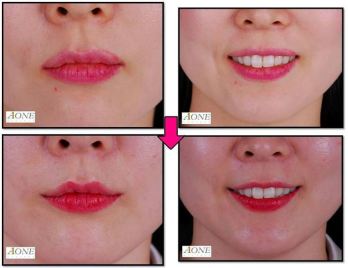
[A] new technique called “Smile Lipt” carves a permanent smile into an otherwise angry face. The procedure, whose name combines “lip” with “lift”—get it?—turns up the corners of the mouth using a technique that’s a milder version of what Scottish hoodlums might call the “Glasgow grin.”
… The procedure is, as KRT reports, increasingly popular among men and women in their 20s and 30s—especially flight attendants, consultants and others in industries aiming to offer service with a smile.
She speculates that, “as with the popularity of other cosmetic procedures in South Korea, which have made it hard for the natural of face to compete for jobs, permanent smiles may too become the norm.” Jonathan Coppage worries about the mainstreaming of this procedure:
If one stays agnostic on the medical ethics of cosmetic surgery, the procedures become a matter of free choice and open markets, where patients and doctors have the freedom to arrange an operation, as long as there is no coercion. But the South Korean example is a very effective demonstration of the ultimate limits of a libertarian paradigm revolving around atomistic free actors. Individuals “with photos of starlets whose face they want to copy,” aggregate to create new norms, because they are part of a social order. And social order inescapably comes with the soft coercive power of conformity.
(Photo: Before lipt surgery on top; after surgery on the bottom)
You are a bad person if you send your children to private school. Not bad like murderer bad—but bad like ruining-one-of-our-nation’s-most-essential-institutions-in-order-to-get-what’s-best-for-your-kid bad. So, pretty bad.
I am not an education policy wonk: I’m just judgmental. But it seems to me that if every single parent sent every single child to public school, public schools would improve. This would not happen immediately. It could take generations. Your children and grandchildren might get mediocre educations in the meantime, but it will be worth it, for the eventual common good.
I think that Benedikt isn’t thinking through what would actually happen if everyone felt a moral obligation to send their kids to public schools. What would actually happen is that Allison Benedikt wouldn’t live in Brooklyn, because New York, like most of the rest of the U.S.’s cities, would have lost all of its affluent families in the 1970s — the ones who stayed largely because private school, and a handful of magnet schools financed by the taxes of people who sent their kids to private school, allowed them to maintain residence without sending their kids into middle- and high-schools that had often become war zones.
Barro points out that a “lot of academics have looked into the question of how private schools affect public schools, and the results are inconclusive”:
In 2002, Professors Clive Belfield and Henry Levin at Columbia University Teachers’ College looked at the existing research and found that “across districts and counties, the effect of private school competition on public school outcomes is mixed.” Of the 12 studies they identified on the topic, 3 found that private competition improved public schools, 3 found that it worsened them, and 6 found no effect.
That’s not terribly surprising, since you’d expect two offsetting effects: private schools might disproportionately attract the best students out of public schools, but competition might force public schools to improve so they can attract students away from privates.
Her argument makes sense if one assumes that current private-school parents would be better able or more motivated to push for improvement than current public-school parents are. To put it another way, it’s not that public schools need more students, but that they need students with a better class of parents. That’s not an unreasonable assumption, but it is an inegalitarian one, which is likely why Benedikt left it unstated.
The issue is less about private vs. public than it is the class privilege that’s tied to geography. Benedikt argues that “We need a moral adjustment, not a legislative one,” and yet no amount of moral shaming is going to change where people live, and the material condition which follow from that. The problem isn’t that the rich person next door has no stake in your child’s education–it’s that the person next door is most likely struggling just as much.
Better that we are all equally ignorant as long as we are all equal. This is what the radical levellers want for us. It is the educational equivalent of Soviet economics. All that matters is that we are united in the state, no matter how stupid, ignorant, and poor it makes us.


 The Dish