Faces Of The Day

dish_kkk

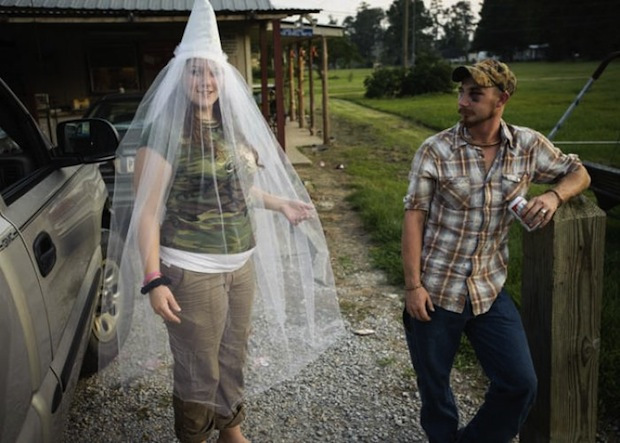
Photographer Anthony S. Karen has spent years documenting the Ku Klux Klan:

The series began in 2005, when Karen was allowed to attend and photograph a Klan event. The trust he gained at that and subsequent events eventually earned him unrestricted access. When asked in an interview with FotoEvidence how he managed to achieve this, he explained that in photojournalism, you get what you give:

I think a lot of the credibility I’ve earned stems from my basic philosophy that you need to give some of yourself in order to receive anything back. I spend time with people, I listen to what they have to say, and I treat each person as an individual. I don’t have to believe what they believe, but whenever I’m in someone’s space, I feel I’m obliged to observe without judgment.

(Photo of a bride with a KKK wedding veil and her fiancé by Anthony S. Karen)

A Defense Of Desire

Jen Polleck Michel hesitates at George Saunders’s recent appeal to kindness:

When he fleshes out his vision of human kindness, he seizes on an example from the parent-child relationship: “If you have kids, that will be a huge moment in your process of self-diminishment. You really won’t care what happens to YOU, as long as they benefit… YOU will gradually be replaced by LOVE.” We are selfish, Saunders says, to want for ourselves. We should abandon desire in favor of love.

This is a fond and familiar heresy: that desire is to be blamed for all moral ills. In his book, The Everlasting Man, G.K. Chesterton compares the Buddhist and Christian solutions to the treachery of desire. Buddha proposed we get rid of desire altogether. He considered it a contagion. But Chesterton defended desire, arguing that the gospel did not obligate us to give up on our desires, but rather, to judge their nature: “I do not see, for instance, why the disappointment of desire should not apply as much to the most benevolent desires as to the most selfish ones.”

In a similar vein, C.S. Lewis takes issue with the idea of unselfishness, in The Weight of Glory:

I submit that this notion [of unselfishness] has crept in from Kant and the Stoics and is not part of the Christian faith . . . The negative ideal of unselfishness carries with it the suggestion not primarily of securing good things for others but of going without them ourselves, as if our abstinence and not their happiness was the important point. I do not think is the Christian virtue of Love. The New Testament has lots to say about self-denial, but not about self-denial as an end in itself.

For the greater part of my Christian life, I have failed to understand what Chesterton and Lewis are saying and what the Bible so clearly defends: desire is not evil. A thousand times and more I have hung myself on the accusation of selfishness, living with the burden of be kind, advice that would subtly seek to obligate me to the whole of humanity and will to find me guilty whenever I cannot appease their demands.
Angels Are No Angels

287845074_f84fb1f382_z

Professor Candida Moss suggests that angels may not deserve their rosy reputation:

In Genesis we learn that the “sons of God” noticed how attractive human women were and took them as wives. Later Jewish interpretations called these angelic beings the “Watchers” and blamed them for teaching humanity the evils of technology. God is so angry at the ensuing wickedness that he sends the flood to wipe almost everyone out. Perhaps the winged snakes weren’t so bad after all.

By the time we get to the New Testament, angels have settled into their roles as messengers and heavenly bouncers. They look like human beings. The two young men who talk to the disciples at the empty tomb of Jesus can be identified as angels only from their dazzling white garments.

They can still be a bit testy though. The Angel Gabriel, best supporting actor of modern nativity plays, is less serene when he announces the birth of John the Baptist to Zechariah. When Zechariah protests that he’s getting on a bit, Gabriel replies “I am Gabriel. I stand in the presence of God, and I have been sent to speak to you and to bring you this good news. But now, because you did not believe my words…you will become mute, unable to speak, until the day these things occur.”

That’s how he delivers the good news. As the poet Rilke wrote, “Every angel is terror.”

(Photo by Elisabeth D’Orcy)

The Separation Of Church And Foreign States

Recently, the State Department announced the creation of a new Office for Religious Engagement, which will focus on reaching out to “faith-based organizations and religious institutions around the world to strengthen U.S. development and diplomacy and advance America’s interests and values.” Linda Woodhead casts a skeptical glance at that last phrase, hoping it doesn’t imply that there’s “only one possible model of religious freedom” based on U.S.-style separation of church and state. She holds up Europe as a counter-example:

Europe’s historical entanglement with religion is deep and ancient. In fact, the very idea of “Europe” is a product of Christianity’s attempt to bring unity to this region under the auspices of the Holy Roman Empire. Moreover, the rise of European nation states in the early modern period is bound up with the contemporaneous creation of national churches. In other words, in the form in which we know them today European states and churches birthed one another. Only in combination did they have the economic, bureaucratic, and cultural capacity to create unified territorial polities.

The result of this symbiotic relation is that it’s impossible for European countries to make religion purely private without engaging in some of the merciless coercion exercised by those communist countries which attempted—with only partial success—to achieve such an end. Imagine the actual costs and consequences of withdrawing state-support from Christian educational foundations given that in many countries they include a significant proportion of primary and secondary schools as well as universities and colleges—even in France, the EU country with the nearest to a state-church separation.

She suggests “going with the grain of existing arrangements” in the countries we work with to avoid doing more harm than good:

Socio-religious ecologies are just that. They are highly complex systems with path-dependent possibilities which have been laid down over centuries (many more centuries in most parts of the world than in the U.S.). When you look beyond the surface, what appears to be unfreedom on a crude index often turns out to work very differently in context and practice. Rash interventions almost always have unintended, often irreversible, consequences.

“When I Pray I See A Face”

Ethan Richardson spots the passage below from Francis Spufford’s Unapologetic, which grapples with the Christian belief that though “all is not well with the world…at least God is here in it, with us.” How Spufford connects that to prayer:

When I pray, I am not praying to a philosophically complicated absentee creator. When I manage to pay attention to the continual love song, I am not trying to envisage the impossible-to-imagine domain beyond the universe. I do not picture kings, thrones, crystal pavements, or any of the possible cosmological updatings of these things. I look across, not up; I look into the world, not out or away. When I pray I see a face, a human face among other human faces. It is a face in an angry crowd, a crowd engorged by the confidence that it is doing the right thing, that it is being virtuous. The man in the middle of the crowd does not look virtuous. He looks tired and frightened and battered by the passions around him. But he is the crowd’s focus and centre. The centre of everything, in fact, because if you are a Christian you do not believe that the characteristic action of the God of everything is to mould the course of the universe powerfully from afar. For a Christian, the most essential thing God does in time, in all of human history, is to be that man in the crowd; a man under arrest, and on his way to our common catastrophe.

Last Sunday’s meditation on prayer here. Previous Dish on Spufford here and here.

A Poem For Sunday

everwine2

“Night” by Peter Everwine:

In the lamplight falling
on the white tablecloth
my plate,
my shining loaf of quietness.

I sit down.
Through the open door
all the absent I love enter
and we eat.

From From the Meadow: Selected and New Poemsby Peter Everwine © 2004. Used by kind permission of the University of Pittsburgh Press. Photo by Tawheed Manzoor)

Orderliness Is Next To Godliness

Tania Lombrozo suggests that the “relevant contrast might not be between science and religion but between beliefs that promise an orderly universe—one in which individual humans or some external forces, be they natural or divine, impose structure and corral uncertainty—and those that do not”:

Perhaps it is no surprise that religious beliefs have tended to fit the more psychologically attractive profile. Religion isn’t tethered to empirical facts the way scientific theories are; it is free to shift, to fit the contours of the human mind. When it comes to science, however, the empirical world offers hard constraints. We can hope for scientific theories that offer an orderly and predictable view of the natural world, but we can’t enforce them.

What we can do is rethink the way evolutionary ideas are presented, and work to improve people’s understanding of the ways in which natural selection is—and is not—a random and unpredictable process. While humanity may be an evolutionary accident in some sense, our place in the tree of life can be characterized in highly systematic ways that highlight the exquisite dynamics of evolutionary change. There are patterns in the natural world, and grasping them can be revelatory.

The Exemplary Life

The_Torment_of_Saint_Anthony_(Michelangelo)

Ben Myers explores the importance of biography in shaping the spiritual lives of early Christians. He argues that it “was Christianity’s immense investment in the idea of incarnation – the belief that God has entered the world in human flesh – that made exemplary lives so important for the Christian moral imagination”:

Nothing is more illustrative of the whole Christian attitude toward life than the preponderance of biography in the early centuries of the faith. The first Christian biographies, like the Passion of Perpetua (circa 203 CE), commended the heroic death of martyrs as exemplars for others. …

In the fourth century, once Christians could not be martyred anymore, biographers turned their attention to a new kind of exemplary life: the person who cultivates self-martyrdom through acts of heroic asceticism. The first and greatest biography of this kind was Athanasius’s Life of Antony, written in Egypt around 356 CE. By now the moral dimensions of biography had been expanded to include all manner of details about the saint’s daily life – diet, dress, moods, habits of speech and so forth – culminating in a meticulously detailed account of his death. Though Antony’s own death is admittedly not the death of a martyr, it is nonetheless performed by Antony as something “worthy of imitation.”

(The Torment of St. Anthony, the earliest known painting by Michelangelo, 1487-88, via Wikimedia Commons)

“Like Us, Animals Grieve When They Have Loved”

Beatrice Marovich reflects on Barbara King’s recent book, How Animals Grieve, claiming that “love is so ubiquitous and natural that we can’t really avoid it” – that words like grief and love apply to more than just human emotions:

When we hear a story about deep social bonds between birds, what do we name that social bond? When we see intense forms of social devotion between dogs captured on video, what do we name it? King is constantly on guard against the charge of anthropomorphism—that she’s violating species boundaries by finding something so human as love, or grief, in animal life. “Anthropomorhic excess”, she acknowledges, can very likely “cause us to miss crucial distinctions.” It could make us humanize all of animal life. For this reason, she’s careful to specify that the physical experience of grieving in cat life looks (like all cat behavior) notably distinct from the experience of grief in dog life, which is inevitably different from goat grief.

The 17th century English philosopher Anne Conway argued that the differences between humans and other creatures were “finite” differences—differences of degree and intensity. There is no infinite difference between creatures that makes another’s form of life wholly and eternally incomprehensible. Whoever can’t see that something sort of like “justice” functions in the animal world, Conway argued, “must be called completely blind.” I’m with Conway. In a sense, then, I’m also with King. Whoever can’t see that something sort of like love, or something sort of like grief, functions in dog life must be blind.