Joking About Suicide

Comedian Amy Schumer says that Comedy Central steered her away from making a suicide joke on her TV show:

“I wanted to write a sketch where a guy tried to kill himself and had a failed suicide attempt, but then still had to come to work on Monday,” 32-year-old Schumer revealed in a recent radio interview. “And everyone knew, but he didn’t get his work done and he is like, ‘Well, I didn’t think I was going to be here.’ And we wanted it to be like he was a hipster — like, what would a failed suicide be as a hipster? And I think they were like, ‘that’s too sensitive’ or ‘too personal.’”

This prompts Emma Garman to wonder whether suicide is the last taboo in comedy. But Michelle Dean suspects Schumer’s set-up just wasn’t funny enough:

[I]t’s not that suicide is viewed as beyond comedy. It’s that a comedian who legitimately thinks the best joke about returning to work after a suicide is of the “hehe, I didn’t do my work” variety is probably not really zeroing in on what’s funny about the situation. I’m no comedian, of course, and can’t tell you what a better joke would be. I can only say, in this context, well: try something else. If you’re going to make suicide funny, well: make it funny. It shouldn’t take a genius to see that’s the only real rule of the game.

Garman cites Heathers as an example of a comedy that successfully worked the topic for laughs:

The low-budget movie, a box office flop that became hugely popular on cable, VHS and DVD, is widely considered one of the best high school comedies ever made. Yet the sophistication of the “Heathers” script, and the unremitting blackness of the humor, places it in a category of its own. High school’s toxic cauldron of peer pressure, mindless conformity and amoral superficiality — embodied in the ruling triad of popular girls all named Heather — is scriptwriter Daniel Waters’ primary target.

But he’s also savage on the self-glorifying earnestness brought forth by public tragedy. “Whether or not a teenager decides to kill themselves is the biggest decision of their life,” declares the hippie-ish guidance counselor in a TV broadcast. “With supervision from people like myself, we can help young people make the right decision.” It’s a rare film whose caustic sensibility packs as hard a punch twenty-five years on, but “Heathers” makes today’s teen comedies, even the more daring ones, seem anodyne. That suicide remains a verboten subject — at least in homegrown comedy — only underscores the audacity of Waters and the director, Michael Lehmann.

How Does An Artist Remain Pure?

The New Yorker just published, for the first time in English, Albert Camus’s The Life of the Artist: A Mimodrama in Two Parts. Ryan Bloom, the translator, describes the short play this way:

Unlike his other plays, “La Vie d’Artiste” contains no dialogue; the text of the mime, or “mimodrame,” as Camus called it, is made up entirely of actions and directions. Composed in a clipped, elliptical style, and alternating between humor and horror, the play, appearing in English here for the first time, poses the question: How is one to be a pure, authentic artist and live in a world that corrupts and destroys purity?

Tracing the evolution of a painter’s fortunes, the entire work can be read in just a few minutes. The opening scene:

A small painter’s studio. Three walls, one of which is, perhaps, made of glass. These panels must be mobile. The studio is shabby but contains some attractive objects: an antique, a beautiful pitcher, some drawings, an old copper vase, two or three pieces of old furniture with dirty, but handsomely made, wood. Above all, the light.

As the curtain rises, the painter and his wife. He paints, she poses. They are shabbily, but tastefully, dressed. She shivers. He looks at her. He stops painting, goes to load up the stove. While he’s doing this, she gets up and goes over to hug him. He keeps her against him a moment, then takes her back to the pedestal on which she poses. She makes angry faces. They laugh. She returns to posing. He works.

Continued here.

The View From Your Window Contest

vfyw_8-17

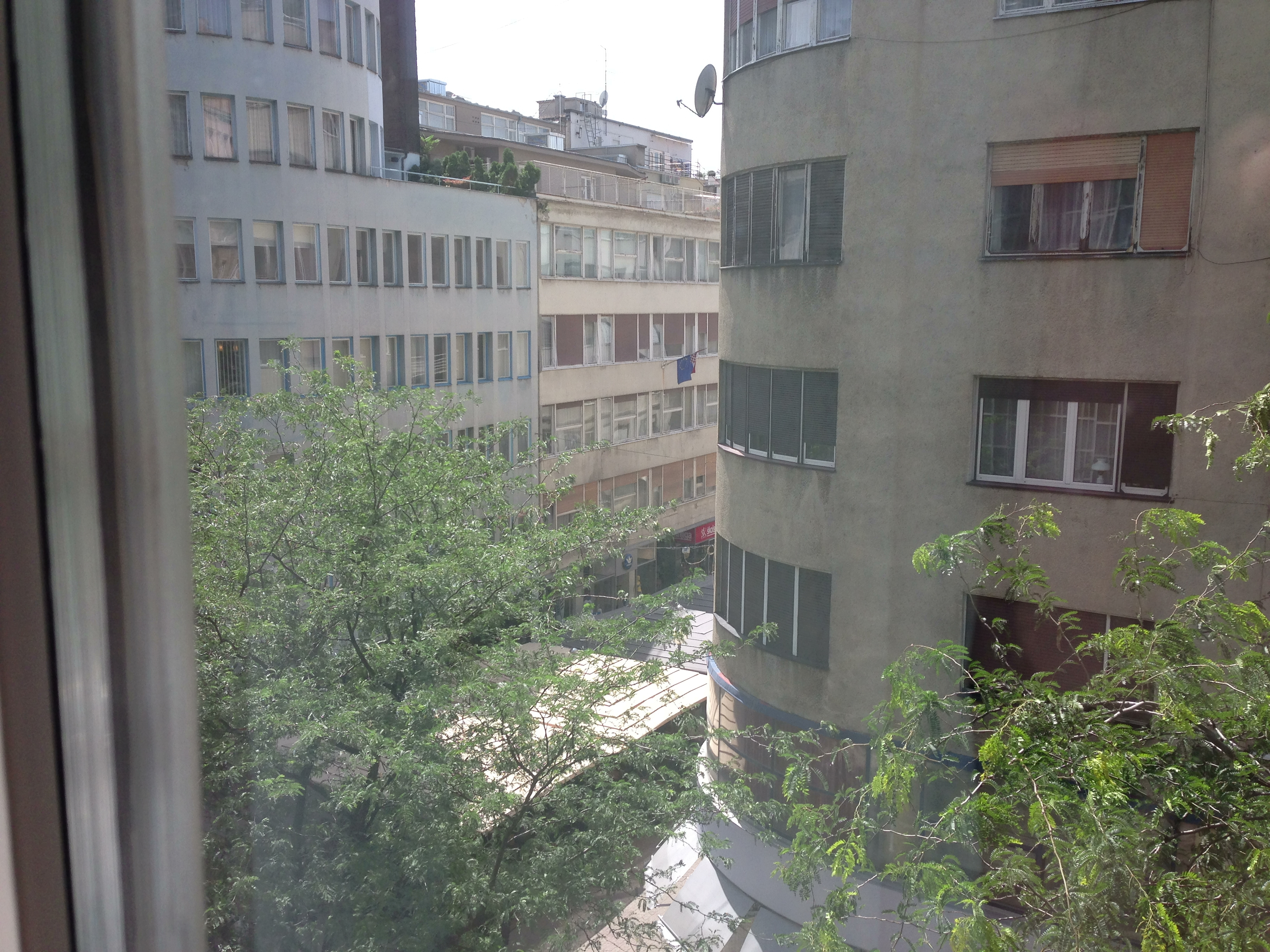
You have until noon on Tuesday to guess it. City and/or state first, then country. Please put the location in the subject heading, along with any description within the email. If no one guesses the exact location, proximity counts.  Be sure to email entries to contest@andrewsullivan.com. Winner gets a free The View From Your Window book or two free gift subscriptions to the Dish. Have at it.

More Friends With Free Will?

Jonathan Schooler surveys research suggesting that belief in free will correlates with desirable personal traits:

Recently we found that a belief in free will is positively correlated with a host of positive attributes (including: self-control, life satisfaction, subjective happiness, mindfulness, and ambition) and negatively correlated with several less desirable traits (such as neuroticism and mind-wandering). Of course, we must be cautious in drawing causal inferences from correlational studies. Nevertheless, these findings are consistent with the view … that a belief in free will affords some positive benefits.

Given these various lines of research, it might be tempting to conclude that a belief in free will makes us better people. However, I think such a blanket conclusion is misguided for a number of reasons.

First, the strengths of the relationships between belief in free will and the assorted positive traits and behaviors reviewed above, though observed in various labs and typically statistically significant, are generally relatively modest. Indeed, some studies have failed to find these relationships at all.

Second, although the bulk of studies investigating the issue have found positive benefits of a belief in free will, there is also evidence that a disbelief in free will has its advantages. For example, a recent set of studies by Sharif and colleagues found that discouraging a belief in free will reduced people’s tendency to punish purely for the sake of vengeance.

Finally, and perhaps most importantly, those who have concluded that a belief in free will is misguided would reasonably cringe at the notion that people who believe in a convenient fiction are “better” than those who have faced up to the reality of the situation.

Chart Of The Day

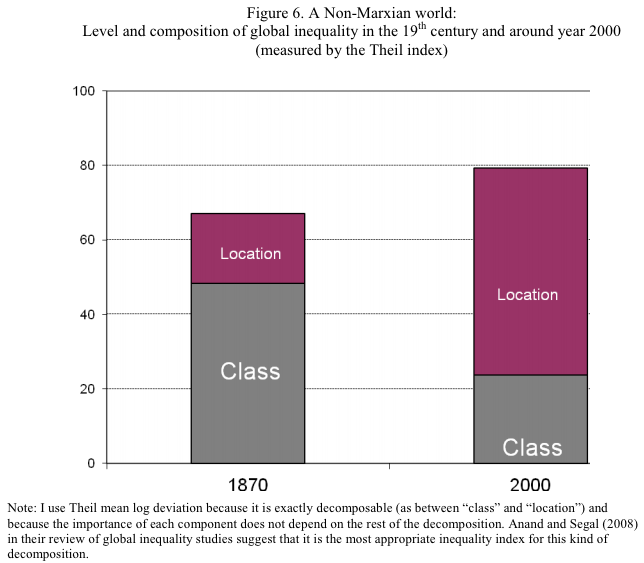
location vs class

Dylan Matthews explains the above chart on global inequality:

[C]lass rank matters far less than location in determining where someone falls in the global income distribution. That’s a big change from the 19th century, where class rank predominated. [Branko Milanovic, the lead economist at the World Bank’s research group] argues this means we live in a “non-Marxian world,” where the relevant cleavage is not between the proletariat and the owners of capital but between those with the misfortune to be born in poor countries and those with the great fortune not to be. “A proper analysis of global inequality today requires an empirical and mental shift from concerns with class to concerns with location,” he writes. “In other words, a movement ‘from proletarians to migrants.’”

An American Family

Sabrina Rubin Erdeley profiles twin siblings Patterson and Georgia Inman, heirs to the Duke tobacco fortune who will inherit a $1 billion trust fund when they turn 21. A riveting excerpt:

Raised by two drug addicts with virtually unlimited wealth, Georgia and Patterson survived a gilded childhood that was also a horror story of Dickensian neglect and abuse. They were globe-trotting trust-fund babies who snorkeled in Fiji, owned a pet lion cub and considered it normal to bring loose diamonds to elementary school for show and tell.

And yet they also spent their childhoods inhaling freebase fumes, locked in cellars and deadbolted into their bedrooms at night in the secluded Wyoming mountains and on their ancestral South Carolina plantation. While their father spent millions on drug binges and extravagances, the children lived like terrified prisoners, kept at bay by a revolving door of some four dozen nannies and caregivers, underfed, undereducated, scarcely noticed except as objects of wrath.

“We were so fearful. I would hide in cupboards smaller than that,” says Georgia in her Southern-tinged lilt, pointing to a two-foot-tall cabinet in the kitchen of their spacious Park City, Utah, home where the twins, now 15, are reassembling their lives and residing with their mother, a woman who has seen her own share of trouble and who has only recently become a presence in her children’s lives. Patterson anxiously paces across the house’s open floor plan with its panoramic view of snowcapped mountains while he and his sister take turns narrating their harrowing history. Unfailingly polite, earnest and occasionally skittish, the twins radiate a sheltered naiveté that can make them seem far younger, or like visitors from another culture. For instance, Georgia confesses she’s never heard of the children’s party game musical chairs.

“What is it?” she asks, her eyes wide and curious. “No, really, tell me!”

Such frank sweetness, delivered in their mushy drawl, tends to take the edge off some of the harsh and surprising things they will say in the coming days, as when Georgia wistfully recalls her toddler years: “I remember walking to my dad’s room and holding a gun to his head. I don’t know what stopped me,” she says before bursting into giggles. “I’m sorry, that’s terrible, I laugh when I’m nervous or upset.”

Not Just For Valley Girls Anymore

Paula Marantz Cohen defends the use of “like”:

“Like” is a comfort word in some respects. It gives those who are tentative or unsure a chance to sidle into a point. It is a marker for uncertainty: “I, like, think I’m going to, like, go to medical school, only, like, I’m not really sure.” That’s qualification with a vengeance, but, then, the subject—whether to spend years in medical school followed by a career ministering to the sick—warrants such uncertainty.

“Like” is also a way to diminish or cushion the force of an idea or to acknowledge an approximation of meaning. One’s first inclination is to be annoyed that the speaker has not found a more precise word. But the right word may not exist, and the approximate word, softened or qualified by “like,” may be more precise. I used the word a while back in my course on Paradise Lost: “The thing you have to realize with Milton is that even if you don’t, like, ‘believe,’ there is a wealth of profound observation about human relationships in the poem.” Here, “like” gives the listener a bit of latitude in how to understand “believe.” It also opens up the idea of belief in a way I felt was helpful. For some, it might seem I was being sarcastic, for others that I was simply acknowledging their probable uncertainty about their own belief or the difficulty of pinning down what belief actually consists of.

The Burka Avenger

A Pakistani cartoon features a burka-clad heroine:

Burka Avenger stars a girls’ school teacher who dons a burka to combat a cast of Taliban-esque villains with a decidedly conservative view of the appropriate role of women in society (the show contains clear parallels to Malala Yousafzai, the young campaigner for girls’ education in Pakistan who was shot in the head by the Taliban). To fight these nemeses, Jiya, the star of the show, employs a novel form of marshal arts that utilizes only books and pens. The message is clear: The pen is mightier than the sword.

Faiza S. Khan defends the show’s use of a burka:

It goes without saying that forcing women to wear anything is entirely unacceptable. The woman in question, however, is adopting the veil of her own free will, for the express purpose of obscuring her identity. When we ignore the character’s intentions behind willingly adopting a burka (as a disguise), it brings us back to good old-fashioned patriarchy, whereby a woman’s decisions are dwarfed by whatever message her clothing is putting out.

Elias Groll agrees that Jiya’s burka is not a simple symbol of oppression:

Ultimately, the show — in emphasizing the right of girls to an education — is doing something far more subversive with the burka than its critics contend. It’s also important to note that Jiya is not covered by day, and only puts on the burka when she assumes her crime-fighting alter ego. That she does so in a burka while running atop power lines to a sweet theme song seems all the better. Suddenly the woman in the burka has been turned into something altogether different — a pretty great superhero.

M. Sophia Newman suggests that the educational benefits of the show may extend beyond wealthier Pakistanis more likely to own a TV:

[A] 2007 economics study (PDF) documented an upswing in gender equality and education in India after the arrival of cable television. “Introducing cable increases the likelihood of current enrollment for girls by 3.5 percentage points,” the authors wrote, describing a shift over four times larger than the 0.83% increase created by the Pakistani government between 2005 and 2011. … By promoting middle-class values to the Pakistanis who do see the show, “Burka Avenger” might make the show’s tagline a real promise to Pakistan’s Islamist minority: “Don’t mess with the lady in black.”

Second Tongue, Second Life

For writers, learning a new language can be profoundly transformative:

Towards the end of Ray Bradbury’s novel “Fahrenheit 451” the reader comes across something whose significance exceeds the confines of the story. It is the scene where Montague meets the “book people.” In a world where printed texts are banned, they have dedicated their lives to preserving the “great books” of the humankind; each commits a book to memory and spends the whole life reciting it. They are living texts, these people, language incarnated. Apart from the masterpieces that inhabit them, they don’t mean much. Their bodies matter as little as the paper on which a book is printed. In a way, a writer who has changed languages is not very different from these people. In the long run, because of their compulsive preoccupation with linguistic precision and stylistic perfection, a colonization of sorts takes place: language penetrates all the details of that writer’s life, it informs and re-shapes it, it proclaims its dominion over her – it takes over. The writer’s self is now under the occupation of an invading power: her own writing in the new language.

In a certain sense, then, it could be said that in the end you don’t really change languages; the language changes you.

At a deeper, more personal level, writing literature in another language has a distinctly performative dimension: as you do it something happens to you, the language acts upon you. The book you are writing ends up writing you in turn. The result is a “ghostification” of sorts. For to change languages as a writer is to undergo a process of dematerialization: before you know it, you are language more than anything else. One day, suddenly, a certain intuition starts visiting you, namely that you are not made primarily out of flesh anymore, but out of lines and rhymes, of rhetorical strategies and narrative patterns. Just like the “book people,” you don’t mean much apart the texts that inhabit you. More than a man or a woman of flesh and blood, you are now rather a fleshing out of the language itself, a literary project, very much like the books you write. The writer who has changed languages is truly a ghost writer – the only one worthy of the name.