When Do Sit-Ins Succeed?

Erica Chenoweth predicted that the pro-Morsi encampments would fail. What successful protest movements look like:

One of the most dangerous misconceptions about civil resistance is that several weeks of street demonstrations or sit-ins can bring about major systemic change. On the contrary, the average civil resistance campaign takes nearly three years to run its course. Although three years might sound like an eternity, the average violent campaign takes three times longer and is twice as likely to end in failure. History shows that civil resistance campaigns tend to succeed when they build the quantity and quality of participants, select tactics that provoke loyalty shifts among ruling elites, prepare enough to maintain nonviolent discipline, and skillfully change course under fire to minimize the damage to participants. All of this takes time, organization, preparation, and a good deal of strategic imagination.

(Hat tip: Joshua Tucker)

Ask Kate Bolick Anything: Marriage Envy?

In today’s video, Kate explains what effect being a proponent of singlehood has had on her dating life, as well as what she envies about the lives of her married friends and family:

Kate is currently working on her first book, Among the Suitors: On Being a Woman, Alone, to be published next year by Crown/Random House. She is also a contributing editor for The Atlantic and writes regularly for ElleThe New York TimesThe Wall Street Journal, and Slate. Her 2011 Atlantic cover story, “All the Single Ladies”, addressed why more and more women are choosing, as she has, not to get married. The Dish debated the piece here and here. A reader responds to the first AA video we aired of Kate:

In my experience, Bolick is completely wrong.  The idea that friends will fill in the gaps where a spouse or family used to be is nonsense.

Outside of spouses and children, who are most likely to feel a bond and an obligation, there are very, very few relationships that oblige someone to go through the sorrow and exhaustion of caregiving that often goes on for years, with no end in sight.  And if Kate believes that home healthcare workers and aides work well without constant family supervision, then she’s clearly got no experience related to this topic. Anyone who has put a loved one in a home or been their healthcare proxy while in the hospital knows damn well the system doesn’t work well when no one is watching out for the patient besides those in the system.  It requires constant strategizing and supervision.

The caregiving that is needed isn’t anywhere on its way to materializing for the single people among us. I just went through the wringer as the primary caregiver for my sister who passed away in April. She was 50 and unmarried. If not for me, there would have been no one to look after her and she would have been warehoused in a nursing home until she passed away. Maybe she would have gotten the same level of care without someone looking out for her (which I do doubt), but who would have held her hand and sat by her side?

I am also not married, but I’m terrified about what will happen to me later in life without children to look after me.

An HIV Test For Everyone

Daniel Engber notes that “at least 18 percent of HIV-positive Americans don’t realize they’re infected, and in developing nations, that rate is almost three times higher.” He advocates for near universal testing:

The therapies we have are already good enough to win the war on AIDS, but they can only score that victory if we reach more infected people quickly. To catch cases while they’re still developing, we’ll need a much bigger net—a way to screen for HIV that’s close to universal, and a means of starting treatment right away. It used to be that we needed better drugs. Now we need better diagnoses.

What this could accomplish in the US:

A group at Stanford has figured that screening all Americans for HIV at least one time in their lives (along with yearly tests for those at higher risk of contracting the disease) could prevent 212,000 new infections over the next 20 years. Such a program would not be cheap, of course, but the researchers estimate that it would buy the equivalent of an extra year of healthy living for every $25,000 spent. That rate of return matches up with those achieved from screening for breast cancer or type 2 diabetes.

Dissents Of The Day, Ctd

The first dissenter follows up:

Thank you for publishing my email. I just wanted to clarify a couple things. First, my point was not that you had argued a discussion of male physiology should be substituted for one of rape culture. Rather, it was that this substitution was a likely rhetorical effect of your response to Bruni. I don’t think that effect was intended. But rape culture is reinforced as much by such Testosterone-3D-stickseffects as it is by explicit arguments.

To take a more obviously egregious example, when someone asks a woman who’s been raped, “Why didn’t you fight back?”, the intention of the question could be a whole range of things – curiosity, trying to elicit whether the rapist had a weapon or whether she was drugged, etc. But the effect of the question, when asked within a culture that tends to disbelieve and shame women who’ve been raped (unless the rape was committed by the near-mythical stranger in the bushes with a knife), is to dissuade her from reporting or talking about the rape.

Second, I’m increasingly unclear on the grounds of your criticism of Bruni’s op-ed. How is your call for a culture of male virtue fundamentally different from Bruni’s call for a culture of masculinity that’s not centered around the denigration and sexual conquest of women?

Both, unless I’m misunderstanding you, would make it socially unacceptable to treat women as objects for domination and violence and, as a result, would make it much harder for rapists, who rely on a culture that tacitly okays treating women that way, to get away with their crimes. So how, then, does testosterone fit it in to all this? Are you actually suggesting that not making rape jokes or calling out other men who let slip that they try to have sex with women who are too drunk to consent goes against the grain of the male psyche? If so, I suspect a lot of your male readers would take personal offense. If not, why worry about how to make this change in a way that’s compatible with testosterone – especially since scientists still know very little about how testosterone interacts with culture.

Given what a red herring male physiology has been (and often still is) among people who think men just can’t help themselves around a women who is too attractive, too drunk, etc., why not just keep the focus on telling men not to rape – and not to valorize those who do?

First point: As a writer I have long believed that my job is to express what I believe is true, and worrying about how such an argument could affect or be used by others is a very secondary mission. I cannot control what others will do with my arguments; I can only really control my own words. When you see previous controversies – race and IQ, the end of plagues, the differences between men and women, the rights of bigots to free speech – you can see where I’m coming from. I cannot write while looking over my shoulder – and won’t start now.

Second: yes, I wrote that I agreed with much of what Frank proposed. I’m just under no illusion that will “solve” the problem because cultural change can only do so much against the violence associated with testosterone. And I think it will be more successful if it comes at this issue with a positive vision of masculinity rather than an assumption that masculinity is only a social construct, and is itself the problem. The other dissenter also writes back:

I’m writing to thank you for taking my argument seriously, and for addressing it publicly. You rightly call my argument out as a liberal one. Indeed it is. My fundamental problem with the conservatism you admire is that it too often overlooks past injustices in its desire to hold on to (often worthy) older values.

While I still strongly disagree with you, I have great respect for your willingness to be open to critique, and to engage in civil discussion of difficult issues. These virtues render your blog a public asset, particularly at a time when shrieking extremism too often passes for debate. And it’s why I plan to continue reading the Dish for years to come.

I also am grateful for the sharp input and pushback from such intelligent, probing readers. It’s this civil interaction that this blog aspires to – not a final word, but a continuing conversation.

The American Response To Egypt

https://twitter.com/attackerman/status/368022051614773248

https://twitter.com/minafayek/status/368021211823226880

Max Fisher doubts the cancellation of the US-Egyptian military exercises this year will give us any leverage over the junta:

[The Generals] surely understood that they would pay a high price for this violence. If the generals are willing to accept 500-plus civilians deaths and the strong possibility of sectarian violence, maybe even a return to the Islamist insurgencies of the 1990s, then it’s hard to imagine they’ll be fussed by missing out on some military exercises with the United States.

Chotiner comes down hard on Obama’s announcement:

[T]he problem is not that Obama looks weak per se; it’s the policy behind the weakness. He hasn’t tried to use aid as leverage (and still refuses to use the word “coup”), he hasn’t (one assumes) put much pressure on American allies who are backing the Egyptian military, and he hasn’t even attempted to lay out the reasons that military rule in Egypt might, in the long term, play against American interests. One need only look to the Middle East and Pakistan to see how military repression can lead to extremism, and rampant anti-Americanism. It was notable that Obama took time to mention that Morsi’s undemocratic actions undermined his case for rule, but not that the military’s much more violent and undemocratic actions did the same.

Heilbrunn nods:

Obama further tried to console Egyptians by making it clear that the “United States strongly condemns” what is taking place. Big deal. It is Obama’s passivity that deserves condemnation. A forceful move would have been to suspend aid to Egypt’s military. So far, Washington appears to have derived zero leverage from continuing aid. Until Obama acts, Egypt’s military will interpret his inaction as acquiesence to its brutal measures.

Earlier Dish on the cancellation of military exercises here.

It’s Getting Worse

dish_octophant

To recap some of the latest developments. We have watched the possibility of Republican support for immigration reform rise and then dramatically fall, as Tom Edsall explains here in charting the decline in the fortunes of Marco Rubio as soon as he stood up for a path to citizenship. Christianists are seeking to end the ban on tax-exempt churches’ endorsing candidates. The recent Pew report found the following among regular Republican primary voters (in Edsall’s words):

Republicans who say that they always vote in primaries (and whose views consequently carry more weight) are much more in favor of their party’s turning in a more conservative direction. Data provided to the Times by Pew shows that 58 percent of Republicans who always vote in primaries advocate more conservative stands, while 37 percent call for moderation, a 21-point split. Republicans who do not always vote in primaries are more evenly divided, 50-44.

Insofar as support or opposition to immigration reform is a proxy for more or less positive attitudes toward Hispanics, the Pew study shows a decided tilt among Republicans. Thirty-six percent of Republican voters say that the party’s stance toward immigration is not conservative enough, compared with 17 percent who say it is too conservative. Crucially, among Republicans who always vote in primaries, the division shifts further to the right, 41-14.

In North Carolina, the state GOP has launched a brazen attempt to disenfranchise minority voters, acting more like Egypt’s Muslim Brotherhood when they came to power rather than a moderate Western political party. And in Washington, Robert Costa is reporting that the House GOP won’t force a government shutdown this fall but that they will “instead use the debt limit and sequester fights as areas for potential legislative trades.” They are going to hold America’s credit-worthiness hostage again – even though such a debt limit crisis would be far more damaging to the economy than even a shutdown, as Chait notes here. But perhaps damaging the economy is the point. The GOP has to minimize any economic growth that might redound to Obama’s benefit – in order to discredit the policies that have obviously worked for the past five years in favor of policies that have been proven failures elsewhere.

And when you look at presidential prospects, you find most of the GOP energy on the far right. And a strategy to keep it that way by ditching the whole notion of impartial debate moderators in favor of far-right talk-show hosts – Limbaugh, Levin and Hannity, for Pete’s sake – as the arbiter of primary slugfests.

We now have pretty solid evidence that the GOP will respond to Obama’s second term exactly as they did his first: total opposition to everything and anything the president supports, sabotage of the economy, and brutal gerry-mandering and voter suppression to give their white base one last chance at a majority. Actual policies? It’s hard to disagree with Newt Gingrich – and not just on healthcare.

I predicted it would get worse before it got better; what we now learn is that it will get worse before it gets worse before it gets better. And the real beneficiaries of this will likely not be the GOP – but Roger Ailes and Hillary Clinton.

(Image of Alexis Diaz‘s work via Colossal)

Hewitt Award Nominee

“Where will [Obama] get his ‘national police’? The NaPo will be recruited from “young out-of-work urban men” and it will be hailed as a cure for the economic malaise of the inner cities. In other words, Obama will put a thin veneer of training and military structure on urban gangs, and send them out to channel their violence against Obama’s enemies. Instead of doing drive-by shootings in their own neighborhoods, these young thugs will do beatings and murders of people “trying to escape” — people who all seem to be leaders and members of groups that oppose Obama,” – Orson Scott Card, in an “experiment in fictional thinking” that “sure sounds plausible.” Award glossary here.

Time To Cut Off Cairo’s Aid, Ctd

A reader writes:

I don’t see how the US can continue to fund Egypt as this shit goes on, but cutting off aid to Egypt isn’t that simple. The aid to Egypt is basically a bribe to the Egyptian military to make sure Israel doesn’t have to fight a war along its Sinai border. That is how it started, and especially post-Mubarak, is how it has played out. I don’t think that Egypt’s ruling class would invade Israel at the drop of a hat if this bribe is removed, but if the Muslim Brotherhood crowd returns to power, that shit would heat up real fast.

Hence, presumably, the lack-luster Obama stance on the junta now running Egypt. Canceling military exercises is not likely to have any effect on the junta’s murderous contempt for civilian life and democratic processes. Here’s the rationale for such a lame response:

Administration officials fear that suspending that aid could destabilize the region, jeopardize Israel’s security, and would deprive the United States of its only lever to use on the generals. Analysts also say that if the United States withdrew its support, Egypt’s generals would be able to replace it with increased assistance from Saudi Arabia.

I can see these points, but when we have no way to prevent the massacres of yesterday, and when, with continued aid, we become complicit in it, our “only leverage” is no leverage.

The same, of course, can be said of aid to Israel: it has given the US no leverage at all over the continued expansion and entrenchment of Eretz Israel. It has simply made the US complicit in de facto apartheid on the West Bank and any bombs that kill Palestinian civilians. Israel, like Egypt, can live without it. And in my view, we should let them. In the coming epochal violence and shifts in the Muslim Middle East, America’s best policy, it seems to me, is distance.

But of course both aid to Israel and Egypt is also fueled by domestic pork-barrel politics. Another reader explains:

I worked throughout the ’90s for a contractor doing work in Cairo for USAID. Here’s how it worked: the US government gave Egypt $n billion per year. It amounted to roughly the same amount we gave Israel.

There was a difference, however. We said to Israel, “spend it wisely, my friends”. We said to Egypt, “we’ll have to approve how you spend it, and most of it should go to American contracting companies.” So the public finance project that we were working on for the Egyptian Ministry of Finance featured a lot of US-made computers, Jeep Cherokees, and guest lectures by IBM in Egypt and abroad. Doing things this way meant most of the money came back to the USA.  It became a shadow pork-barrel operation. If that’s still the way it works, it would explain why Congress has been reluctant so far to defund it.

Oh, and by the way.  Israel spends most of theirs on American weapons, so we get that back as well.  I think the English invented this system back in their empire days.

Yes, it is an ancient imperial device. But at least Britain also controlled the countries it aided. America today is an empire without any control over its client states – the worst of both worlds.


Islam, Putin, Obama And Gays

984ad02bb8d1b74085033c67d80d9c6c

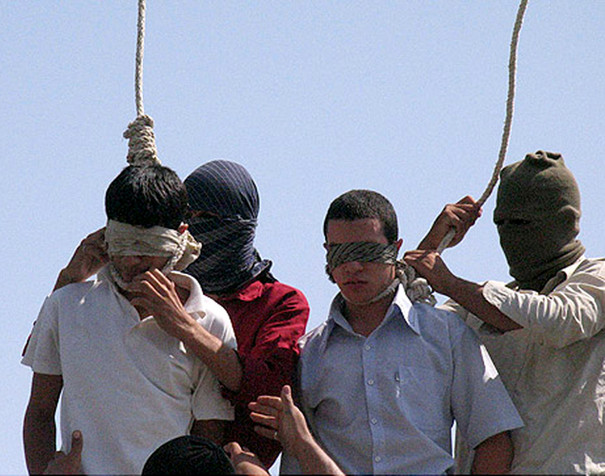
Andrew McCarthy is only for gay equality when he can use it to bash Obama, but he raises some interesting points about the US position on Russia’s abolition of free speech and assembly for gay people. If relations with Russia can be severed on these grounds, why on earth are we still trying to manage relationships with Islamist regimes that treat gay people far, far worse? I think he’s absolutely right to point out how viciously homophobic laws are completely mainstream in much of the Muslim world. And he uses this statement by the president to accuse him of rank hypocrisy:

I have no patience for countries that try to treat gays or lesbians or transgender persons in ways that intimidate or are harmful to them.

This is the core case:

Will President Obama call out King Abdullah of Saudi Arabia the way he called out Putin? Will he start lecturing and cutting off American aid to violent and thin-skinned Muslim populations? Will he start demanding that Islamic leaders in the United States loudly and unambiguously call for reform of anti-gay laws and practices in Muslim countries?

I guess there are a few responses to this.

The first is to agree that the gay rights element was not the core reason for abandoning the “re-set” with Russia; and that Obama was indeed bullshitting a little when citing it as such. But bullshitting (a constant in politics) is not the same as rank hypocrisy and Obama has not ended relations with Russia, just given up on a real re-set. Russia, moreover, has just intensified its anti-gay policies, and could perhaps be prodded to reverse them. Such options, as McCarthy shows, do not exist in the Muslim Middle East.

As for Saudi Arabia, any engagement with that theocracy is repellent in terms of human and civil rights, but our dependency on foreign oil compels us to deal with them (if fracking doesn’t help us gain more distance). As for Iran, we have such an interest in keeping its nuclear program to civilian use that other issues fade into the background. And, of course, Obama has presided over the most punitive sanctions regime ever imposed on the country.

So good debating point, and healthy reminder of how poisonously backward much of the Middle East is. But in the end, no dice.

(Photo: the execution of two young men for homosexual activity in Iran in 2005)