Appraising Tragedy

James Oliphant profiles Ken Feinberg, a lawyer who determines compensation for victims of national disasters:

Feinberg works hard not to be swayed by emotional appeals—and he tries as best he can to keep some distance. “You sob in private,” he says. “Never in front of a victim.” As a rule, he does not visit the sites of the tragedies to which he has been connected. He avoided the marathon finish line and the Sandy Hook campus. He didn’t inspect Ground Zero in Manhattan until after the claims process was finished, and he never returned. Nor does he make a habit of visiting claimants in the hospital; he makes them come to an office, to keep himself from becoming entangled in their despair.

He broke his rule in Boston when he visited two victims at a rehabilitation facility—and he regrets it now. The first man, he says, greeted Feinberg with bitterness: “You’re going to give me a million dollars or more,” he said. “I’ve got a better idea. Give me my leg back.” The second victim’s legs were stippled by shrapnel and gangrene, but he still had them. He had been lying in bed doing the math, and he had a simple question for Feinberg. Should he have his legs amputated before the July 1 deadline for determining his award? The difference in his payout would have been more than $1 million, tax free. Feinberg didn’t know what to say. The man decided to keep his legs—and received $948,300. The first man, who lost one leg, received $1,195,000. Feinberg walked out of the facility that day and vowed: Never again. “There have to be limits,” he says.

(Hat tip: Longform)

Gaming Out The Brain

dish_eyewire

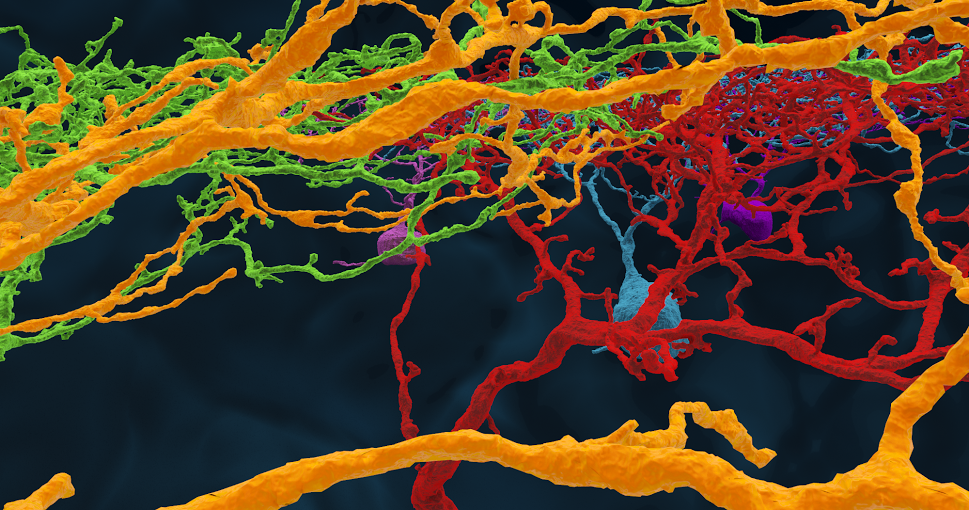
Neuroscientist Sebastian Seung wants to develop a better picture of the human brain – with your help. EyeWire is a browser-based game developed by Seung’s lab at MIT that invites players to map the connections between retinal neurons:

[Creative director Amy] Robinson says it currently takes the lab around 50 hours to reconstruct one neuron, even with help from artificial intelligence. Multiply that by the 85 billion (the approximate number of neurons in a human brain), and you can see how they might need some help.

Turns out, citizen scientists are very good helpers. Humans are more adept at spotting the patterns of neuron connectors than most machines are, which is why every player’s moves are recorded and fed to artificial intelligence to help machines get better at this very task. Since EyeWire’s public launch in December, more than 70,000 people have played the game. In total, they’ve colored in more than a million 3-D neuron cubes (each cube represents a tiny chunk of brain), resulting in the mapping of 26 whole cells.

“It takes players about three minutes on average to complete a cube,” says Robinson, “So they’ve spent an equivalent of six years of time on EyeWire since the launch.” In the grand scheme of the brain, 26 cells might not seem like much, but that’s a testament to the game’s emphasis on accuracy (anywhere from five to 25 people will trace the same set of connectors before it’s deemed valid).

(Photo via Eyewire)

On Anger And Writing, Ctd

Laura Bogart discusses how the emotion informs her writing and life:

In some ways, anger has been my saving grace. The ability to get good and pissed-off at the ways I’ve been mistreated—and not just by my family—is life affirming. The whisper of my roiling blood tells me that I matter, that I don’t deserve what I’m getting (or not getting). My current therapist actually has made a very potent distinction between anger and rage. Anger, she says, is that affirming force. Rage, she says, is a kicked dog that bites the first person that tries to pet her. My work in nonfiction and fiction examines the often hairline difference between the two, which has made me very aware of whether what I’m experiencing is anger or rage. That is to say, whether what I’m feeling is a legitimate reaction to a genuine slight, or just an excuse to bare my teeth.

A perfect example:

So, I’ve moved below a woman with a teenage son, and on occasion, they can get a little loud. I’m a quiet-loving introvert who, if I had my preferences, would live inside a hermetically sealed bubble. My initial reaction to the first bit of dubstep (and why is it that the people with the worst tastes always blare it the loudest?) was to become a human volcano. How dare they intrude on my solitude? Don’t they know I need quiet to write? So I got out my broomstick (if I’d had curlers in my hair and pink fuzzy slippers, my transformation into cranky hausfrau would have been complete) and I banged on the ceiling like I was trying out for a job as a sound effects specialist in the new Thor movie. The woman came down, immediately apologetic, almost tearfully apologetic, and told me that her son was just sharing his new favorite song with her. That’s when I what our lady of Oprah would call a “light bulb” moment: The music hadn’t rattled the cupboards; it had only lasted a moment; and, oh yes, other people have a right to enjoy life in their apartments.

Previous Dish on the subject here.

A Poem For Saturday

yusef_komunyakaa_2011_nbcc_awards_2012_shankbone

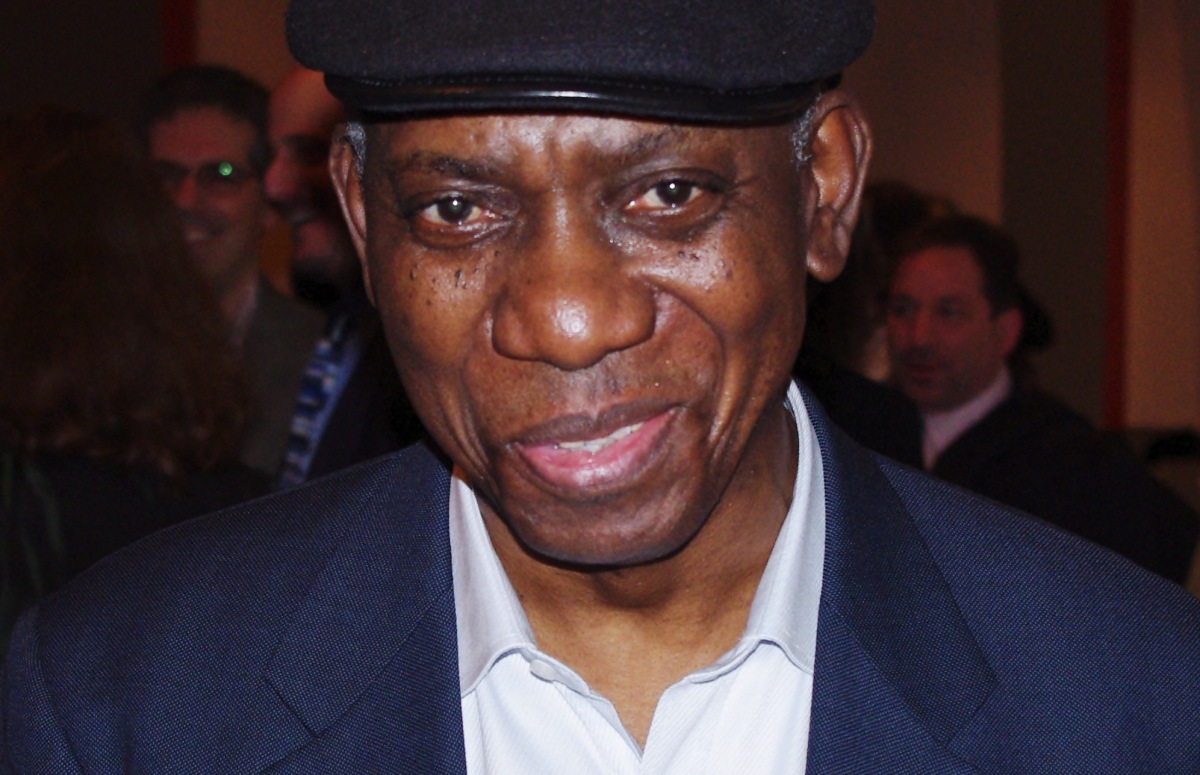
This weekend we’re featuring poems from The Chameleon Couch, the eighth and newest collection by the Pulitzer Prize-winning poet Yusef Komunyakaa. His many awards during his distinguished career include the Wallace Stevens Award from the Academy of American Poets and the Shelley Memorial Award from the Poetry Society of America. In Poetry Magazine, David Wojahn praised him as a poet with “a near-revelatory capacity to give himself over to his subject matter and to the taut concision of his free verse.” Here’s Komunyakaa’s “A Voice on an Answering Machine”:

I can’t erase her voice. If I opened the door to the cage & tossed
the magpie into the air, a part of me would fly away, leaving only
the memory of a plucked string trembling in the night. The voice
unwinds breath, soldered wires, chance, loss, & digitalized im-
pulse. She’s telling me how light pushed darkness till her father
stood at the bedroom door dressed in a white tunic. Sometimes
we all wish we could put words back into our mouths.

I have a plant of hers that has died many times, only to be revived
with less water & more light, always reminding me of the voice
caught inside the little black machine. She lives between the Vale
of Kashmir & nirvana, beneath a bipolar sky. The voice speaks of
an atlas & a mask, a map of Punjab, an ugly scar from college days
on her abdomen, the unsaid credo, but I still can’t make the voice
say, Look, I’m sorry. I’ve been dead for a long time.

(From The Chameleon Couch: Poems © 2011 by Yusef Komunyakaa. Used by kind permission of Farrar, Straus and Giroux. Photo by David Shankbone)

Where Scary Clowns Come From

dish_clown

We can credit Dickens with the “scary clown” meme. In 1837, the young writer was tasked with editing the memoirs of Joseph Grimaldi, “the Homo erectus of clown evolution”:

Dickens had already hit upon the dissipated, drunken clown theme in his 1836 The Pickwick Papers. In the serialized novel, he describes an off-duty clown—reportedly inspired by Grimaldi’s son—whose inebriation and ghastly, wasted body contrasted with his white face paint and clown costume. Unsurprisingly, Dickens’ version of Grimadli’s life was, well, Dickensian, and, [scholar Andrew McConnell] Stott says, imposed a “strict economy”: For every laugh he wrought from his audiences, Grimaldi suffered commensurate pain.

Stott credits Dickens with watering the seeds in popular imagination of the scary clown—he’d even go so far as to say Dickens invented the scary clown—by creating a figure who is literally destroying himself to make his audiences laugh. What Dickens did was to make it difficult to look at a clown without wondering what was going on underneath the make-up: Says Stott, “It becomes impossible to disassociate the character from the actor.” That Dickens’s version of Grimaldi’s memoirs was massively popular meant that this perception, of something dark and troubled masked by humor, would stick.

(Photo by Flickr user joiseyshowaa)

Redefining “Delusion”

Vaughan Bell flags an important definitional shift in the DSM-5 that alters how psychiatrists approach patients’ unusual beliefs:

[M]ental health professionals are often required to decide if someone’s thinking indicates a disturbance in their understanding of the world, and this is where the new DSM-5 definition of a delusion may usher in a quiet revolution in psychiatry. No longer are psychiatrists asked to decide whether the patient has “a false belief based on incorrect inference about external reality that is firmly sustained despite what almost everyone else believes and despite what constitutes incontrovertible and obvious proof or evidence to the contrary”. A wordy and unhelpful definition that has so many logical holes you could drive a herd of unicorns through it.

Instead, the new definition of delusions describes them as fixed beliefs that are unswayed by clear or reasonable contradictory evidence, which are held with great conviction and are likely to share the common themes of psychosis: paranoia, grandiosity, bodily changes and so on. The belief being false is no longer central and this step forward makes it less likely that uncomfortable claims can be dismissed as signs of madness.

Why Haven’t More Muslims Won The Nobel Prize?

Tom Chivers counters Dawkins’ tweet:

It might be true that Islam is holding back scientific and other achievement among Muslims. I actually wouldn’t be surprised if it were. But you don’t get to simply assert it, because there are far too many other variables. Islamic countries are themselves usually poorer than Western ones (and far poorer than the average Trinity alumnus). Their standards of public health are lower, nutrition, education, everything. Does the average Muslim do worse in the Nobel prize stakes than the average similarly deprived Christian or atheist or Hindu? I don’t know. You need to do proper analysis, statistical regression, to work that out. What’s worse, Dawkins knows that.

Nelson Jones thinks Dawkins makes a weak case:

The reason for this isn’t an international conspiracy and it’s ridiculous to view it as some sort of failure on the part of Islam. Rather, it shows that modern science (by which I mean academic, research-intensive science) has been and remains an overwhelmingly Western phenomenon. To ask “where are all the Muslims?” as Dawkins does is to miss the point. One might as well ask, Where are all the Chinese? China has just eight native-born Nobel winners, and all but two of them are affiliated with Western universities, mostly in the United States.

Dan Murphy adds:

When the Nobel Prize was founded in 1901, the vast majority of the world’s Muslims lived in countries ruled by foreign powers, and for much of the 20th century Muslims did not have much access to great centers of learning like Cambridge.

Owen Jones thinks Dawkins makes atheists look bad:

As a non-believer, I want the atheist case to be made. I want religious belief to be scrutinised and challenged. I want Britain to be a genuinely secular nation, where religious belief is protected and defended as a private matter of conscience. But I feel prevented from doing so because atheism in public life has become so dominated by a particular breed that ends up dressing up bigotry as non-belief.

And Nesrine Malik rolls her eyes at Dawkins:

To wearily engage with his logic briefly: Yes, it is technically true that fewer Muslims (10) than Trinity College Cambridge members (32) have won Nobel prizes. But insert pretty much any other group of people instead of “Muslims”, and the statement would be true. You are comparing a specialized academic institution to an arbitrarily chosen group of people. Go on. Try it. All the world’s Chinese, all the world’s Indians, all the world’s lefthanded people, all the world’s cyclists.

Dawkins responds to that argument:

[F]air point. Somebody mentioned redheads (neither he nor I have figures on redheaded scientific achievement but we get the point). I myself tweeted that Trinity Cambridge has more Nobel Prizes than any single country in the world except the USA, Britain (tautologically), Germany and France. You could well think there was something gratuitous in my picking on Muslims, were it not for the ubiquity of the two positive boasts with which I began [There are 1.6 billion Muslims, nearly a quarter of the world’s population, and we are growing fast” and “Islamic science deserves enormous respect.” Redheads (and the other hypothetical categories we might mention) don’t boast of their large populations and don’t boast of their prowess in science.
The Lottery Tax

Pat Garofalo calls lottery tickets “a tax on those who can least afford it”:

Study after study has shown that lottery tickets are disproportionately purchased by low-income, less-educated people, and that lottery purchases go up when the economy and the unemployment rate gets worse. (22 state lotteries set sales records during the height of the Great Recession.)

James Gibney suggests a solution to this problem:

The research also shows, however, that the bigger the jackpot, the more affluent the ticket buyers.

One 2004 study by Emily Oster, now an economist at the University of Chicago, actually projected (with the usual academic caveats) a jackpot size at which Powerball becomes progressive: around $806 million.

Oster looked at buyers of Connecticut state lottery tickets by zip code and found that as the size of the jackpot grew, sales increased in richer areas: in fact, “at the highest jackpot levels the poorest 20% contribute only about 19% [of state sales] and the richest contribute close to 32%.” She suggested that “fewer games, with longer odds and higher jackpots, could allay some fears about regressivity.”