The Latest In Hamburger Technology, Ctd

Meat Predictions

Alexis rounds up predictions about the availability of lab-grown meat:

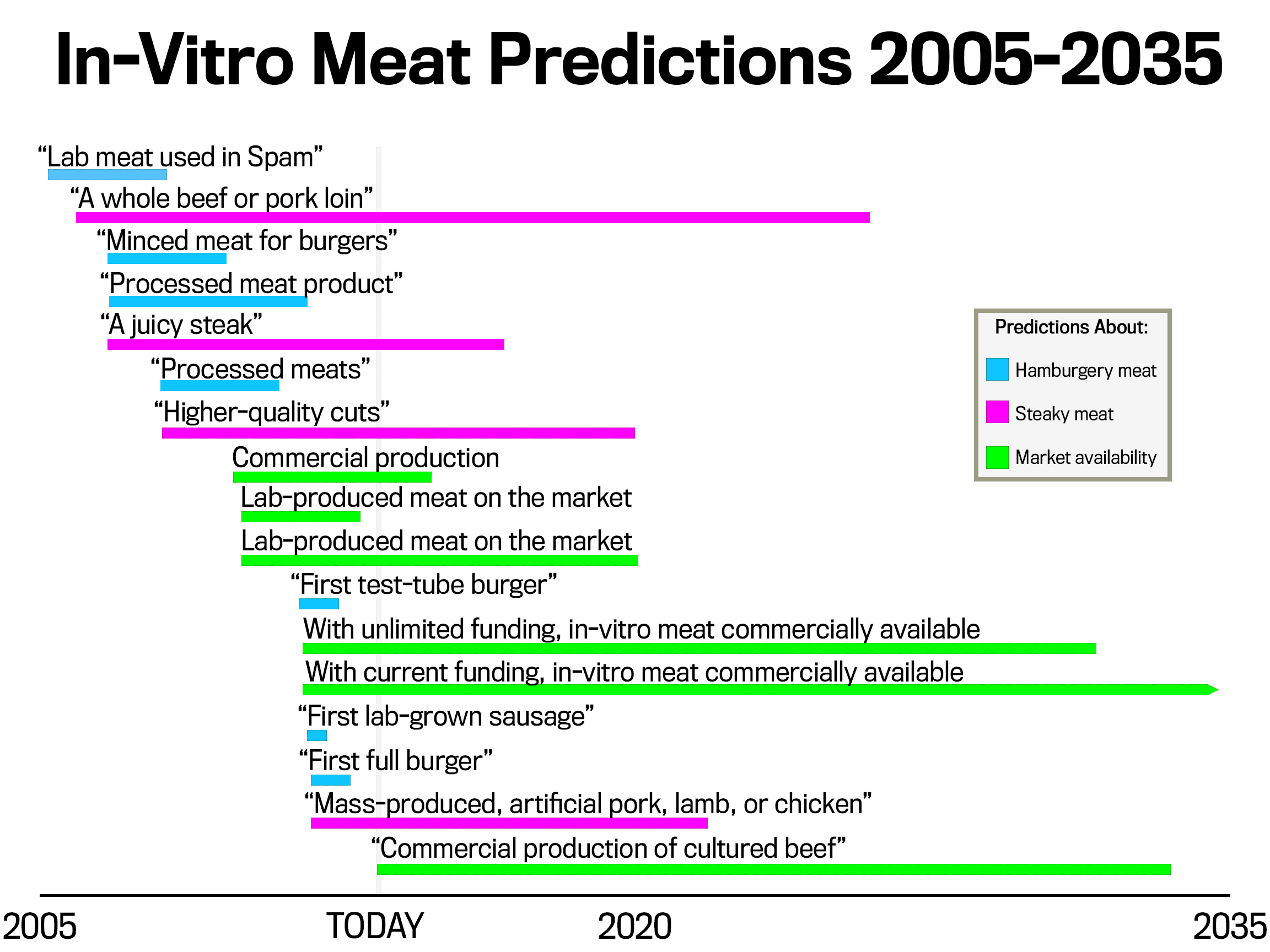
Ever since I started following in-vitro meat at Wired six years ago, I’ve noticed a trend. Each time there’s a media moment about test tube burgers, dozens of writers discover the existence of this corner of science and get an expert make a prediction about “when we’ll see this kind of meat on supermarket shelves,” or whatever.

This time around, Reuters got Post to predict commercialization in 20 years, but there have been many other types of forecasts. My intuition was that the predictions were always just far enough into the future to make them checking them unlikely. So I made this chart with some help from my memory, Google News, and Lexis Nexis, so that we can all keep track going forward; the data’s embedded below and linked here.

Brad Plumer bets that we won’t see commercially available test-tube burgers any time soon:

At the moment, as Tom Philpott highlights, the artificial meat cells need to be nurtured with ”fetal bovine serum,” or blood derived from cow fetuses. That’s not exactly ideal from an environmental or animal rights perspective — and it’s massively expensive, with the serum selling for around $250 per liter.

So, as an alternative, some scientists hope that future meat cells could be fed with algae. That’s an enticing idea. Algae are exceedingly efficient at photosynthesis, which is why researchers have often looked to the organisms as a way of minimizing the environmental footprint of food production. But it’s never quite worked in the past

Should these hurdles be overcome, Ezra considers the market for lab-grown meat:

Taco Bell, for instance, has been sued for serving beef that’s only 35 percent beef. They countered by insisting their beef is at least 88 percent beef. No one is suggesting their beef is 100 percent beef. Meat grown in a lab wouldn’t be much of a jump. And it’s megachains like Taco Bell and McDonald’s where environmentally friendly, completely humane lab meat would make the biggest difference, anyway.

Earlier Dish on the world’s first lab-grown hamburger here.
Ominous In Egypt

Today the country’s interim president cut short a series of meetings between his government and Western envoys – including a tag team of McCain and Butters – meant to mediate Egypt’s factions:

In the statement Wednesday, interim President Adly Mansour said the international efforts had “ended today.” Additionally, the statement said the Brotherhood and its allies bear “full responsibility for the failure and what will follow.” After meetings Tuesday, U.S. Senators John McCain and Lindsey Graham expressed concerns that mediation efforts might fail. McCain said, “These folks are just days or weeks away from all-out bloodshed.”

Bassem Sabry elaborates on why Egyptians continue to sour on America’s role post-coup:

Some Islamists retain anger over the US being too accommodating of Hosni Mubarak and his repressive tactics. Now, almost all Islamists think America has abandoned Morsi and “electoral legitimacy” after his July 3 overthrow. Of course, many also still retain the belief that the US is against any form of Islamism by nature. They see the recent policy on events in Egypt as proof.

Many in the anti-revolution camp, in turn, think Obama and the US gave up on Mubarak too easily, were too friendly and non-critical of the Brotherhood, if not in strong direct support or even outright control of them. Then, with some irony, many in the liberal, nationalist and leftist pro-revolution camps also share the same view of the relationship between the US and the Brotherhood, while also believing that recent US policy and rhetoric on June 30 and Morsi’s overthrow to be unfair and hypocritical, not sufficiently recognizing the “evils” that the Brotherhood has committed. A large percentage of them also even see the US as trying to protect former allies (or, in that view, proxies) rather than conducting fair policy.

Fouad Ajami observes that the “national mood is foul”:

In their eagerness to overlook their defeat at the polls, the secularists are fierce in their conviction that it was a “revolution” that swept Mohamed Morsi aside.  One figure of the Old Regime, Amr Moussa, a former foreign minister and Secretary General of the Arab League, insists that Morsi had been brought down by “popular impeachment.”  Thus has June 30, the time of the big street protests that led to the coup d’état, been enshrined as a seminal event in Egypt’s political calendar – on par with July 23, 1952, and with January 25, 2011, which marks the agitation that overthrew Hosni Mubarak.  For now, there is infatuation with the army and its commander; there is even revisionism about the police, once the stuff of nightmares for the secularists.

Egypt needs no more revolutionary dates.  What its condition calls for is a recognition of the schism that has brought its political life, once again, into a historical stalemate, and the rule of the army.

Alexander Brock and Amr T. Leheta see an opening for the Salafists:

Their pragmatism has even resulted in the most unlikely of alliances: [leading Salafist party] al-Nour ultimately sided with liberal forces in support of the military intervention against Morsi, perhaps yet again seeing an opportunity to implement its own vision. … [N]ow popularity, not purity of doctrine, that is the compass for al-Nour’s leadership in its decision-making, made clear by al-Nour party spokesman Nader Bakkar’s statement that although twenty percent of its followers is disappointed in its position regarding the military intervention against Morsi, eighty percent remains faithfully aligned.

A New Coat Of Paint For Housing Policy

Lydia DePillis provides a primer on the housing speech Obama gave yesterday. Yglesias analyzes the speech:

[T]he administration isn’t pushing for any major rethink of housing policy in the wake of the crisis. The idea that the government should encourage people to make leveraged investments in owner-occupied housing and that these investments should be the cornerstone of middle-class savings is alive and well with us. Concurrently with that conceptual framework came a policy framework for the future of Fannie Mae and Freddie Mac that hews closely to a bill that’s been introduced in the Senate by Bob Corker and Mark Warner. As befits a bipartisan bill this is a very moderate piece of legislation. It’s a small-c conservative bill that tries to address some of the problems with the old Fannie/Freddie system but tries to achieve essentially the same goal—have the government intervene in housing finance to promote 30-year fixed rate mortgages for owner occupied housing as the normative paradigm in American life, while gesturing at a handful of ancillary social goals.

Yglesias later asks why the government should encourage 30-year fixed rate mortgages, which are unheard of in many other countries:

If you cross the border into Canada it’s not like people are living in yurts. It works fine. But since homebuyers have to carry a bit more interest rate risk, they seem to purchase slightly smaller houses. … [I]t’s not a coincidence that Americans live in the biggest houses in the world. But is getting people to live in marginally larger houses than they otherwise would an important policy goal? I don’t really see why.

A Bloomberg editorial urges Obama to “avoid the siren song of homeownership for everyone”:

The best way to prevent mortgage borrowers from defaulting is to make them put a large amount of equity — at least 20 percent — into their homes upfront. It’s roughly analogous to the sensible requirement that banks use less leverage.

Minimum down payments and strict debt-service ratios have the added benefit of mitigating destabilizing swings in house prices. Economists have shown that, during the recent housing bubble, prices rose as down payments fell. This empowered buyers who had been shut out of the market, which pushed up prices and temporarily increased the homeownership rate — until it came crashing down.

Barro likewise wishes that Obama would stop lauding homeownership:

Americans want to be middle class, and if we keep telling them that homeownership is the “most tangible cornerstone” of middle classness, and the best available evidence of whether you’ve worked hard and been responsible, they’re going to keep wanting to buy houses.

Why not instead emphasize that renting—that is, not taking all the money you have in the world and putting it into a highly leveraged real estate investment—is a perfectly valid life choice, even for people leading prosperous, middle-class lives?

Along the same lines, Douglas Rice points out that more “than a third of American households are renters, but only less than a fourth of federal spending on housing assistance goes to renter households.”

The Religious Left

EJ Dionne says that when it comes to religion, “liberals and Democrats have a far more complicated task of coalition management” than Republicans do:

[A recent Public Religion Research Institute/Brookings Institution] analysis found that 56 percent of Republicans were religious conservatives and 33 percent were religious moderates. Only 5 percent were religious progressives and just 6 percent were nonreligious. Democrats, by contrast, were all over our analytical map: 28 percent were religious progressives, 13 percent were religious conservatives, 42 percent were religious moderates and 17 percent were nonreligious. Among self-identified political liberals, the proportion of nonreligious [self-identifiers] was even larger: 31 percent of liberals were nonreligious. …

Two things are thus true simultaneously: Nonreligious Americans are a very important part of the liberal constituency, yet the majority of liberals have ties to religion.

Ed Kilgore adds:

Now, the growing number of “non-religious” among young people in this country is a familiar topic. But this survey reinforces the little-understood reality that among the majority of “Millennials” who do have a positive religious identity, religious progressives outnumber religious conservatives significantly (23 percent to 17 percent), while religious moderates weigh in at 38 percent, exactly their percentage among the population as a whole. Interestingly, the median age of religious progressives is 44, while that of religious conservatives is 53.

No Victim Here

sydney_leathers_porn-620x412

Further evidence against the Brown-Quinn thesis that millennial women are somehow not full, eager participants in the sexting culture:

When Anthony Weiner’s latest sex scandal broke last month, 23-year-old sexting partner “Sydney Leathers” was painted as the latest naive girl manipulated by a powerful politician. Leathers thought that she and Weiner were “in love,” gossip site The Dirty reported. The two “spoke on the phone daily” for six months. “Weiner played with her emotions and mind.” The Dirty branded Weiner a “sexual predator.” Leathers was his victim.

[Yesterday], Leathers took to xoJane to reverse the narrative. “I enjoy my sexuality, and it doesn’t make me anything other than what I am: a young woman who’s enjoying her life to the fullest and going on plenty of adventures with willing partners,” she wrote. Leathers says she was the one who manipulated her powerful sext partner. “Anthony Weiner was a weird science experiment. I wanted to see how far it could go. How far could I push it? How long could it go on?”

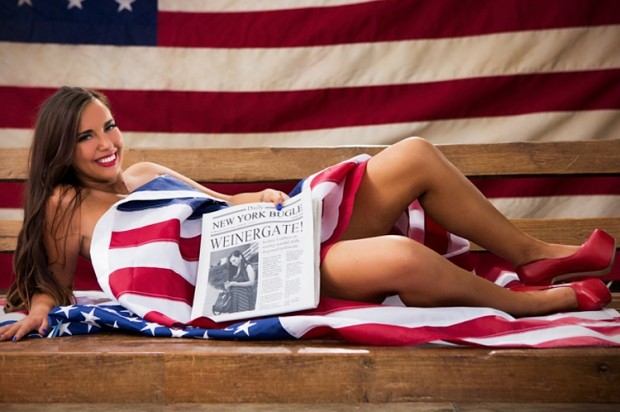
Connor Simpson has more on what Leathers has been up to, including the above image:

You may cringe when you see Sydney Leathers posing in a bikini for the New York Post or taking her clothes off for Vivid Entertainment, but at least she’s owning the spotlight the scandal has given her. Leathers writes that she’s “made certain choices, some of which involve my sexuality,” on XOJane this morning. That she’s exploiting a narcissistic politician for her own ends is a fascinating development in the sex scandal narrative, because that’s not usually how this story plays out. …

Sydney Leathers is a bit of a revolutionary in comparison to Lewinsky [who avoided the spotlight]. She can go out and probably make somewhere close to $1 million from Vivid Entertainment (an estimate) for taking her clothes off and masturbating on camera. She can get paid an undisclosed sum to pose in a bikini for The New York Post while the tabloid makes fun of her appearance. She can reach out to a company that sells leather skirts to be their new spokesmodel, because, duh, of course Sydney Leathers would advertise leather. She can get paid, based on estimates from the Who Pays tumblr and fellow writers on Twitter, between $50 and $150 for an XOJane essay about seducing politicians. Sydney Leathers can share an agent with Tan Mom because Sydney Leathers wants to be a D-list celebrity, and she’s getting exactly what she wants.

Tracy Clark-Flory reviews Leathers’ Vivid “sex tape”, clarifying that it’s “more accurately described as a video of her soft-core photo shoot.” She adds:

[Leathers] is indeed following a decidedly American narrative of the “fallen woman.” Her post-scandal power isn’t in asserting that she’s more than a sexting mistress; it’s in essentializing herself as that. Her redemption, such as it is, is in making herself available to men — all of them.

And that is totally her choice. Money quote from the “sex tape”:

My first sugar daddy was someone who kind of just helped me pay the bills. I was several years younger. He helped me with rent, helped pay for my car – just normal things like that. He would kind of spoil me. The funniest part about that situation is that I kind of made him think that something would happen eventually – and nothing actually did. And that went on for three years. It was the most exciting part of my life at the time.

(Image from Vivid Entertainment)

Al-Qaeda’s Rallying Call

Eli Lake and Josh Rogin report on the purported intel behind recent terror alerts that closed US embassies across the Mideast and Africa. Intelligence officials say the US got wind of an impending attack by intercepting a conference call between al-Qaeda HQ and its affiliates in Iraq, Pakistan, Nigeria and elsewhere:

“This was like a meeting of the Legion of Doom,” one U.S. intelligence officer told The Daily Beast, referring to the coalition of villains featured in the Saturday morning cartoon Super Friends. … [D]uring the meeting, the various al Qaeda leaders discussed in vague terms plans for a pending attack and mentioned that a team or teams were already in place for such an attack.

Max Fisher explains that a new planned attack may have been due to al-Qaeda’s own fractured politics:

Something to keep in mind about al-Qaeda and its affiliates is that they’re separated by thousands of miles, not to mention differing priorities, personnel and, potentially, missions and ideologies. Especially now that Osama bin Laden is gone, there’s not quite as much tying them all together. Zawahiri is ostensibly in charge of all of those affiliates, to some degree. But Watts suggests that the group structure may be fracturing, and with it the ability of Zawahiri and “al-Qaeda Central” to lead.

In this theory, the Yemen plot would be a way for Zawahiri to reassert his leadership and to revitalize the part of the al-Qaeda network over which he has the most control. That could be about more than just Zawahiri jockeying for more of a personal role: It could also be about holding together the broader al-Qaeda network, which has always had infighting but may actually be on the verge of splitting in two.

The Economist questions the logic of the US closing embassies and publicly announcing the foiled attack:

It is also not yet apparent why the White House opted to make such a dramatic public statement of its concerns rather than use the information to disrupt the plot. Not only is there a significant economic cost from the consequent delays to travel, but according to intelligence sources there are potentially major security drawbacks as well. First,

al-Qaeda has been given precious information about American surveillance capabilities that will help it keep its communications more secure in future. Secondly, the plotters might have a “plan B” up their sleeves that the intelligence agencies have as yet no knowledge of. Thirdly, it goes strongly counter to the administration’s previous claims that, thanks to its efforts, al-Qaeda’s ability to carry out complex operations against Western targets had declined to such an extent that it was on the brink of strategic defeat.

Friedersdorf remains generally skeptical of the story:

As with the Bush Administration’s color-coded terror alerts, I can’t help but wonder if the State Department warning and this week’s news stories about renewed threats from Al Qaeda are being hyped. To what extent does this week’s news reflect changes in that threat, and to what extent is the American public being manipulated, or else misled so that Team Obama can manipulate Al Qaeda? There’s just no way to know. It wouldn’t shock me if the closure of diplomatic facilities abroad is entirely threat based… or if the threat were being exaggerated to undermine the growing Congressional backlash to NSA surveillance. Or to give Team Obama cover for a surge of drone strikes in Yemen, despite that recent drone speech.

Meanwhile, Max Read puzzles why, after all the fuss about Snowden, intelligence officers are leaking this national security info to the press.

A Climate Success Story

Ben Richmond relays some rare good news about climate change:

The Montreal Protocol, already hailed by Kofi Anan as “perhaps the single most successful international agreement to date,” can add another feather to its cap. In addition to slowing the growth of, and then shrinking, the hole in the ozone layer, the researchers have used computer models to demonstrate that without the reduction of CFCs, the environmental changes projected for the next decade – already expected to be really bad – would be twice as severe.

It certainly wasn’t part of the reason for ratifying the Montreal Protocol, which was aimed specifically at reducing the hole in the ozone layer over Antarctica, but it’s another positive result – collateral benefit, if you will. “We dodged a bullet we did not know had been fired,” said Richard Seager, a scientist at Columbia University’s Lamont-Doherty Earth Observatory who coauthored the study.

The Church Tacks To The Center

Douthat recently speculated that Pope Francis might be able to move “U.S. Catholics away from a too-close entanglement with the fortunes and platform of the Republican Party.” Along those lines, John L. Allen Jr. notes that “Francis seems to be repositioning the church in the political center, after a fairly lengthy period in which many observers perceived it to be drifting to the right”:

Veteran Italian journalist Sandro Magister recently observed, “It cannot be an accident that after 120 days of his pontificate, Pope Francis has not yet spoken the words abortion, euthanasia, homosexual marriage,” adding that “this silence of his is another of the factors that explain the benevolence of secular public opinion.”

Yet Francis has imposed no such gag order on himself when it comes to other political topics, such as poverty, the environment and immigration. …

In Rome, the perception is that power brokers associated with moderate positions, such as Cardinal Oscar Rodríguez Maradiaga of Honduras, coordinator of the commission of cardinals, are on the ascendant, while those linked to neoconservative or traditionalist stances, such as Cardinal Raymond Burke of the United States, head of the Vatican’s supreme court, are in decline.

The church may not veer sharply in its political allegiances, but there seems a clear preference for the social Gospel over the culture wars.

How Long Do You Want To Live?

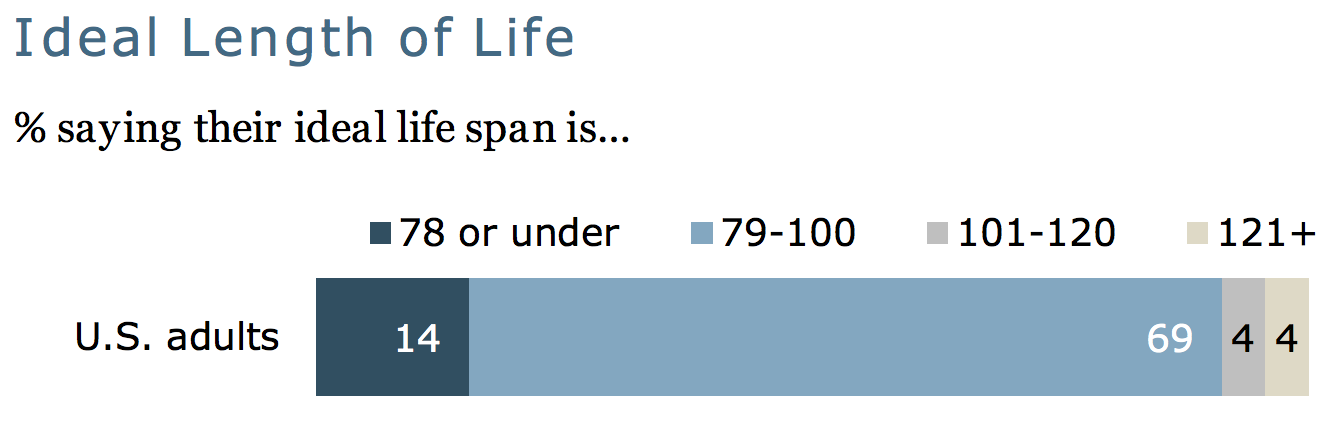
The answers Pew received:

Ideal Lifespan

Saletan expects that medical advances would change these numbers:

People don’t want to live past the age at which severe diseases and disabilities are expected. When respondents are asked how long they’d like to live, fewer than 10 percent choose 100 or older. Twenty percent want to live into their 90s. Thirty-two percent want to live into their 80s. Thirty percent don’t want to make it past 80. Why do most people want to die before they reach 90? Probably because being 90 sucks. But that’s true only because of the current rate of physical decline.

If resistance to life extension is based on the assumption that the extra years would be frail and painful, look out. That resistance will dissolve in the face of contrary evidence. If modern medicine learns how to slow aging, making the average 90-year-old feel as good as a 70-year-old feels today, people will recalibrate. Those who in our time would have preferred to die at 80 might be happy to live to 100.