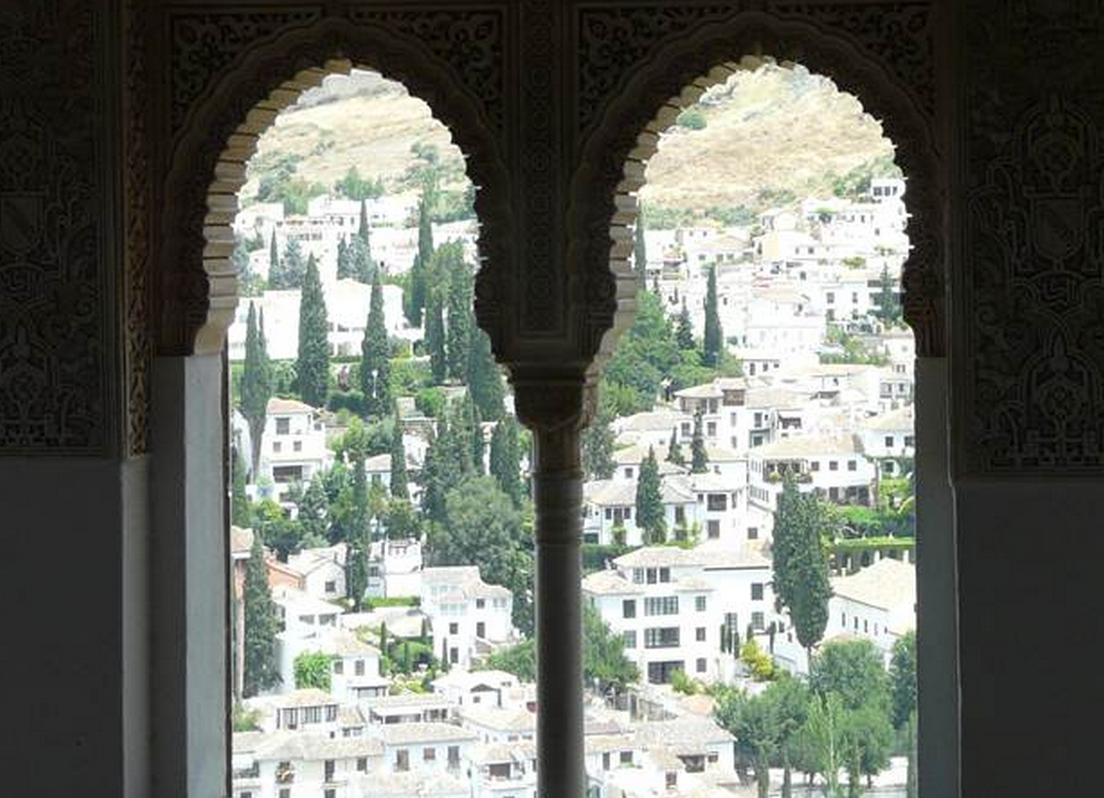
The View From Your Window Contest: Winner #165

vfyw_8-3

A reader writes:

First impression of the picture gives me a distinct eastern Mediterranean vibe.  The architecture and climate could fit anywhere between Egypt and Turkey.  While it wouldn’t shock me if this was on the Iberian Peninsula somewhere, I’m staking my claim in Jordan.  It seems a bit too sparsely vegetated for Turkey, too hilly for the Nile delta, and with conflict in Syria, I’m eliminating that country.  It’s a crap shoot between Israel, Jordan, and Lebanon but I had to pick one, so here’s hoping.

Another reader:

I’ve never entered the contest before, but the decoration around the window is the first thing that struck me as so familiar. Though the coloring in the photo isn’t very sharp, the view and the pines also drew me to Villa d’Este, Tivoli, Lazio, Italy.  Looking through photos I have from my last visit, so many of the buildings are similar. Though I’m not sure what exact window in the Villa it was taken, I believe it is facing north from a 3rd floor window toward the Reserva Naturale Monte Catillo. The only other problem is most windows in the villa are rectangular with only a few being arched.

But there are so many sights like this in central Italy, it could be just about anywhere.  Oh, well! It did take me back to my last trip to Italy.

Another:

Is it the view from the bell tower of St. Francis of Assisi church, Umbria, Italy (and a hat-tip to the pope for his comments about gays last week?)

Another:

It looks like the hilly areas around Jerusalem, the Mount of Olives.

Another:

Tehran? Parts of it are extremely affluent and some of the architecture there is Beverly Hills-esque. That’s my guess.

Another gets in the right territory:

My guess is that this picture was taken in the southern part of Spain, Andalusia region. Specifically I think it is Cordoba. My wife and I went to Malaga for our honeymoon, so when I saw the picture, the South of Spain immediately came to my mind. It looks like the great mosque-cathedral or maybe Alcazar Palace.

Another nails the exact location:

Spain, Italy, Greece, Turkey. Right away, I narrowed this week’s contest to those four countries. 8-3vfyw1Next, I eliminated Spain, since last week’s contest was in Spain, and what are the odds? Then I crossed off Italy, since those windows seemed to be plainer. Nothing really doing in Greece, so I turned to Turkey, fairly confident. The detail on the arches themselves, the Byzantine-looking designs around windows, Turkey seemed like a strong possibility.

But then I found the attached picture, and PLOT TWIST, it’s actually in Spain.

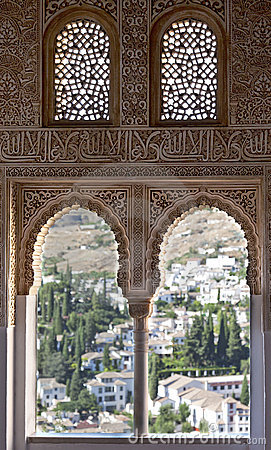
Specifically, it’s from the Alhambra, in Granada, Andalusia, Spain, facing north. Thanks for an easier one after last week. Although I did learn a lot last week, and I was the fifth or sixth best guess, which I’ll take given how hard it was.
Another provides some history:

The Alhambra was originally constructed as a fortress in 889 and later converted into a royal palace in 1333 by Yusuf I, Sultan of Granada.  As Ferdinand and Isabella completed the reconquest of Spain, the last Muslim ruler Muhammad XII of Granada surrendered the Emirate of Granada in 1492, a singular year for the Spanish Empire for several reasons besides this final capitulation of Islam in the West.  Legend has it that as the Moorish royal party moved south toward exile, they reached a rocky prominence which gave a last view of the city. Muhammad XII, surveying for the last time the Alhambra and the green valley that spread below, burst into tears. Whereupon his mother, clearly a an unsentimental person, reproached him bitterly mocking, “Thou dost weep like a woman for what thou couldst not defend as a man.”

Another reader:

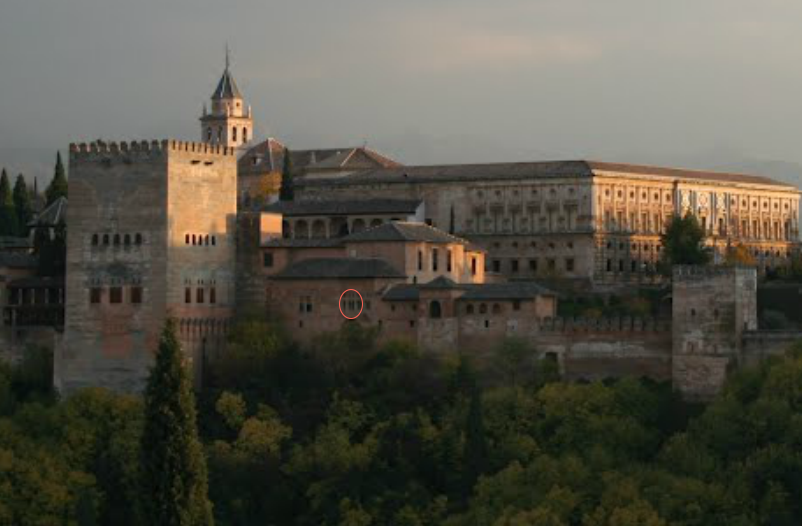
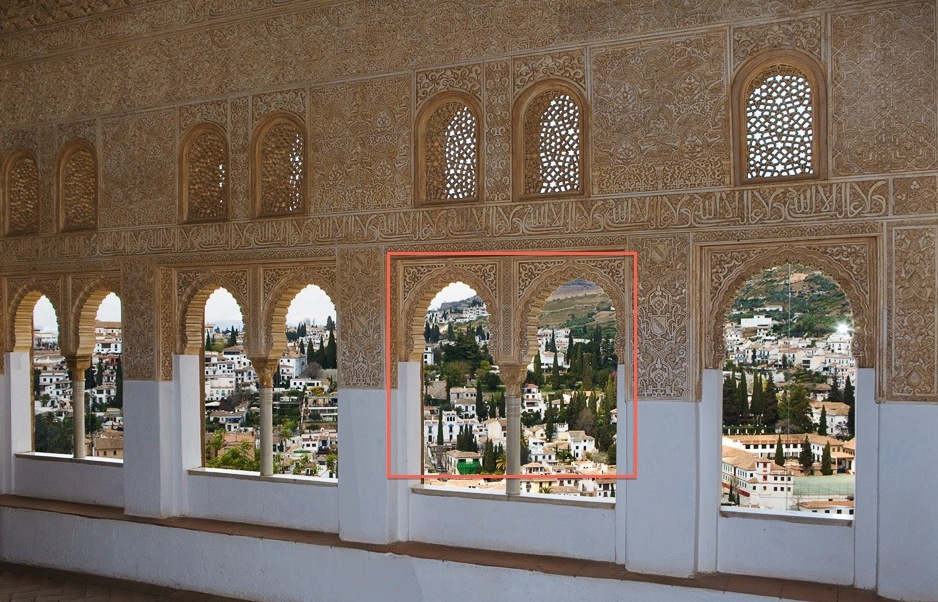
The window is one of four twin arches in the Oratory at the Alhambra, which means Red Castle in Arabic:

Screen Shot 2013-08-04 at 20.46.59

I’m still frustrated I didn’t get my submission in on time last week, so I looked at this week and thought: I’m not sure that I’m ready to face it.  I gave it to my wife to look at, and in less than ten minutes she said: “It’s Alhambra, Spain!”  If I win with this submission – when it wasn’t even me that found it – and when I might have won last week’s really hard one if I’d just got the time change right, then well, I guess c’est la vie.
Another:

I have a feeling that this week’s contest might not be too difficult.  It took about 10 seconds to find a higher quality picture similar to the contest photo to confirm that we are in Granada Spain north of the Alhambra. Then it took some time searching images from inside the Queen’s Dressing Room, the Comares Tower, the Ladies Tower, and the Tower of Mihrab before finally stumbling on the Oratory:

Oratory Interior with Circled Window

You posted my aerial view with the red lines in the answer to #156.  It was one of the first contests I entered and the first time you posted anything I submitted. I assume that I will lose this one because either I was yet again one or two windows off or someone else will win the tiebreak.  As always, thanks for the contest.
Another:

The palace is of course beautiful, and its reputation is well-deserved. One interesting fact is that there are some 10,000 calligraphic inscriptions in the palace, which are apparently not at all easy to read even for Arabic speakers.  Amazingly, there was no effort to systematically catalog and transcribe them until recently.

Rick Steves provides an up-close tour:

Another reader:

You must be feeling charitable this week. I’ve seen so many of these views where I had not even the slightest clue. This one is obvious enough that I imagine you’ll receive a flood of emails. The Alhambra Palace – one of the most magnificent and beautiful creations of humanity, is the site of the photo. If it’s not, then you’ve really out-tricked me.

I had the opportunity to visit the Alhambra about 13 years ago, and found myself enthralled. I could’ve spent days wandering the place, examining the details and taking in the views. It’s a remarkable achievement from when the Moors ruled Spain.

We did indeed receive a flood of emails this week. Of the more than 150 readers who wrote in, about 95% answered Alhambra. About a dozen of those readers’ email addresses are marked with a “Correct Guesser” filter, which means they have gotten a difficult view (defined as one guessed by 10 or fewer readers) without having won the tie-breaker.  Of those dozen, one clearly stands out for the number of contests participated in (31), so that reader breaks the tie this week. (His entry is the first visual one seen above, the one with a “PLOT TWIST”.)  One more reader writes:

Didn’t you already do Granada within the last year? Regardless, this week took me all of 12 seconds, and I’ve never even been to Granada, so I’m going to assume that I have a flat zero chance at winning (especially since this is a famous window), but I’ll go ahead and submit a guess to hopefully better my chances of winning someday. Not to complain, but all of the recent contests have regularly been either some of the easiest or most difficult ever, any chance you could try to hit that middle ground a little more often?

Finding a good contest candidate – an interesting location that is not too easy, not too hard – is incredibly difficult, especially lately.  Often it takes close to an hour combing through unused VFYWs just to find a decent candidate. So bear with us a little; the contest is only as good as its options.

(Archive)
Is Christie The New Giuliani?

Larison thinks so:

Christie’s national security rhetoric is best understood as confirmation that he is the candidate of the people that thought Giuliani was a competitive and credible presidential candidate. Many of the people urging Christie to run in 2012 were former Giuliani backers, and Christie seems well-suited to represent the small constituency that combines hawkishness and security state authoritarianism with more moderate or liberal views on some at least some domestic issues. It is not a constituency that will propel a politician to a presidential nomination, but it could ensure a devoted club of admirers among hawkish editorial writers and columnists.

Nate Cohn disagrees with the comparison:

It’s surprisingly easy to envision Christie winning the nomination.

His conservative credentials are pretty good, so now all he needs to do is get Republicans to remember. That shouldn’t be hard for Christie. His charisma and brass-style will make him an excellent Obama-, union-, and liberal-basher once he wins reelection. It’s easy to envision him cleaning up the debates, like Newt Gingrich before South Carolina. It’s worth recalling that he was once a Tea Party favorite for exactly this reason. Unlike 2008, when Giuliani’s northeastern starting point was interrupted by Romney and McCain, there’s not another northeastern, maverick-y candidate to prevent Christie from doing well in a state like New Hampshire, Michigan, or Florida. If Jeb Bush doesn’t run, there isn’t another candidate better positioned to start locking down endorsements and donors. Electability will help, too.

Uncle Sam Loses His Beer Gut

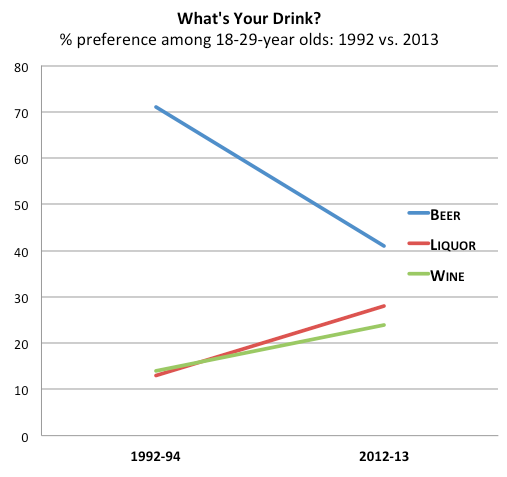
Beer is less popular with young Americans than it used to be:

Beer Young

But beer is still dominant globally:

According to a 2011 working paper by the American Association of Wine Economists, the global volume of beer in the 1960s was twice that of wine. As of 2005, beer consumption (153 billion liters) was six times that of wine (24 billion liters). In financial sums, beer is vastly ahead; the authors state that the beer industry accounts for an estimated 130 billion U.S. dollars, while the wine industry brings in around 65 billion.

The increase in beer production is in part due to its growing popularity in China. As of 2011, China, with its enormous population, consumed 20 percent of all beer in the world and replaced the U.S. as the largest beer market.

What’s Next For The WaPo?

How Josh Marshall understands the sale of the paper:

What Bezos is doing isn’t philanthropy. He’s buying a for profit company and presumably aims to run it as a profit. But from a broader vantage point, it represents one of our Gilded Age robber barons taking his ample wealth and directing toward what is something like a public trust. I think that’s a good thing. In that sense, I think it’s similar, though not quite as altruistic and on nothing like the scale of what Bill Gates is doing with his vast fortune, investing in generally unglamorous projects that have immense impact in human terms for people around the world.

Pareene disagrees:

[B]illionaires don’t buy newspapers to run them as public goods, and smart billionaires don’t buy newspapers to make money. Billionaires buy newspapers for influence. That is the point.

The Post is among the most influential in the nation. Second- or third-most, depending on which party is in power. Buying the Washington Post is sort of like retaining the best-connected lobbyist in Washington, in a parallel world in which lobbyists are universally praised for their value to functioning democracies. Bezos needn’t even exercise his influence in the vulgar fashion of a Murdoch. He can merely staff the paper with people attuned to his worldview and allow the opinion page to evolve to reflect his interests naturally.

Sasha Issenberg bets that Bezos is more interested in the WaPo’s delivery infrastructure:

UPS, like its peers in the postal and shipping sectors, never aspired to offer same-day delivery. In fact, only one industry has consistently done so: newspapers. Their delivery networks — hub-and-spoke fleets trucking bundles of newsprint into warehouses and out to retailers, with individual delivery drivers bringing single products to pre-selected doorsteps in neighborhoods they know well. The Washington Post, like nearly every newspaper in the country, already offers pre-dawn same-day delivery, a service extended to subscribers for less than the cost of buying individual copies from a newsstand.

Newspapers may become obsolete, but there is no reason that their distribution networks have to die, too.

Massie zooms out:

There are two roads, I think, open to the media. You can be very, very large and survive or you can be very, very small and thrive. The choice is Walmart or the boutique corner shop; everything in between seems likely to be pulverised.

And The New Doctor Is …

Peter Capaldi, of “The Thick Of It” fame. Here’s the inevitable mash-up of foul-mouthed Malcolm Tucker as the Doctor:

Capaldi is a life-long fan of the series:

“It is so wonderful not to keep this secret any more,” he said. “For a while I couldn’t even tell my daughter. Being asked to play the Doctor is an amazing privilege. Like the Doctor himself I find myself in a state of utter terror and delight. I can’t wait to get started.”

Jenny Colgan approves:

[I]f we are to have a 12th white male … could we have done any better? Working on the excellent template of angular Scottishness perfected by David Tennant, the possibilities for Peter Capaldi, an actor with such extraordinary experience and range, are fun and immense. There will be an undeniably dangerous edge: not just of Malcolm Tucker – viewers may also remember him as the Angel in Neil Gaiman’s Neverwhere, full of purity and beauty while hiding terrible secrets within; or the gentle, heartbreaking moral conflict of his John Frobisher in Torchwood’s Children of Earth, one of the most underrated pieces of television of the past 10 years.

Mary Elizabeth Williams likes the pick as well:

He’s a versatile everyman who’s also utterly unique. In short, he is everything a classic Doctor should be – able to pivot from slapstick goofball to heartbreakingly tragic figure in the span of a single scene. And as one of the oldest actors to play a man who’s already nine centuries old, Capaldi also brings a worldly gravitas that will serve in contrast to the lithe physicality of his previous two predecessors.

Ted Kissell bemoans the choice, sighing, “another white male”:

[N]ot taking a bolder leap in the casting and switching up the gender and/or race of the Doctor feels like a missed opportunity. The Feminism of Doctor Who Tumblr, in anticipation of the announcement, ran a feature called The Time Lady Project, which suggested dozens of potential actresses who could play the part. Some of these were pie-in-the-sky because they were such big stars (Tilda Swinton, Helen Mirren, Emma Thompson), but many of them were in that really-good-but-not-too-big-to-commit-to Who’s-grueling-schedule range. And having a woman as the smartest, bravest person in the universe, being able to fix any problem, save the world with her wits, a magical vehicle, and boundless courage–who wouldn’t want to watch that show?

SEK is on the same page:

I wanted Steven Moffat to make a selection as outrageously ambitious as the show itself can be, and Peter Capaldi is more of the same. Which isn’t to say he’ll be a terrible Doctor, as Capaldi’s a fine actor and will bring to the role a gravitas it’s lacked since the end of David Tennant’s run. But as heroes go, the Doctor’s just “a madman with a box” whose power, such as it is, is the ability to bluff his way out of a war. And as powers go, “intelligence” is limitless in its potential appeal because everyone likes to think they’re smart. Having him embodied by an endless parade of white British males creates an unwholesome and unnecessary connection between intelligence, acts of extreme whiteness and penises.

Previous Dish on the expectations for the 12th Doctor here and here.

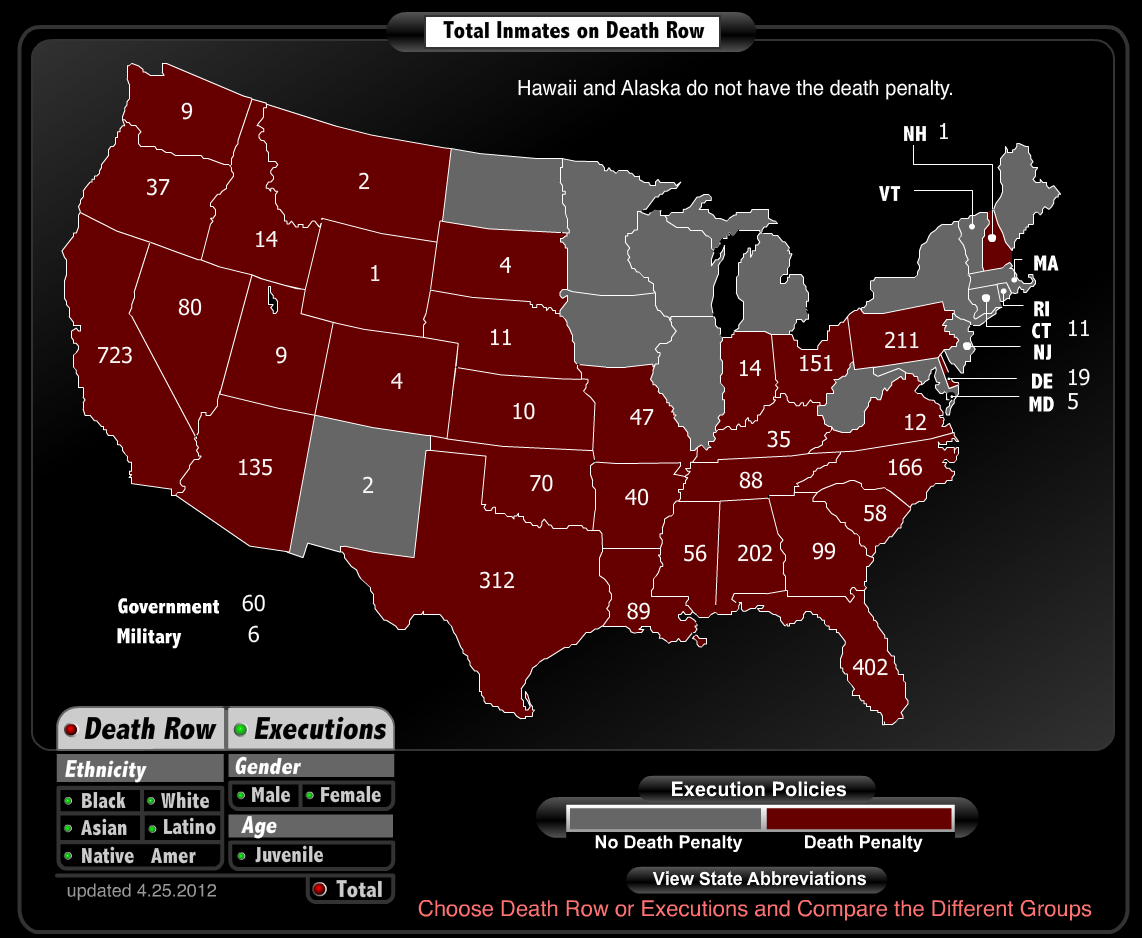
Can The Death Penalty Be Defeated?

Screen Shot 2013-08-06 at 6.54.26 PM

Janell Ross talks to activists who think capital punishment’s days are numbered. Recent progress:

Since 2000, death-penalty sentences handed down by state courts and juries have declined nearly 75 percent, and the number of executions has been cut in half, said Richard Dieter, executive director of then Death Penalty Information Center, a Washington, D.C.-based anti-death-penalty nonprofit.

Keith Humphreys argues that “the most important thing to know about the death penalty is that it is something only a small number of states do”:

If one state — Texas — abolished the death penalty its prevalence would drop by over a third (Texas has executed 503 of the 1342 people who have been put to death since the 1976 restoration of capital punishment). More broadly, as Ross notes, southern states today execute four times as many people as the rest of the states do combined.

What Americans as whole think about the death penalty therefore doesn’t matter much. What matters is what people in Texas and Florida and Virginia think about the death penalty. Those are the hearts and minds that must be changed for this practice to end in this country.

(Interactive map of inmates on death row as of May 2012 from the website Death Penalty Curriculum)

Are Mermaids The New Vampires?

Mermaid

Carolyn Turgeon thinks so:

Conflicted, frustrated sexualities are integral to both the vampire and the mermaid. But compared with vampires (or zombies too, for that matter), the mermaid makes for a much livelier figure: She’s not dead, for one, plus she has a bright, pretty tail and exists in full sunlight. And she’s female. (Mermen are so rare as to be culturally negligible.) She’s primal and wild, from the deep ocean — she is death and birth and the subconscious and the great mother. And typically she is represented as super hot — think of Daryl Hannah in Splash or pretty much any other mermaid you’ve ever seen — yet she might kill you if you get too close, as with the killer mermaids in Pirates of the Caribbean. Even Disney’s friendly flame-haired Ariel swims around shipwrecks and skeletons at the bottom of the sea.

But the appeal of the mermaid may depend primarily on her flexibility.

Mermaids offer an image of female sexuality that is both potent and nonthreatening to men. As Stephin Merritt recently commented of mermaids, “I think straight men like the idea of women with all the knockers and none of the complicated parts.” Mermaids allow women to tap into something essential and powerful without becoming “unlikable” or unattractive. For women, mermaids offer the freedom of different interpretive options depending on her vicarious needs: Mermaids can be read as sexed or unsexed, vulnerable or terrifying, accessible or forever remote.

Forrest Wickman isn’t buying it:

I can give you one simple reason that mermaids aren’t the new vampires, and never will be: genitals. If you want people to fantasize about you, or about being you, genitals are pretty much a requirement.

Mer-partisans will try to counter this. They’ll claim that the lack of genitals just adds an alluring unattainability. Wasn’t that the point of Twilight, after all? This is factually wrong and woefully misguided. As anyone who knows anything about Stephenie Meyer’s saga will know, the whole driving force behind all the sexual tension in those books and movies is the fact that Bella and Edward are capable of having (spoiler alert) wild, headboard-tearing vampire sex. If there wasn’t that possibility of romance—and with mermaids, to make a long story short, there basically isn’t—there would be no sexual tension. Has there ever been a lasting vampire series that didn’t indulge in a little fang-banging? It’s the sole reason for True Blood’s existence.

Recent Dish coverage of The Little Mermaid here.

(Photo by Kathryn Rotondo)

Contaminated By Wealth

Christopher Mims flags a UK study revealing that the rich absorb different toxins than the poor:

People who can afford sushi and other sources of aquatic lean protein appear to be paying the price with a buildup of heavy metals in their bodies, found Jessica Tyrrell and colleagues from the University of Exeter. Using data from the US National Health and Nutrition Examination Survey, Tyrrell et al. found that compared to poorer people, the rich had higher levels of mercury, arsenic, caesium and thallium, all of which tend to accumulate in fish and shellfish.

The rich also had higher levels of benzophenone-3, aka oxybenzone, the active ingredient in most sunscreens, which is under investigation by the EU and, argue some experts, may actually encourage skin cancer.

Ben Richmond notes the toxins more common at the bottom of the social ladder:

Those of lower socioeconomic status had higher levels of lead, cadmium and three types of phthalates—compounds commonly found in plastics.  The reasons for these disparate chemical levels point to disparate lifestyles and environments. [Also], lead and cadmium come into those of lower socioeconomic status via cigarette smoking and their jobs.

The Geography Of Milk

lactase-hotspots2

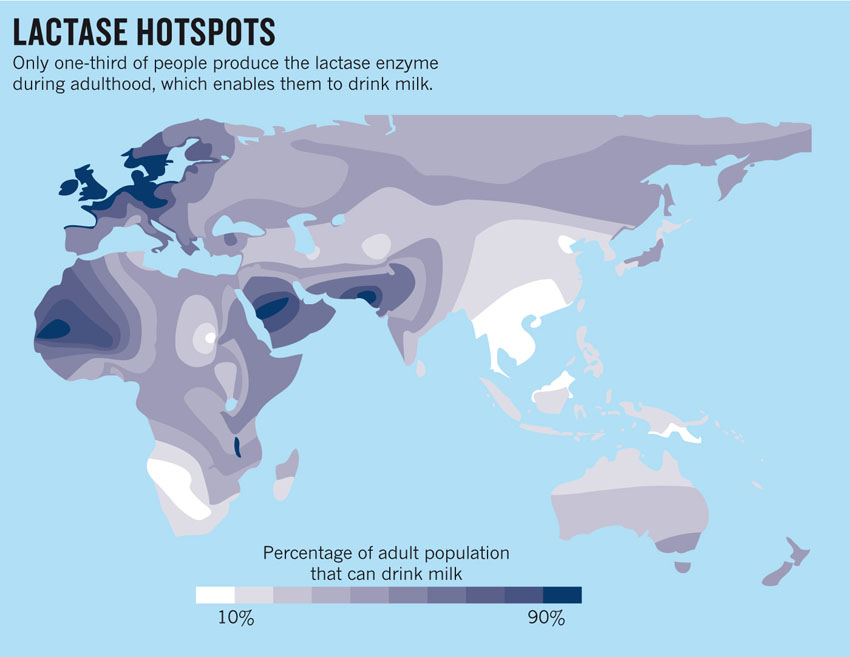
If you had milk with your coffee this morning, thank evolution:

During the most recent ice age, milk was essentially a toxin to adults because – unlike children –they could not produce the lactase enzyme required to break down lactose, the main sugar in milk. But as farming started to replace hunting and gathering in the Middle East around 11,000 years ago, cattle herders learned how to reduce lactose in dairy products to tolerable levels by fermenting milk to make cheese or yogurt. Several thousand years later, a genetic mutation spread through Europe that gave people the ability to produce lactase – and drink milk – throughout their lives.

The remnants of that pattern are still visible today. In southern Europe, lactase persistence is relatively rare – less than 40 percent in Greece and Turkey. In Britain and Scandinavia, by contrast, more than 90 percent of adults can digest milk.

(Map from Nature, based on figures from International Dairy Journal)

The Illegal Cigarette Trade

Keith Humphreys worries that high cigarette taxes encourage black markets and drug-war excesses:

In New York City, a legal, fully taxed pack of cigarettes costs $10-15; Chicago prices are only slightly less. Working class and poor addicted smokers (i.e., most smokers) thus face great temptation to enter into the black market. Columbia University Professor Shelley Cantrell documented that “the $5 man” – a street seller of untaxed black market cigarettes – is now a pervasive feature of life in low-income New York City neighborhoods.

He thinks the federal government should push states to adopt moderate cigarette taxes:

If one imagined for the sake of argument that [a tax of] $1.50-$2.50 a pack were the initial chosen range for receiving federal tax largesse, that would give the 28 states below that range an incentive to hike state taxes. Citizens in those states would smoke substantially less, improving public health and more fully reimbursing the public purse for the costs of smoking. And out-of-state gangs of tobacco smugglers would have far less incentive to maintain a presence in the state. High-tax states (e.g., Washington, New York, New Jersey) would reap little net revenue from that part of their tax which was over $2.50 a pack because of the loss of the federal tax rebate. This would give them an incentive to stop further increases or even cut back. This could have the lamentable effect of reducing the frequency of price-driven smoking cessation, but those same states would benefit in terms of shrinking black markets.