The Ethics Of Scientific Studies

Virginia Hughes describes a study that focused on Romanian orphans:

In 1999, [neuroscientist Charles Nelson] and several other American scientists launched the Bucharest Early Intervention Project, a now-famous study of Romanian children who were mostly ‘social orphans’, meaning that their biological parents had given them over to the state’s care. At the time, despite an international outcry over Romania’s orphan problem, many Romanian officials staunchly believed that the behavioural problems of institutionalised children were innate — the reason their parents had left them there, rather than the result of institutional life. And because of these inherent deficiencies, the children would fare better in orphanages than families.

The scientists pitched their study as a way to find out for sure. They enrolled 136 institutionalised children, placed half of them in foster care, and tracked the physical, psychological, and neurological development of both groups for many years. They found, predictably, that kids are much better off in foster care than in orphanages.

She elaborates on the logic underlying the inquiry:

Perhaps the strangest part of this project was that the fundamental scientific question it posed — Are orphanages bad for kids? — had already been answered. Definitively. Studies going back many decades had shown that orphanages are awful. Research with human subjects is normally considered unethical if it doesn’t tackle novel questions. In this case, though, Nelson’s project was ethically justified because Romanian officials had not paid any attention to those previous studies. Quite the opposite: They had a strong cultural belief that state-run orphanages would protect orphans far better than unstable and untrustworthy foster parents.

This cultural belief persists in various forms, as Hughes explores further here.

Happy And Unhealthy?

A new study suggests that a meaningful life is healthier than a simply happy one:

[Researchers Steve] Cole and [Barbara] Fredrickson found that people who are happy but have little to no sense of meaning in their lives — proverbially, simply here for the party — have the same gene expression patterns as people who are responding to and enduring chronic adversity. That is, the bodies of these happy people are preparing them for bacterial threats by activating the pro-inflammatory response. Chronic inflammation is, of course, associated with major illnesses like heart disease and various cancers.

“Empty positive emotions” — like the kind people experience during manic episodes or artificially induced euphoria from alcohol and drugs — ”are about as good for you for as adversity,” says Fredrickson.

It’s important to understand that for many people, a sense of meaning and happiness in life overlap; many people score jointly high (or jointly low) on the happiness and meaning measures in the study. But for many others, there is a dissonance — they feel that they are low on happiness and high on meaning or that their lives are very high in happiness, but low in meaning. This last group, which has the gene expression pattern associated with adversity, formed a whopping 75 percent of study participants. Only one quarter of the study participants had what the researchers call “eudaimonic predominance” — that is, their sense of meaning outpaced their feelings of happiness.

This is too bad given the more beneficial gene expression pattern associated with meaningfulness. People whose levels of happiness and meaning line up, and people who have a strong sense of meaning but are not necessarily happy, showed a deactivation of the adversity stress response. Their bodies were not preparing them for the bacterial infections that we get when we are alone or in trouble, but for the viral infections we get when surrounded by a lot of other people.

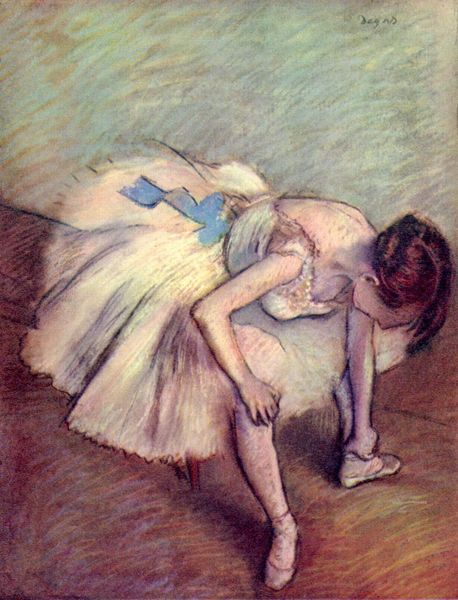
The Fragility Of Degas

Barry Schwabsky focuses on the painter’s interest in instability:

Degas seizes upon moments that [Jean-Auguste-Dominique] Ingres would have found utterly insignificant. In his images of dancers, for instance, he rarely shows the dance itself; what interests him is dish_degas2the rehearsal, or even the warm-up for the rehearsal. Likewise, he will sometimes paint a horse race, but more often he shows the period before the race has started or after it’s over. As [curator Line Clausen] Pedersen says, “Degas chooses unstable moments and situations that are not long-lasting, but not instantaneous either,” ones in which “the figure is preparing for something else—something that lies further out in the future or is perhaps over.”

The allure of ambiguous moments led Degas to reconceive the purpose of drawing: instead of crystallizing a moment, it liquefies a momentary order. A fascination with instability is especially evident in the many small wax or clay figure studies that Degas kept in his studio. The only sculpture of his own that he ever exhibited was the famous Little Dancer Aged Fourteen, but after his death, seventy-four others that he’d made were cast in bronze. (The Ny Carlsberg Glyptotek is one of the few institutions to own a complete set of them, and Pedersen has put them to excellent use in the exhibition.) Not only do they often represent unbalanced poses, but the sculptures themselves are also unbalanced: their original wax or clay forms required external as well as internal armatures to keep them upright. These sculptures were not meant to bear their own weight.

The exhibition “Degas’ Method” runs through September 1st at the NY Carlsberg Glyptotek in Copenhagen.

(Image of a dancer by Edgar Degas, 1881-1883, via Wikimedia Commons)

An Ode To English Majors

Mark Edmundson pens one:

Real reading is reincarnation. There is no other way to put it. It is being born again into a higher form of consciousness than we ourselves possess. When we walk the streets of Manhattan with Walt Whitman or contemplate our hopes for eternity with Emily Dickinson, we are reborn into more ample and generous minds. “Life piled on life / Were all too little,” says Tennyson’s “Ulysses,” and he is right. Given the ragged magnificence of the world, who would wish to live only once?

The English major lives many times through the astounding transportive magic of words and the welcoming power of his receptive imagination. The economics major? In all probability he lives but once. If the English major has enough energy and openness of heart, he lives not once but hundreds of times. Not all books are worth being reincarnated into, to be sure—but those that are win Keats’s sweet phrase: “a joy forever.” …

What [the English major] feels about language most of the time is wonder and gratitude. For language is a stupendous gift. It’s been bequeathed to us by all of the foregoing generations. It is the creation of great souls like Shakespeare and Chaucer to be sure. But language is also the creation of salesmen and jive talkers, quacks and mountebanks, hookers and heroic warriors. We spend our lives, knowingly or not, trying to say something impeccably. We long to put the best words in the best order. (That, Coleridge said, is all that poetry really comes down to.) And when we do, we are on the lip of adding something to the language. We’ve perhaps made a contribution, however small, to what the critic R.P. Blackmur called the stock of available reality. And when we do, we’ve lived for a moment with the immortals.

The Best Of The Dish This Weekend

sunsetstorm

How is porn sex different than real sex? How can you truly defend pacifism without addressing the Hitler question?

How Bach is the opposite of rock. We juxtaposed the simple faith of Quakers with the complicated faith of the doubter. And we celebrated the extraordinary contribution gay men have made to the art of the Catholic church.

This is Ernest Hemingway’s idea of Heaven.

The most popular post remained “The GOP Calls Its Own Bluff,” followed by this post on a Tumblr that uses porn GIFs to advertize furniture.

See you in the morning, if I can sleep tonight.

(Photo: a summer storm at dusk in Provincetown Harbor, today.)

Broadcasting Bereavement, Ctd

photo (20)

A reader writes:

Your Broadcasting Bereavement post caught me in the throat. For me, it coalesces with The Last Lesson We Learn From Our Pets, a Dish thread I followed eagerly and with dread as my precious little dog, Georgia, was dying from congestive heart failure.

She died eight days ago, at home, in my arms. I asked my partner to take a picture of me holding her. I’m not sure why. I think it was because I didn’t want to let her go and thought a photograph would give me a way to hold her forever. I don’t use Twitter or Facebook, so I sent news of her passing via text message. But I wanted to share more than the news of her death. I wanted to share the news of my grief. I find it’s difficult to convey with words the enormity of such things, so I sent the photo too, which I’ve attached here as well.

What, then, is the last lesson our beloved pets teach us? I think it’s this: until the moment of death arrives, live – explore a new cushion on the floor, rub your nose in the grass, sniff the night air.

Alas, I’m a lousy student. One would think I’d be an expert by now, since Georgia is the 13th companion animal I’ve lost. Hopefully this time I’ll find a way to think more about how Georgia (indeed all of them) lived, and less about how much it hurts to lose them.

Friday was the first day in her life that my beloved Dusty didn’t wolf all her food down. She creaked out of her crate, meandered toward it and then began to walk back. It’s been like that every morning and evening since. The growth in her bladder seems to be constraining her more and more: she now seems permanently thirsty and proportionately incontinent. She peed through her diaper and entire bed the other night. This morning, we woke up to puke everywhere. This is happening more and more.

And yet, this afternoon, as we took her for a walk on the beach, and there was a little skip, a slight wander into the very edge of the water, and then, back home, playtime on the lawn. There are moments when she snaps back to normal, and makes me feel like a monster to take even a second of life from her. But those moments are getting fewer and fewer, and the incontinence and thirst and warts and growths cloud more of her hours and days. We talked it over and have decided that the discomfort will only get worse, dehydration could take hold, and then pain and suffering.

We’re going to let her go tomorrow if we can find a vet to come to our home. Your emails were so supportive and helpful I know many of you know where Aaron and I are right now. I’m just a little shocked at how totally gutted I feel – to end the life of this little being who has been with me longer than anyone else, whom I held in my hands at a couple of months old, who, right now, is lying in her crate, looking up at me typing. She has had 15 glorious summers on this beach; and she has loved this one. It’s just time, she is telling us.

Sweet Jesus this is hard.

The Smiling Face Of The Church

VATICAN-POPE-AUDIENCE

Lost amidst the discussion of the Pope’s recent remarks on homosexuality was this observation from John Allen: the theme that Francis invokes the most is joy:

Every pope seems to have a signature spiritual idea. For John Paul II, it was courage: “Be not afraid!” was his catchphrase to invite the church to recapture its missionary swagger after years of introspection and self-doubt. For Benedict XVI, it was “faith and reason,” the idea that religious belief and intellectual reflection need one another to remain healthy.

For Francis, the best early candidate for his signature touch is mercy, expressed in his repeated emphasis on God’s endless capacity to forgive…

In a recent essay for the Italian newspaper Corriere della Sera, Enzo Bianchi, founder of the celebrated ecumenical monastery of Bose, offered a statistical analysis of the words used most frequently by Francis since his election. He found that the single most commonly used term was “joy,” more than 100 times, followed closely by “mercy,” which the pope has used almost 100 times.

One that note, it’s worth revisiting Francis’ remarks from a homily he delivered during a Mass celebrated in the Chapel of the Domus Sanctae Marthae at the end of May:

The Pope began by referring to the readings of the day from the book of Zephaniah (3:14-18) and the Gospel of Luke (1:39-56), saying that they “speak to us of joy and happiness: ‘rejoice, shout for joy’, says Zephaniah… ‘The Lord is in the midst of you’… He too will rejoice over us. He, too, is joyful”.

“Everything is joy. But we Christians, we are not used to talking about joy, about happiness. I think that many times we prefer complaints! What is joy? The key to understanding this joy is in the Gospel: ‘Elizabeth was filled with the Holy Spirit’. What gives us joy is the Holy Spirit.

“It is the Spirit who guides us. He is the author of joy, the creator of joy, and this joy of the Holy Spirit gives us true Christian freedom. Without joy we Christians can not become free. We become slaves to our sorrows”.

(Photo: Pope Francis smiles after his weekly general audience in St Peter’s square at the Vatican on June 12, 2013. By Alberto Pizzoli/AFP/Getty Images.)

The Light Inside

dish_turrell

“To understand Turrell’s art … it is necessary to have some familiarity with what Quakers do,” writes Morgan Meis of James Turrell, who was raised as a Quaker:

Quakers worship by getting together and having a meeting. All you need is two Quakers for a meeting, but Quakers are happy to get together in larger groups. Quakers conduct their meetings by sitting silently, usually for about an hour. Talking is allowed, but not encouraged. You talk if you are moved to talk. Otherwise, you sit quietly. It is fair to call this meditation. While Quakers are meditating, they seek what they call the Inner Light. The idea of Inner Light goes all the way back to the early 17th century and to George Fox, the very first Quaker. As a young man, George found himself displeased with religion in its contemporary form. He struggled to find the truth, as sensitive young men and women will do. These were years of darkness and tumult. And then he found peace. In 1647, George heard a voice that said to him, “There is one, even Christ Jesus, who can speak to thy condition.”

Fox remembered that Christ sometimes calls himself “the light” in the Gospels. He decided that light was the key to correct and meaningful religious practice. There is a light inside of all of us, he thought. When you connect to the light, you are also connecting to God. For this reason, Quakers aren’t all that jazzed up about specific religious doctrines. If you are wondering what to do, how to live your life, just sit quietly and try to listen to the Inner Light. That’s all the doctrine any good Quaker needs. The answers are there inside, because God is inside.

Meis particularly sees the influence of Quakerism in “Aten Reign,” Turrell’s current exhibition at the Guggenheim:

I’d like to suggest that the best way to approach and interpret Turrell’s installation at the Guggenheim is to say it is a Quaker meeting. Observe, if you will, what happens when people enter the ground floor of the museum. They stop and look up. They see that the spirals of the Guggenheim have been transformed into a glowing light installation. They roam around for a minute or so looking up. Then they find a space to lie down on the floor. Generally, they stop talking. They watch the glowing lights and the luminescent egg. This silent watching goes on for many minutes. More than ten minutes. More than fifteen minutes for many people, and more than that for others.

In other words, James Turrell has managed to get people in New York City to lie on the floor silently meditating for more than ten minutes. Most of these people have never meditated in their lives. Many of them would not sit still silently for ten minutes if you paid them to do so. But the power of the egg compels them.

(Photo of “Aten Reign” by Flickr user Nika)

The Hard Questions For Christian Pacifists

In an interview, the theologian and ethicist Stanley Hauerwas responds to the most frequent objection to his own Christian pacificism – what about fighting Hitler?

I always answer the challenge of WWII by asking people “Who fought in Hitler’s war?” The people who fought in Hitler’s war were Catholics and Protestants. All I’m trying to do is help Christians be able to recognize what they’ve been given in Christ, which is the ability to say “no” to the Hitlers of the world. Of course, the world would be better without the Nazi regime, but that’s not to say that the war was a good thing. Moreover, it wasn’t a just war as it was not fought on just war principles.

On the near-ubiquitous American flags placed in churches:

I’ve long said that flags being used in churches on the 4th of July is a form of betrayal. It is so because the flag represents for many a more determinative sacrifice than the sacrifice of Christ.

Previous Dish on Hauerwas’ work here and here.