The Beauty Of Bach

Kaya Oakes describes Bach’s last major work:

[N]ever performed in his lifetime, [it] was a full setting of the Latin Mass, the Missa tota. Lutherans had thrown out the Latin Mass; only Catholics practiced the long, elaborate ceremony. Bach presented a couple of chunks of the Mass to the Catholic King of Poland in an attempt to land a gig as the Polish court composer. King Augustus didn’t bite, but Bach later raided his own cantatas to finish the Mass. The shiver-inducing melody of the Agnus Dei is an exact replica of the melody of one of Bach’s earlier church cantatas from the Ascension Oratorio, and snatches of others can be heard throughout the Mass. The Mass in B Minor, like the Saint Matthew Passion, was mostly forgotten until the 18th century. Rediscovered, it became known as one of the towering works of classical music.

Oakes reflects on the distinction between Bach and rock:

The thing about rock music, in all of the forms that I’ve worshipped, is that it’s not about thinking. You have your cerebral performers, but rock music is about the body: the corporeal sensations of fucking, moving, imbibing, ejecting. It is not about the caverns of the mind. And those caverns are where Bach spent his lifetime chasing the intricacies of forms, twisting the ideas of what music can do, wedding it to mathematical possibilities, but never forgetting that, as Keats wheezed, Beauty is Truth. Beauty is the best thing we can point at in order to say “God.”

Face Of The Day

ogle-face

Travel writer Michael Hodson highlights a talented photographer:

Alex Ogle is just one of those Instagramers that has a great eye. He lives and works in Hong Kong as an editor on the AFP Asia-Pacific desk. His photographs are almost entirely of that city and they are wonderful. He can be followed on Instagram here and on Twitter here.

TNR recently published a slideshow of Ogle’s work.

Consider Kindness

Earlier this week, George Saunders provided the NYT a copy of the commencement address he gave this year at Syracuse University:

Here’s something I know to be true, although it’s a little corny, and I don’t quite know what to do with it: What I regret most in my life are failures of kindness. Those moments when another human being was there, in front of me, suffering, and I responded…sensibly. Reservedly. Mildly. Or, to look at it from the other end of the telescope: Who, in your life, do you remember most fondly, with the most undeniable feelings of warmth? Those who were kindest to you, I bet. It’s a little facile, maybe, and certainly hard to implement, but I’d say, as a goal in life, you could do worse than: Try to be kinder.

His thoughts on cultivating a more compassionate life:

There are ways. You already know that because, in your life, there have been High Kindness periods and Low Kindness periods, and you know what inclined you toward the former and away from the latter.

Education is good; immersing ourselves in a work of art: good; prayer is good; meditation’s good; a frank talk with a dear friend; establishing ourselves in some kind of spiritual tradition – recognizing that there have been countless really smart people before us who have asked these same questions and left behind answers for us…

One thing in our favor: some of this “becoming kinder” happens naturally, with age. It might be a simple matter of attrition: as we get older, we come to see how useless it is to be selfish – how illogical, really. We come to love other people and are thereby counter-instructed in our own centrality. We get our butts kicked by real life, and people come to our defense, and help us, and we learn that we’re not separate, and don’t want to be. We see people near and dear to us dropping away, and are gradually convinced that maybe we too will drop away (someday, a long time from now). Most people, as they age, become less selfish and more loving. I think this is true. The great Syracuse poet, Hayden Carruth, said, in a poem written near the end of his life, that he was “mostly Love, now.”

Video of Saunders’ speech can be seen here. Recent Dish coverage of the author here, here, here, and here.

The Minds Of Monks

Christof Koch describes a classic 2008 study that investigated the brains of Buddhist monks:

The cognitive scientists fitted skullcaps with 128 electroencephalographic (EEG) electrodes to the heads of eight long-term Buddhist practitioners and 10 student volunteers. The former were asked to attain a state of “unconditional loving-kindness and compassion” (a form of meditation that does not focus on a single object and is sometimes referred to as “pure compassion”), whereas the volunteers thought about somebody he or she deeply cared about and then tried to generalize these feelings to all sentient beings.

The onset of meditation in the monks coincided with an increase in high-frequency EEG electrical activity in the so-called gamma band (spanning 25 to 42 oscillations a second), which was synchronized across the frontal and parietal cortices. Such activity is thought to be the hallmark of highly active and spatially dispersed groups of neurons, typically associated with focusing attention. Indeed, gamma activity in these monks is the largest seen in nonpathological conditions and 30 times greater than in the novices. The more years the monks had been practicing meditation, the stronger the (normalized) power in the gamma band.

More important, even when the monks were not meditating, but simply quietly resting, their baseline brain activity was distinct from that of the students. That is, these techniques, practiced by Buddhists for millennia to quiet, focus and expand the mind—the interior aspect of the brain—had changed the brain that is the exterior aspect of the mind. And the more training they had, the bigger the effect.

The Human Face Of Holiness

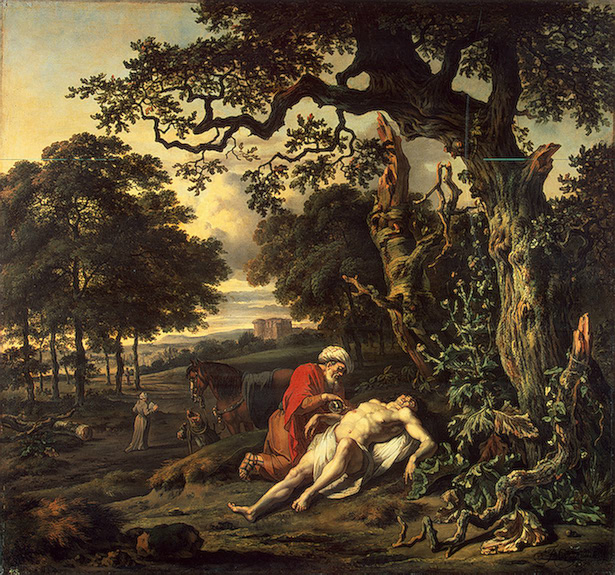
Jan_Wijnants_-_Parable_of_the_Good_Samaritan

In a sermon on the parable of the Good Samaritan, delivered to the Congregational United Church of Christ in Iowa City, Marilynne Robinson concludes with these thoughts on Jesus’ teachings:

The Gospel gives us a scene in which a legal scholar is disputing with a self-taught carpenter about a point of law. A bright fellow, he must have thought, interesting enough to spar with a little. He’s attracting crowds, and that can be dangerous. If I give him a question we specialists have struggled with, I might take him down a peg. No harm in that.

The writers of the Gospels take this carpenter to have been, in fact, the epitome of holiness, the Word made flesh, the universal judge. The lawyer is debating the law with God Himself, whose own commandments are at issue. This makes the scene most remarkable. But it is remarkable for nothing more than for the fact that Jesus, the Christ of Luke’s Gospel, is an ordinary man. On a landscape where prophets have appeared he is taken by some people to be one more prophet. Others have no opinion, or take no notice. But, in light of the utterly singular Presence the writer we call Luke understood him to be, there is the greatest significance in the fact that he really is one of us. He might have been the man lying injured by the side of the road, and he might have been the Samaritan who took him up. His wounds would have bled, his voice and his hands would have comforted, just as theirs did, just as ours do. The deep holiness with which human life is invested, which is so great that the Christ could take on true humanity without the least diminishment of his holiness, should tell us who we are and whom we are among, and why it is that the love of neighbor is “like unto” the love of God.

(Image: Parable of the Good Samaritan by Jan Wijnants, 1670, via Wikimedia Commons)

(Hat tip: Wesley Hill)

Atheists Aren’t That Angry, Ctd

Responding to the much-discussed recent study that parsed the various types of atheists, Herb Silverman spots the categories that were left out:

My biggest disappointment about the study is that it left out the largest category: closeted atheists. They are the elephants in the room and the ones most likely to change the culture by coming out. However, many of them feel they have good reasons not to, including potential ostracism from family and friends as well as loss of income or employment. Another unmentioned category is what I call functional atheists, those who may or may not have vague supernatural beliefs that play no practical role in their lives. They live as if there is no god, just as all atheists do.
An atheist is simply someone without a belief in any deities. But disbelief in gods doesn’t describe individual atheists any more than disbelief in the divinity of Muhammad, Krishna, and Zeus describes individual Christians. Everybody disbelieves in some gods; atheists just disbelieve in more gods than theists do.

Previous Dish coverage of Silverman’s thoughts on atheism here.

The Faithful Aren’t The Only Fighters

William T. Cavanaugh argues against the notion that religion is uniquely or especially prone to violence:

The crucial point is this: people devote themselves to all sorts of things. People treat all sorts of things as their religion. With regard to the question of violence, people kill and die for all sorts of things; there is no good reason to suppose that people are more inclined to kill for a god than for a flag, for a nation, for freedom, for free markets, for the socialist revolution, for access to oil and so on. In certain contexts, ideologies of jihad or the sacrificial atonement of Christ can lend themselves to violence. In other contexts, belief in the free market or in Greater Russia or in the United States as worldwide liberator is what releases killing energies. If the biblical critique of idolatry is on the mark, there is no essential difference between the two, between religious and secular causes. There is no religious/secular distinction in the Bible. In the Middle Ages, the religious/secular distinction was a distinction between two types of clergy; it meant nothing like what we mean by it now. The way we now use the religious/secular binary is a modern, Western invention; it does not simply respond to the nature of things.

His broader point:

The idea that religion causes violence, in other words, can be used to blind us in the West to our own forms of fanaticism and violence. When we label our own devotions as secular, we tend to treat them as if they were not the subject of violence at all.

We are endlessly fascinated by the violence supposedly hardwired into Iran’s Shiite Islam; we prefer not to dwell on the Shah’s 26-year reign of U.S.-supported secularist terror. We remember that the ayatollahs imposed an Islamic dress code when the Shah was ousted in 1979; we forget that the first shah imposed a secular dress code in 1924.

It must be repeated—though it should go without saying—that nothing justifies the violence done in the name of Islam or any other faith. My point is simply that nothing justifies violence done in the name of secular faiths either, and that there is no essential difference between the two kinds of faith. Both are based on pre-rational narratives of belonging and deliverance. A sound approach to violence avoids making sweeping statements about religion, as if we knew what that was, and adopts a more empirical, case by case approach, on a level playing field between religious and secular ideologies and practices. Wahhabist Islam will not escape scrutiny in examining the Chechen conflict, but neither will secular, Russian nationalism. Forms of evangelical Christianity may be relevant to American military adventures abroad, but more so are secular, Enlightenment forms of salvation narrative that fly under the dangerously ambiguous banner of “freedom.”

“Gay Men Have Created The Glories Of The Church”

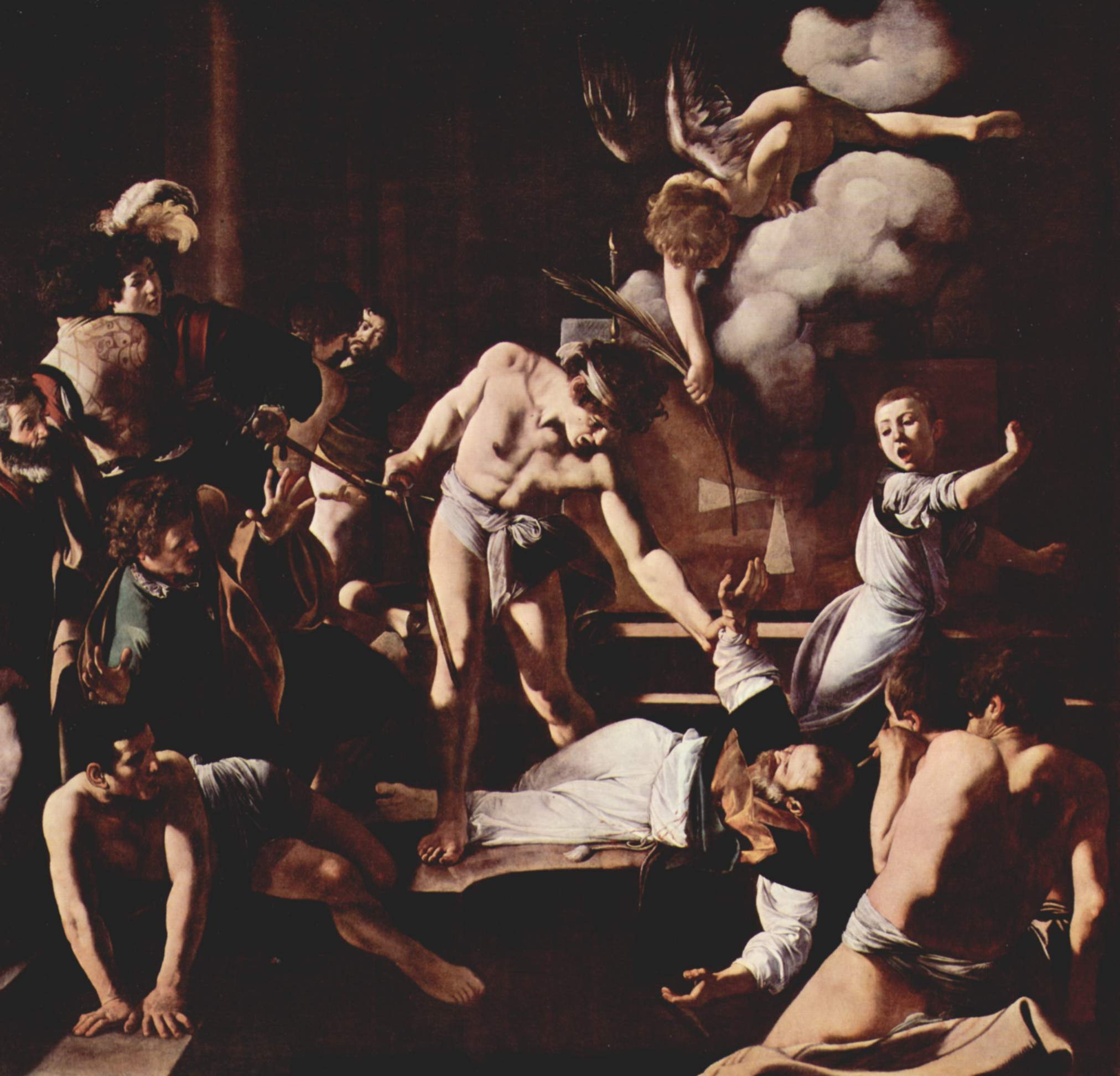
Michelangelo_Caravaggio_martyr

While appreciating the decency of Pope Francis’s recent comments on homosexuality, Jonathan Jones invites him to take a stroll through the Vatican’s art collection if he wants to further contemplate the matter:

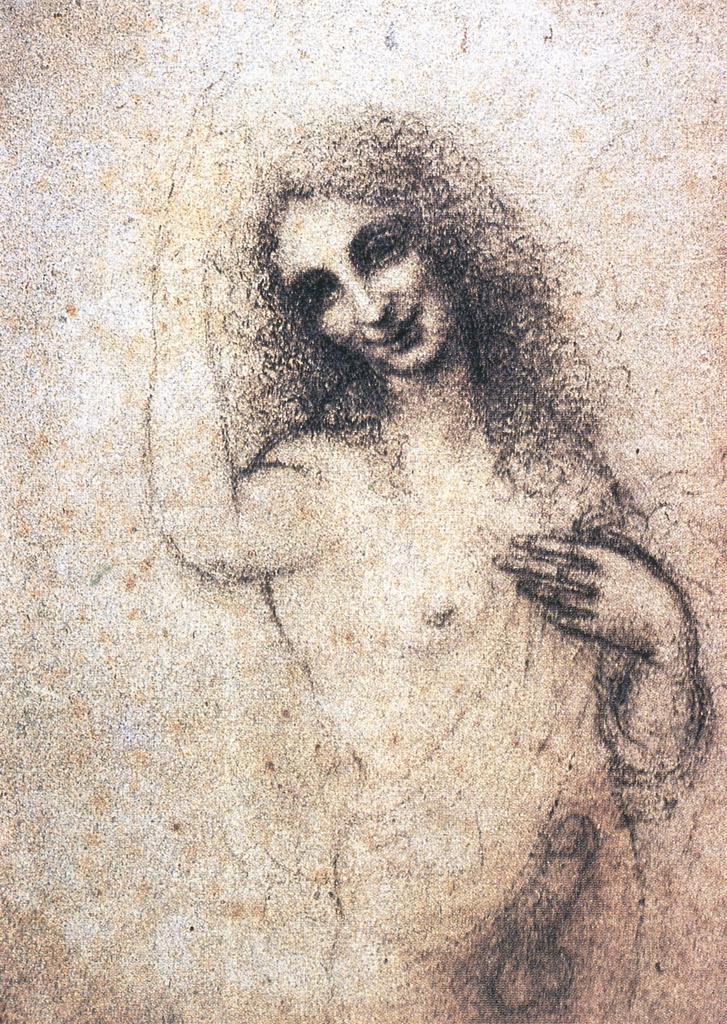
In the Vatican museum he should contemplate Leonardo da Vinci’s St Jerome in the Desert. An ascetic sits in anguished thought in a rocky wilderness in this unfinished masterpiece. It is a great, introspectively spiritual work of religious art whose creator was well known for his love of young men. Leonardo surrounded himself with good-looking assistants and painted a subversively gay icon of male beauty, his bronzed Saint John the Baptist. When da Vinci was in his 20s, he was formally accused of sodomy.

Brooding on these facts, the Pope might walk into the Pauline Chapel, to look upon Michelangelo’s frescoes there. This chapel is in a private part of the Apostolic Palace not open to the public, but I don’t think the Pope would find entry difficult. There, looking at the suffering of the saints, he might consider how Michelangelo courageously expressed his love for men, even as he created some of the most eloquent art of the church.

Is there no escape from this issue? Remembering that some art historians deny the so-called “calumny” that Caravaggio and his clerical patrons were gay, perhaps the Pope might visit the Roman church of San Luigi dei Francesi to look on this master’s paintings of St Matthew. But the demons of desire cannot be suppressed. The naked male flesh in Caravaggio’s paintings tells its own story. By the time Caravaggio came to Rome in the 1590s, Leonardo and Michaelangelo – not to mention the aptly named Italian painter Il Sodoma – had already blazed a gay trail through the art of the Holy City. Caravaggio made art dangerous and exciting again by taking that homosexual impulse to new extremes.

(Painting: Caravaggio’s flesh-filled The Martyrdom of St. Matthew, 1599-1600, via Wikimedia Commons)