Comparing what remains of his faith to “an indignant old man…wheeled into life support for a death that lingers,” the Red State Mystic ruminates over belief and doubt:
Crises of faith are supposed to lead you back to sureness: either to a reinforced belief or towards a triumphantly faithful Atheism. The latter says you must disavow those tactile experiences of the Divine. You were fooling yourself, you must say, clutching a closet’s darkness. Doubt becomes just another form of belief as the unsure questions are packed away with the rest of the dead old man’s stuff in the attic. I believe in my doubts. I have doubts about my doubts.
I still let the old man linger. I listen to his ragged breaths, slow heartbeat. If there is such a thing as resurrection, that is Christ’s business—not mine. But, I cannot look away. Doubt and belief, ecstasy and lingering pain are one around this bed. I don’t have to make sense of my life. I don’t have to make it fit your understanding or even understand it myself. I just bear witness to what I see, what I feel. I feel nothing. I am nothing. I am everything. I spill over into the world. Let’s just get this over with.
If your days last long on this earth, you will find yourself saying words that would have been abhorrent to you years before. Nasty, vile words suddenly taste sweet to your lips. Snatching the me’s out of time, I could lay them end to end and watch them argue. I have lived long enough to hold every opinion. I’ve discovered the only thing I hate is myself.
When are we happiest? he asked her.
Not one of them could get the seats
to go back, not one of them really knew
what was in the glove box, though
everything there was theirs.
When they got to where they were going,
a park, a gray squirrel came jumping along.
Childhood! It was in one of the houses nearby.
Money! Every day it seemed to loose itself
from its lurking-place and drift away.
So he smelled the underside
of his own arm. And the squirrel
paused, one of those little eternities
never mentioned again.
“To me a heaven would be a big bull ring with me holding two barrera seats and a trout stream outside that no one else was allowed to fish in and two lovely houses in the town; one where I would have my wife and children and be monogamous and love them truly and well and the other where I would have my nine beautiful mistresses on 9 different floors and one house would be fitted up with special copies of the Dial printed on soft tissue and kept in the toilets on every floor and in the other house we would use the American Mercury and the New Republic. Then there would be a fine church like in Pamplona where I could go and be confessed on the way from one house to the other and I would get on my horse and ride out with my son to my bull ranch named Hacienda Hadley and toss coins to all my illegitimate children that lined the road. I would write out at the Hacienda and send my son in to lock the chastity belts onto my mistresses because someone had just galloped up with the news that a notorious monogamist named Fitzgerald had been seen riding toward the town at the head of a company of strolling drinkers,” – Ernest Hemingway in a letter to F. Scott Fitzgerald, 1925
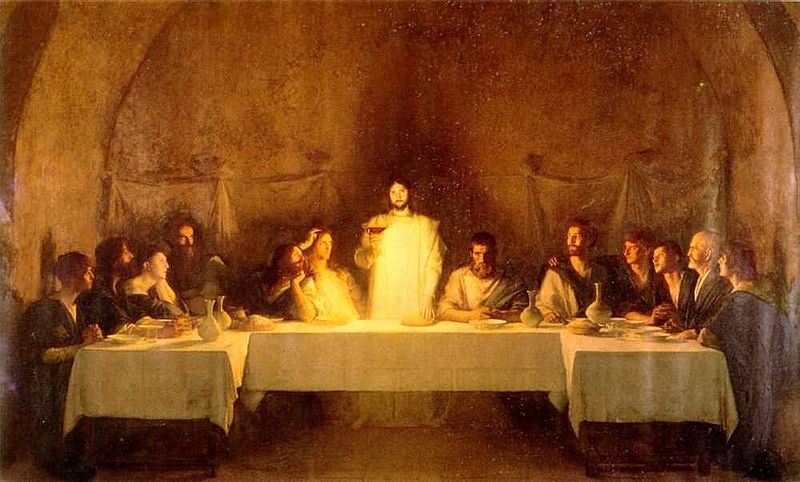
Jennifer Phillips, an Episcopal priest, contemplates the reasons that all manner of people – from a curious Jewish woman to an uncertain immigrant family – have slipped into her New Mexico parish to participate in the sacrament of Holy Communion. Why she never turns them away:
All sorts and conditions of people are drawn to the rail for all sorts of reasons conscious and unconscious, in a great variety of states of preparedness and unpreparedness. There’s always lots of teaching going on to help form people in our sacramental life, but the plain truth is that the power of God in the liturgy touches, moves, transforms, and attracts people right then, and at the rail doesn’t seem a good place to question beyond “do you desire to receive the Body of Christ?” At the heavenly throne I’d much rather be explaining why I fed some people inappropriately than why I failed to feed some who hungered and thirsted for God and put their hands out; and I’d rather give an extra blessing with a touch to someone who is drawn forward than explain they should be satisfied with a general blessing at the end. Like grain, in full measure, poured out, spilling over into one’s lap, this love and graciousness of God in the sacrament of the altar.
On a similar note, Rachel Held Evans recently spotted the following passage from Sara Miles’s memoir, Take This Bread:
What happened once I started distributing communion was the truly disturbing, dreadful realization about Christianity:
You can’t be a Christian by yourself….Sooner or later, if I kept participating in communion, I’d have to swallow the fact of my connection with all other people, without exception….I wasn’t getting [communion] because I was special. I certainly didn’t get to pick who else was good enough, holy enough, deserving enough, to receive it. It wasn’t a private meal. The bread on that Table had to be shared with everyone in order for me to really taste it….I was going to get communion, whether I wanted it or not, with people I didn’t necessarily like. People I didn’t choose. People such as my parents or the strangers who fed me: the people God chose for me.
(Painting: Pascal Dagnan-Bouveret’s The Last Supper, 1896, via Wikimedia Commons)
More readers share their thoughts on the recent thread:
As a female atheist I agree with the reasons for our scarcity theorized by Susan Jacoby in the Humanist article you linked to previously. The source communities for atheism are male dominated, and politically conscious women are – in my experience with student activism at least – more inclined to tackle issues specific to women.
I would add my own supplemental theory, which is that women are the traditional transmitters of culture to the next generation. Whatever parent does the most caregiving is the most responsible for instilling in the children a code of behavior, and progress toward parental equity notwithstanding, that’s still mostly women. Because our society still equates morality and social cohesion with supernatural belief, I’m sure there are many women who start out with a neutral position toward religion but drift closer to it – and away from atheism – as a subconscious promotion of their children’s social acceptability. There is plenty of anecdotal evidence that believers often become more devout when they start raising children and I wouldn’t be surprised if that has a drag effect on the level of belief.
Another writes:
I don’t think that it’s the job of the atheist community to pick a couple of women from their ranks and “promote” them, whatever that means. Atheism is not, sorry to say, a political movement where there are party bosses who can pick up some back benchers and give them prominent roles to advance their careers. Atheists are a herd of cats, which is really a problem on many fronts, including any kind of organized promotion of pretty much anything.
Another isn’t impressed with some of the high-profile atheist women so far:
My first memory of the term atheist was Madalyn Murray O’Hare on the Phil Donahue show. I was probably around 10 at the time and remember very little of it other than a general impression of what an awful person she was and what a shame, since it would be nice to have a real discussion about the obvious fact that there is no magic man up in the sky. That experience is probably not a significant reason why I am a deGrasse Tyson Agnostic (dTA) rather than an out-and-loud atheist, but if I were older at the time I saw it, and especially if I were a woman, I could see watching that and the audience reaction to her and just shutting up about religion for good.
The HBO documentary series Real Sex, which premiered in 1990, took an unusually candid approach to depicting sexuality on TV. Molly Langmuir presents a tribute and a behind-the-scenes oral history:
By turns bawdy, sexy, hilarious, and simply weird (though never not sincere), [Real Sex] filled in the gaps high school sex ed classes left, which turned out to be vast. Real Sex covered not only sex toys and polyamory, but the vaginal molds of porn stars, squirting demonstrations at swingers’ conventions, and workshops in which participants were prompted to dip their testicles in sprinkles.
Through it all, the mostly female team that produced the show experienced firsthand the almost absurdly vast array of desires that comprise human sexuality. “One of the main things I remember was how much we laughed,” said Katie Smalheer, who worked on the show for nine years. “We weren’t laughing at people; we were just laughing at how silly we can all be when it comes to sex — role-playing, dress-up, sex toys, dirty talk, strap-ons, corsets, striptease, mud play, latex. That was the essence of Real Sex, real people doing what turned them on, and having fun.”
Deb Wasser [street interviewer, segment producer, director]: The lawyers were very careful about what we could show.
They would examine it frame by frame. What a job. Then they’d come back to us and say, remove these three frames. Of course when we were out there filming people really having sex, they weren’t stopping and starting for the camera.
Lynn Sadofsky[line producer, co-producer]: It could feel a bit absurd sometimes. I remember one sex workshop where the participants were in the throes of whatever practice they were doing and I literally had to call lunch because the crew had to stop filming — we weren’t a union set, but we did basically follow union rules. Finally I just called, “lunch time.” I guess [the workshop participants] stopped. I guess they lined up for lunch.
Katie Smalheer [associate producer, coordinating producer, supervising producer]: There were a couple of segments toward the end that I remember clearly. Someone pitched us a story about these sex orgies and at first we didn’t do it because who wants to go to sex party and let you film them?
Turns out a lot of people. We ended up shooting this orgy, which was basically a costume party, or a masquerade, like in Eyes Wide Shut. There was even a woman who looked like Marie Antoinette with one of those skirts with the structure underneath. And they were good-looking people. By the end of the night, everyone had their clothes off and were fucking. At a certain point when you’re shooting vérité, there’s nothing for the producer to do. You just have to let the cameraman shoot. Patti and I ended up hiding behind this bookcase looking at each other, like, “What life are we living that we’re in the middle of someone else’s sex party?” People were getting fucked by other people’s husbands. A woman was in a dentist’s chair with three guys.
And it wasn’t horrible, either. There was something sexy about this.
According to Gary Shteyngart, wearing Google Glass makes you seem more appealing to strangers:
My friend Doug and I hit Bushwick and Williamsburg. Everyone at the bar at Roberta’s restaurant wants a piece of me. “Ah, future!” a German man cries. “We saw you have the Google,” a girl from a group of visiting Atlantans drawls. “Can we try it awn?” And then, without warning, I’m talking to young people. We’re all squealing, full of childish zeal. We are rubbing up to the future, hearing the first gramophone playing scratchily in the distance. Doug knows a movie producer who recently got Glass and said, “This is as close as I’ll ever get to being a rock star.” When the velvet-rope hostess at the of-the-moment Wythe Hotel bar in Williamsburg stops to take a photo of me with her iPhone, I know exactly what the producer meant. This is the most I will ever be loved by strangers.
But:
Wearing Glass takes its toll.
“You look like you have a lazy eye,” I’m told at a barbecue, my right eye instinctively scanning upward for more info. “You look like you have a nervous tic,” when I tap at the touch pad. “You have that faraway look again,” whenever there’s something more interesting happening on my screen. To awaken Glass, one must tap at the touch pad or jerk one’s head; otherwise the device remains inactive, conserving its limited battery supply and allowing the user to remain perfectly human. At breakfast, I jerk my head up theatrically, and then use a new function which allows me to move around Web sites by holding two fingers to the touch pad and moving my head about, in effect turning my skull into a cursor. “Domo arigato, Mr. Roboto,” my wife says.
After a full day of Glassing, of constantly moving my eye up and down as if in preparation for the bifocals I will need when I’m older, I fall into bed exhausted. I want to take my Glass off, but there’s a tweet from Joyce Carol Oates in response to a tweet I posted of myself wearing Glass. Oates is more concerned about my choice of shirts in the photo I tweeted. “Did Rasputin wear a button-down collar?” she asks, questioning my identity. “Not the actual G.S., possibly.”
A video of Shteyngart experimenting with Glass is here.
Europeans … once considered the bubbling beverage a product of poor winemaking. In the late 1400s, temperatures plunged suddenly on the continent, freezing many of the continent’s lakes and rivers, including the Thames River and the canals of Venice. The monks of the Abbey of Hautvillers in Champagne, where high-altitude made it possible to grow top quality grapes, were already hard at work creating reds and whites. The cold temporarily halted fermentation, the process by which wine is made. When spring arrived with warmer temperatures, the budding spirits began to ferment again. This produced an excess of carbon dioxide inside wine bottles, giving the liquid inside a fizzy quality.
In 1668, the Catholic Church called upon a monk by the name of Dom Pierre Pérignon to finally control the situation. The rebellious wine was so fizzy that bottles kept exploding in the cellar, and Dom Pérignon was tasked with staving off a second round of fermentation.
In time, however, tastes changed, starting with the Royal Court at Versailles. By the end of the 17th century, Dom Pérignon was asked to reverse everything he was doing and focus on making champagne even bubblier. Although historical records show that a British doctor developed a recipe for champagne six years before Pérignon began his work, Pérignon would come to be known as the father of champagne thanks to his blending techniques. The process he developed, known as the French Method, incorporated the weather-induced “oops” moment that first created champagne—and it’s how champagne is made today.
Mark Wilson sees the educational merits of the video:
[I]t’s not just silliness for silliness’s sake; this clip is well-designed sex education. By coupling innocuous foods with taboo topics, the presentation drops our inherent prudishness and becomes an analogy that anyone is comfortable relating to. And maybe more important, it’s refreshingly funny. Imagine if they showed this intentionally hilarious video in schools (to encourage real laughter) rather than unintentionally hilarious dry alternatives (that just encourage nervous laughter).


 1400s, temperatures plunged suddenly on the continent, freezing many of the continent’s lakes and rivers, including the Thames River and the canals of Venice. The monks of the Abbey of Hautvillers in Champagne, where high-altitude made it possible to grow top quality grapes, were already hard at work creating reds and whites. The cold temporarily halted fermentation, the process by which wine is made. When spring arrived with warmer temperatures, the budding spirits began to ferment again. This produced an excess of carbon dioxide inside wine bottles, giving the liquid inside a fizzy quality.
 The Dish
