Drinking And Drafting, Ctd

Modern Drunkard catalogs the novelist Carson McCullers‘ astonishing drinking regimen:

Attending a ferocious flurry of cocktail parties thrown in her honor, she took no small amount of pleasure in shocking the gathered intelligentsia — not with boorish behavior (she was generally quite shy), but by showing them how much booze a young lady from the South could put away. Carson possessed a prodigious capacity for liquor and reveled in sending large proud Yankees staggering home while she drank deeper into the night.

Carson liked sherry with her tea, brandy with her coffee and her purse with a large flask of whiskey. Between books, when she was neither famous nor monied, she claimed she existed almost exclusively on gin, cigarettes and desperation for weeks at a time. During her most productive years she employed a round-the-clock drinking system: she’d start the day at her typewriter with a ritual glass a beer, a way of saying it was time to work, then steadily sip sherry as she typed. If it was cold and there was no wood for the stove, she’d turn up the heat with double shots of whiskey. She concluded her workday before dinner, which she primed with a martini. Then it was off to the parties, which meant more martinis, cognac and oftentimes corn whiskey. Finally, she ended the day as it began, with a bedtime beer.

Recent Dish on the subject here.

(Hat tip: The Paris Review)

Keroauc And Mom, On The Road

In 1965, Jack Keroauc narrated his travels with his mother (“Memère”) for the May issue of Holiday. He describes their journey to New Orleans:

There’s hardly anything in the world, or at least in America, more miserable than a transcontinental bus trip with limited means. More than three days and three nights wearing the same clothes, bouncing around into town after town; even at three in the morning, when you’ve finally fallen asleep, there you are being bounced over the railroad tracks of a town, and all the lights are turned on bright to reveal your raggedness and weariness in the seat. To do that, as I’d done so often as a strong young man, is bad enough; but to have to do that when you’re a sixty-two-year-old lady … yet Memère is more cheerful than I, and she devises a terrific trick to keep us in fairly good shape—aspirins with Coke three times a day to calm the nerves.

From mid-Florida we roll in the late afternoon over orange-grove hills toward the Tallahassee and Mobile of morning, no prospect of New Orleans till noon and already fair exhausted. Such an enormous country, you realize when you cross it on buses, the dreadful stretches between equally dreadful cities, all of them looking the same when seen from the bus of woes, the never-get-there bus stopping everywhere, and worst of all the string of fresh enthusiastic drivers every two or three hundred miles warning everyone to relax and be happy.

Sometimes during the night I look at my poor sleeping mother cruelly crucified there in the American night because of no-money, no-hope-of-money, no-family, no-nothing—just myself, the stupid son of plans all compacted of eventual darkness. God, how right Hemingway was when he said there was no remedy for life.

(Hat tip: Longform)

The Allure Of Wounded Brutes

Joan Marcus comes to terms with her childhood crush on Caligula, the Roman emperor famed for his cruelty:

In childhood I was conditioned early to empathize with suffering, and Caligula certainly suffered, but he was also dangerous; I suppose that combination was the real source of his seductive power over me. Volatility without pathos wouldn’t have moved me. A man who dominated without showing some vulnerability would have been repulsive, and a gentle soul who got crushed to a pulp would have been pathetic. It was the wounded man simmering with barely-contained energy that fascinated me — passion or violence, it all felt the same.

This is the same quality, I imagine, that draws some women to incarcerated killers — that they smolder, chastened by the system and in need of sympathy.

Ted Bundy and Richard Ramirez both had flocks of groupies. As of this writing, Boston Marathon bombing suspect Dhokhar Tsarnaev has thousands of fans on social media sites, many of them young women, many thoroughly smitten. Behind bars these men are immobile love objects, captives suffering bravely under the weight of justice.

Perhaps their fans imagine them wrongly accused, or remorseful, or working through the trauma of childhood. Perhaps, in some strange way, they believe them to be empathetic. These are men who know suffering intimately and would relate to our own. They hate the power structures that hurt them but could share a deep bond with an insightful woman if only they had the chance. News outlets provide plenty of images to feed this fantasy. That aerial shot of nineteen-year-old Tsarnaev shortly after his capture, the one where he’s on the ground face up with his arms locked behind and his abdomen exposed, that’s wounded man porn right there, grist for all those girls who confuse pity with love and violence with passion.

Are We Failing At Grading Schools? Ctd

A reader writes:

The recent letter you published in (qualified) defense of Tony Bennett relies on some claims that are pretty well debunked in this Slate article by Jordan Ellenburg.  The state already had a system in place for dealing with the “non-traditional” schools in Indiana, one that would not make the grade for Christel House inherently unfair.  As Ellenburg writes, Bennett intervened after the odd “grade 3-10” issues of measurement had been worked out, and he created an entirely new loophole for the school.  Basically, rather than using a different weighting system, Bennett just got rid of the bad scores of 9th and 10th graders, and then gave the school an A even though with these scores removed it STILL earned a B.

In other words, while your education-employed correspondent may be right in general, in this case Bennett was intervening after the statistical work had been done to account for the factors that made Christel House “unique.”  This is a pretty clear-cut case of politically motivated intervention, not just an accident of a complex school accountability scheme.  These systems may have honest problems, but Tony Bennett is a dishonest one.

Another:

NPR yesterday had a fairly good report on Tony Bennett. Showing “both sides”, as they do, they gave Bennett’s side of the story:

After his system gave the friend’s charter school a “C”‘ he quietly ordered corrections (the school doesn’t graduate students, since it only handles two grades under 12th grade). With the “fix” made, the system upped the grade to an “A”. Good story, but it doesn’t cover everything. NPR then got a rundown of the situation from Mike Petrilli, VP at Thomas B. Fordham Institute who’s been critical of Bennett policies in the past. Petrilli slammed the school and Bennett, saying the school was failing Indiana’s state standardized tests.

Another reader, who agreed to forgo the Dish’s default anonymity policy, writes:

My name is Lili Lutgens and I am President of the Board of Directors of Community Montessori Charter Public School in New Albany, Indiana. We are a pre-K through 12th grade charter public school that uses Montessori teaching techniques to offer families in our community an alternative to traditional public education. Like Christel House Academy, we added one grade per year until 2010 when we graduated our first class of seniors. We also take children who have struggled academically in the traditional public education environment and so we take a lot of kids who are not very good test takers.

But unlike Christel House Academy, our accountability scores have never taken any of this into consideration.  Instead, we are judged solely on our students’ test taking performance and graduation rates.  Never mind that we are offering an alternative for kids struggling in a traditional academic setting and that historically in any given year we have had a significant number of new students.

I guess we just don’t have the kind of money to donate that it takes for the state to give us the benefit of the doubt.

By the way, if you want more info on exactly why the standardized tests underlying these accountability scores are problematic, you may want to look at the work of W James Popham, professor of academic testing at UCLA.  In a nutshell, the tests do not measure instructional quality but are used to judge it anyway.  Popham delivered an important paper at the annual meeting of the National Council on Educational Measurement last year, and it can be found here [pdf].

Borges Behind The Podium

Eric Benson takes a look at Professor Borges, a new book compiling the transcripts of a survey course taught in 1966 by Jorge Luis Borges, the famed Argentine writer:

The twenty-five lectures that make up the book are ostensibly introductory, but they’re only masquerading as English 101. Instead, this is Borges’s highly idiosyncratic tour of his favorite authors and most revered myths, a view of history and literature as filtered through his capacious, whimsical mind.

The book begins with the Anglo-Saxon migration to Britain in the Fifth Century AD and ends with Robert Louis Stevenson’s death on the Samoan Island of SavaiʻI in 1894. Vikings, mythical Old English heroes, and Icelandic historians dominate the first third of the course. James MacPherson, a literary forger who composed an anachronistic epic called Ossian and tried to pass it off as ancient Scottish verse, is credited as a key founder of the Romantic movement. The writings of nineteenth century poet William Morris are the topic of the three classes. The works of John Milton and William Shakespeare are the topic of none.

Instead of hallowing the English tradition’s most acclaimed texts, Borges offers the proudly non-academic thoughts of an erudite enthusiast. He narrates the events of largely forgotten battles. He goes on tangents to discuss arcane linguistics. And he tosses off historical theories based on the scantest shreds of evidence (Beowulf’s setting in Denmark and Sweden is definitive proof that “after 300 years of living in new lands, the Anglo-Saxons still felt homesick”). It’s hard to imagine these lectures will end up as required reading for any serious English-literature course. It’s also hard to imagine any serious reader failing to discover pleasure in the joyful digressions and virtuoso distillations of this strange, wonderful book.

Mark O’Connell marvels at the man’s immense learning – and peculiar prejudices:

The “Borges” who is revealed, or perhaps performed…seems like the Platonic ideal of the man of letters: a man who taught himself German because he wanted to read Schopenhauer in the original, and learned it, moreover, by reading the poetry of Heine; a man who taught himself Icelandic in order to pursue his interest in Norse sagas. His loss of sight seems strangely appropriate; in the interviews, he speaks of the “luminous mist” of his blindness as though it were a kind of blessing, a removal of all distraction from what was most important, most real—the life of the mind. (And there was never any shortage of people willing to read to the great writer in his old age.)

But there were things that Borges didn’t see whose invisibility had nothing to do with his physical blindness—things he didn’t see because he wasn’t interested in looking at them. The lecture course in “Professor Borges” doesn’t feature anything written by a woman. It’s a history of English literature that includes no Austen, no Shelley, no Charlotte or Emily Brontë, no Eliot, and no Woolf. He was a great admirer of Emily Dickinson’s poetry, but even that admiration is not without its strain of condescension: in an interview with the collection’s editor, Willis Barnstone, he describes her as “the most passionate of all women who have attempted writing.”

Hardcore fans can check out this Borges lecture on Johnson and Boswell, excerpted from Professor Borges in the New York Review of Books.

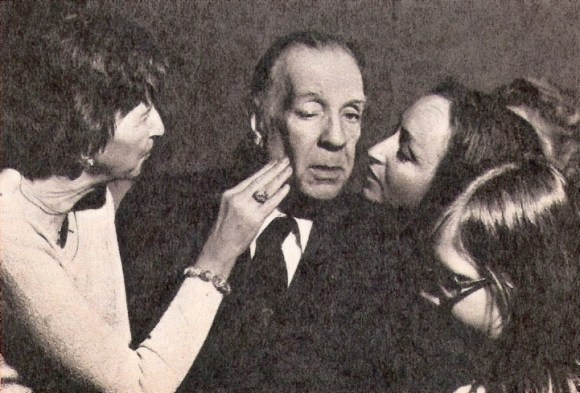
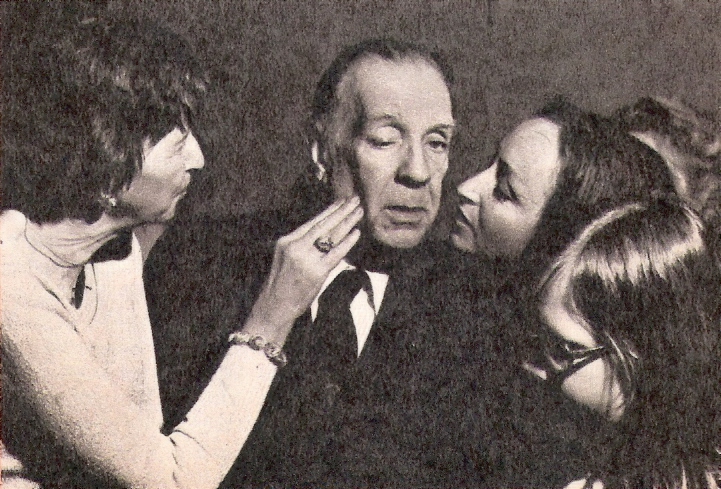
(Photo of Borges with “groupies” in 1976, via Wikimedia Commons)
A Flair For Evil Genius

Shirley Jackson lived a life fraught with paranoia, alienation, and cruelty – experiences she was able to channel into her fiction:

The six novels she wrote, and the attendant short story collections, all shared the same theme, Jackson said, “an insistence on the uncontrolled, unobserved wickedness of human behaviour.” She excelled at writing narrative that went through the looking glass and found beyond it not simply absurdity but malevolence. The switch happened in an instant, a lightning strike that turned a colour image into its negative. “It was Shirley’s genius,” [biographer] Judy Oppenheimer claims, “to be able to paint homey, familiar scenes … and then imbue them with evil – or, more correctly, allow a reader to see the evil that had been obvious to her all along.”

Her most famous story, “The Lottery,” is the most perfect example.

It tells the story of ordinary townspeople gathering together to draw lots according to a long-held tradition. When one housewife holds up the piece of paper with the single black spot, her neighbours, with deliberate and eager intent, turn upon her and stone her to death. The story created outrage on publication in 1948 in The New Yorker, described in letters to the magazine office as “gruesome” and “a new low in human viciousness.” But Jackson preferred to quote the letters she received from readers who “wanted to know where the lotteries were being held, and if they could go watch.”

Jackson’s audacity was to suggest that the terrifying face of evil was part of ordinary people and small town life. She knew what she was saying: “everything I write,” she told her publisher, was concerned with “the sense which I feel, of a human and not very rational order struggling inadequately to keep in check forces of great destruction.” Her advice to writers that “so long as you write it away regularly, nothing can hurt you,” makes it likely she knew whereof she spoke.

The New Yorker has published a previously unreleased story by Jackson, “Paranoia,” available here (subscription required), along with an interview with her son, Laurence Jackson Hyman, who offers a glimpse into her sillier side:

In real life Shirley had a wonderful sense of humor, and had a jovial laugh she got from her father, counter-balanced by the polite, proper persona she learned from her mother. There were always jokes in our house, especially at meals, where we each had to tell one. Both my parents were great jokesters. They would leave funny notes and drawings around the house, literary puzzles, playful poems on doors.

Broadcasting Bereavement

Starting July 21, when his mother entered the ICU of a Chicago area hospital, until she died eight days later, NPR’s Scott Simon live-tweeted her passing to his 1.3 million followers. Meghan O’Rourke believes the outpouring of interest in the public grieving “suggests a hunger on the part of Americans for a way to integrate death and mourning into our lives—a hunger that is being met by social media”:

Simon’s Twitter feed was not an imposition of his mourning on others, not some kind of gruesome exhibitionism. It was simply a modern version of what has always existed: a platform for shared grief where the immediate loss suffered by one member of a community becomes an opportunity for communal reckoning and mourning. As the novelist Marilynne Robinson once said, suffering is a human privilege. Grief is the flip side of love. Mourning has become an all too isolated experience—but Facebook and Twitter have become a place (strange as it may seem) where the bereaved can find community, a minyan of strangers to share their prayers. Yes, it might seem strange to stumble upon announcements of death or the intimate details of dying amidst updates about summer trips to Costa Rica, Anthony Weiner’s escapades, and the arrival of a new puppy. But this strangeness is the strangeness of the real.

Will more and more people tweet from hospital rooms? It’s possible. It’s already common on Facebook, where people often announce that a loved one is in the hospital or has died. While some have bemoaned this—the Social Q’s column, in my recollection, once pronounced that Facebook was not the place to announce a death—it doesn’t feel morbid or inappropriate to me. It’s our equivalent of the ringing of church bells in the town square, for better or for worse.

Dreher, who blogged his sister’s Ruther’s fight with cancer, and then wrote with brutal honesty about their relationship in The Little Way of Ruthie Leming, wonders when a writer who deals with such intimate matters crosses the line into “mawkish exhibitionism”:

I don’t think Simon crossed the line — I loved his tweets, actually, and think they honored his mother artfully and compassionately. I hope I didn’t cross the line either, but it’s a hard line to discern, especially when you are in the middle of intense emotions. This is a particular risk for writers and journalists, like Simon and me, who tend to process experience through writing. Often I don’t know what I think about something until I have written it down. If a tree falls in the woods and I fail to write about it, at some level I think it hasn’t happened.

The overwhelming majority of the world isn’t like that, and finds that sort of thing weird and alien. As my wife often reminds me, for writers, everything is material, but it’s not like that for most. Truman Capote was genuinely shocked when his closest friends dropped him after he repeated, under a veil of fiction as thin as onion skin, scandalous gossip he’d heard over lunch. He couldn’t understand why they didn’t realize that he was a writer, and this was material for him. That was inhuman of Capote, but I understand his confusion, and have to fight it in myself. Perhaps I don’t fight it enough, I dunno.

The View From Your Window Contest

vfyw_8-3

You have until noon on Tuesday to guess it. City and/or state first, then country. Please put the location in the subject heading, along with any description within the email. If no one guesses the exact location, proximity counts.  Be sure to email entries to contest@andrewsullivan.com. Winner gets a free The View From Your Window book or two free gift subscriptions to the Dish. Have at it.