Noah Berlatsky considers what it’s like to discover a new musician or artist in the age of endless, easily accessible info:
Music used to be a secret, hidden by the barriers of nation and region and history, and you could prove that you could feel a sense of knowledge or at least discovery by finding out what was on the other side of that (not necessarily large) hillock over there. Now all the hillocks are leveled, or at least the internet elevates us so that we can look over them anytime we want. In some sense that makes us more cosmopolitan. We can listen to more content from more places. But when you can see over every hillock, the grass there stops looking greener and starts looking just like your grass.
Sure, the old-style sense of exoticism–feeling like you have special access to another culture because you picked up a bargain CD–is creepy. But the modern sense of media where every culture is spread out in an instantly accessible smorgasbord for consumption has its disturbing aspects as well. The cultural imperialism of appropriating someone else’s cultural realness has transformed into a cultural imperialism where there is no other culture to appropriate — just a single, flat, internet-mediated mono-world. You don’t need to condescendingly anthropologize Robert Johnson any more; he’s always already been blandly digitized.
Julia Turner argues that the game Boggle vastly outclasses the more popular Scrabble and thus deserves its own gaming circuit:
Scrabble is all about constraints; you trickle out one mingy word per turn. Boggle begets a deluge, with bits of the language bobbing from your eye to your mind to the page. Part of the fun is the challenge of seeing the words on the board, looking for promising groupings (an ED, say, or an ING) and then manipulating the surrounding letters in your mind until you find words that work. [Scrabble champion Will] Anderson also pointed out another mental skill required by Boggle that has no analogue in Scrabble, something he calls the “mental queue.”
Often, an ace Boggler will see a bunch of words at once and must hold them in his head until he can record them all with his pen (or keyboard)—all while his eyes are roving on to hunt out the next word. All that mental activity feels strangely serene when you get the rhythm right. Scratching words out on paper, keeping a keen ear to the pace of your rivals’ scribbling, finding the next run of related words—DINTED, DENTED, MINTED, DEMENTED—these are sensations of pure joy. …
It’s time to demand that Hasbro—or Winning Moves, or someone!—reissue the classic implementation of the game. It’s time to launch a competitive Boggle circuit so that expert Bogglers can get their due. And, most of all, it’s time to stop cowering before our Scrabble-mad peers.
Update from a confident reader:
I am ready for the game (and myself, in tandem) to ascend. I have no idea what qualities of the mind are specific to Boggle, but apparently finding word strings in a fixed grid is the chief gift I was given by providence. Mere mention of the game in my circle of friends starts a cascade of reminiscences about my freakish ability. (Mind you, this group includes a former National Merit Scholar and a Harvard linguist who got a perfect score on his SAT.) We all knew something was up when, the first time six of us sat down to play, I cancelled out all but a few of everyone’s words (only words unique to the group’s combined list score) while filling a page with enough of my own to reach the agreed-upon winning score. Favorite word string: estivate (d), (s), (ing). Longest word I remember finding: interrogatory (ies).
Let there but be a substantive surge in the game’s popularity and I may finally escape my anonymity. Game on!
Previous Dish on Scrabble and its discontents here.
Michael Agresta is missing one form of media that boasts a relatively recent blockbuster example of the Western: video games. Mention “Red Dead Redemption” (2010) in pretty much any gaming forum and you will witness an explosion of nostalgia, as well as something much more unusual: young men, not so young men, and adolescents admitting to shedding tears over a story. That scene [above] brought tears to my eyes. My wife sat down to watch me play through the final scenes and ended up sobbing. There’s some power in the Western genre yet.
To Paul Cantor’s point, Rock Star (the studio that developed and published the Red Dead Redemption) sits alongside Matt Stone and Trey Parker in my book: Rock Star didn’t shy away from American Indian or Mexican story lines, but they didn’t pander, either. They played up the funny, sinister, noble, and criminal elements of the characters in all cases, treating them with some depth. They also acknowledged the prejudice and tired tropes plaguing those characters, accomplishing this through satire, sarcasm, and general wittiness.
I’m sure others among your readership enjoyed the game, so I just wanted to send the tidbit your way.
Another tidbit:
Considering the topic of this thread, you will be interested to know that Rock Star released a downloadable content extension to the game called “Undead Nightmare“.
An expat describes how she finally broke down and parted with her print-only loyalism:
I felt dirty watching the download bar turn blue, but once I began, I found I didn’t know how to stop. First came Alice Munro. The verisimilitude between Munro’s Southern Ontario and the Kabul expatriate community was striking. Both were a whorl of gossip. Both involved dinners parties made from canned provisions. Both were rife with what Munro called the “great shock of pleasure” that life affords you sometimes. And both were populated by the “wrecked survivors of the female life,” girls who grew up to be dissatisfied women, who found ways of negotiating with the rough terrain of an inherently male landscape. The small humiliations, the minutiae of everyday existence, the intensity of the social gaze—farm towns of rural Canada have much in common with this war zone capital.
Next came Junot Díaz’s short stories, then Zadie Smith’s novel, then George Saunders’ latest. I rationed out these texts as if they were wartime succor. Not only does downloading take a long time, spending $10 to $15 per book seemed slightly insane in a country where that amounted to an average worker’s weekly pay.
Once I tried explaining the concept of ebooks—that they cost more than three watermelons and cannot be lent to someone—to an Afghan friend and was swiftly ridiculed for my vanity. He never said as much, of course. But he did give me a look that Afghans often give me: a look that seemed to say, “Youuu eeeeediot.”
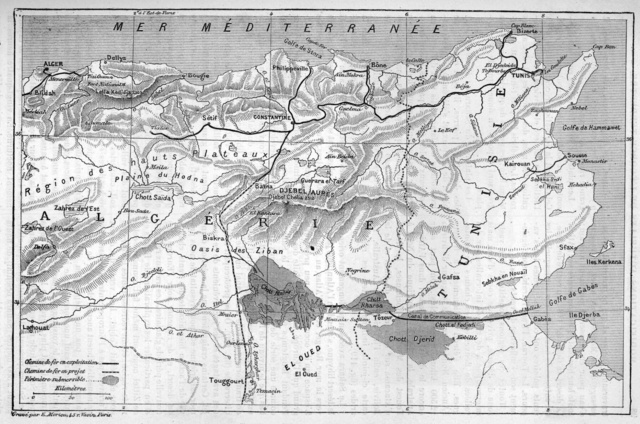
Frank Jacobs shares the story of François Élie Roudaire, a French Army captain who led the failed colonial campaign to create an inland sea in the Algerian desert. Roudaire proposed the project in 1874, after he came across upon a dry salt-lake bed, Chott el-Mehrir, that seemed strangely familiar:
Knowing his classics, Roudaire couldn’t help thinking that this submarine salt plain might once have been part of the fabled Bay of Triton. Described by Herodotus but unknown to modernity, the lake’s debatable existence and location constituted an Atlantis-type mystery popular among geographers. Could Chott el-Mehrir be contiguous with other chotts [dry lake beds] towards the Tunisian coast, forming the ghostly imprint of a former sea inlet? And could this semi-mythical body of water be resurrected?
With the blessing of Suez Canal engineer Ferdinand de Lesseps, Roudaire developed a plan to construct a 78-foot-deep, 3,100-square-mile inland sea. The project would cost a fraction of France’s Suez Canal venture, he assured investors:
The price tag [was] a mere 25 million francs. A small investment with a large return: the proof of France’s enlightened policies, progressive intentions and beneficial results in North Africa. “The Sahara is the cancer eating away at Africa,” Roudaire wrote. “We can’t cure it; therefore, we must drown it.”
The London Times said that the plan “dazzles the imagination, yet it has a sufficiently substantial basis to satisfy several shrewd traders in African commerce and some distinguished engineers.” … This new sea “is sure to be frequented by trading vessels,” reported the British magazine All the Year Round, “to carry off the produce of its banks, which will eventually be dotted with groves of date and coconut palms. … Hotels, perhaps towns, will spring up on picturesque and eligible sites; luxurious house-boats will float in its most sheltered and shady creeks.”
(Image: Map of the planned sea. Note that Lake Geneva is offered for scale in lower right-hand corner.)
When Alice Quinn started with the Dish as poetry editor last July, we began our collaboration by posting “All the Activity There Is,” from Mary Ruefle’s Selected Poems. So this weekend, the Dish commemorates the year with three poems from Mary’s new volume Trances of the Blast, just published by Wave Books. Here’s “Spider”:
The spider can barely walk, his legs are so scared—
he’s got to get from the bar of soap to the uppermost
showerstall tile that is his home, and he has suffered
a betrayal so great he’s lost in his own neighborhood,
crawling on his hands and knees, so to speak, in and out
of the shadows of other tiles he’s passed before but
barely recognizes, given his state of shock and disbelief.
Spiders don’t hear very well—he can’t hear the rain
as it falls and cools his flaming legs, the distant screams
of another’s crisis mean nothing to him, he can’t hear
his own heartbeat, an alarm casting his skeleton straight
into hell, his blood ignited by the bellows of loss.
If the gods implore him to hold his saliva, he doesn’t
hear them, he goes on crawling toward the one safe spot,
which has become, in his mind, the destination of his life
and this night rolled into one, a wet bag at the bottom
of which, were it to fall, would lie his demise—
too awful to discuss.
Rosa Brooks surveys the reasons that Americans join the military:
Some people sign up because — reared on old World War II movies, or maybe just on first-person shooter video games — they want to “go to war.” (It’s an unrealistic aspiration for many military personnel: Even in the post-9/11 era, many military personnel never deploy, and even fewer see combat.) Others dislike the idea of going to war, but believe that a strong military will prevent war by deterring potential adversaries and want to be part of such a deterrent force. Others still join up for reasons that don’t really have much to do with the nature of the military: They’re attracted by the military’s educational benefits and free heath care, they’re looking for opportunities to travel and learn, or they simply view the military as a stable job with benefits during economic hard times.
A 2011 Pew survey asked post-9/11 military veterans to list the most important factors that had motivated them to join the military.
Nearly 90 percent listed serving the country as an important reason for joining, and 77 percent listed educational benefits as important. Upwards of 60 percent said they wanted to “see more of the world,” and 57 percent said that learning skills for civilian jobs was an important factor. In contrast, only 27 percent said that difficulty finding a civilian job had been an important factor in the decision to join the military.
She also notes a common misconception:
The perception that “the military is right wing” probably stems from studies that focus on senior officers. Although senior officers make up only about 6 percent of the Army, they are substantially more conservative (and more Republican) than junior officers, and dramatically more conservative than enlisted personnel, whose views tend to more closely track those of the general population.
Update from a reader:
I joined the United States Air Force, serving from 1984-1992 as a Security Policeman working in Law Enforcement. My family had a rich history of serving this country, from my great-great-grandpa, who at 10 years old ran away from home to serve as a drummer boy in the US Army during the Civil War; three uncles who served in both fronts during WWII, and one who was onboard a cruiser during the Cuban Missile Crisis; and my father who served during the Korean War. So for me, it was a family tradition.
In fact, all through high school I wanted to join. But it wasn’t just a patriotic calling; I also wanted to see the world. I grew up in a small town in central Illinois and I shuddered at thought of attending college locally. I just wanted to get out. My folks didn’t have the money to send me to school, so being able to get funds via the GI bill was another reason I served.
So off I went, and after completing Basic Training and Law Enforcement school, I was stationed at Clark AB, Philippines. That was in 1985, just one year shy of the People’s Revolution in the Philippines. Here I was just a 19 year old, witnessing the overthrow of President Marcos while most of my friends back home were partying in college.
I worked Town Patrol later on and saw a lot for a young man (we had something like 100 bars packed into a two-mile radius with US Airmen, Navy, Marines, Army, as well as several other allied countries enjoying the Angeles City night life). It was wild and I saw a lot of tragedies: murders, decapitated heads, stabbings, prostitution, shootings, corruption, robberies – you name it. Then in 1987, a good friend and K9 handler was brutally shot to death, along with several other Airmen and Naval personnel. That had to be the worst thing I ever experienced. I rushed to the hospital and was allowed to see his body. I had seen people shot before, but this was so different. It’s hard to imagine a friend (he was only 21) and fellow Airmen lying there dead with his wife next to him. Hell, we had only been out partying a couple nights before and now he was gone. To this day I can still see his body lying there in the hospital emergency room. Nothing prepared me for that.
Then in 1991, Mt. Pinatubo erupted and all hell broke loose! I have never seen such a powerful natural destruction and was never scared more in my life. I lost everything in that disaster and was reassigned back to the US. I got out in 1992 and attended college locally with the GI bill money I received.
I will never forget the experiences I encountered during my service. I guess I was able to see a lot more since I was working Law Enforcement. Some great memories abound, but there are other horrible ones I just can’t forget.
I hate that I have to partly defend Tony Bennett, but here goes. The education reform movement has sold politicians and the public what is, at best, the polite fiction of objectivity in school accountability. There’s some truth to Michael Petrilli’s flippant remark you quoted, describing these systems are “more akin to baking cookies than designing a computer,” and Bennett’s involvement is more the rule than the exception. I should know, I’ve worked in the kitchen.
The basic architectures of these systems are sketched out by elected officials, high-level education bureaucrats, and stakeholders (such as teachers’ unions or reform lobbyists). Discussions tend to focus on the traditional elementary-middle-high school model, and final designs are a compromise between what they’d like to measure and what’s actually available in the data.
Most of these systems are based on some combination of pass/fail percentage, graduation rate, attendance rate, and test score improvement or growth (Jeb Bush’s group has been particularly instrumental in pushing the latter as the solution to the snapshot-in-time “failure” of NCLB). The basic idea is that each measure has a value that’s converted to a score, and then all the scores are combined into a composite from which accountability identifications are made.
In practice, it’s not that simple.
There are well-known statistical problems with aggregated test scores from small populations, and every state sets minimum sizes for inclusion of a group. Different measures have different distributions: pass/fail rates almost always follow the classic bell curve, while attendance rates bunch at the high end with a long tail of “problem” schools. Combining measures requires making value judgments on balancing relative priorities.
Then states find schools that don’t have all the data to fit their designs, or don’t match the stereotypical model. What do they do with a K-12 school? How about a school with too few kids? Stretching the design to encompass more schools adds yet another layer of complexity and subjectivity. (This is where Indiana ran into trouble: they hadn’t accounted for charter high schools too new to have graduated any kids yet, so averaging what measures they had made this school’s score inherently worse than high schools with graduation rates, which often cluster toward the high end.)
Once states develop scores, they have to assign meaning to them. Specifying which scores fit what labels – either by defining ranges or translating scores to fit a particular rubric (like Indiana’s GPA) – is the most subjective and political part of the process. Decision-makers inevitably test designs against what they believe about particular schools. I guarantee that every state with this sort of school accountability system has an email chain like Bennett’s, with a top official questioning a favorite school’s score as too low.
Did Bennett cross an ethical line? He certainly sidled up to it, but whether or how far he actually stepped over depends on two things: First, how much Indiana’s system was modified to fit one school, as opposed to all schools with the same quirks. Second, whether there was a quid pro quo between the grade modification and campaign contributions Bennett received from the school’s founder (knowing how the reform movement operates, I suspect there was but doubt there’s any way to prove it).
So what does this mean? Major factions within both parties have bought into these accountability systems, even though most who champion them – including and especially Arne Duncan and his staff – don’t understand their complexity. Politicians and special interests misuse information that ought to identify trends and target improvements as ideological weapons. The media’s default position of blind credulity occasionally gives way to scandal-mongering, without any real attempt to understand the issue.
How’s that for a cheerful perspective on the future of American education?
Updates from readers originally posted in this post, in addition to an email from an Indiana school official, can be found here.
The thing is: There’s not a lot of evidence to suggest that Proust really ate madeleines. Although his vivid memories of the delicate cookies from In Search of Lost Time have become iconic, early versions of the novel actually don’t include madeleines at all. Instead, we see Marcel biting into humble biscotte – a piece of dry toast.
What Proust really ate:
[A]s his illness worsened, his need to write began to subsume his desire to eat, and breakfast became Proust’s meal of choice. Instead of the madeleines and tea we known from his fiction, the real Marcel demanded croissants and cafe au lait, brought to him in bed while he read the paper and began his work. He would dunk his croissant in the coffee (just as his fictional self would mimic with a cup of tea) and ate little else for the rest of the day.
Cécile Albaret, Proust’s trusted servant, would later marvel at the writer’s ability to live on so little, after years of hedonistic eating. “The most extraordinary thing was how he could survive and work, ill as he was, … by living on the shadows of foods he’d known and loved in the past.” In the absence of beef and beer, Proust’s writing (and those morning croissants) was all that remained, evoking those tantalizing sense memories of meals gone by—his own personal madeleine moments.




 The Dish