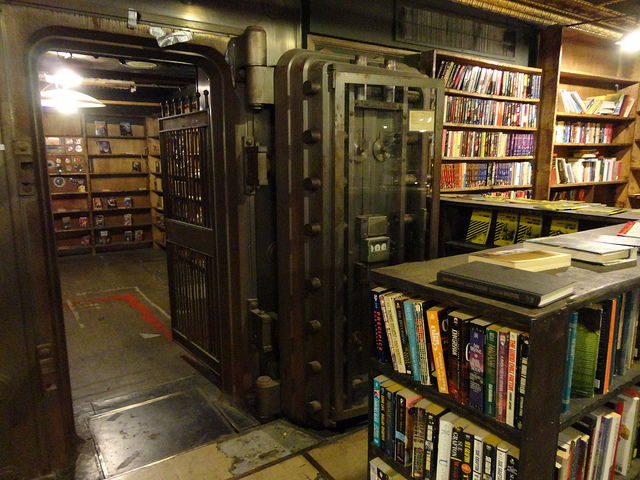
Casey N. Cep’s visit to The Last Bookstore in Los Angeles, mingled with childhood memories of bookshelves her father built, sparked these reflections on the future of reading:
Few people believe that the end of bookstores would be the end of reading, or even the end of browsing or serendipitous encounters with literature. No matter how far into the digital realm literature moves, there are those who will always revere the book. Rare book libraries and manuscript archives will always, and for good reason, keep vaults full of parchment and paper. Artists like Michael Piscitello, David Lovejoy, Jena Priebe, Brady Westwater, Nick Lord, and the many others who have contributed to the Last Bookstore will continue to make art from physical books, while artists and archivists will always devote themselves to the book as concept.
The rest of us, though, will realize it is not books that we have loved, but words and stories.
Take those bookcases in my childhood room. It was not the stained pine shelves that I cherished, but the father who made them. Take the sawhorses that my father used to build the shelves. It was not the battered pine sawhorses we prized, but the grandfather who built them and used them for his trade. The charity and hope and utility of the sawhorses and the shelves are what we loved, not the things themselves.
The same, I think, is true of books. Had we come of age in the scroll era, we would be just as resistant to the codex. But here we are, creatures of the book looking for new homes on Web sites and Kindles. The charity and hope of the stories we love are still there in their digital equivalents. Telling a story, communicating an idea, capturing an emotion: these are all possible with words whatever their format.
Recent Dish on bookshops here and here.
(Photo of The Last Bookstore, described by Cep as “equal parts mausoleum, shrine, and warehouse,” by Scott Garner)
 The Dish