Elias Groll considers the connection between economics and suicide:
The question of whether suicides increase as a result of financial crisis is a hotly debated topic, and experts in the field emphasize that each case of a person taking his or her own life stems from a web of complex factors. Financial difficulty may be but one part of that web. “We all seek understandable reasons for that kind of behavior,” Dr. Yeates Conwell, a professor of psychology and the co-director of the Center for the Study and Prevention of Suicide at the University of Rochester in New York, told ABC in October 2008. “To say that somebody kills themselves because of their financial stress is going to be a gross oversimplification.”
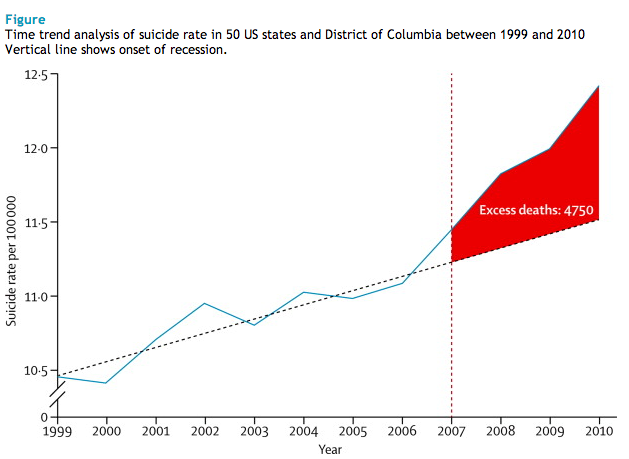
But the numbers certainly indicate that financial crisis corresponds to an uptick in suicide rates. Between 2007 and 2008, Greece and Ireland – two of the countries hardest hit by the recent spate of economic troubles – saw increases of 17 and 13 percent, respectively. More recent data suggest that, between 2010 and 2011, the suicide rate in Greece increased by 26.5 percent, or an additional 100 suicides. In the United States, researchers estimate that the suicide rate has increased four times faster during the recession than in previous years. That means an excess of 4,750 suicide deaths.
Austerity can literally kill.
 The Dish