Tod Newcombe sees power shifting from national and state governments toward cities:
As Bruce Katz points out in his new book, The Metropolitan Revolution, several key factors have opened the door to cities. For one, he writes, the Great Recession has disrupted national economies while partisan gridlock has stymied national politics. At the same time, states that are heavily dependent on federal grants to run programs are struggling with decisions of what to keep and what not too. But, he writes, “cities and metros … are responding with pragmatism, energy and ambition to get things done.” …
Mayors are behind a growing political movement that is setting national policy at the local level. Urban experts and scholars are taking note that cities have become an “important breeding ground for new ideas,” because they are far more nimble than states or federal the government.
And less bogged down by partisanship:
Republican and Democratic mayors in metropolitan areas tend to cooperate more than their counterparts at the national level, says Scott Smith, the Republican mayor of Mesa, Ariz., and president of the US Conference of Mayors. Why? “Because they have to solve problems. In Washington they don’t sense this need,” Smith told National Journal. “I still have to pick up the garbage on Thursday. When someone dials 911, I have to make sure the police show up.” Smith adds: “There is no such thing as national economies anymore. That’s why you see the big business deals done not so much between commerce secretaries any more as between mayors, like the mayor of Shanghai and the mayor of Los Angeles.”
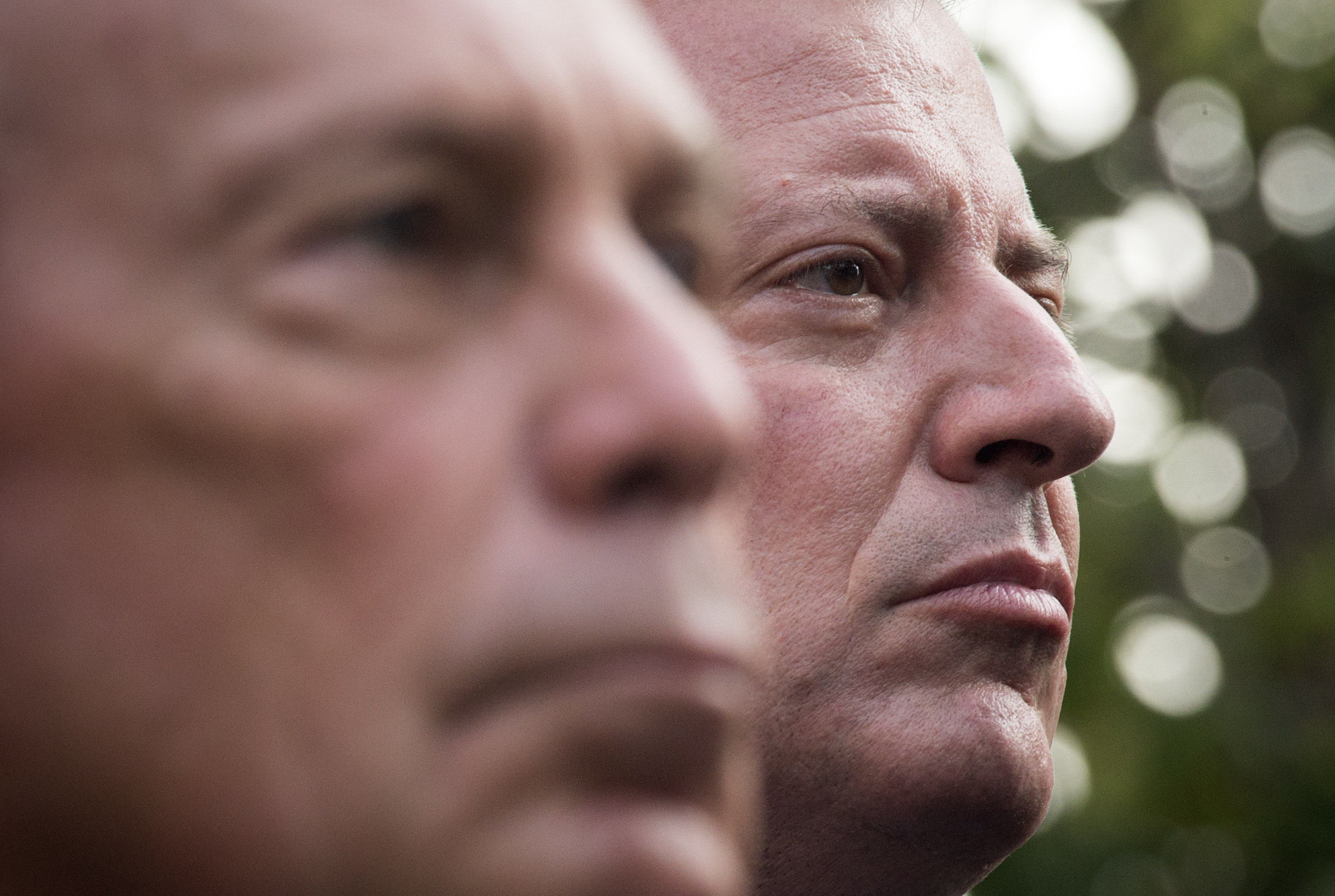
(Photo: New York Mayor Michael Bloomberg stands with his likely successor, Bill de Blasio, during the 9/11 Memorial ceremonies on September 11, 2013. By Adrees Latif-Pool/Getty Images)
 The Dish