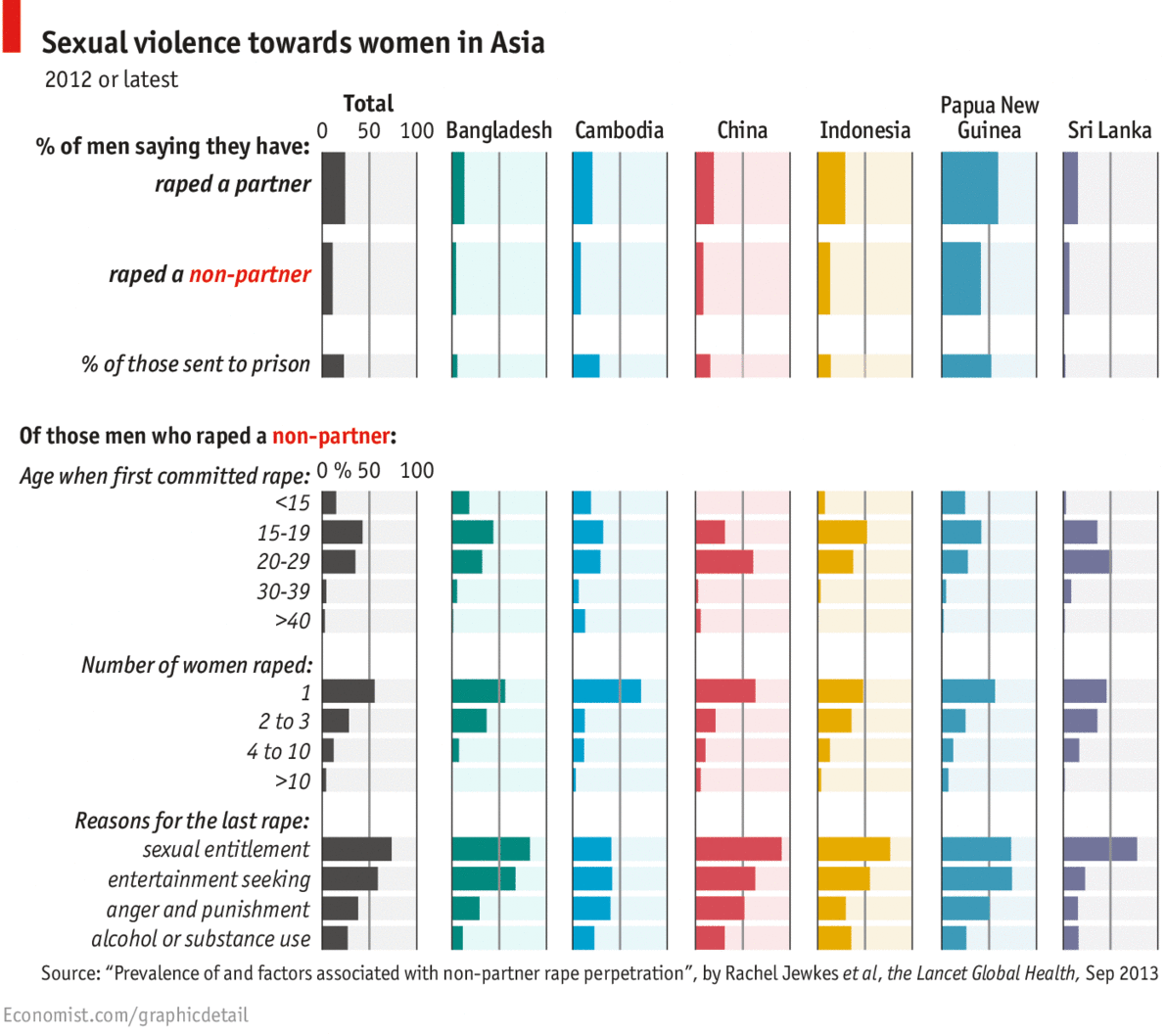
The Economist flags a disturbing new report:
The study, part of a United Nations project, is the first to give a comprehensive tally of rape in several Asian countries. The researchers surveyed more than 10,000 men in Bangladesh, Cambodia, China, Indonesia, Papua New Guinea and Sri Lanka. The men, aged 18-49, met male interviewers. They were never asked about “rape” explicitly; instead they were asked if they had “forced a woman who was not your wife or girlfriend at the time to have sex”. The answer varied from 4% in Bangladesh to a staggering 41% in Papua New Guinea. Shockingly, more than one in seven rapists committed their first rape when they were younger than 15. More than half did so before the age of 20.
Olivia Solon adds to the grim picture:
The vast majority of those men who admitted to rape (between 72 and 97 percent of men depending on the location) didn’t experience any legal consequences. In fact, many men felt that they had the right to have sex with women regardless of consent — more than 80 percent of men who admitted to rape in rural Bangladesh and China felt this way. Perhaps most startlingly, four percent of respondents said they had perpetrated gang rape against a woman or girl (although this varied between just one percent to 14 percent depending on the location).
To help understand the findings, Katelyn Fossett digs up some significant research from the 1970s on factors that encourage rape:
[Anthropologist Peggy Reeves] Sanday dissected the cultural variables that made societies more or less prone to rape, arguing that ideologies of male toughness, traditions of violence, and a lack of female participation in politics were key factors in “rape-prone” societies.
Some of these variables appear to be at play in the [UN-backed] Lancet study as well. Sanday, for instance, has observed traditions of “raiding other groups for wives” in the groups she studies; the Lancet study, similarly, hypothesizes that “the high prevalence of rape in Bougainville (Papua New Guinea) and Jayapura (Indonesia) could be related to previous conflict in these settings.” Sanday’s studies also find a correlation between low rates of female political participation and high rates of rape — a link that is echoed by the Lancet study’s findings. In the U.N. study, the country with the worst rape statistics by far was Papua New Guinea, which also happens to have the lowest rate of female parliamentary representation of the countries studied, with female MPs making up a mere 2.7 percent of Parliament.
 The Dish