In an excerpt from his new book on Austrian satirist Karl Kraus, Jonathan Franzen reveals his quasi-apocalyptic take on modernity:
If I’d been born in 1159, when the world was steadier, I might well have felt, at 53, that the next generation would share my values and appreciate the same things I appreciated; no apocalypse pending. But I was born in 1959, when TV was something you watched only during prime time, and people wrote letters and put them in the mail, and every magazine and newspaper had a robust books section, and venerable publishers made long-term investments in young writers, and New Criticism reigned in English departments, and the Amazon basin was intact, and antibiotics were used only to treat serious infections, not pumped into healthy cows.
It wasn’t necessarily a better world (we had bomb shelters and segregated swimming pools), but it was the only world I knew to try to find my place in as a writer. And so today, 53 years later, Kraus’s signal complaint – that the nexus of technology and media has made people relentlessly focused on the present and forgetful of the past – can’t help ringing true to me. Kraus was the first great instance of a writer fully experiencing how modernity, whose essence is the accelerating rate of change, in itself creates the conditions for personal apocalypse. Naturally, because he was the first, the changes felt particular and unique to him, but in fact he was registering something that has become a fixture of modernity. The experience of each succeeding generation is so different from that of the previous one that there will always be people to whom it seems that any connection of the key values of the past have been lost. As long as modernity lasts, all days will feel to someone like the last days of humanity.
Jennifer Weiner takes exception to the part of Franzen’s writing that disparages “‘Jennifer Weiner-ish’ self promotion”:
In his essay, Franzen reserves his respect for “the people who became writers because yakking and tweeting and bragging felt to them like intolerably shallow forms of social engagement,” the
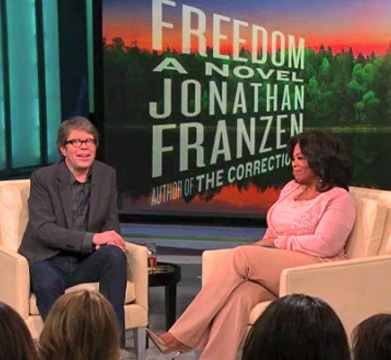
ones who “want to communicate in depth, individual to individual, in the quiet and permanence of the printed word.” But as long as there have been books, there have been writers who’ve preferred yakking and bragging to quiet and permanence. In the 1880s, there was Oscar Wilde on lecture tours. In the 1960s, there was Truman Capote on “What’s My Line?” … Other literary writers have won prizes, or Oprah’s endorsement. Other writers have appeared on Time’s cover, or have been able to shun social media, but only Franzen’s done it all. From his privileged perch, he can pick and choose, deciding which British newspaper gets the honor of running his 5600-word condemnation of self-promotion that ends with an unironic hyperlinked invitation to buy his new book. Few—no—other writers have it so good. For the rest of us—commercial and literary alike—there is social media for fun, ads and tours for publicity, billboards and book trailers only if we’re lucky.
Kevin Pires details how “Jonathan Franzen Is Wrong Again: Why Twitter Is Great for Writers.” Mic Wright belittles the novelist as “the non-thinking person’s thinker, a snap, crackle and pop insight peddler trying to do a Malcolm Gladwell”:
Franzen thinks technology and those who build and use it are what’s wrong with the modern world. The real problem with the modern world? The veneration and promotion of tedious bores like Jonathan Franzen. The short conclusion is that Franzen hates technology and hates those of us who don’t. … Here is Franzen on Jeff Bezos, a man who has done more to keep good writing alive in his purchase of The Washington Post than Franzen’s literary novels ever could:
In my own little corner of the world, which is to say American fiction, Jeff Bezos of Amazon may not be the antichrist, but he surely looks like one of the four horsemen. Amazon wants a world in which books are either self-published or published by Amazon itself, with readers dependent on Amazon reviews…and with authors responsible for their own promotion.
Oh shock! Oh horror! Strip away the paranoid tone and what you’re left with is this: Amazon is a business. It wants to serve its customers and shareholders. It likes making money and it will assist writers without the traditional publishing industry acting as intermediaries. It also thinks that writers promoting themselves and broadly controlling their own careers is a good thing. What monsters. Birching is clearly too good for the devilish Mr Bezos.
Maria Bustillos suggests that such Franzen-hate has gone into overdrive, “since the most pointed of Franzen’s claims in the essay are so obviously true, or, at the very least, worthy of serious consideration”:
How come everyone got so sore, then? I believe part of the answer is that Franzen’s critics, cool kids almost to a man, from Mic Wright in the Telegraph to Dustin Kurtz at Melville House, were hit in a tender spot by this essay. Because what Franzen is railing against is not mere tech obsession but, rather, the intellectual and spiritual poverty, the weakness and the obedience, of soi-disant “creatives” who buy what they’re told rather than rage against the machine, who are too infatuated with their wonderful little toys even to look up from them while the world burns. Very few of us aren’t at least a little guilty of that.
Dustin Kurtz offers advice to those confronting “the horrors of agreeing with Jonathan Franzen.” If you’re not one of them, click here to test your ability to distinguish between Franzen’s gripes about technology and YouTube rants against saggy pants. Previous rounds of the novelist raving against the Internet here, here and here.
 The Dish