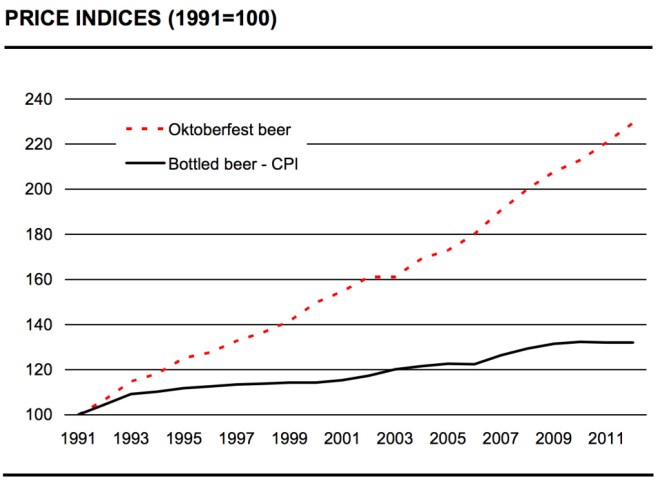
Roberto Ferdman finds that the annual beer festival – which started today – follows its own economic rules:
Beer is what economists call an elastic good; the more it costs, the less of it people buy. But at Oktoberfest, Germany’s debaucherous annual beer festival in Munich, the rule doesn’t exactly hold. In fact, it gets flipped on its head. …
“On average, a 1% increase in the price of beer triggers a roughly .3% decline in the demand,” according to [the UniCredit Research’s 2013] report. But Oktoberfest, it appears, is anything but average. Dating all the way back to 1980, a 1% increase in beer prices at the event has, rather incredibly, corresponded with a 0.3% increase in demand. Oktoberfest beer, the report explains, falls into the category of what economists call a Giffen paradox, whereby the demand for and price of a good increase simultaneously.
 The Dish