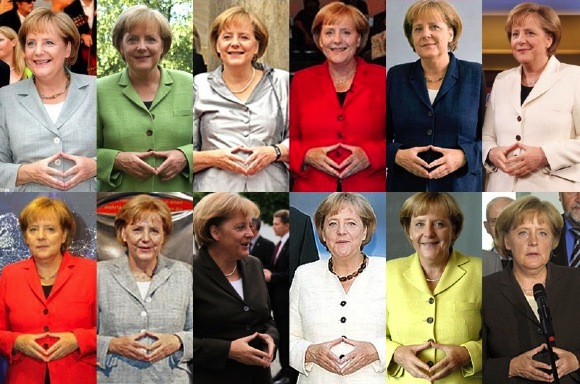
Anne Applebaum delivers some backhanded praise for the reelected Merkel:
Her very dullness, her middle-aged frumpiness, and her lack of emotion must actually represent something that Germans want: leadership without drama. It’s not just that she’s a “safe pair of hands”: Merkel provokes no jealousy, no anxiety, and no fear, either in Germany or in Germany’s immediate neighborhood.
Nobody writes about Merkel as the leader of the “Fourth Reich,” after all, and nobody compares her to Hitler or Bismarck. The eastern neighbors treat Germany as a benign partner. The southern neighbors are resentful but can’t really complain. Everyone else imports German products and feels relieved that at least one large European country still has decent economic growth and good prospects for the immediate future. Merkel makes it possible for Germany to be the dominant power in Europe without anybody really noticing, in other words. That suits her countrymen. And for the moment, it seems to suit other Europeans as well.
Maybe not the Greeks:
Greece is stuck in its sixth year of recession, but this has not stopped Prime Minister Antonis Samaras from declaring this month that “Greece is turning the page,” when the national statistics agency reported that the Greek economy shrank by “only” 3.8 percent in the second quarter, less than the expected 4.6 percent.
By the term “Un-Thatcher”, I meant the lack of polarizing drama – not a relentless pursuit of fiscal retrenchment. After all, what Merkel has done to Europe in the last few years is largely what Thatcher did to her own country in the early 1980s. But Thatcher was able to use the British parliamentary system to dominate politics in a way that Germany’s coalition-style polity cannot. Catherine Mayer wonders if Merkel will be able to form a stable government on her current course:
Merkel’s options for coalition partners are limited.
The Free Democrats, who served with her during her last term, crashed spectacularly at the election, failing even to achieve the 5% of votes necessary to enter parliament. Merkel governed in her first term in a grand coalition with her largest rivals, the Social Democrats (SPD). They too suffered at the ballot box after their association with Merkel and fear that a return to coalition with her will damage their party in the long term. They may be right. Proximity to Merkel has proved politically fatal to rivals within her own party, including her mentor, former Chancellor Helmut Kohl, whom she was key to ousting when scandal damaged the CDU’s ratings. Her popularity is also such that her supporter base—which extends far beyond the ranks of traditional CDU voters—tends to attribute every success to her and blame every failing on the government of the day.
(Image thanks to the Internet)
 The Dish