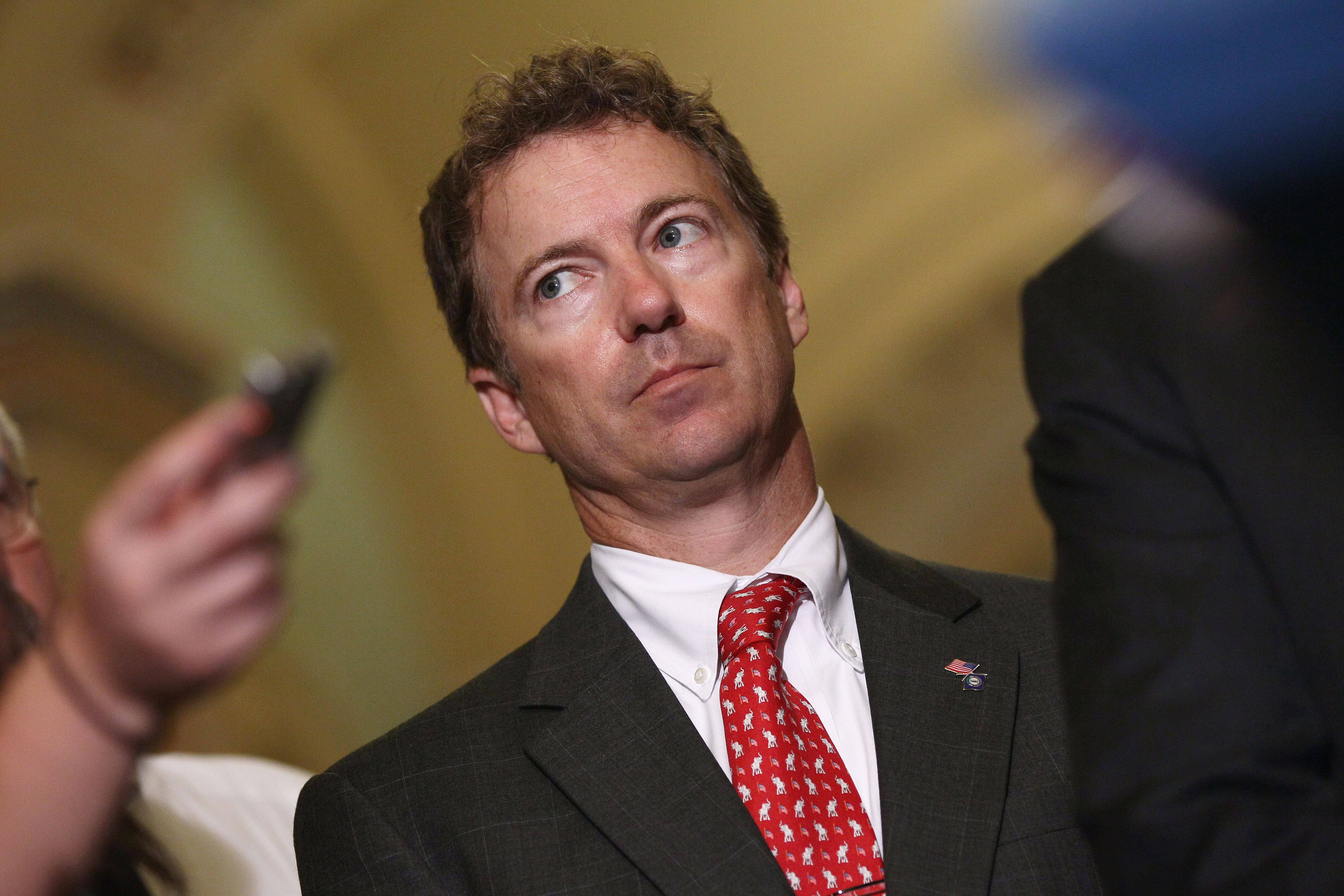
Frank Rich believes that a Rand Paul presidency “would be a misfortune for the majority of Americans who would be devastated by his regime of minimalist government.” That, of course, presupposes that Paul’s domestic radicalism would get past a Congress, which I seriously doubt. Even the current House couldn’t actually live up to its much more modest cuts in discretionary spending, and cutting entitlements – the real and sanest money-saver – is extremely hard.
The real promise of a Paul presidency, as Rich argues, would be in foreign affairs.
Look: I don’t support the extreme version of non-interventionism Paul backs. But I do believe, on Eisenhower lines, that the military-industrial complex is out of control, that our military spending has less to do with defense than with sustaining a global hegemony that has proven itself more of a burden than an asset, and that it is simply more politically realistic that Americans will back cuts in defense over healthcare. If you want a return to fiscal balance, cutting defense is essential and I see no figure on right or left more capable of doing so than Paul.
Of course, he’ll be opposed by the Congress as well. But in foreign policy, a president can do a lot on his own to shift direction. Obama has been a small-c conservative on this, gently nudging us back toward a more balanced role in the world – with the Syria deal the recent high-point. But we need to do more on this front, if we are to keep the lobbyists and the McCainiacs at bay.
After all, no faction in foreign policy has been more destructive of American interests in the 21st century than neoconservatism. And only if the GOP can rid itself of that hubristic faux expertise will we be able to bring down the long-term debt and more accurately connect America’s ends and means. On this surely Frank Rich is right:
The complacent neocon Establishment has been utterly blindsided. Just ask Bill Kristol, who had predicted that only five Republican Senators would join Paul in opposing military action in Syria—a vote count off by more than 400 percent. And just ask Christie, who attacked Paul’s national-security views this summer from what he no doubt thought was the unassailable political and intellectual high ground—only to find out he had missed the shift in his own party’s internal debate. …
Paul’s opposition to Bush-administration policies is essentially the same as Obama’s when he rode to his victories over Hillary Clinton and McCain. An Ur-text for Paul’s argument against Syrian intervention can be found in Obama’s formulation of 2007: “The president does not have the power under the Constitution to unilaterally authorize a military attack in a situation that does not involve stopping an actual or imminent threat to the nation.” Like Obama the candidate, Paul was in favor of the post-9/11 war in Afghanistan, against the war in Iraq, skeptical about the legal rationale for Guantánamo, and opposed to the Patriot Act. That’s more or less the American center now.
Why should Paul not occupy it? Hillary sure won’t. It takes nerve to face down the CIA and the NSA. Obama has been more co-opted than many of us hoped for. Paul isn’t the co-optable sort.
(Photo: Win McNamee/Getty.)
 The Dish