A reader writes:
I was pleasantly surprised to see your post on Stolperstein. Two years ago my family flew out to Berlin to see the unveiling of two Stolpersteins bearing the names of great-grandparents outside of their apartment. My grandfather, who was raised in the house until he was ferried off to hide in France at age 11 and never got to see his parents again, led a brief but beautiful ceremony standing standing outside on the quiet and peaceful Neukolln street. For me, the Stolpersteins are an unassuming, simple and devastatingly powerful reminder of the personal toll of the monstrosities of the Holocaust. It’s one thing to try to visualize 6,000,000, and it’s another thing to try to imagine the family that once lived right where you happen to be standing.
But for my grandfather, they were something else. As he walked us down his childhood streets, each Stolperstein would bring up memories of this gossiping neighbor, or this childhood friend, or this guy who ran the shop down the street. Whereas we could only see each as a tragedy, he could see them as memories as well.
[Above] is a particularly powerful video that was sent to us of a child living in the same building as my grandfather grew up in, seeing and learning about the Stolperstein for the first time.
If any German-speaking Dishheads would be willing to send us a translation, we will update. (Update below.) Another reader points to a different memorial:
The reader who shared his experiences in Bad Godesberg struck a chord with me. He wrote: “Finding out a few years ago that it had been owned by a prominent Jewish Family that had to flee was dumbfounding to me; I had never thought of that possibility while sneaking in and playing on its grounds.” I, too, had an experience like that.
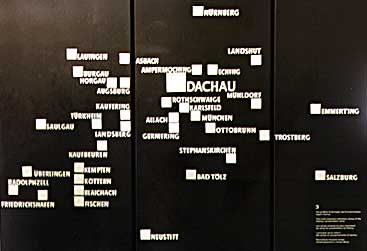
My father was stationed in Bad Tölz during the 1980s, and I spent four years playing in the (now closed) US Special Forces base there – the Flint Kaserne. After college, in 2000, I returned to Germany for the first time since I was ten years old. While in Munich, I paid a visit to the Dachau
concentration camp. They had a map of all the satellite camps and stations where prisoners would be sent to work as slave laborers, and there in big bold letters was “Bad Tölz.”
In that instant I knew (and later confirmed) that my old swimming pool, bowling alley, t-ball fields, playgrounds, Dad’s office, soccer fields, basketball courts, trick-or-treating streets, and cafeterias – practically my whole existence for four of the best years of my life … all of it was on the satellite camp.
It’s been 13 years since I made that discovery, and I still feel conflicted about the Flint Kaserne. I had a wonderful childhood there, and yet I think of all the elderly German neighbors, who would have been adults during WWII, and I can’t help but want to yell at them: “You knew! All this time you knew!” Sadly, my experience is hardly unique.
Update from a reader:
It is hard to understand some parts, and in fact they say nothing extremely moving (very German). It goes as the following:
woman: i am not sure if this has an educational value
young man steps out of the door: whose roses are these?
he reads: 1942, two years before the end of the war, what happened at this point?
old man: they lived here
young man: ok
woman: that was a jewish family that lived here
young man: and they survived the holocaust?
woman: no they were killed, in belgium
young man: they lived in this flat, in this house?
woman: yes, they lived in this house, we put these small “stolpersteine” everywhere, because these people have no …
young man reads the names: ok they were married
woman: we put these stones in the pavement all over berlin
young man: a horrible time
woman: because nobody cares about them any longer are we putting these stones in the ground, they were gassed and because of that there is nobody left
young man: i hope they rest in peaceI am a young German (18), living in Trondheim in Norway and I was amazed to see that even here there are a number of Stolpersteine. This is a great project, and if you live in a bigger German city, chances are good that you walk over some of these stones every day. They remind one in a very careful way of those who were killed because our ancestors supported or cowardly accepted the Nazis.
 The Dish