
Chart Of The Day

UN Agreement

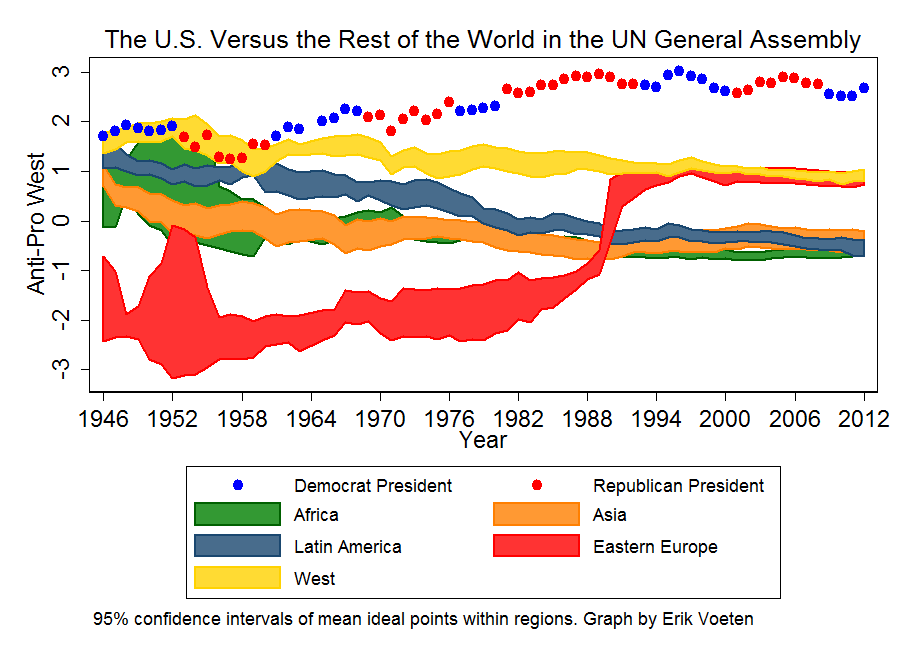
Erik Voeten looks at how the UN and the US have diverged:

The graph above plots the ideal points of the United States and the average ideal points of states in various regions of the world (as defined by the United Nations) based on their votes in the U.N. General Assembly. This is essentially the same thing as estimating how liberal or conservative senators are based on their votes in the Senate. …

The picture does not look pretty for the United States. There is a massive gap between this country and everyone else, and this gap seems to be widening steadily rather than closing. Obama may have moved a little bit toward the center of the space, but not much. And there is no evidence that other states have gravitated toward the U.S. position.

The GOP’s Declaration Of Total War On Our System Of Government, Ctd

In a post earlier today, I quoted the eminently quotable Jon Chait with this question:

Is there an example in American history of a losing party issuing threats to force the majority party to implement its rejected agenda?

I answered no – at least not on this almighty scale. (Caveats here.) Readers beg to differ:

There is an obvious example: the election and subsequent secession crisis of 1860. The southern Democrats were quite clear with their threats to secede from the Union should Lincoln be elected.

Seeing the Obama presidency as a Cold Civil War of the South against a Northern president does help explain the splenetic rage, and the obvious belief in the illegitimacy of the elected president because of the policies he ran on and won with. Another reader elaborates:

The Southern Strategy, which began as a tactical gambit, now accounts for substantially all Republican rhetoric and policy. So the other party is just that — The Other. The point of making demands is making demands. The point of the resentment is the resentment. The point of not compromising is the emotion and the show of not compromising.

The demands over the debt ceiling don’t even involve debt.

More to the point, there didn’t appear to be all too much Republican anti-government resentment during the George W. Bush Bush presidency, as the GOP pushed for Medicare Part D, No Child Left Behind, the executive’s asserted power to wiretap and to detain & torture US citizens without charges or a warrant, surpluses turned into deficits, the right in Raich v Gonzales to imprison folks for activity legal under state law, and the invasion for bogus reasons & failed occupation of an arbitrarily selected Middle Eastern country.

But, President Bush was One of Us. The Kenyan anti-colonial secret Muslim? Less so. Hence, insane demands, in the service of taking Our country back from Them.

Marks In Time

Zach Schonfeld serves up some fun facts from Shady Characters, Keith Houston’s new book on the history of punctuation:

The asterisk (*) and dagger (†), for instance, grew largely out of the symbols the grammarian Aristarchus of Samothrace placed in the margins of works of Homer to note lines of questionable origin; the em dash (—) nearly drifted into neglect when typewriter keys forced typists to turn to the double-hyphen (–) instead, but was subsequently validated by modern word-processors. And the Internet plays a tremendous role in the drama as well: the octothorpe (#), for example, fell into obscurity before Twitter resurrected it as the devilishly popular hashtag.

In other words, Houston’s Shady Characters covers a tremendous amount of historical and topical ground—veering from ancient Greece to a 1960s Madison Avenue exec seeking to jumpstart a new punctuation mark, from the Protestant Reformation (Martin Luther’s Ninety-Five Theses played a minor role in the development of the asterisk) to online communities, where numerous would-be pioneers have proposed an irony or sarcasm mark. (A huge success, obviously.)

The Brutal Weapons That Don’t Cross The Red Line

Charli Carpenter points to an ominous infographic from the UK nonprofit Action On Armed Violence:

IGp-DD-Overview

It shows some of the worst conventional weapons used in Syria:

What NGOs are calling attention to is what Nina Tannenwald refers to as a perverse effect of international prohibitionary norms. While norms can constrain bad behavior, such norms also exert “permissive effects” whereby the social sanction against one type of action implicitly legitimizes others. The international reaction against chemical weapons in Syria, to the exclusion of attention to other types of civilian harm, constitutes such a “permissive effect” on civilian targeting and the indiscriminate use of explosives which should rightly be questioned by human security advocates.

The organization says such weapons have been responsible for about two out of every five deaths in the civil war. Ninety percent of those victims have been civilians.

The Struggle Against The End Of The Tunnel

pom-wonderful-cheat-death (1)

Lewis Lapham takes stock of shifting attitudes toward death:

About the presence of death and dying I don’t remember the society in the 1950s being so skittish as it has since become. People still died at home, among relatives and friends, often in the care of a family physician. Death was still to be seen sitting in the parlor, hanging in a butcher shop, sometimes lying in the street. By the generations antecedent to my own, survivors of the Great Depression or one of the nation’s foreign wars, it seemed to be more or less well understood, as it had been by Montaigne that one’s own death “was a part of the order of the universe … a part of the life of the world.”

For the last 60 or 70 years, the consensus of decent American opinion (cultural, political, and existential) has begged to differ, making no such outlandish concession. … The wonders of medical science raked from the ashes of the war gave notice of the likelihood that soon, maybe next month but probably no later than next year, death would be reclassified as a preventable disease. That article of faith sustained the bright hopes and fond expectations of both the 1960s countercultural revolution (incited by a generation that didn’t wish to grow up) and the Republican Risorgimento of the 1980s (sponsored by a generation that didn’t choose to grow old). Joint signatories to the manifesto of Peter Pan, both generations shifted the question from “Why do I have to die?” to the more upbeat “Why can’t I live forever?”

Recent Dish here on Google’s new company aiming to extend life indefinitely.

The GOP’s Declaration Of Total War On Our System Of Government

crashing-elephant-thumb

Ezra rattles off the demands the GOP is making if they are not to destroy the US and global economy:

In return for a one-year suspension of the debt ceiling, House Republicans are demanding a yearlong delay of Obamacare, Rep. Paul Ryan’s tax reform plan, the Keystone XL pipeline, more offshore oil drilling, more drilling on federally protected lands, rewriting of ash coal regulations, a suspension of the Environmental Protection Agency’s efforts to regulate carbon emissions, more power over the regulatory process in general, reform of the federal employee retirement program, an overhaul of the Dodd-Frank financial regulations, more power over the Consumer Financial Protection Bureau’s budget, repeal of the Social Services Block Grant, more means-testing in Medicare, repeal of the Public Health trust fund, and more.

Why not demand president Obama’s resignation while they’re at it?

What the sheer gob-smacking scale of these demands means is that the GOP effectively wants to nullify the last election entirely (except of course for their gerry-mandered, no-popular vote House majority). The staggering thing about this party as it now exists is that it views the governance of the other party as always effectively illegitimate. Elections do not matter. Only their agenda matters. No compromise is possible, even when this kind of catastrophic default is hanging over our heads. In fact, the danger of catastrophic default is something they relish in order to undo the basic principles of democratic government.

This is not a bargaining position; they already voted for the budget that requires us to raise the debt ceiling. It is a bald attempt to reverse elections as the mark of a democracy and replace them with endless blackmail until they get their way. This isn’t conservatism. It’s pure constitutional vandalism. Derek Thompson’s jaw drops:

Give us everything we want or else we’ll destroy the country! is the sort of demand that only a broken party inside a broken system could possibly hope to make.

The debt ceiling should not exist and the rules of the Senate and House shouldn’t allow a minority to repeatedly extort the majority, but, well, you go to debtmageddon with the government you got. Republicans, inching away from shutdown, are all in on an apocalyptic strategy to trade the full faith and credit of the country for their agenda.

Barro chimes in:

America’s constitutional system only works if the divided branches of government are willing to work together to make consensual agreements about running the government. Republicans are showing themselves to be too irresponsible to make the American constitutional system work.

And Chait searches for a historical precedent:

The fact that a major party could even propose anything like this is a display of astonishing contempt for democratic norms. Republicans ran on this plan and lost by 5 million votes. They also lost the Senate and received a million fewer votes in the House but held control owing to favorable district lines. Is there an example in American history of a losing party issuing threats to force the majority party to implement its rejected agenda?

Not on this massive scale, no.

(Photo by Tony Karumba/AFP/Getty Images)
The Reasons For Traditional Worship

orthodox worship

Will McDavid finds this passage from Andre Dubus’s short story, “A Father’s Story,” to get at the heart of liturgical worship:

Each morning [at Mass] I try, each morning I fail, and know that always I will be a creature who, looking at Father Paul and the altar, and uttering prayers, will be distracted by scrambled eggs, horses, the weather, and memories and daydreams that have nothing to do with the sacrament I am about to receive. I can receive, though: the Eucharist, and also, at Mass and at other times, moments and even minutes of contemplation. But I cannot achieve contemplation, as some can; and so, having to face and forgive my own failures, I have learned from them both the necessity and wonder of ritual. For ritual allows those who cannot will themselves out of the secular to perform the spiritual, as dancing allows the tongue-tied man a ceremony of love.

Frederica Mathewes-Green makes related points on behalf of un-trendy, liturgically-oriented worship:

[Worship] was aimed at God, in adoration and supplication, not at attracting non-believers, or even at giving fellow-worshippers a good worship experience. This focus on God was the case until very recently; now our immersion in a consumer economy has led us to think of everything in terms of appealing to potential customers. We are so mentally saturated in advertising that we have come to think of ourselves and our faith as products that need to be persuasively sold.

That’s how worship gets redirected from the Lord to outsiders, who have no ability yet to understand or respect Him. The church becomes an organization that is primarily occupied with planning a billboard, because the most important goal is to capture non-believers’ attention. When someone responds to a billboard and becomes a member of the community, he discovers that he has joined an organization that — is planning a billboard. The main goal of members of a church is to attract more members to the church. It’s like Ponzi scheme.

Dreher remembers his first experiences at Orthodox worship services – and appreciates that what he found there was strange to him:

When I first started attending an Orthodox church, I thought, OK, this is really beautiful, insanely beautiful, like no other Christian worship I’ve attended … but I don’t understand what’s going on. People were really friendly, but they didn’t try to dumb the worship down for my sake, or any seeker’s sake. They just did what they always do. The beauty and integrity of it drew me in.

(Photo by Flickr user bobosh_t)

“The Audience Wants The Control” Ctd

Those words from a popular speech from Kevin Spacey we posted recently are in the same spirit as this interview with Netflix CEO Reed Hastings. The latter contends that the current practice of scheduling TV shows into weekly time slots will one day seem as antiquated as forcing readers to wait a month between each chapter of a novel:

Two hundred years ago, a lot of fiction was written for magazines. It was a serialized format for novels. And then book manufacturing got cheap enough where you could make a book and sell it at a reasonable cost. And then people got control of all 13 chapters; they could read on their own schedule, and that greatly outcompeted the serialized release model of the then-historic magazines.

And I think we’ll see the same thing [with television], which is: More and more, consumers want control. They want freedom. Occasionally they binge, and that makes a great story, but most of the time it’s just a single episode like you read the chapter of a book. And we’ll see chapters that are variable length. Like TV shows, instead of having 22 minutes for every episode, you can go with 30 minutes and 16, depending on the natural rhythms of the story.

Contesting The “Cannabis Closet”

We recently sat down with the Marijuana Policy Project’s Mason Tvert, author of Marijuana is Safer: So Why Are We Driving People to Drink?. In the following video from Mason, he reveals the size of the cannabis closet and why he thinks people “coming out” about their personal use isn’t enough:

Jeff Winkler thinks we should ditch the term altogether:

‘Cannabis closet’ is an intentionally loaded term. In 2009, Andrew Sullivan, the editor of The Daily Dish blog and a proudly ‘out’ gay man, solicited a series of pot-smoking testimonies from readers under that heading. In the introduction to his subsequent book, Cannabis Closet: First-Hand Accounts of the Marijuana Mainstream (2010), Sullivan wrote:

I wondered whether the humor and laughter around the subject were not some nervous way of coping with the vast discrepancy… Like homosexuality, pot use was … accepted as part of reality, but rarely spoken of in public. It carried a stigma.

Though not quite the same, the lesbian, gay, bisexual and transgender (LGBT) movement has succeeded in equating its cause to that of the civil rights struggle. Sullivan uses the gay middleman to suggest the same for weed. It’s a rhetorical trope increasingly used by weed proponents. However, even if we acknowledge the inherent prejudice of the first pot prohibition laws, it’s still dubious as an argument.

When the former congressman and presidential candidate Dennis Kucinich invoked Martin Luther King Jr at the 2011 Seattle Hempfest, the comparison rankled.

Teacher Bob uses weed to manage his post-traumatic stress syndrome (he is a two-tour Iraq veteran, ‘not some crazy hippie from the hills’) as well as the side effects of some of his prescription medications. But he made it clear he also likes the stuff. I asked why he and the other teachers would risk their livelihood for a hush-hush toke or two behind closed doors. In reply, Teacher Bob cited Henry David Thoreau. ‘It’s an act of civil disobedience,’ he said. …

Choice is great! But it is dishonest to suggest that choosing to ingest a drug is anything more than that. To compare it with ending the persecution of homosexuals or the fight of black activists seems like an insult to those legacies. Why not just come out and say: ‘Weed gets me high and that’s OK’? Or, to borrow more superficially from the LGBT movement: ‘We’re blazed! Unfazed! Get used to it!’

I take the point, and would not want to take these analogies too far. My argument was that, as in the past with illegal sodomy in many states, the illegality of pot-use crippled a public discussion of the pros and cons of the drug – hence the “closet.” My other point was simply to note that both sodomy and pot use – as long as they are by consenting adults – harm no one else, and are about freedom over one’s own body. Of course these movements are not identical. But I don’t regret initiating a new trope of conversation about the issue – even if it leads to a sensible conclusion that we should not conflate distinct causes too glibly.