Who Will Control Afghanistan in 2014?

Christian Neef reports that although NATO “claims it will be leaving behind a pacified Afghanistan when it withdraws its troops next year, there are already increasing signs that the former mujahedeen are reactivating their militias”:

The mujahedeen feel the Afghan army is incapable of providing security in the country after NATO’s withdrawal. Despite the West’s efforts to nurture this fledgling military force, over the past three years one out of every three soldiers has deserted – a total of 63,000 men. Even leading politicians in Kabul – including Vice President Mohammed Fahim, who is himself a former warlord – are predicting that the mujahedeen will make a comeback in 2014. Ahmed Zia Massoud, the brother of legendary mujahedeen commander Ahmad Shah Massoud, publicly proclaims that his supporters are in the process of rearming themselves.

Where Paul Is Promising

Senators Discuss Balanced Budget Amendment

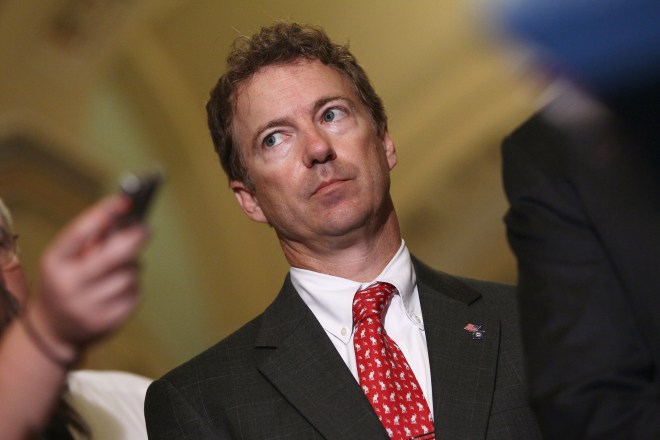
Frank Rich believes that a Rand Paul presidency “would be a misfortune for the majority of Americans who would be devastated by his regime of minimalist government.” That, of course, presupposes that Paul’s domestic radicalism would get past a Congress, which I seriously doubt. Even the current House couldn’t actually live up to its much more modest cuts in discretionary spending, and cutting entitlements – the real and sanest money-saver – is extremely hard.

The real promise of a Paul presidency, as Rich argues, would be in foreign affairs.

Look: I don’t support the extreme version of non-interventionism Paul backs. But I do believe, on Eisenhower lines, that the military-industrial complex is out of control, that our military spending has less to do with defense than with sustaining a global hegemony that has proven itself more of a burden than an asset, and that it is simply more politically realistic that Americans will back cuts in defense over healthcare. If you want a return to fiscal balance, cutting defense is essential and I see no figure on right or left more capable of doing so than Paul.

Of course, he’ll be opposed by the Congress as well. But in foreign policy, a president can do a lot on his own to shift direction. Obama has been a small-c conservative on this, gently nudging us back toward a more balanced role in the world – with the Syria deal the recent high-point. But we need to do more on this front, if we are to keep the lobbyists and the McCainiacs at bay.

After all, no faction in foreign policy has been more destructive of American interests in the 21st century than neoconservatism. And only if the GOP can rid itself of that hubristic faux expertise will we be able to bring down the long-term debt and more accurately connect America’s ends and means. On this surely Frank Rich is right:

The complacent neocon Establishment has been utterly blindsided. Just ask Bill Kristol, who had predicted that only five Republican Senators would join Paul in opposing military action in Syria—a vote count off by more than 400 percent. And just ask Christie, who attacked Paul’s national-security views this summer from what he no doubt thought was the unassailable political and intellectual high ground—only to find out he had missed the shift in his own party’s internal debate. …

Paul’s opposition to Bush-administration policies is essentially the same as Obama’s when he rode to his victories over Hillary Clinton and McCain. An Ur-text for Paul’s argument against Syrian intervention can be found in Obama’s formulation of 2007: “The president does not have the power under the Constitution to unilaterally authorize a military attack in a situation that does not involve stopping an actual or imminent threat to the nation.” Like Obama the candidate, Paul was in favor of the post-9/11 war in Afghanistan, against the war in Iraq, skeptical about the legal rationale for Guantánamo, and opposed to the Patriot Act. That’s more or less the American center now.

Why should Paul not occupy it? Hillary sure won’t. It takes nerve to face down the CIA and the NSA. Obama has been more co-opted than many of us hoped for. Paul isn’t the co-optable sort.

(Photo: Win McNamee/Getty.)
“Mountain Dew Mouth”

A reader explains:

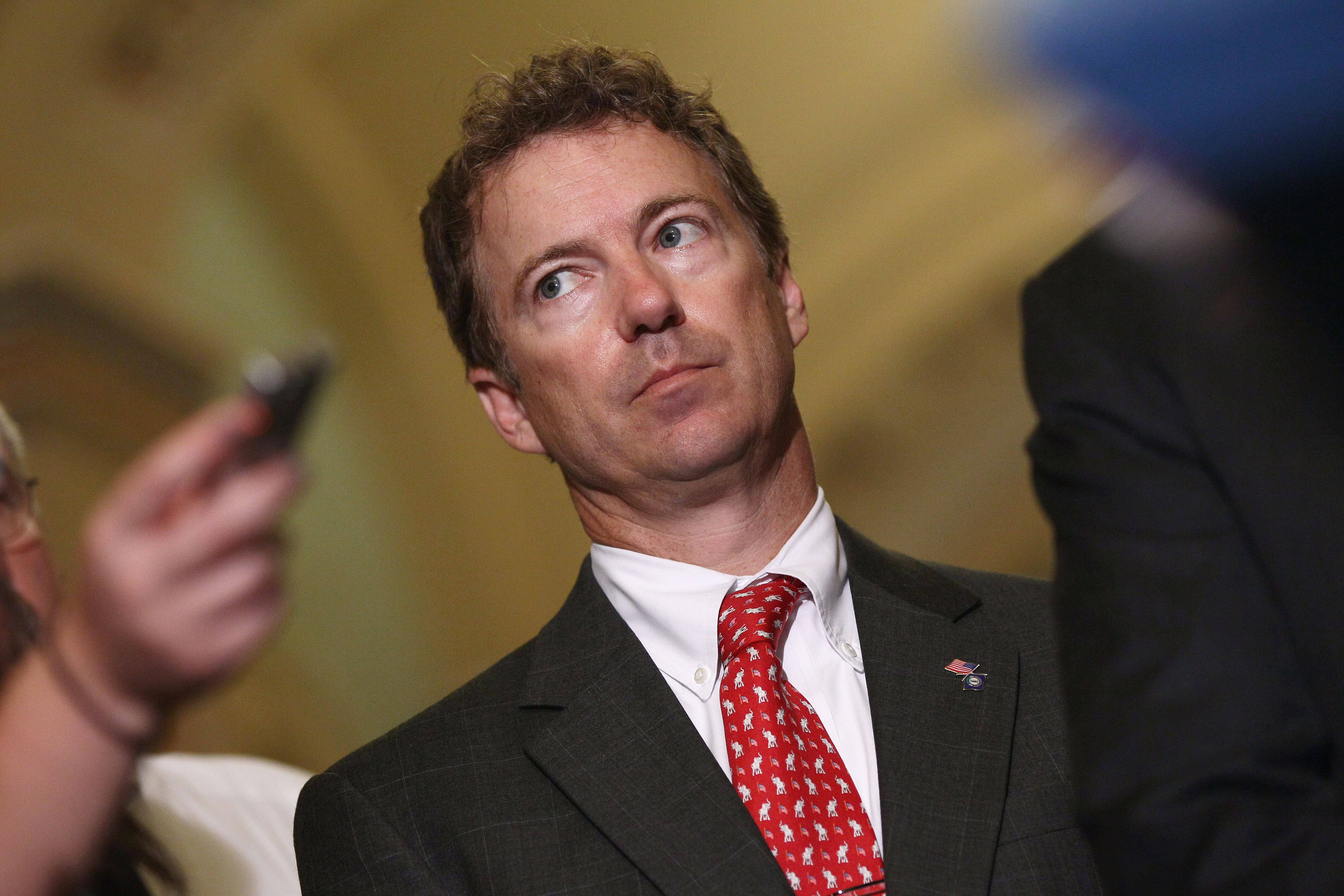
Both parties are at fault in this push and pull on food stamps: the GOP is at fault for using a cudgel when real policy is needed and Democrats are guilty of continuing the shameful status quo. I am not talking about giving handouts to blacks in the South, as your readers discussed, but the blind enabling of a true public health crisis: Mountain Dew Mouth. NPR recently did a piece on the issue. Money quote:

“We are using taxpayer dollars to buy soda for the SNAP program, and we are using taxpayer dollars to rip teeth out of people’s heads who can’t afford dental care and are on Medicaid,” says Dana Singer, a research analyst at the Mid-Ohio Valley Health Department in Parkersburg, W.Va., who wants to see stricter regulations on sales of all sugary beverages in the region. “It makes no sense to be paying for these things twice.”

As someone who was raised in the Appalachian Mountains, this is a glaring issue neglected by sodacariesfifteenyearold01_smallboth sides for a long time. The right is tone-deaf to the issues affecting its base – Southern and rural working-class whites – while the left seems to think any infringement on someone’s ability to use government benefits is unacceptable.

My mother, a dental hygienist, has volunteered in these dental clinics to the point of fatigue. These people have no lobby, no caucus, no real representatives to step forth and demand real change to they way the federal government doles out “nutritional” benefits loaded with sugar, citric acid, and high fructose corn syrup. Shame on both parties for failing to use an opportunity for real policy to influence the well-being of millions of Americans. In light of the First Lady’s crusade against obesity, such a squandered opportunity to end this tax-payer enablement is particularly poignant.

Previous Dish on whether food stamps should cover soda is here. Related thread on the fluoridation debate among liberals here.

(Photo of a “15 Year Old With Severe Cavities” from ParentingHelpMe.com)

Frequent Testing Gets A Passing Grade

Ezekiel J. Emanuel argues for more student testing. How to do it right:

A key to triggering the testing effect is timing: The sooner students are tested after encountering new material, the more it sinks in, while waiting just seven days to test students can substantially reduce performances. On the other hand, the more testing a student gets on a given set of more information, the greater the benefits. With the first few tests, students show dramatic gains. With further testing, the positive effects on retention taper off. But surprisingly, there is no plateau. Even after 20 or 30 tests, students’ performances progressively improve with each additional assessment.

A Happy Rise In Unemployment

child-labour-hazardous-work-percent-of-children-in-child-labor_chartbuilder-2

Tim Fernholz notes that child labor has fallen substantially around the world since 2000:

Wondering how 168 million child laborers could be a positive thing? Well, the number represents about a third fewer workers aged 5 to 17 than there were in 2000. The fastest decrease in child laborers has come in last four years, even though child advocates had feared an increase because of the global recession. … The [International Labour Organization] points to two major reasons for the recent decrease: The poorer nations where child labor is concentrated recovered more quickly from the global recession, which meant fewer children were forced by impoverishment into child labor. Also, reduced labor demand meant that older children weren’t able to enter the workforce as quickly.

But Harriet Grant stresses that the number is still too high, especially with many working children hidden in the less formal pockets of the economy:

[ILO child labor expert Yoshie] Noguchi said that because the family-based model of working was so common, it remained difficult to tackle child labor through a model of transparency in supply chains. “Consumers can indirectly give a signal to business that they do not want [child labor] and then the supply chains might give a signal to suppliers, but the supply chain is very long now,” she said. “It’s not easy for enterprises to say no, because people can sub-contract down to even a family-based level that nobody comes to inspect. Child labor exists more in that kind of setting than anywhere else.”

No One Deserves Cancer

Charlotte Huff laments the blame game that is so often associated with cancer diagnoses:

After Linnea Duff learned at age 45 that she had developed lung cancer, she practically encouraged people to ask if she had ever smoked. But in the eight years since, her feelings have soured considerably on the too-frequent question, and she’s developed an acute sense of solidarity with fellow patients: smokers, former smokers, and never-smokers alike.

“It’s just so inappropriate,” says Duff, who believes that people with other serious illnesses don’t field so many intrusive queries. “Would you ask someone, ‘Did you eat too much?’ or ‘Did you have too much sex?’”

Why this line of inquiry persists:

Judgments about behavior not only unsettle and stigmatize the patient, but reflect the interrogator’s own insecurities. Frequently, those disease detectives are attempting to regain a sense of control amid the inherently random and sometimes unjust world that we all reside in, according to researchers who have studied stigma. Psychologists refer to this as the “just-world hypothesis,” a bias in thinking and perception that was first described by psychologist Melvin Lerner and colleagues more than four decades ago, and which has since been documented in numerous books and articles.

The Tree Of Liberty Had Non-American Roots

Reviewing Charles Murray’s new ebook, American Exceptionalism: An Experiment in History, Richard Gamble finds fault with his understanding of the Founding. The critique is a useful reminder that Charles is not a conservative in the sense of someone who sees everything embedded in the intimations of the past as they relate to the future:

Murray’s preoccupation with innovation ignores more than a century of colonial America’s prior experience in self-government and constitutionalism and its acknowledged debt to ancient, European, and most of all English political theory and practice. It is hard to recognize historical reality in Murray’s depiction of America’s past. America was not sui generis; it was a variation on themes reaching back thousands of years. The republic did not emerge de novo in the New World; it altered—to use the word the Declaration of Independence chose—an existing form of government while announcing the more general right of a people to abolish their government.

Murray complains at one point about “both liberals and conservatives quoting snippets of [the Founders’] writings” to endorse their own views. But Murray’s own snippets are vulnerable to the same charge.

He uses an 1825 letter from Thomas Jefferson to Henry Lee, for instance, to show that after 50 years of reflection Jefferson called the rights language of the Declaration “an expression of the American mind.” If this is true, it comports nicely with Murray’s claim that America transformed an ideology of natural rights into an enduring political creed. But Jefferson’s letter never makes this connection. In fact, the full text of Jefferson’s letter makes a hash out of Murray’s insistence on an America made “from scratch.” The “object of the Declaration of Independence,” Jefferson told Lee, was “not to find new principles, or new arguments, never before thought of, not merely to say things which had never been said before; but to place before mankind the common sense of the subject.” He continued: “Neither aiming at originality of principle or sentiment, nor yet copied from any particular and previous writing, it was intended to be an expression of the American mind.” And he then cited “Aristotle, Cicero, Locke, Sidney, &c.” This letter may not prove a counter-argument against Murray’s claims, but it certainly doesn’t support them.

Larison complements the critique:

This is familiar territory for Prof. Gamble. He wrote a TAC article on the same subject last year, and wrote In Search of the City on a Hill: the Making and Unmaking of an American Myth to investigate the origins and uses of the “city on a hill” rhetoric that now regularly crops up in appeals to American exceptionalism. As he wrote in his article last year, there are two competing traditions of American exceptionalism:

The old exceptionalism was consistent with the ethos of American constitutional democracy; the new is not. The old was an expression of and a means to sustain the habits of a self-governing people; the new is an expression of and a means to sustain a nationalist and imperialist people. The old exceptionalism suited a limited foreign policy; the new suits a messianic adventurism out to remake the world.

As we have seen once again in the last few weeks, Americans have no appetite for such adventurism.

The Best Of The Dish Today

This embed is invalid

 
Five recommendations: how Pope Benedict still doesn’t get the child-rape scandal from the point of view of the children; how Israel will try to prevent a deal with Iran; the first honest marijuana legalization PSA; a beard that explodes; and how Obamacare premiums look set to be lower than predicted, which must have broken Ted Cruz’s heart.

The most popular post? My tribute to Stephen Colbert’s post-everything Catholicism; followed by the good news on Obamacare.

And, er, what are you doing reading this when South Park is starting in a few minutes?

See you in the morning.