Allowing Anyone To Be An Instant Sharpshooter

Or “democratizing accuracy,” a euphemistic phrase used by the CEO of TrackingPoint Solutions:

Brian Anderson tested out the company’s precision guided firearm (PGF):

The art of sniping has traditionally been one of complex ballistics. A long-distance shot must be aimed above a target due to the bullet’s drop (gravity) and a slew of other ambient factors that play with projectiles—wind, incline, cant, humidity, temperature, the coriolis effect. TrackingPoint’s system does the exact same real-time ballistics calculation, only it does it for you. …

They call it TTX, short for Tag, Track, Xact. Put very simply, when you tag a target down range the PGFs laser-range finder beams there and back 54 times per second, illuminating the target and measuring the time delay “reflected by the target, providing range measurement accuracy within one meter,” according to the PGF white paper. From here, the system’s on-board ballistic computer realigns your reticle, seen through the PGF’s unique heads-up display, to account for said ambient factors. Squeeze and hold the trigger, and only when your pip perfectly aligns with the reticle will the system’s electronic trigger reset, firing the gun.

How much more lazy could a hunter get? And of course it raises the specter of hunting humans more accurately. The full 20-minute documentary is after the jump:

One, Two, Three-State Solution?

Yousef Munayyer insists that unification of Israel and the Palestinian Territories into one state has become inevitable:

Everything about the Israeli state’s actual behavior suggests it has no intention of ever leaving the West Bank.

Recognizing that we have a “one-state problem” is the key to peace. The first step is ending discrimination in the law based on ethnicity or religion throughout the entirety of the territory. Palestinians must be part of shaping any future state they will live in, and they can do so only on equal footing with their Jewish counterparts before the law, not under military occupation. For the next steps, numerous historic examples of multi-ethnic democracies exist, including those that made transitions from parallel situations. South Africa is one. It is important to note that while each case is different, and no analogy is perfect, lessons learned from those experiences and examples can inform the path forward for Israelis and Palestinians, even as they simultaneously take into consideration the uniqueness of this case.

Bernard Avishai, on the other hand, claims the proponents of one state are chasing an illusion:

They speak, often sincerely, about Judaism as a religion that could continue to be practiced in a secular state that looks like some idealized Palestine before Zionism spoiled things, with no Hebrew, no history, no literature, no Yehuda Amichai poetry, no Yehudit Ravitz songs—none of that national culture that Quebecers learned long ago requires a state apparatus to protect, and which the provinces shrewdly kept within their jurisdictions. As Peter Beinart says eloquently in the current New York Review of Books, one can also find any number of Jews who deny that Palestinians constitute a nation, and who expect them graciously to disappear from the Land of Israel and assimilate into Jordan, Syria, and the Arab world in general.

In fact, advocates of a two-state solution are not a bunch of naïfs unwilling to see how badly the peace process is doing. They are terrified citizens, trying, against hope, to avoid Bosnia—that is, a terrible, engulfing violence in which memories of the fighting of 1948 will be eclipsed by much greater atrocities, which will leave us with exactly the same problem we had at the start: namely, Canada’s problem. How do you reconcile the fierce desire for national distinction—and the fear of national extinction—with civil rights for all?

Assaf David revisits the possibility of the third and usually unpopular option, a Jordan-West Bank merger:

It seems that all the parties involved might, under some circumstances and preconditions, entertain it. The most important of these for Jordan and the Palestinians is that the confederation would not be the dream scenario of the Israeli right wing: unilateral annexation of parts of the West Bank to Israel and de facto presumption that Jordan will be drawn into managing the remaining Palestinian territory to preserve order. That scenario would make both Jordan and the Palestinians Israel’s worst enemy—something Israel’s leaders don’t really want, either.

A confederation would not be an easy way out for any of the three parties. To get Jordan in, Israel would likely have to agree to something close to the 1967 borders, potentially with a land swap on a one-to-one basis, which would mean evacuating Jewish settlers from the West Bank and giving up on East Jerusalem. However, the confederation might be easier for all the parties to accept at this point than any of the various scenarios involving an independent Palestine.


Is War Innate?

No, according to evolutionary biologist David Barash. First he distinguishes between violence and war:

Violence is widespread and, sadly, deeply human, just as the adaptation for violence under certain circumstances is similarly ingrained in many other species. But war is something else. It is a capacity, and involves group-oriented lethal violence. Thus it deserves to be distinguished from rivalry, anger, ‘crimes of passion’ or revenge, or other forms of homicide. …

In his justly admired book The Better Angels of our Nature (2011), the evolutionary psychologist Steven Pinker made a powerful case that human violence — interpersonal as well as warring — has diminished substantially in recent times. But in his eagerness to emphasise the ameliorating effects of historically recent social norms, Pinker exaggerated our pre-existing ‘natural’ level of war-proneness, claiming that ‘chronic raiding and feuding characterised life in a state of nature’.

The truth is otherwise. As recent studies by the anthropologist Douglas Fry and others have shown, the overwhelmingly predominant way of life for most of our evolutionary history — in fact, pretty much the only one prior to the Neolithic revolution — was that of nomadic hunter-gatherers. And although such people engage in their share of interpersonal violence, warfare in the sense of group-based lethal violence directed at other groups is almost non-existent, having emerged only with early agricultural surpluses and the elaboration of larger-scale, tribal organisation, complete with a warrior ethos and proto-military leadership.

A roundup of Dish posts on the debate over Pinker’s Better Angels here. On a related note, Michael Kazin describes how the current war-weariness over Syria “keeps faith with American tradition”:

The Democrats focused their 1900 campaign on opposition to the ongoing war of conquest in the Philippines. In early 1917, the public’s desire to stay out of World War I was so widespread that peace activists demanded a popular referendum on the question which they thought they had a decent chance to win.  Until Charles Lindbergh started accusing Jews of seeking to pull the U.S. into World War II, his America First Committee was an ideologically diverse group with some 800,000 paid members. The throngs which railed against the wars in Indochina and forced an end to the draft belonged to the most successful of all the peace movements. If hundreds of thousands of protesters had not flocked to the Mall starting in 1965, Lyndon Johnson would likely have been elected to a second term, and Richard Nixon might never have had a first one.

The only wars Americans have almost universally supported have been those which began with an attack on the nation: Pearl Harbor and 9/11. And by the time Obama’s “surge” in Afghanistan ended in mid-2012, half the public wanted him to accelerate the withdrawal of U.S. troops. Even brief offensives like the Army’s “punitive expedition” in Mexico that Woodrow Wilson ordered in 1916 and Ronald Reagan’s proxy wars in Central America in the 1980s stirred mass demonstrations and outrage in Congress.

The Great Horse_eBooks Hoax

Susan Orlean revealed on Tuesday that @horse_ebooks, a Twitter feed passing itself off as a self-tweeting algorithm, is actually operated by humans:

[Jacob Bakkila and Thomas Bender] have been working on the project for almost four years, keeping their identities secret from just about everyone, including their colleagues at BuzzFeed, where Bakkila is a creative director, and Howcast, where Bender, until about a year ago, was the vice-president of product development.

Russell Brandom interviewed Bakkila, who defends the project as a work of art:

For starters, Bakkila says he never scheduled a tweet. That meant late nights and fitful posting hours, but for Bakkila, the hardship was part of the art. He modeled the project off of the performance art pieces of Marina Abramovic and Tehching Hsieh, in which the artist’s endurance becomes a central focus of the art. “The point was to never automate it,” Bakkila says. “Part of the installation was performing with no breaks for two years. You begin to see things differently.”

Jason Farago scoffs:

If we were really to believe that @horse_ebooks was art, we would have to find some meaning or importance in its central conceit. Yet the indistinct border between human and machine is about as clichéd as it gets these days, and the hoodwinking of hundreds of thousands of Twitter followers is not a sign of some digital sprezzatura, but of the meaninglessness of the distinction in the first place.

Natalie Kane’s perspective:

The interesting thing is that, in being announced as human-controlled performance art, Horse_eBooks loses most of its power. Knowing that each post wasn’t algorithmically generated, but individually, manually created, tells us differently to what we thought we knew about the technologies that use this technique, less about data and scripts, and more about our need to emulate machines, so as to prove our own supposed authenticity.

Above is the most popular Horse_eBooks tweet, according to FavStar.

Faces Of The Day

PAKISTAN-UNREST-CHRISTIAN

Pakistani Christians protest in Lahore against the suicide bombing of a church in Peshawar. A devastating double suicide attack on a church in northwest Pakistan has triggered fears among the country’s beleaguered Christian community that they will be targeted in a fresh wave of Islamist violence. By Arif Ali/AFP/Getty Images.

The Wrong Way To Run For President

Pareene doubts Ted Cruz will mount a successful bid for president:

[T]he trick is to try to be an insurgent conservative that the donor class is still comfortable with. Cruz is not bothering to make alliances with people whose support he would actually need if he decided to run for president. As a trio of BuzzFeed political reporters show, Cruz has already alienated the donor class.

Waldman also discounts Cruz’s chances:

[B]arring a run by the reanimated corpse of John C. Calhoun, Cruz is going to be the most conservative Republican running. And for all the talk of the power of the base, when was the last time the GOP nomination was won by the most conservative candidate in the race? You have to go all the way back to 1980 and Ronald Reagan. Ever since, Republican primary voters have ultimately gone with somebody who was conservative enough—not the most doctrinaire, not the most confrontational, but the one who assured them he’d be with them when it counted, but also assured them he could win. Ted Cruz will not be that candidate.

A Long Speech That Changed Little

Ezra compares Cruz’s quasi-filibuster to Rand Paul’s filibuster:

In some ways Rand Paul had an easier task when he took the floor against the drone war in March. Opinions on that issue are softer and more malleable than on health care. But in some ways, his task was harder, as both public opinion and Republican opinion was arrayed against him. And yet by targeting his complaints narrowly and speaking as if his interest was persuasive rather than combative, he managed to change the politics of that issue. It was a tremendous performance, and it revealed a politician skilled at speaking to those who disagree with him.

Daniel McCarthy piles on:

Paul’s filibuster was also symbolic, but there’s a tremendous difference between the educational effect of what Paul did—his message was not just aimed at the Republican base—and Cruz’s pitch to the true believers. Cruz’s position is that the Republican Party only needs to be more Republican, as “Republican” has been defined by the talk-radio right in the past 20 years.

Bernstein thinks it’s “worth emphasizing, as some others have, that this stunt is in fact very different from recent similar stunts by Bernie Sanders and Rand Paul”:

In both of those cases, the point of the extended speech was to raise the visibility of an issue. That’s certainly not the case with health care reform! Neither the issue in general, nor Cruz’s views on the issue, have been marginalized in the press. … All in all, as silly politician stunts go, this is one of the least useful and impressive. It’s far more focused on Ted Cruz, personally. There’s no other particular point to it.


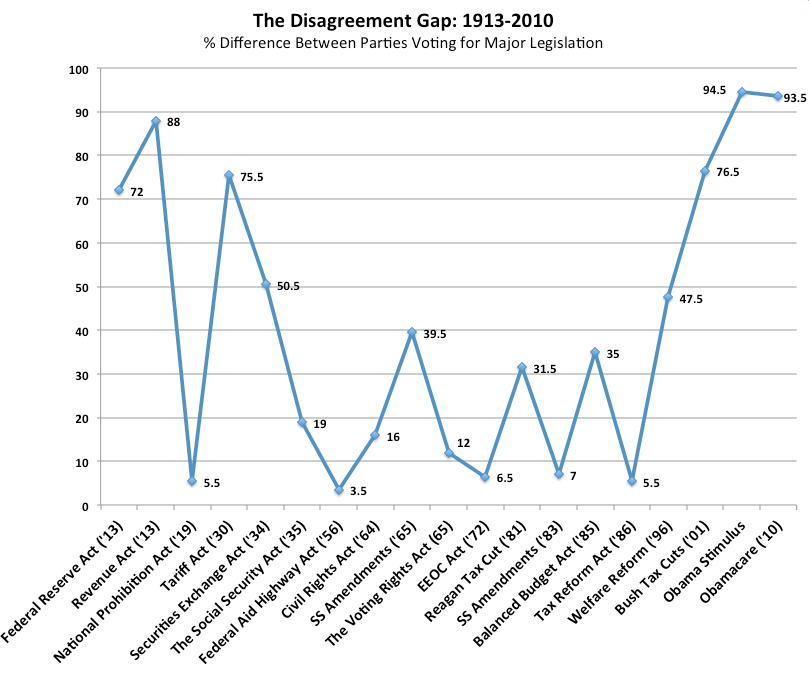
The Disagreement Gap

Disagreement Gap

Derek Thompson uses the above chart to argue that Obamacare and the stimulus are “the most divisive legislation in modern history”:

How do you measure most divisive? [Michael Cembalest, chairman of market and investment strategy at JP Morgan,] constructed a table … of the century’s major legislation and the percent difference in voting between the two parties. For example, in 1956, 98 percent of House Republicans and 93 percent of House Democrats voted for the Federal Aid Highway Act, which built the interstate highway system. That’s a “difference gap” of 5 percent. In the Senate, 100 percent of Republicans and 98 percent of Democrats voted for the bill — a “difference gap” of just 2 percent.

Seth Masket counters that just ” because something isn’t partisan doesn’t mean it’s not divisive”:

Obamacare gets an astounding 93.5% score — almost every Democrat supported it, and no Republicans did so. But it’s possible to be divisive without having such a partisan split.

For example, let’s look at the Civil Rights Act of 1964. According to Thompson’s graph, there’s only a “disagreement gap” of 16% — the model of comity. But that tells us little about the bill and a great deal about what the mid-20th century parties looked like. Both parties contained liberals and conservatives. Little separated the two parties, but a great deal divided them internally — particularly civil rights. Look at the roll call vote. Nearly every Representative from every former Confederate state voted no, while virtually every member from a non-Confederate state voted aye. That’s really divisive! It’s just not partisan, given how the parties of the day were organized.

The Courageous Friends We Are Abandoning, Ctd

BELGIUM-AFGHANS-DEMONSTRATION

George Packer tells stories of the Iraqi and Afghan allies we have betrayed:

Of the eight thousand seven hundred and fifty visas created for Afghan interpreters, just a thousand one hundred and fourteen have been issued. In the five years of the Iraqi S.I.V. program, eight thousand out of twenty-five thousand have gone through. So far this year, the number for Iraqis is down around three hundred sixty. As of September 30th, the Iraq program is scheduled to end, with thousands of visa slots unfilled. In July, the House passed a bill that would extend the program, with an overwhelmingly bipartisan vote of 420-3, nothing short of miraculous in this Congress.

But the bill won’t come to the Senate floor until December, and, meanwhile, it stands to die in the House, where Republicans just passed a budget whose single priority is the defunding of Obamacare. Iraqis who attached their fates to the U.S. government in Iraq stand to be casualties of a U.S. government shutdown in Washington.

I asked Becca Heller, of the Iraqi Refugee Assistance Project, why so few visas have been issued. “It’s not nefarious,” she said. “It’s just a total lack of political will.” Kirk Johnson, who founded The List Project to Resettle Iraqi Allies, has just published a searing account of his years working on this issue, “To Be a Friend Is Fatal.” In it, he writes, “I have yet to meet an Iraqi interpreter who can’t rattle off the names of several slain colleagues. If George Bush or Barack Obama had been willing to exercise leadership, many of them would have been saved, but instead bureaucracies under each president’s control continue to regard these friends as potential enemies. They do this, they say, to protect us against terrorists, who hate us for our values.”

Recent Dish on visas for Iraqi allies here.

(Photo: A protester shouts during a protest of Afghan refugees against their deportation, in the Wetstraat – rue de la Loi in Brussels, on September 25, 2013. By Olivier Vin/AFP/Getty Images)