A compilation of the best sports Vines:
Month: September 2013
The Brotherhood After The Ban
In the wake of the Muslim Brotherhood’s official ban by a Cairo court, Eric Trager reviews the group’s options. A worrying scenario:
Muslim Brothers may abandon the Brotherhood and turn to other Islamist movements, including violent ones. After all, younger Muslim Brothers tend to be more radical than their strategically conservative leaders, and they may now act on that radicalism. Moreover, rank-and-file Muslim Brothers have used violence as a political tool in the recent past—most notably last December, when Brotherhood cadres attacked, tortured, and killed protesters outside the presidential palace in northern Cairo. And history is rich with examples of Muslim Brothers who turned towards jihadi activities during periods of state repression.
Dalibor Rohac expects the ban to backfire:
The Brotherhood was banned during Nasser’s presidency. In Syria, Brotherhood membership was a capital offence between 1980 and 2011. If anything, these and similar bans strengthened the organization’s narrative of victimhood and enabled it to reemerge strengthened and relying on broader popular support. In a recent paper, I show that the electoral success of the Muslim Brotherhood in the aftermath of Arab Spring was foreseeable and resulted from the fact that the group had been actively involved in the provision of social services, particularly to poorer segments of the Egyptian population, and possessed a well-recognized brand name. Over time, this electoral advantage would have dissipated, particularly as the Brethren proved to be rather inept policymakers.
Alas, with the crackdown on the organization, the current leadership of the country seems to be determined to drive the organization underground and to radicalize it.
Joshua Hersh wonders whether the waning revolution has come to an end:
The ruling was breathtaking in scope: it applied not only to the Brotherhood’s political wings but to its social-services activities, and even to any personal declarations of membership individuals might be brazen enough to make—all were declared illegal. The intent was clear: to cast out the Brotherhood from any future role, not just in politics but in Egyptian society altogether. “The plan is to drain the sources of funding, break the joints of the group, and dismantle the podiums from which they deliver their message,” an Egyptian official told the Associated Press.
But if the future of a democratic Egypt is bleak, it is not simply because of sweeping court rulings like Monday’s. Indeed, the question that consumed Egypt for much of July and August —was it a coup?— was always the wrong one. Of course it was a coup. The real question is whether any of the lofty aims of the revolution (the dreams of a popular, democratic government, with civilian control of the military, and a thriving free press), or even the more basic ones (an end to wanton police abuses and outright political corruption) still stand a chance amid the backlash.
Wiping Ahmadi Off The Map
Trita Parsi explains how Rouhani’s recent Rosh Hashanah outreach was definitely a tweet in the right direction:
In his UN speech yesterday, the new Iranian president continued to differentiate himself from Ahmadinejad:
Intriguingly, Rouhani did not mention, even once, the word that so infamously was associated with his predecessor: Israel (or, as Iranian leaders prefer, “the Zionist regime”). At the end of his speech, he recited a verse from the Qu’ran that talked about the Jewish holy book, the Torah. Those two choices should have pleased the sole Iranian Jewish MP accompanying Rouhani in his UN visit to New York.
Then during an interview last night with Christiane Amanpour, Rouhani had this to say about the Holocaust:
“I have said before that I am not a historian, and that when it comes to speaking of the dimensions of the Holocaust it is the historians that should reflect on it,” Rouhani told Amanpour. “But in general I can tell you that any crime that happens in history against humanity, including the crime the Nazis committed towards the Jews, as well as non-Jewish people, was reprehensible and condemnable as far as we are concerned.”
Another Reason Not To Fear Amazon
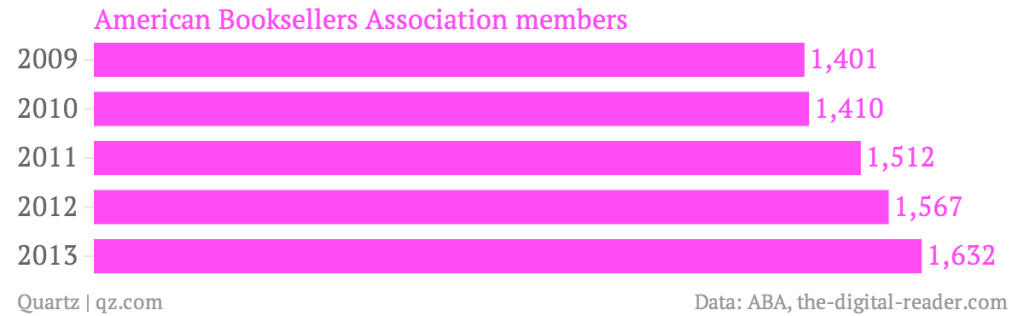
Sorry Franzen, indie booksellers are actually doing quite well in the Amazon age. The real victims are the chain bookstores:
Borders is long gone. Barnes and Noble isn’t in the best health. And Waterstones in Britain has started selling Kindles. The reason? There is very little difference between big, impersonal chain stores selling books and a big, impersonal website selling books. Independent retailers, on the other hand, have a lot to offer that Amazon cannot: niche coffee, atmosphere, serendipitous discoverability of new titles and authors, recommendations from knowledgable staff, signings and events, to name a few.
Similar to what live shows still offer to indie musicians that iTunes can’t. Publishers’ Weekly found that this past summer was “one of the best” for many non-chain bookstores, especially family-friendly ones:
According to PW’s informal post-Labor Day survey of summer sales, even without the Hunger Games trilogy, most independent bookstores with strong children’s sections are doing fine. They’re at least even with last year, and newer stores like year-and-a-half-old Parnassus Books in Nashville, Tenn., are up in the double digits, 27 percent year to date. “Children’s brings parents in, who buy adult books along with kids’ books. It gives the store a lot of life,” said Parnassus co-owner Karen Hayes.
Memorials To Monstrosities, Ctd
A reader writes:
Having lived in the diplomat town of Bad Godesberg, Germany in the ’70s as a youth, I was familiar with Denkmals and Mahnmals. Interestingly, an abandoned and vandalized villa near where I lived has now been restored and is now classified as a Baudenkmal, or a memorial building that enjoys historic building protection. It’s still a privately-owned residence, sold by the original Jewish family (who eventually got it back) in 1997 to the
current owner who restored it to its former glory. Finding out a few years ago that it had been owned by a prominent Jewish Family that had to flee was dumbfounding to me; I had never thought of that possibility while sneaking in and playing on its grounds.
But more poignantly I just recently came across this project that qualifies for both Denkmals and Mahnmals: Stolperstein, or “stumble stone” (or as Wikipedia translates it, “stumbling block”) is an interesting project of placing a personalized brass memorial capped cobblestone outside the houses where Jewish (and others) victims of the Holocaust had lived. I first found out about it a few weeks ago when using TracesOfWar.com. It was fascinating for me to see locations at houses near all the places where I had lived in Germany. Powerful local reminders. As of July 2013 over 40,000 stones have been placed by the German artist.
Another reader points to the memorial featured in the earlier post:
Being more of a Francophile, I was unaware of the differences between the two German words for memorial. But I have been to Berlin and walked down into the Memorial to the Murdered Jews of Europe. The gray monoliths don’t look particularly impressive from the outside and I was perplexed about them when I first saw it. But if you walk down into the memorial, their symbolism becomes quite clear.
The monoliths are situated so that only a few feet from the street, you lose sight of everything except walls of dull gray concrete, and far above, the sky, which in Berlin is often also gray. It is a terribly claustrophobic feeling, as though you are lost and will never be able to find your way back. I can imagine that’s what the murdered Jews, and gays and others felt when they were doomed to Bergen-Belsen, Dachau and Auschwitz. So this memorial not only conveys mahnmal, but for anyone who troubles to walk down into it, it can convey a terrible sense of despair and loss.
Conversely, the Reichstag building in Berlin, which sat burned out and unused from 1933 and pockmarked from bullets and artillery fire in 1945 during the battle for Berlin, has been, since reunificaiton, completely rehabbed and brought back to life. Its most arresting feature is the chamber for the Bundestag, the German parliament, which sits on the top floor of the building under a giant glass dome which contains a system for reflecting light down into the chamber.
There are three symbols at work. One, the rehabilitation of the building was conceived and designed by the great British architect Sir Norman Foster. Yes, the Germans selected an architect from the victors of WWII to build their “capitol” building. Second, the building was last used as the seat of German government in 1933, the last time Germany was a democracy, however flawed, before the dark ages of Nazism and the Cold War. So it is a bridge over those times. Lastly, but perhaps most importantly, the glass dome symbolizes Germany ruled in the light, hopefully never again in the darkness.
Berlin is a very modern, cosmopolitan city, and can be a lot of fun. But it’s also a city of ghosts and reminders of terrible things.
(Image caption: “Stolperstein for Max and Olga Mayer, June 2013, Heidelberg, Germany”)
The Competition To Hate Obamacare The Most
Steinglass spells out Ted Cruz’s strategy:
First, you identify a demon, and spend a few years whipping up a hysterical frenzy over the threat it poses. You want to tie it to a few key words that you can repeat in a derogatory, contemptuous tone of voice, over and over, until the very signifier evokes such a feeling of loathing in your audience that anyone associated with it is contaminated. Let’s call it Thing X. Now, most people will think your goal here is to drum up a successful campaign against Thing X and against your opponents, who support it, but this is at most part of the mission. Thing X itself may or may not be terribly important, and your opponents are your opponents; there’s not much you can do about them. What is crucial here, though, is that once you’ve firmly established your followers’ revulsion towards Thing X, you can use it to annihilate your “allies”—also known as “rivals”—by accusing them of insufficient vigilance against Thing X.
Beutler contends that six months from now “the right’s anti-Obamacare single-mindedness could easily become a real liability” in the next election:
Republicans are setting themselves up to tumble into a discontinuity of their own creation. The surge of anti-Obamacare legislative antics has created a feedback loop between Republicans and GOP base voters, where each vote increases the right’s insistence on defeating the law, which in turn creates more pressure on Republicans to take radical steps to defund or delay or repeal it. But unless they plan on trying to take away people’s insurance in an election year, they’ll have to dial back their extreme anti-Obamacare procedural tactics at the moment that the right’s insistence on keeping up the fight is most pitched.
It might look right now like Obamacare will dominate the politics of 2014, but I think that’s a premature judgment. At least some Republicans will feel pressure to change their views about the law — or at least their view that it should be repealed — next year. Certainly after primary season is behind them. That’ll be an awkward turn for them to take.
The First Honest Marijuana PSA
Finally, a clear dramatization of the absurdity of the war on cannabis:
Repeat after me: marijuana is a net positive social and personal good. Keeping it illegal and classified in the same category as heroin is insane. And good beard, by the way. From Chris McGuire and Schlepp Films.
The Damage Of Delaying The Mandate
Annie Lowrey has a primer on it:
Congress could substantially mar the law by stripping or delaying the tax penalties on Americans who decline to buy insurance — the so-called “individual mandate.” And it is one tactic that Speaker John A. Boehner of Ohio is mulling.
A new Urban Institute study explains why. Using Congressional Budget Office figures, it shows that delaying the individual mandate for a year would reduce coverage by about 11 million people in 2014. That would save the government some money. However, the effect on the health insurance marketplace might be profound. Many young and healthy people would decline to buy insurance coverage, with no penalty. The pool of the insured would be relatively sicker. Insurers would be forced to increase rates, as the healthy would do less to cross-subsidize the ill. Premiums would shoot up.
Kliff makes related points:
“The individual mandate is inextricably linked to the ACA’s insurance market reforms,” says Robert Zirkelbach, spokesman for America’s Health Insurance Plans. “All of the premiums that have been submitted for exchange coverage are based on the individual mandate being in effect. If the coverage requirement were to change, premiums would have to be modified to account for fewer young and healthy people signing up for coverage.”
Ezra highlights another reason for Democrats to resist delay:
Democrats point out that Obamacare’s implementation schedule wasn’t an accident. It was purposefully designed to begin in an off-year. That way there would be a year to work out the worst kinks, and by the time of the actual election, Democrats could point to millions of people getting insurance, running ad after ad highlighting constituents who now have coverage. If implementation didn’t begin until October 2014, all voters would know about Obamacare would be the early glitches, as insurance coverage wouldn’t begin until January 1, 2015.
In other words, the GOP is trying to sell Democrats on a political nightmare they specifically wrote the law to avoid — and they’re doing so on the grounds that it would actually be a political boon!
Helping Kids Delete Stupid Mistakes

The governor of California recently signed a law giving teenagers some control over their online data trail:
While the youth of every other state struggle with the permanency of their virtual decisions, California will require web companies to expunge content at a minor’s request, starting in 2015. The bill leaves the mechanism for requests up to the individual companies. All that’s stipulated is that a removal option must be offered, that minors must be notified that removal is an option, and that clear instructions be given should a minor wish to make a request.
But the law has “significant limits“:
If someone else takes a photo of you, it’s not covered by the law. If you’re an adult looking to delete something you posted when you were a minor, you’re not covered. Most significantly, if an embarrassing photo is copied by someone else to another website, it ceases to be covered by the law. In fact, the law only covers media posted by a minor specifically to, for instance, Facebook or Twitter, and only while the poster is under 18.
Here’s a prediction: in the near future almost everyone in public life will have an embarrassing selfie – maybe even a Weiner – in his past. God knows I have (yep, an early adopter, as usual). We will just have to get used to it – and grow the fuck up. Laws like California’s seem like pissing into a hurricane to me. In fact, Ashley Feinberg calls the law “a testament to the fact that lawmakers (at least in California) have no real idea how the Internet actually works”:
Perhaps the most glaring aspect overlooked in the legislation is the status of server data. Though the post will, theoretically, be deleted from the page, there are no stipulations requiring deletion of the actual data on the servers. Servers that may or may not be in California – which brings us to problem number two. Presumably, this law wants to regulate all websites, even those not under California’s jurisdiction. Obviously, web sites with users in California won’t necessarily have their servers based in the state, and it’s highly unlikely that theses sites will comply with the restrictions. …
There’s also a little something that we like to call “screenshots.” And though the law is meant to combat bullying, this gives the bullies themselves an ephemeral outlet in which they can spew hate at their victim and promptly delete the evidence.
The above screenshot is featured on the tumblr “Selfies At Serious Places“:
The guy above wrote me this morning:
I’m one of the people on your tumblr blog, and I have to say you made me realize how much of an idiot I made myself look. I’ve had people messaging me and calling me stuff, all of which I obviously deserve. I know you probably think I’m just an idiot who is willing to put pictures like that on the internet, and you’re not too wrong. You’ve really made me think about it, and I’d like to thank you for that. Now I’m going to beg that you remove the picture, and I doubt you would, because you will gain absolutely no benefit from doing so, but from one severely regretful person to another person, please, do so. Sorry for being such a dick.
This was big of him, I thought, and no one photo—even a thumbs-up selfie at the Holocaust Memorial—defines a person. We agreed on the solution you see: a blocked-out face and blurred-out Twitter handle, and his apology.
A reporter recently asked me if I thought these selfie-takers defined a spoiled generation, and I replied that no, absolutely, they did not. There’s a lot of youthful stupidity on display here, but every prior generation would have embarrassed themselves publicly, were they equipped with the technology to do so. This Tumblr captures people in moments they haven’t fully thought through, but that doesn’t mean they’re incapable of thinking further.
Will Israel Prevent A Deal With Iran?
Trita Parsi downplays the idea that the Iran-Israel standoff is ideological and existential:
Along those geostrategic lines, Paul R. Pillar expects that Israel will try to stop a deal between the US and Iran:
To understand Netanyahu’s posture one needs to realize that it is not only, or maybe even primarily, about a possible Iranian nuclear weapon. It is partly a matter of heading off any rapprochement between Iran and the United States, which would weaken the Israeli claim to being America’s sole reliable and important partner in the Middle East. It is partly a matter of sustaining the Iranian nuclear issue as the regularly invoked “real threat” in the region that serves to divert attention from matters the Israeli government would rather not talk about or be the subject of international scrutiny. And it is partly a matter of Netanyahu riding a topic he has made a signature issue of his own in Israeli domestic politics and a basis for his claim to tough-guy leadership.
It is pointless to talk about how an agreement between Iran and the P5+1 could be fashioned to win Netanyahu’s acceptance, because such acceptance will not be forthcoming. Anyone interested in the peaceful resolution of differences with Iran needs instead to view Netanyahu—and the Israeli Right of which he is a part, and those in the United States who unthinkingly and automatically follow his lead—as irredeemable spoilers and to think about how their efforts at spoiling can be countered.
I don’t discount the genuine existential fears that many Israelis have about an Iranian nuke. On the other hand, fear is not a strategy. It can lead to irrationality. The Israelis, after all, have a massive nuclear deterrent, and democracies have long lived in the shadow of potential nuclear war – and the dangers from the 1950s to the 1980s were very real. We lived with a nuclear Stalin and Mao. We live with a nuclear Pakistan, for Pete’s sake. Many senior Israelis in the military and intelligence sectors are not fazed by the Iranian “threat”. Many have argued that their main concern is not that Iran would nuke Israel – which would include some of the most sacred sites to Islam – but that the very threat could precipitate emigration or a collapse in immigration to the Jewish state.
But the real threat, as Pillar notes, is that a US-Iran rapprochement could isolate Israel, denying it its unique relationship with the super-power in the region. But, of course, from the perspective of the US, it’s a good thing to have good relations with both Israel and Iran.
Few alliances are more dysfunctional than the current US-Israel relationship. Another regional interlocutor – of far greater strategic importance – would help normalize the US-Israel relationship, and certainly make a deal on two states for the Palestinians and Israelis more feasible. I suspect that Netanyahu’s hyper-ventilating about Iran is ultimately about his goal of controlling the West Bank for ever, rather than genuine fear of annihilation. Gershom Gorenberg previews Obama’s meeting with Netanyahu next week:
Netanyahu’s goals next week are to get Obama to commit himself to conditions for a deal on Iran’s nuclear program that Tehran will reject and to avoid paying with any concessions to America’s position on the Israeli-Palestinian talks. Syria will also be on the agenda. As always, Netanyahu will try to get Congress to take his more hawkish stance against the president, with encouragement from AIPAC, the pro-Israel lobbying group. But there are contradictions—logical, strategic, political, and personal—in Netanyahu’s stance that weaken him even before the conversation with Obama begins.
First, the logical problem: Netanyahu categorically insists that any relatively moderate rhetoric from Iran’s new president, Hassan Rouhani, is “spin,” obscuring his intentions. The problem is that Netanyahu also insisted that all extreme statements from Rouhani’s predecessor, Mahmoud Ahmadinejad, were precise expressions of what he planned to do. By this measuring stick, all Iranians have the same policy and can be trusted only to the extent that they are as crude as Ahmadinejad. Negotiating with Iran is therefore a dangerous waste of time.
Methinks the bluff is wearing thin.
 The Dish