Beard Of The Week

1233494_714908798535486_1184257662_n

One of dozens of hirsute portraits by Greg Anderson Photography of the participants in the 2013 Beard And Mustache Championships in New Orleans a couple weeks ago. This one is Scavullo meets young Gandalf. I am not worthy.

Update from a nerd:

As your friend and LoTR superfan Stephen Colbert would happily point out, Gandalf was never young. The Istari – the wizards – were spirits sent to Middle Earth by the Valar in the form of old men.

Nevertheless, pretty rockin’ beard.

Dissents Of The Day

A reader quotes from my reaction to Rouhani’s UN speech:

The US is exerting force to insist on Syria’s destruction of its chemical weapons arsenal, even as we send military aid to Israel, which has not ratified the Chemical Weapons Convention. We have threatened force to prevent Iran getting a nuclear bomb, but we give military aid to Israel, which currently has a break-out capacity of up to 300 nuclear warheads. Is it not reasonable for humankind to look at this double standard and say collectively: WTF?

Well, no, it’s not reasonable.  Syria is being asked to destroy its chemical weapons in the aftermath of a chemical attack which more than likely originated with the Syrian stockpile.  Iran has admitted to sponsoring terrorism and given the nature of terrorists, they are far more likely to use such weapons than even Iran would be.  Given Iran’s rhetoric towards Israel, it’s pretty reasonable to not want them to have those weapons.

If you can think of a comparable situation where Israel has 1) used chemical weapons or 2) put nukes in the hands of people who would use them, then it would be a double standard.  Here, the standard applied by the US isn’t hypocritical at all.

I’m not persuaded that Iran, given its history in foreign policy, would ever hand off nuclear weapons to terrorist proxies, especially given the devastating consequences that would ensue. Mercifully, not even the Pakistanis have done that, and Pakistan is a far more troubling nuclear power than Iran would be.

My point is about non-proliferation. If we are as intent on it in the Middle East as we seem to be under Obama (I’m more of a believer in deterrence than non-proliferation, for what it’s worth), then leaving the one nuclear and chemical power out of it – and never even mentioning it – does seem like a whopping double standard to most people around the globe. I’m unaware, either, of Iran assassinating Israel’s nuclear technicians. And yet we accept the reverse with nary a quibble. At some point, the US has to deal with this glaring discrepancy in the eyes of the world. Another reader:

I’m confused. According to your logic, Obama was right to threaten force in Syria because that was the only way the world would get serious about Assad’s chemical weapons. But AIPAC/neocons are wrong to push Obama to threaten force in Iran because that would … scuttle the possibility of a deal and give them the war you allege they’ve been gunning for?

Putting aside your caricature-ish portrayal of what the “Greater Israel Lobby” “wants” (by the way, do you really think anyone who cares seriously about Israel wants a war with Iran, which is almost certain to bring reprisals against Israeli citizens and interests and embolden the mullahs – or do you concede that at some point Israel might calculate a strike to be its least worst option?), let’s inject some discipline into the argument.  Essentially you admitted Obama’s threat of force in Syria compelled Russia to act, producing an outcome on Assad’s CW stockpile that was at least minimally acceptable to us.  If this is the case, why wouldn’t the continued pressure of sanctions and an on-the-table military option serve a similar goal in helping us get the best deal – for us, Israel, and the Gulf states – with Iran?  Chuck Schumer has called for just this approach: openness to talks while keeping Iran’s feet to the fire.  In short, the best diplomacy is armed diplomacy, and the surest means of avoiding a strike, either by us or the Israelis.

Yes, but there is always a moment at which that constant threat of force makes diplomacy very difficult, for a simple reason. Countries have pride. No country, and certainly not one with as ancient a civilization as Iran, wants to be seen to be cowed into submission. There comes a point at which a strategy of force-backed diplomacy has to open itself up to simple diplomacy. Reagan did it. Obama can too. To get a deal, we need to find a way for Iran to save face. With Syria, that meant giving Putin a big feather in his cap, allowing Assad to claim the decision as his own, and argue that the chemical attacks were the work of others (preposterous, I know, but necessary for him to save face). With Iran, at some point it means taking the threat of force slowly off the table – especially since they claim they want the same thing we do.

I’d argue, in any case, that the threat of military force has been less integral to Iran’s recalculation of its interests than crippling sanctions. The Iranians know that we cannot truly destroy their nuclear technology from the sky. And that technology cannot be unlearned, even if Israel assassinates mere scientists. And after such a potential attack on nuclear facilities, any regime would regard it as a point of honor to reconstitute its nuclear program as soon as possible thereafter. It’s not really a solution, as the sanest Israelis understand. But the sanctions that are wrecking the economy in a country whose regime rules by brute force and whose legitimacy, certainly in the major cities, is close to non-existent? In this case, these economic sanctions have been our major tool – and they have been critically backed by Europe as well.

In other words, the threat of force is not as effective with Iran as economic isolation has been. Using such force would cost us a great deal too. Sanctions, in contrast, cost us relatively little. It will require real statesmanship to detect the right moment to make the leap toward true engagement, to take force off the table for a while – but that’s what we elected Obama for. It’s also, it seems to me, what the Iranian people elected Rouhani for. And these opportunities do not occur very often.

Carpe diem.

Saint Stephen The Ironist

I’m biased, because I have gotten to know the man a little over the years, and have barely missed a single show since he started, but I have to agree with Jessica Winter that, in an era in which Catholicism, until very recently, has seemed positively callous, distant and authoritarian,  Stephen Colbert is “the greatest thing to happen to American Catholics since Vatican II”:

He provides day-to-day proof that devout Catholicism can coexist with critical thinking, irreverence, a guiding belief in equal rights, and a fundamentally anti-authoritarian worldview – by, for example, dishing on the papal doctrine of social justice for the poor with Colbert Report chaplain Jim Martin (editor of America magazine), or breaking character during a congressional panel on rights for migrant farm workers by paraphrasing Scripture: “Whatever you did for the least of my brothers, you did for me.” Colbert is America’s Sunday school teacher and “Catholicism’s best pitch man,” as Patheos.com’s Matt Emerson put it in a beautifully argued 2011 piece. But until now, what he’s been pitching hasn’t necessarily been what the Vatican has been selling.

That’s all changed now. Catholics have a pope who loves the poor, embraces critical thinking, and has a delightful sense of humor  the same holy trinity of virtues that Stephen Colbert, the new America’s Catholic, exemplifies.

And what Colbert does is talk to a generation that has largely turned off any public statements from the American Catholic hierarchy. The Millennials have been a lost generation to Christianity – because, in my view, the most prominent representatives of Christianity are simply from a different universe than those building lives and loves in the 21st Century. Colbert shows that Catholics can be hilarious and serious, ironic and yet deeply sincere.

If I were to sum up the various forms of popular culture that I have come to love in this century, I’d say they both start from a place of total irony and yet express beyond it a deep, humane sincerity. Living in 2013 means living in a world saturated in knowingness, framed by quotation marks, awash in the mash-ups of post-everything fragments of a once-more coherent and uniform culture. There is no going back. But there are two core choices in this ironic age: to wallow in its relativist chaos, or to love it for what it says about our freedom in modernity and refuse to give in to cynicism or nihilism. Indeed to insist on the constant possibility of redemption in an agnostic, atheist as well as religious sense.

South Park does this. It’s shockingly blasphemous in both secular and religious meanings of that word. And yet it is deeply sincere and has a clear, consistent moral worldview. The same can be said of the Simpsons. And, yes, what I love about the Pet Shop Boys is that they revel in modernity’s irony and technology and yet return again and again to the need for compassion, empathy, hope and love. Colbert is arguably the most skilled at the furthest edges of irony and sincerity. Nothing on television is as ironic as his stock character; and yet you cannot watch his arch, hilarious, scathing performances night after night and not feel the deeply serious call to decency and love underneath.

He’s a good man, Stephen Colbert. And his irony – which masks everything – becomes, after a while, a kind of humility. He has given me a lot of hope these past few years – because, for all his jokes, he has never lost sight of either faith or charity.

Previous Dish on Colbert’s living faith here and here.

What Obamacare Will Cost You

I hope you’re sitting down. After all the stories about a “train-wreck”, after every Dr Seuss classic read out loud in the Senate, after sticker shock shock and crazy-ass Forbes hit-pieces, we now greet something called reality. The gist of the new report on Obamacare premium prices:

The report, released Wednesday by the Department of Health and Human Services, showed significant variation in the insurance premiums that Americans shopping on the individual market could pay under the president’s health-care overhaul. Across the 48 states for which data were available, the unsubsidized monthly premiums could be as low as $70 for an individual and as high as $1,200 for a moderate plan for a family of four.

The average national premium for an individual policy will be $328 in 2014, before including any of the tax credits that will be available to low- and middle-income Americans to help them purchase coverage.

It gets worse for Republicans. Kaiser Health News notes that many red states will have relatively low premiums:

One of the report’s most striking findings is that states like Texas and Florida, where the law has faced fierce opposition despite high rates of uninsured residents, will see rates at or below the national average.

“There is no clear political pattern to these premiums,” said Larry Levitt, a senior vice president at the Kaiser Family Foundation, a nonpartisan research organization. …“Some conservative, anti-Obamacare states have lower-than-average premiums, and some pro-Obamacare states have higher-than-average premiums.”

Yglesias compares these numbers to the CBO’s projections:

HHS reports that in about 94 percent of cases the CBO overestimated how high premiums would be.

Specific premiums are going to vary quite widely from state to state and according to your age and the size of your family. But nationwide health care spending has grown more slowly than people had expected over the past couple of years, and in most states insurance companies have offered fairly aggressive bids to participate in the exchanges. Obviously this could all change 18 months from now when people are actually in the plans, but for now it looks like Obamacare will be cheaper for families and taxpayers than was thought at the time Congress voted on it.

Cohn provides more details on the report:

The HHS report spotlighted only silver and bronze plans, which are the ones people are most likely to buy. Based on a quick skim, the most expensive unsubsidized policies I saw were in Jackson, Mississippi, and Cheyenne, Wyoming. In those places, a family of four too wealthy for subsidies will pay more than $1200 a month for the second-cheapest silver plan. The least expensive were in Nashville, Tennessee, where the full “sticker price” of the second cheapest silver plan will be $559 a month.

There’s a lot less variation for families whose incomes qualify them for those subsidies. And that’s very much by design: The law effectively tries to dictate what people will pay for the second-cheapest silver plans, no matter where they live. For a family of four with income of $50,000, the cost for such a plan in almost every city and state is $282 a month. But because of the way the subsidies work, applying those subsidies to even cheaper plans can reduce premiums even more—and at varying levels, depending on location. In Philadelphia, Pennsylvania, that family of four making $50,000 a year could get the cheapest bronze plan for $96 a month. A similar family living in the Virgina suburbs of Washington, D.C., could get one for nothing.

Drum weighs in:

After tax credits, that family of four in Texas will pay $3,384 per year for the second lowest-cost silver plan. According to the Kaiser Family Foundation, the average family with employer health coverage pays $4,565 per year in contributions. Those aren’t directly comparable, but they’re close. What it means is that although Obamacare is hardly free, it does allow individuals to buy coverage for roughly the same amount they’d have to pay with an employer plan. No one is shut out of the market any longer.

Benedict Unrepentant

As Pope Francis has charmed the globe, the former Pope has been corresponding with Piergiorgio Odifreddi, an Italian mathematician and philosopher, on a whole range of topics. I haven’t been able to get an English translation and cannot find one online (if a reader has one, I’d be most obliged). Maybe the reported fragments lack important context, but they sound like Benedict to me, especially on the long, horrifying child-rape conspiracy from the Vatican on down, over which he had total control and unique knowledge from 2001 onwards.

To give some obvious, glaring examples of his complicity: despite sitting on mounds of evidence of the crimes of Marcial Maciel for years, Benedict waited and waited to act, and refused to talk in public about the matter, while Maciel went on to rape even his own son; he also helped give refuge to Cardinal Law, one of the most heinous cover-up artists in the whole disgusting saga; he even personally ensured that the man who raped over 200 deaf boys at St John’s School for the Deaf, Father Murphy, was allowed to retire in peace in the “dignity” of his priesthood.  And yet Benedict is still capable of telling his interlocutor:

I never tried to cover up these things.

Seriously. But to me, the most egregious statement is the following:

That the power of evil penetrates to such a point in the interior world of the faith is, for us, a source of suffering. On the one hand we must accept that suffering, and on the other, at the same time, we must do everything possible so that such cases aren’t repeated.

Notice who is suffering here. Not the children, but the Church. “We must accept that suffering,” he goes on, in what can only be called obscene narcissism. Did the thousands of children who were raped in the past also have to “accept that suffering”? And notice too, even now, rather than prostrate contrition, we get this institutional reflex:

It’s also not a motive for comfort to know that, according to sociological research, the percentage of priests guilty of these crimes is no higher than in other comparable professional categories. In any event, one must not stubbornly present this deviance as if it were a nastiness specific to Catholicism.

Even now, this is a point he insists on making? And he still cannot say what his successor said first of all: “I am a sinner.”

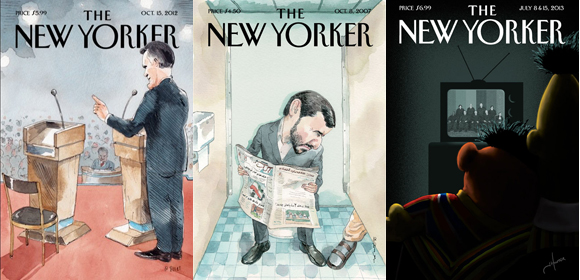
A Picture Worth A Billion Views

covers

Marc Tracy says the traditional New Yorker cover  bereft of photos, cover-lines, or teasers, and “invented when people sent telegraphs” – is surprisingly well-suited for the Internet age:

Read any article about media today, and you will learn that what travels fastest and most furiously on the web are things that are funny, topical, easy-to-understand, well-branded, and, apart from widely available cultural references, require no further context. I just described a topical New Yorker cover. It is Internet perfection—so perfect you would think it was genetically modified. It out-BuzzFeeds even BuzzFeed. (“This is the cover of this week’s New Yorker,” tweeted @BuzzFeedNews Monday morning.) The Bert and Ernie cover garnered 657 million “impressions” – times people saw it, essentially. That’s a massive number, generated by a perfect Internet storm.

Talking To Our Enemies Isn’t A Concession

Walt sighs:

Refusing to talk to people or countries with whom we differ is really just a childish form of spite and one the United States indulges in mostly because we can get away with it. But it also makes it more difficult to resolve differences in ways that would advance U.S. interests. In short, it’s dumb.

Did it really help U.S. diplomacy when we refused to recognize the Soviet Union until 1934? Were U.S. interests really furthered by our refusal to recognize the People’s Republic of China for more than two decades after Mao’s forces gained control there? Has keeping Fidel Castro’s Cuba in the deep freeze since 1961– that’s nearly 53 years, folks — brought his regime crashing down, helped the lives of Cubans, or even advanced the political goals of Cuban-American exiles? Has our refusal to conduct direct talks with Iran slowed the development of its nuclear research program and helped us explore possible solutions to the problems in Afghanistan, Syria, or the Persian Gulf itself?

Obviously not. But because the United States is so powerful and so secure, it can usually afford to snub people or governments it doesn’t like.

Larison adds:

It is remarkable how much importance has been attached to the mere possibility that Obama and Rouhani might briefly meet this week. If we were talking about bilateral relations between almost any other pair of governments, such meetings would be commonplace. The question wouldn’t be whether such a meeting would take place, but rather how productive it would prove to be. The U.S. and Iran can’t even begin to find out what kind of deal is possible so long as holding meetings between top officials is itself treated as making a concession to the other side. All of this should remind us how abnormal and counterproductive it is to have no formal diplomatic ties with Iran. There are hardly any other states where the U.S. has gone this far out of its way for so long to avoid high-level contacts with a foreign government, and it severely limits our government’s ability to conduct effective diplomacy.

A Church For Atheists

This embed is invalid


Kate Engelhart drops in on a rapidly growing congregation:

Like the Sunday Assembly’s founders, stand-up comics Pippa Evans and Sanderson Jones, I don’t think religion should have a monopoly on community. I like the idea of a secular temple, where atheists can enjoy the benefits of an idealized, traditional church a sense of community, a thought-provoking sermon, a scheduled period of respite, easy access to community service opportunities, group singing, an ethos of self-improvement, free food—without the stinging imposition of God Almighty.

Evidently, I was not alone. [Within months], SA was boasting 400 to 600 regular attendees. As the hype mounted, Evans and Jones began receiving emails from all over the world from would-be Sunday Assembly founders. Jones admits that he had aspirations to expand from the get-go. Eventually, the founders opted for a controlled unfolding, choosing to personally license and launch 22 Sunday Assembly branches within a 2-month period.

An irony Engelhart notes: “As the atheist church becomes more church-like, however, it seems to be deliberately downplaying its atheism”:

Where the Assembly once stridently rejected theism (at April’s Assembly, Jones poked fun at the crucifixion), it is now far more equivocal. “How atheist should our Assembly be?” Jones wrote in a recent blog post. “The short answer to that is: not very.”

“‘Atheist Church’ as a phrase has been good to us. It has got us publicity,” Evans elaborated. “But the term ‘atheist’ does hold negative connotations. Atheists are often thought to be aggressive, loud and damning of all religion, where actually most atheists, in the UK anyway, are not defined by their non-belief.” At a recent assembly, Jones opined: “I think atheism is boring. Why are we defining ourselves by something we don’t believe in?”

Licensed To Pack Heat

Tim Murphy discovered first-hand just how easy it is to get a concealed-carry permit from Utah:

As part of a National Rifle Association-backed movement to roll back concealed-carry restrictions, in the mid-1990s Utah became a “shall issue” state. That means it grants concealed-carry permits unless it has a compelling reason (such as a felony record) not to do so. Licensees don’t need to demonstrate proficiency with a handgun, and they don’t even need to set foot in the Beehive State. They just have to take a class on firearm safety and pay a processing fee (approximately $50) and some of the cheapest renewal fees in the business (as little as 75 cents every five years).

The result has been a boom in out-of-state residents seeking permits and the birth of a cottage industry catering to them. As of June, nonresidents held more than 60 percent of Utah’s 473,476 valid concealed-carry permits. Maryland alone has 33 Utah-certified instructors. One, Mid-Atlantic Firearms Training, boasts “No Firearm Qualification Needed”; another, Semper Fidelis Consulting, touts its NRA ties and its convenience. (It makes house calls.)